Chungcheong · Daejeon
Daejeon travel guide: Sungsimdang, Yuseong hot springs and Gyeryongsan
Daejeon grew from a farming town into one of Korea's largest cities because the railway put it there: the Gyeongbu Line to Busan arrived in 1905 and the Honam Line to the south-west in 1911. It is still the junction where trains from Seoul split for the south, and that is the best reason to stop. The city has two halves that matter to a visitor. Around Daejeon Station is the old town, with the Sungsimdang bakery, a hundred-year-old market, kalguksu noodle shops and railway-era lanes turned into cafés. To the west, the planned new town around the research institutes runs out to Yuseong, a hot-spring district close to Gyeryongsan National Park, with Expo Science Park and Hanbat Arboretum in between.
- Suggested time
- 1–2 nights
- Where to stay
- Daejeon Station and Eunhaeng-dong for trains and the old town; Yuseong hot-spring district for baths and Gyeryongsan
- Season and timing
- Spring and autumn are the best walking seasons: cherry blossom lines the 3 km approach to Donghaksa in spring, and VisitKorea's 2026 fall foliage forecast names Jangtaesan in Daejeon among its foliage spots, with peak colour across the country expected from mid-October to early November. Yuseong's retusa fringe tree festival is in May. The market arcade and the hot springs work in any weather.
The short answer
Give Daejeon one night, or two if you want a day on Gyeryongsan or a side trip to Gongju. Sleep near Daejeon Station if you are mainly passing through by train and want the bakery, the market and the noodle shops on foot; sleep in Yuseong if you want a hot-spring hotel, the free foot baths and quick access to the mountain and to the Gongju buses. Arrive by KTX — the Gongju National Museum's directions give about 50 minutes from Seoul and about 1 hour 50 minutes from Busan — spend the first afternoon in the old town, cross to Expo Park and the Expo Bridge for the evening, and use the next morning for Sutonggol Valley or Donghaksa on Gyeryongsan before moving on.
Station or Yuseong: choose your base first
Daejeon is spread out, and the two areas you are likely to use are about the length of the city's only subway line apart. Daejeon Metro Line 1 runs from Panam in the east through Daejeon Station, City Hall and the Government Complex to Yuseong Spa and Banseok in the west, so the two bases are linked without changing trains; check journey times on the operator's site, djtc.kr, which has English pages.
Around Daejeon Station you are in the old town. VisitKorea describes Daejeon Jungang Market as a three-minute walk from the station, Soje-dong's café lanes and the railway residency village are close to the station, and Sungsimdang and Euneungjeongi Culture Street are a short distance away in Jung-gu. This is the base for a one-night stop between trains, and for anyone whose trip is mainly about food.
Yuseong is a designated special tourist zone built around hot springs, with hotels that pipe in the spring water — VisitKorea mentions it at Hotel Interciti on Oncheon-ro and at B Station and the Legend Hotel on Gyeryong-ro — plus the free street foot baths. It is closer to Expo Science Park, to Sutonggol on Gyeryongsan, and to the intercity buses for Gongju, which the Gongju National Museum lists every few minutes from Yuseong, about 30 minutes away. Choose it for two nights, or if you are travelling on to Gongju and Buyeo.
The old town: Sungsimdang, the market and the railway lanes
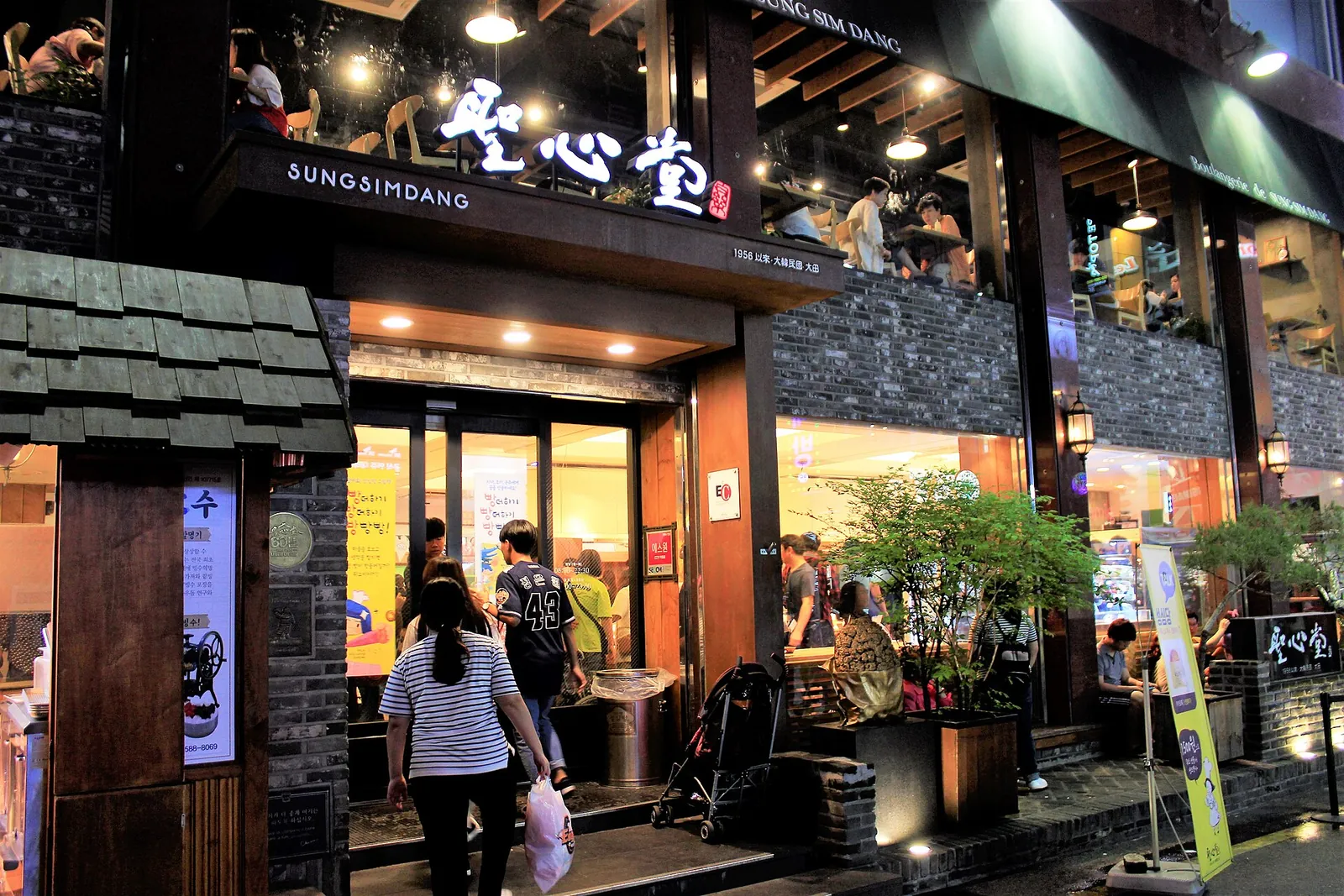
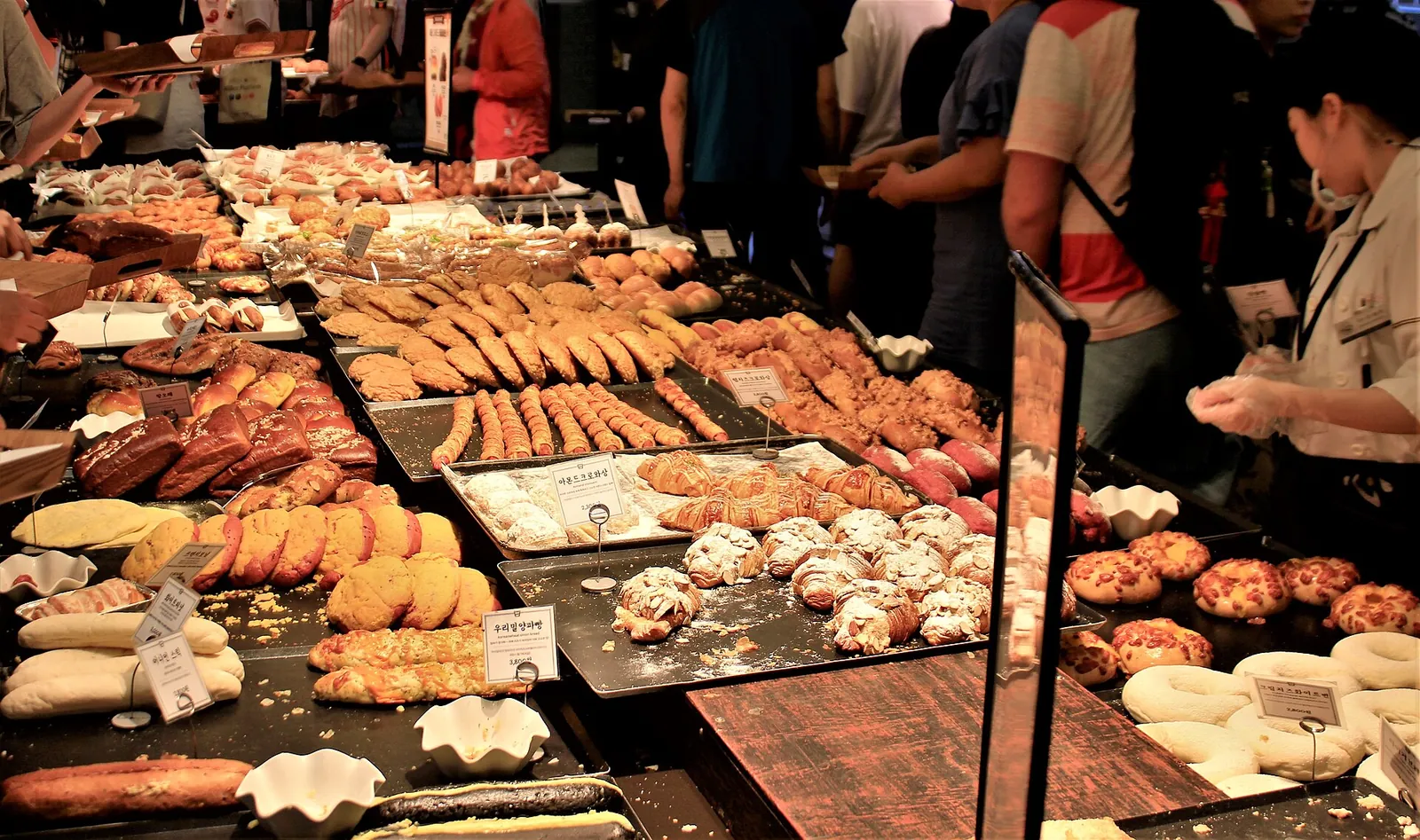
Sungsimdang (often romanised Seongsimdang) opened in 1956 as a small steamed-bun stall in front of Daejeon Station and is now the city's best-known business. VisitKorea says it makes almost 400 kinds of baked goods by hand, some on a 16-hour slow fermentation, and that it supplied bread during Pope Francis's visit to Korea. The main store is at 15 Daejong-ro 480beon-gil in Jung-gu, beside Euneungjeongi Culture Street. When we checked on 3 October 2026, VisitKorea's restaurant listing gave daily hours of 8:00 to 22:00 with no closing day, but an older VisitKorea shopping page listed it as closed on Sundays, so check before you plan a Sunday around it. Expect a queue; the store told VisitKorea that staff who speak English, Chinese and Japanese are on hand. A minute away, the Sungsimdang Culture Space in a converted dormitory sells the bakery's merchandise and has seating where you can eat what you bought.
Euneungjeongi Culture Street itself is the old town's shopping strip — VisitKorea likens it to Myeong-dong and counts more than 150 shops including galleries and craft studios — with the Sky Road overhead, which VisitKorea calls Korea's largest media-art installation and which is best after dark. On Jungang-ro, the avenue that leads from here to the station, is the Daejeon Modern History Exhibition Hall in the former South Chungcheong provincial government building, a registered heritage building that tells the city's last hundred years. When we checked, VisitKorea listed it as free, open from 10:00 to 19:00 between March and October and to 18:00 in November, and closed on Mondays. The Daejeon Travel Lounge at 187-1 Jungang-ro is a tourist information centre with free rest space and old-school-uniform dress-up.
Daejeon Jungang Market is a cluster of markets stretching from the station to the Daejeoncheon stream, with streets for dried seafood, herbal medicine and hanbok; its covered arcade keeps you dry. Near the station, the Railway Residency Village (Sollangsiul-gil) in Soje-dong is what remains of more than 100 houses built for Japanese railway engineers in the 1930s; VisitKorea counts about 40 survivors, several of them registered heritage. The neighbouring Soje-dong café street has turned similar old houses into cafés and restaurants. Both are best on foot in daylight.
Make time for the local food
What to eat and where to look
Sungsimdang breads: fried soboro and leek bread
Sungsimdang's two best-sellers, according to VisitKorea, are the twigim soboro — a streusel bun filled with hand-made sweet red bean paste and deep-fried — and the pantalong leek bread with leek, egg and ham. VisitKorea also recommends the springy, water-roux 'mochi mochi' bread and the seasonal fruit cakes.
- Where to look
- The main store at 15 Daejong-ro 480beon-gil, Jung-gu; Sungsimdang Culture Space at 11 Junggyo-ro 73beon-gil has merchandise and seating.
- Fit it into your day
- Breakfast or an afternoon snack in the old town; the soboro is fried on the spot, so eat it while it is warm.
Queues are long at busy times, and the two VisitKorea pages disagree on whether the main store closes on Sundays — check first. Fried soboro contains egg, butter and almonds.
Kalguksu (knife-cut noodle soup)
Daejeon is a noodle-soup city. VisitKorea describes Sindo Kalguksu, founded in 1961, serving a broth of beef bones and anchovies enriched with perilla seed powder, and Samdaejjae Jeontong Kalguksu on the same lane simmering a Korean-beef bone broth; both pair the noodles with suyuk, boiled pork slices.
- Where to look
- The noodle shops on Daejeon-ro 825beon-gil by Daejeon Station, and the stalls in Jungang Market, where VisitKorea lists kalguksu among the classic market dishes.
- Fit it into your day
- Lunch on arrival or before a train; a bowl is quick and filling.
Broths are beef- or anchovy-based, so not vegetarian. Samdaejjae closes for the Seollal and Chuseok holidays, and Sindo closes on irregular days.
Dubu duruchigi (spicy stir-fried tofu)
Stir-fried tofu in a spicy sauce, a standard partner to kalguksu in Daejeon. VisitKorea lists it at Sindo Kalguksu, and describes Daebok Sikdang's signature ojingeo dubu duruchigi — kimchi, squid and tofu stir-fried together — with boiled kalguksu noodles mixed into the sauce.
- Where to look
- Sindo Kalguksu near Daejeon Station; Daebok Sikdang at 67 Jinjam-ro 140beon-gil in Yuseong-gu.
- Fit it into your day
- A shared dinner for two or more, with extra noodles to mop up the sauce.
Spicy. VisitKorea lists Daebok Sikdang as closed on Sundays.
Market snacks at Jungang Market
VisitKorea lists tteokbokki, sundae (Korean blood sausage) and kalguksu as the classic eats under Jungang Market's covered arcade.
- Where to look
- Daejeon Jungang Market, from Daejeon Station towards the Daejeoncheon stream.
- Fit it into your day
- A cheap grazing lunch, or a rainy-day meal; in 2025 VisitKorea also reported a Friday and Saturday evening night market from June to October.
Stall hours vary by shop. Sundae is often served with offal; ask for it on its own if you prefer.
Yuseong hot springs and the free foot baths
VisitKorea describes Yuseong as a spa town used for healing since the Three Kingdoms period, with spring water at 27 to 56°C and an alkaline pH of 7.5 to 8.5 drawn from about 200 metres underground; the district's hotels and bathhouses are supplied with it, and their prices and hours vary. If you are not staying in a spa hotel, the Yuseong Foot Spa in Bongmyeong-dong is the easy way in: four open-air foot baths using natural spring water at about 40°C, with room for some 200 people and a separate area where you wash your feet first. It is free. When we checked, VisitKorea listed it open from 7:00 to 22:00 in summer and to 21:00 in winter.
Bring a small towel and roll-up trousers. The foot baths make a good end to a hiking day on Gyeryongsan: VisitKorea notes that hikers often come down to Yuseong for the springs. In May the streets lined with retusa fringe trees host the district's flower festival.
Expo Science Park, the Expo Bridge and Hanbat Arboretum
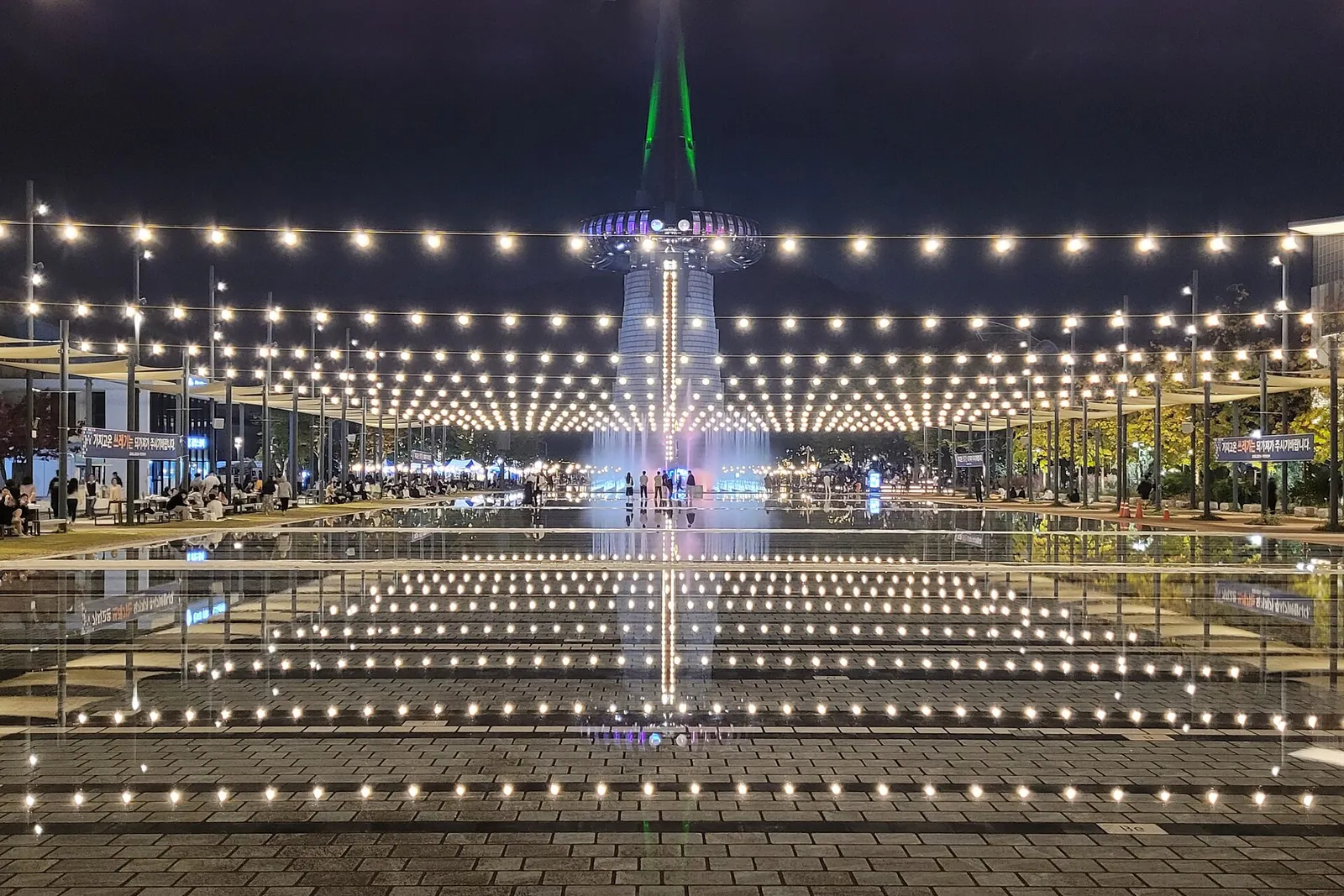
The 1993 Daejeon Expo left the city its landmark. Hanbit Tower, 93 metres high, has an observation deck over Expo Science Park; when we checked, VisitKorea listed it free, open from 9:30 to 17:40 and closed on Mondays. The plaza below has a musical fountain and a media façade on the tower after dark, and VisitKorea includes the park in its round-up of Korea's most striking night views. Next door at 481 Daedeok-daero, the National Science Museum is the family stop, with hands-on halls and a planetarium; VisitKorea listed it as open from 9:30 to 17:50, closed on Mondays, with fees varying by exhibition.
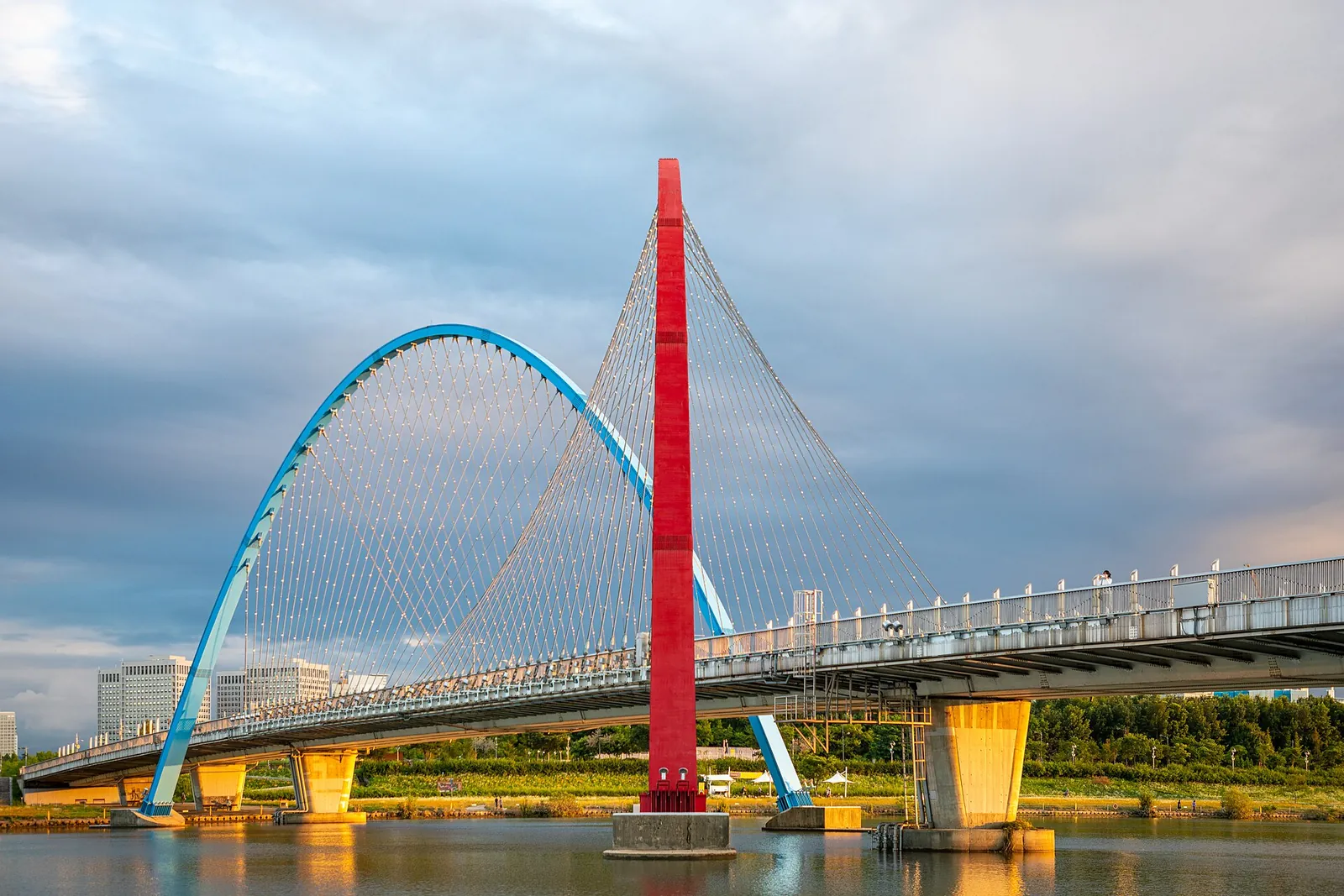
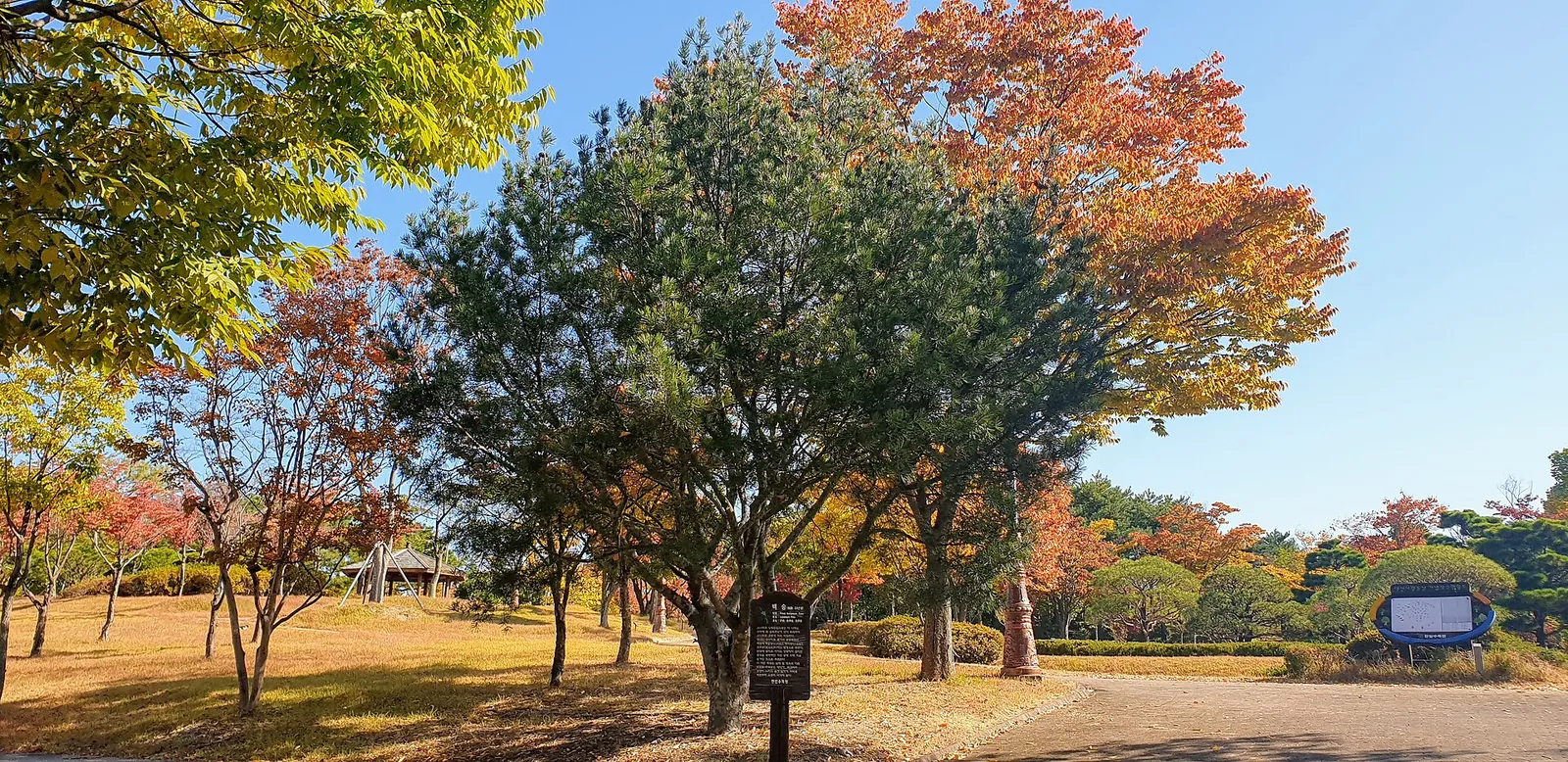
The Expo Bridge crosses the Gapcheon from the park to the riverside plaza. VisitKorea says its lights are on from sunset until 22:00 all year, with a musical fountain on summer weekends. On the far side, Hanbat Arboretum is the largest man-made urban arboretum in Korea at 387,000 square metres, divided into an East Garden and a West Garden with a tropical greenhouse. Entry is free. When we checked, VisitKorea listed October to March hours of 8:00 to 19:00 for the outdoor gardens; note that the East Garden closes on Mondays and the West Garden on Tuesdays. The Gapcheon banks between the bridge and the university campuses have walking and cycling paths.
Do this as one afternoon-into-evening: tower and museum before they close, arboretum in late light, then back over the bridge for the fountain and the illuminations.
Gyeryongsan: Sutonggol from Yuseong or Donghaksa from Gongju
Gyeryongsan National Park, designated on 31 December 1968, straddles Daejeon, Gongju and Nonsan. VisitKorea explains the name — a ridgeline that looks like a dragon wearing a chicken's crest — and lists Cheonhwangbong (847 m) as the main peak. There are two easy ways in from Daejeon.
Sutonggol Valley, inside Yuseong-gu, is the park's city-side entrance: VisitKorea describes a gentle trail along the valley to Sutong Falls, with a longer climb to Geumsubong. It is the choice for a half-day hike from a Yuseong hotel. Donghaksa on the Gongju side of the mountain is the park's most visited spot: a temple that VisitKorea calls the first and oldest academic institute for Buddhist nuns, home to about 150, reached by a 3-kilometre valley approach that becomes a cherry-blossom tunnel in spring. When we checked, VisitKorea listed adult admission to the temple at 3,000 won.
Hiking hours on Gyeryongsan change with the weather and trails can close; check the Korea National Park Service before you set out, carry water, and come down to the Yuseong foot baths afterwards.
Using Daejeon as a hub
Daejeon Station is on the Gyeongbu Line between Seoul and Busan and on the Chungbuk Line towards Cheongju, so it slots into any north–south rail trip. The Honam Line to the Jeolla provinces starts at Seodaejeon station instead, VisitKorea notes, so check which Daejeon station your ticket names. Rail tickets can be bought from Korail's website and app, at stations and through Naver; VisitKorea says sales usually open a month before departure at 7:00.
Gongju is the closest heritage side trip: the Gongju National Museum recommends taking the train to Daejeon and continuing by intercity bus, with frequent departures and about 30 minutes from Yuseong. Buyeo, the last Baekje capital, follows from Gongju. Cheongju is around 50 minutes by ITX or Mugunghwa train, according to VisitKorea. Our guides to Gongju, Buyeo, Cheongju and Songnisan cover those onward stops.
A workable Daejeon stay
This is an editorial suggestion, not a timetable. Check closing days: several museums and gardens shut on Mondays.
- Arrival afternoon: drop bags near Daejeon Station, eat kalguksu near the market, walk Jungang Market and Soje-dong, then queue at Sungsimdang in Eunhaeng-dong.
- Evening: subway west to Expo Science Park for Hanbit Tower's fountain and the lit Expo Bridge, or straight to Yuseong for the foot baths.
- Second morning: Sutonggol Valley on Gyeryongsan from Yuseong, or Donghaksa on the Gongju side of the mountain.
- Moving on: intercity bus from Yuseong to Gongju, or the KTX north or south from Daejeon Station.
Practical questions
Is Daejeon worth a stop?
Yes, if you are travelling by train between Seoul and the south. One night covers Sungsimdang, the old-town market and noodles, and an evening at Expo Park or the Yuseong foot baths; a second night adds Gyeryongsan or a side trip to Gongju.
How long is the train from Seoul to Daejeon?
The Gongju National Museum's directions give about 50 minutes by KTX and about 1 hour 30 minutes by Saemaeul or Mugunghwa train. Trains for the Jeolla provinces on the Honam Line use Seodaejeon station rather than Daejeon Station.
Where should I stay in Daejeon?
Near Daejeon Station for a short stop by train, food and the old town; in Yuseong for hot-spring hotels, the free foot baths, Gyeryongsan and buses to Gongju. Line 1 of the subway links the two.
Is the Yuseong foot bath free?
Yes. When we checked on 3 October 2026, VisitKorea listed the Yuseong Foot Spa as free, open 7:00 to 22:00 in summer and 7:00 to 21:00 in winter. Wash your feet in the separate area first.
When is Sungsimdang open?
VisitKorea's restaurant listing gave 8:00 to 22:00 daily, but an older VisitKorea page listed the main store as closed on Sundays. Check the bakery's own channels before a Sunday visit, and expect a queue.
Can I hike Gyeryongsan from Daejeon?
Yes. Sutonggol Valley is inside Daejeon's Yuseong district and has a gentle valley trail; Donghaksa is on the Gongju side. Check trail and weather notices from the Korea National Park Service first.
Sources and checks before you travel
Reference sources for the version dated 3 October 2026. Confirm opening times, access, transport and conditions for your travel dates.
- VisitKorea: Sungsimdang ↗ — opens in a new tab
- VisitKorea: Sungsimdang Culture Space ↗ — opens in a new tab
- VisitKorea Like A Local: Sungsimdang bread and merch ↗ — opens in a new tab
- VisitKorea Like A Local: Euneungjeongi Cultural Street ↗ — opens in a new tab
- VisitKorea Like A Local: Daejeon night views ↗ — opens in a new tab
- VisitKorea: Korea Beyond Seoul — Cheongju and central Korea ↗ — opens in a new tab
- VisitKorea: Daejeon Jungang Market ↗ — opens in a new tab
- VisitKorea: Railway Residency Village (Sollangsiul-gil) ↗ — opens in a new tab
- VisitKorea: Soje-dong Cafe Street ↗ — opens in a new tab
- VisitKorea: Daejeon Modern History Exhibition Hall ↗ — opens in a new tab
- VisitKorea: Daejeon Travel Lounge ↗ — opens in a new tab
- VisitKorea: Yuseong Foot Spa ↗ — opens in a new tab
- VisitKorea: Yuseong Hot Springs and Special Tourist Zone ↗ — opens in a new tab
- VisitKorea: Yuseong hotels ↗ — opens in a new tab
- VisitKorea: Tower of Great Light (Hanbit Tower) ↗ — opens in a new tab
- VisitKorea: Korea's most stunning night attractions ↗ — opens in a new tab
- VisitKorea: Daejeon Expo Park ↗ — opens in a new tab
- VisitKorea: Expo Bridge ↗ — opens in a new tab
- VisitKorea: Hanbat Arboretum ↗ — opens in a new tab
- VisitKorea: National Science Museum ↗ — opens in a new tab
- VisitKorea: Gyeryongsan National Park ↗ — opens in a new tab
- VisitKorea: Gyeryongsan Sutonggol Valley ↗ — opens in a new tab
- VisitKorea: Donghaksa Temple ↗ — opens in a new tab
- VisitKorea: Sindo Kalguksu, Samdaejjae Jeontong Kalguksu and Daebok Sikdang ↗ — opens in a new tab
- VisitKorea: An autumn culinary journey ↗ — opens in a new tab
- VisitKorea: 2026 Fall Foliage Forecast ↗ — opens in a new tab
- VisitKorea: Jangtaesan Recreational Forest ↗ — opens in a new tab
- VisitKorea: Train travel in Korea ↗ — opens in a new tab
- VisitKorea: Subway in Korea ↗ — opens in a new tab
- Wikipedia: Daejeon Metro Line 1 ↗ — opens in a new tab
- Gongju National Museum: transportation ↗ — opens in a new tab
- VisitKorea: Airport transportation guide ↗ — opens in a new tab
Does this experience fit your route?
Daejeon itself needs no tour: the KTX, one subway line and a few buses cover it. A guided day from Seoul makes more sense for the Baekje sites of Gongju and Buyeo if you will not be staying in the region.
Browse relevant experiences on Viator ↗ — opens in a new tabAffiliate link · Book with ViatorPhoto credits
The Expo Bridge across the Gapcheon links Expo Science Park with Hanbat Arboretum
Photograph: Aatu Dorochenko — opens in a new tab · CC BY-SA 4.0 — opens in a new tab
Changes: Resized and converted to WebP; displayed with responsive crops. · Original photograph and licence details ↗ — opens in a new tab
Sungsimdang's counters hold hundreds of breads; the fried soboro bun is the best-seller
Photograph: Trainholic — opens in a new tab · CC BY-SA 4.0 — opens in a new tab
Changes: Resized and converted to WebP; displayed with responsive crops. · Original photograph and licence details ↗ — opens in a new tab
A Sungsimdang store in Daejeon's old town
Photograph: Trainholic — opens in a new tab · CC BY-SA 4.0 — opens in a new tab
Changes: Resized and converted to WebP; displayed with responsive crops. · Original photograph and licence details ↗ — opens in a new tab
Hanbat Arboretum's East Garden in autumn
Photograph: Ryuch — opens in a new tab · CC BY-SA 4.0 — opens in a new tab
Changes: Resized and converted to WebP; displayed with responsive crops. · Original photograph and licence details ↗ — opens in a new tab
Hanbit Tower and the waterfront plaza at Expo Science Park after dark
Photograph: Bernard Gagnon — opens in a new tab · CC0 — opens in a new tab
Changes: Resized and converted to WebP; displayed with responsive crops. · Original photograph and licence details ↗ — opens in a new tab