Jeolla · Jeonbuk State
Naejangsan guide: maple tunnel, Naejangsa and beating the November crowds
Naejangsan is a horseshoe of nine rocky peaks south of Jeongeup in Jeonbuk State, and its valley is one of Korea's best-known autumn sights. VisitKorea calls it the best mountain in Korea for autumn foliage, and it has been known as the 'Geumgang of Honam' since the Joseon dynasty. The Korea National Park Service (KNPS) made it the country's eighth national park in 1971. The park also takes in Baegamsan and Ipamsan to the south, across the border in Jeollanam-do. The core of a visit is short and flat: a lake pavilion, a tunnel of old maples, Naejangsa temple and an easy loop beyond it. That is why the November peak brings traffic jams, and why timing matters more here than fitness.
- Suggested time
- 1 day, or 1 night for an early start
- Where to stay
- Naejang-dong at the park entrance, or central Jeongeup near Jeongeup Station; Baegyangsa temple stay on the southern side
- Season and timing
- VisitKorea's 2026 fall foliage forecast (credited to Weatheri) expected Naejangsan to peak around 11 November, among the latest of the major mountains, with the warning that actual dates depend on the weather. KNPS uses winter entry hours from November to March, so the foliage weeks fall under the shorter 05:00–15:00 window at the Naejang trailheads. VisitKorea also recommends spring azaleas and cherry blossoms, summer greenery and snow on the cliffs in winter. Trails can close in severe weather.
The short answer
Give Naejangsan one full day, or one night if you want to be on the trail at first light. Sleep in Naejang-dong at the foot of the park or in central Jeongeup near the station; Jeonju works as a base only if you accept a longer journey. Take the train to Jeongeup on the Honam Line, then a city bus to the Naejang terminal (KNPS lists buses 171 and 171-1). Walk past Uhwajeong Pavilion and through the maple tunnel to Naejangsa, then choose: the flat Wonjeokgol nature trail (3.9 km, about 1 hour 20 minutes), the cable car to the observatory, or the Seoraebong climb (5.9 km) if you are fit. VisitKorea's 2026 forecast put Naejangsan's peak around 11 November. In November, KNPS trail entry runs only from 05:00 to 15:00, so go on a weekday, start early and leave the car at home.
How Naejangsan works: one valley, three ways up
Almost every visit starts on the Jeongeup side. The road from the Naejang bus terminal runs past Naejangho Lake and Uhwajeong Pavilion, which VisitKorea describes as standing in a lake on the way to the visitor center, to the Naejangsan visitor center. From there you walk through the Iljumun gate and the maple tunnel to Naejangsa temple. KNPS describes ten courses across the park, and the most popular start from this valley.
Decide on the day's shape before you arrive. The valley floor is flat and suits anyone. The cable car lifts you to an observatory on the flank of Yeonjabong without effort. The peaks of the horseshoe, Seoraebong, Bulchulbong, Sinseonbong and Kkachibong, are a real climb with steep stairs and, near Kkachibong, rope sections. KNPS course figures make the choice easy.
- Easy, about 1 hour 20 minutes: Wonjeokgol nature trail loop from Iljumun via Naejangsa, Wonjeogam and Byeongnyeonam, 3.9 km (KNPS).
- Easy with the cable car, about 50 minutes: visitor center, cable car, observatory and down to Naejangsa, 1.81 km (KNPS).
- Half day, fit walkers: Seoraebong and Bulchulbong loop from Iljumun, 5.9 km; KNPS gives 3 hours in one place and 4 hours in another.
- Most of a day: Sinseonbong, the highest peak at 763 m, and Kkachibong, 7.4 km in two sections of 2 hours 20 minutes and 2 hours 40 minutes (KNPS).
- Full day, experienced hikers: the ridge circuit over eight peaks, 11.7 km and about 7 hours (KNPS).
Uhwajeong, the maple tunnel and Naejangsa
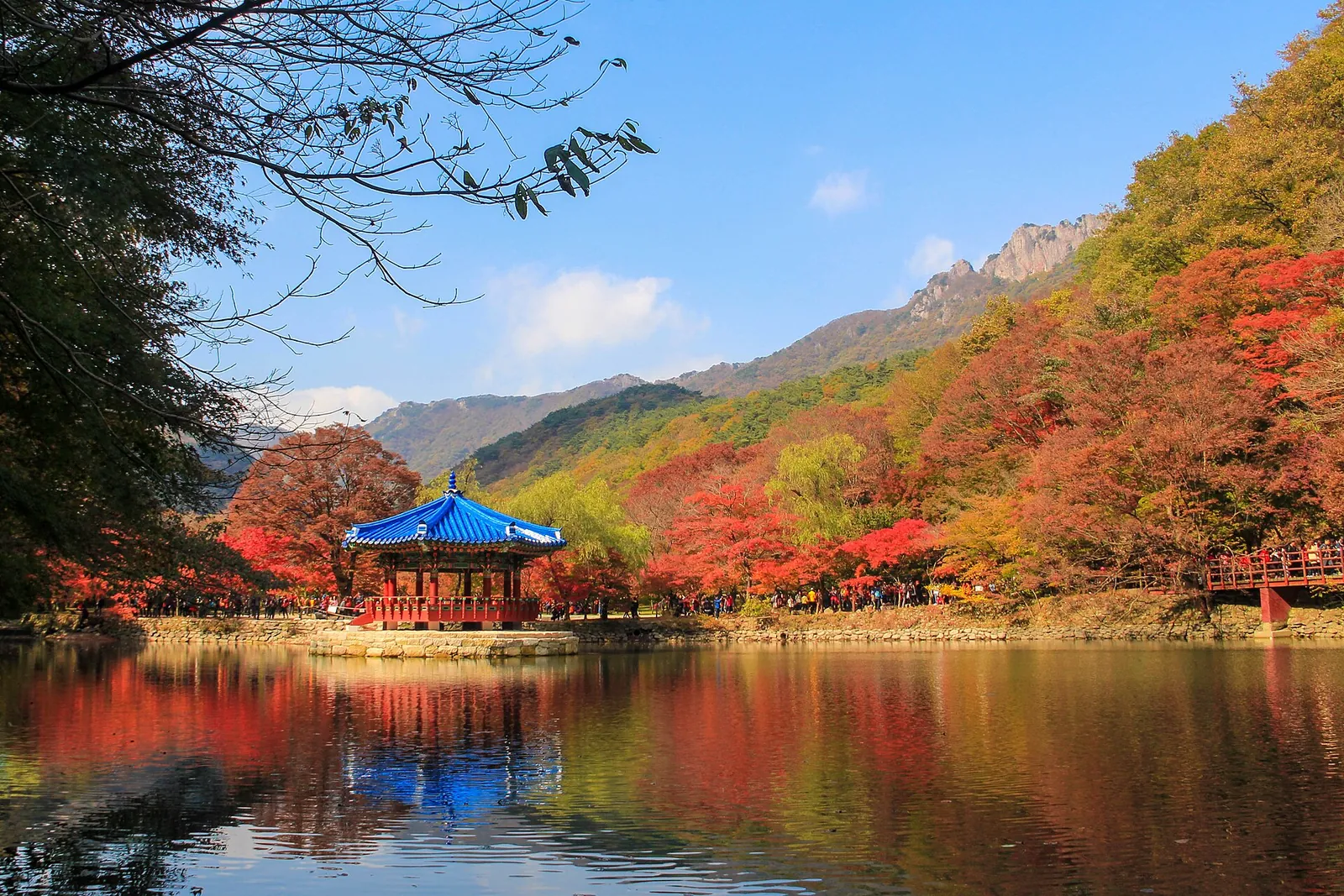
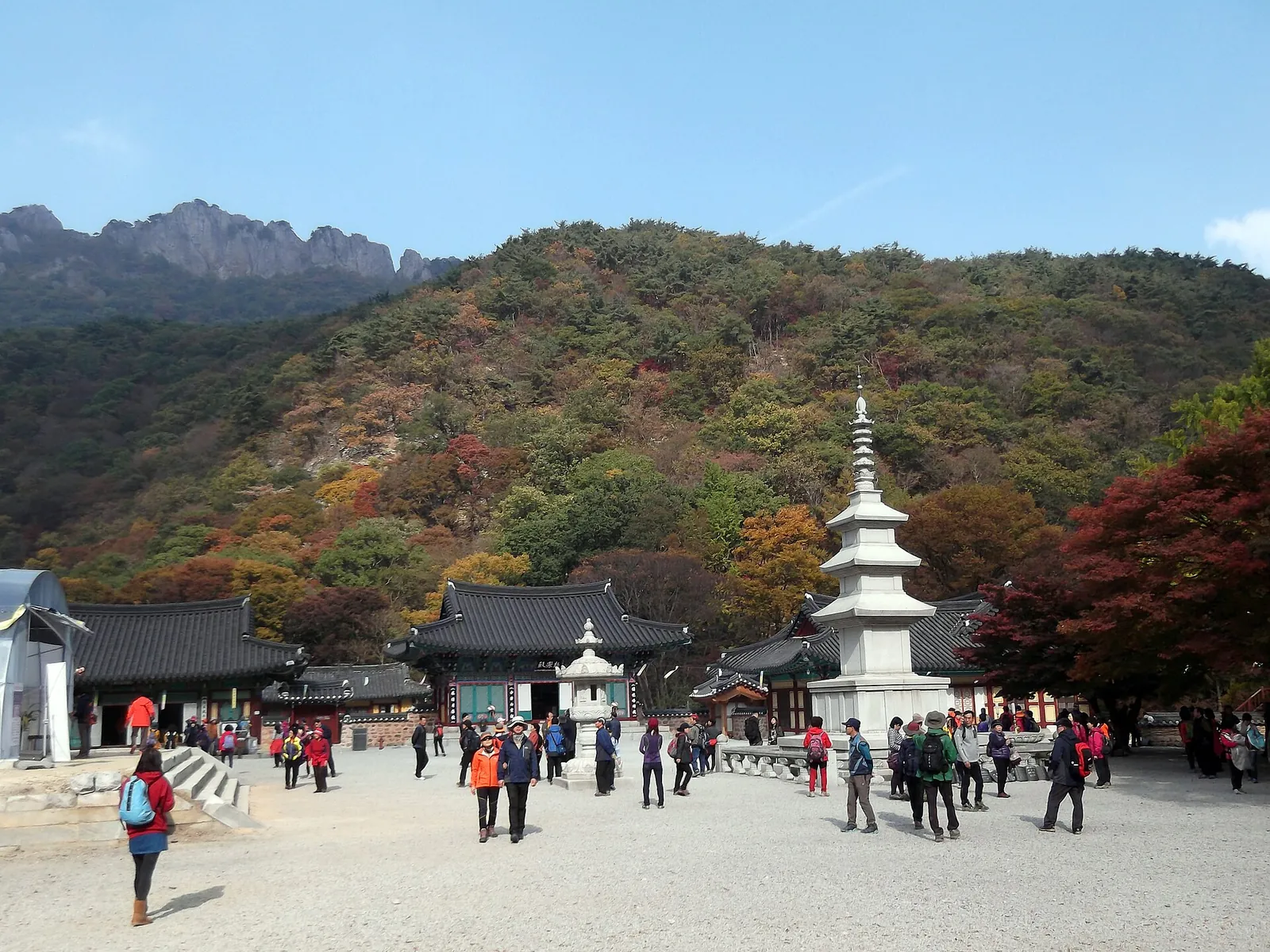
This is the walk most people come for. Uhwajeong takes its name from a legend that the pavilion grew wings and rose into the sky, says VisitKorea; its reflection in the lake with the autumn trees behind it is the classic Naejangsan photograph. Beyond the visitor center, KNPS describes the maple tunnel as a stretch of about 400 m from Iljumun, lined with 108 maples that were chosen as a 'forest to preserve for the 22nd century'.
Naejangsa stands just beyond the tunnel, by the Geumseon stream. KNPS explains that the mountain was once called Yeongeunsan after the temple's original name, Yeongeunsa, and that 'Naejang' means 'hidden within', for the endless sights tucked inside the mountain. VisitKorea's list of the park's highlights also includes Byeongnyeonam hermitage and the cave where the Annals of the Joseon Dynasty were kept safe; KNPS identifies it as Yonggul, on the Geumseon valley path, which sheltered the Annals during the Imjin War. Walk the tunnel early in the morning and leave the photographs of Uhwajeong for your way out if the lake is busy.
Make time for the local food
What to eat and where to look
Naejangsan sanchae bibimbap
Rice mixed with mountain greens and mushrooms. Jeongeup City counts it among its three signature tastes and says it is made with around ten ingredients, including wild-gathered greens.
- Where to look
- Restaurants in Naejang-dong at the foot of the park, which gives the dish its name, and in central Jeongeup; the city's tourism site keeps a list of specialist restaurants.
- Fit it into your day
- An early lunch after the maple tunnel and the Wonjeokgol loop, or dinner before the train back.
It is often served with gochujang; ask for it on the side if you avoid chilli.
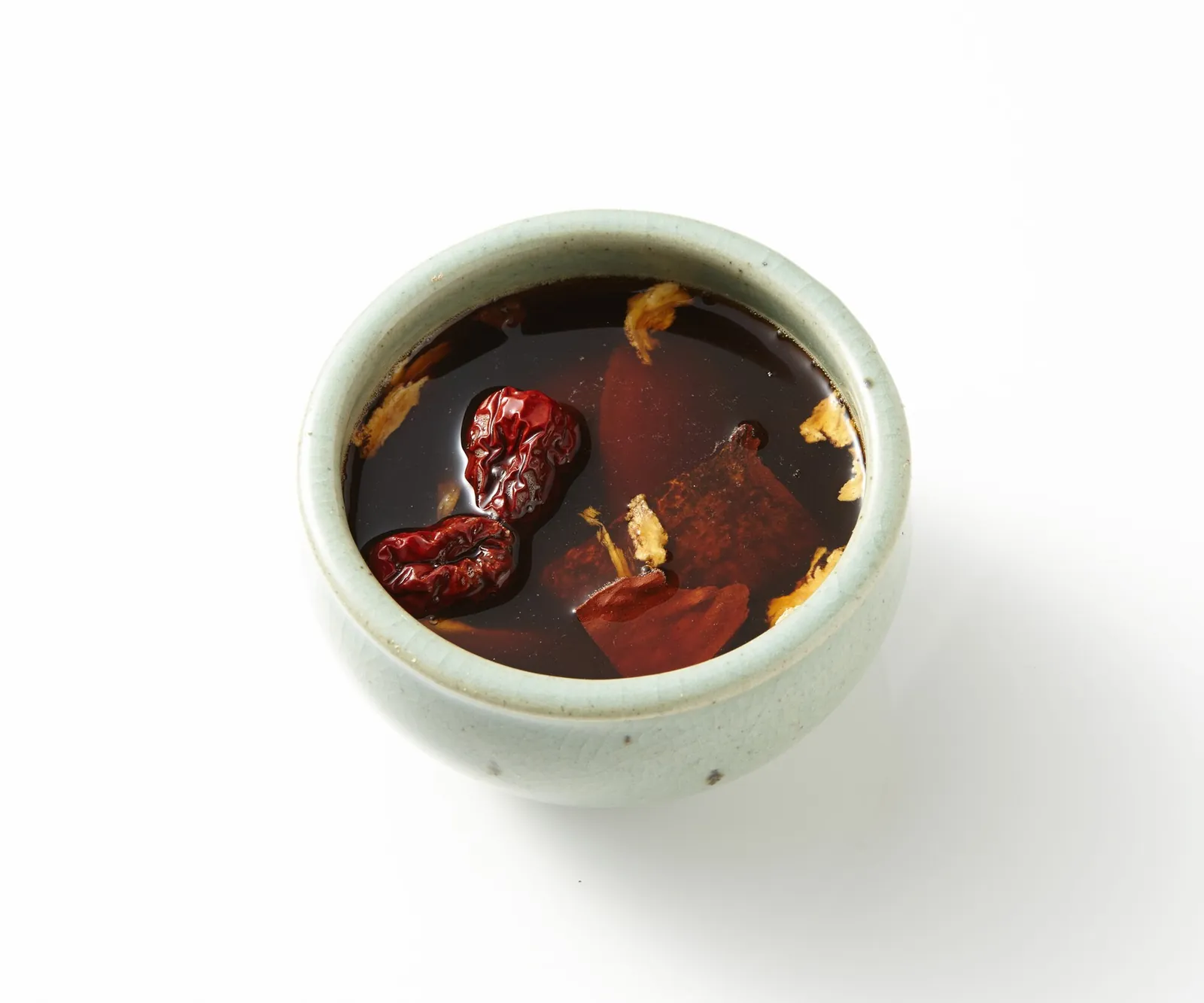
Jeongeup ssanghwacha
A dark herbal tea brewed from ingredients such as Chinese foxglove, white peony, angelica and licorice, often topped with nuts or egg yolk. Jeongeup City lists it first among its signature tastes, and VisitKorea describes it as herbal and bitter with a sweet finish.
- Where to look
- Ssanghwacha Street on Jungang 1-gil in downtown Jeongeup, where VisitKorea counts about ten teahouses, including the Ssanghwatang Teahouse with more than 30 years of history.
- Fit it into your day
- An afternoon stop on the way back to Jeongeup Station; VisitKorea says the teahouses usually serve garaetteok rice cakes or nurungji with it.
Hours vary by teahouse. The tea is medicinal in taste, and the nut and egg garnishes matter if you have allergies.
A packed lunch for the peaks
For Seoraebong, Sinseonbong or the ridge circuit, KNPS asks hikers to carry enough water, lunch and snacks for a long day. Gimbap or rice balls from a convenience store or bakery in Jeongeup travel well.
- Where to look
- Buy it in Jeongeup before you take the bus to the park.
- Fit it into your day
- Lunch at a viewpoint on the ridge, with sanchae bibimbap or ssanghwacha back in town afterwards.
We found no official confirmation of food sales on the ridge trails, so carry everything and take your rubbish down.
The cable car or the Wonjeokgol nature trail
For a big view without a climb, take the Naejangsan cable car. KNPS says the lower station is about 150 m, two minutes' walk, from the visitor center, that the ride takes about five minutes and that cars run about every 20 minutes, so plan around the wait. From the top, a path past a colony of daphniphyllum (Natural Monument No. 91) leads in about seven minutes to the observatory; VisitKorea puts it 300 m from the upper station. You can walk down 0.8 km to Naejangsa in about 25 minutes. Take care crossing the Geumseon stream in front of the temple after rain, KNPS warns. When we checked on 2026-10-03, VisitKorea listed hours of 09:00–18:00 (subject to change) and fares of 8,000 won return or 5,500 won one way for adults (13 and over), and 5,000 won return or 3,500 won one way for children aged 3 to 12.
The Wonjeokgol nature trail is the gentle alternative, and KNPS calls it the first nature trail created in a Korean national park. It loops from Iljumun past Naejangsa, up the Wonjeok valley to Wonjeogam hermitage and back via the 'Bridge of Love' and Byeongnyeonam: 3.9 km and about 1 hour 20 minutes on mostly level gravel and earth. A short flight of steps near Wonjeogam leads to a torreya tree that KNPS dates at 300 to 500 years old. KNPS recommends it for children and older walkers.
Seoraebong, Sinseonbong and the ridge circuit
Seoraebong (624 m), the saw-toothed cliff above Naejangsa that KNPS likens to a farmer's harrow, is the park's most popular climb. The loop goes from Iljumun up past Byeongnyeonam to Seoraebong, along to Bulchulbong (622 m) and down past Wonjeogam: 5.9 km in all. KNPS gives 4 hours in its summary and 3 hours in its detailed text, so allow the longer figure in November crowds. The path from Iljumun to Byeongnyeonam is concrete and fairly steep, and the section past Seoraebong has steep iron stairs. You can also start from the Seorae visitor support center near the Naejangho car park.
Sinseonbong (763 m) is the highest of the nine peaks. KNPS routes it up the Geumseon valley to the Sinseon junction and the summit (3 km, 2 hours 20 minutes), then over Kkachibong (717 m) and down to Naejangsa (4.4 km, 2 hours 40 minutes); the rocks near Kkachibong have fixed ropes. The ridge circuit links eight of the nine peaks in 11.7 km and about 7 hours, with a steep roped section between Kkachibong and Sinseonbong; KNPS says you can drop down partway if you tire, and that the cable car is about 30 minutes below Yeonjabong. KNPS asks you to carry water, lunch and snacks for the long routes and to pick up a trail map at the visitor center.
Beating the November crowds
VisitKorea's 2026 forecast put the peak around 11 November, so plan for the weekends around that date to be the busiest. Go Monday to Thursday if you can. Above all, use the trail hours: when we checked on 2026-10-03, KNPS listed entry at the Naejang trailheads (Geumseon valley, Wonjeok valley, Byeongnyeonam, Donguri, the top of the cable car and the Seorae support center) from 05:00 to 15:00 from November to March and from 04:00 to 16:00 from April to October. Being at the maple tunnel soon after first light gives you the best chance of seeing it before the day visitors arrive. Do not plan to start a peak after lunch.
Leave the car behind. VisitKorea's Jeongeup tourist-zone page notes that taking the KTX to Jeongeup makes the trip much easier at the foliage peak and avoids traffic jams. If the main valley is too busy, look beyond it. The Naejangsan Maple Ecology Park near Naejangho Lake, which VisitKorea lists as free, open 24 hours and at its best in November, has 11 native maple species. On the southern side, KNPS describes the gentle Jangseong Saejae path from Jeollanam-do over to Ipam as uncrowded: 2.5 km and about 1 hour 20 minutes to the pass, then 2 km and 40 minutes down to the Ipam ranger post. It is not a loop, so arrange your transport at both ends.
Baegyangsa: the southern side of the park
Baegyangsa lies inside the national park on Baegamsan, in Jangseong County, Jeollanam-do. VisitKorea dates the temple to the 6th century and describes a forest walk to a lake overlooked by Ssanggyeru Pavilion at the entrance, a famous autumn view, with more than 5,000 torreya trees around the temple, some over 500 years old. When we checked on 2026-10-03, VisitKorea listed admission at 3,000 won for adults and 1,000 won for teenagers and children, and a temple stay programme booked through baekyangsa.templestay.com.
From the temple, KNPS's Baegyangsa ridge course climbs to Baekhakbong (651 m) and along the ridge via Sangwangbong: 8.1 km and about 5 hours 30 minutes, with a steep 400 m section up to the Hak rock viewpoint. Strong hikers can cross the whole park on the Baegyangsa–Naejangsa traverse, 12 km and about 7 hours, which KNPS recommends for experienced hikers rather than beginners. KNPS's public transport route to this side is by train to Baegyangsa Station, then from Jangseong's bus terminal to the Baegam visitor center. Treat Baegyangsa as a separate day or as the start of the traverse, not as an add-on to the Naejangsa valley.
Getting there from Jeongeup
Jeongeup is the gateway. VisitKorea says Jeongeup Station on the Honam Line is especially famous in autumn for hikers heading to Naejangsan, and that the Honam Line starts at Yongsan Station in Seoul. KNPS's rail route runs from Yongsan to Jeongeup and then by city bus 171 or 171-1 to the Naejang terminal and on past the park office to the visitor center, about 3 hours 30 minutes in all from Seoul. By express bus, KNPS lists Central City (Honam line) terminal in Seoul or Dong Seoul to Jeongeup, then the same city bus. From Gwangju, KNPS gives about 1 hour 30 minutes by bus or train. VisitKorea puts the mountain about 11 km from downtown Jeongeup.
We could not find an official timetable for buses 171 and 171-1, so check at Jeongeup before you set off and allow extra time on peak weekends. Drivers will find parking at the park; when we checked, VisitKorea listed 2,000 won for small cars and 4,000–5,000 won for mid-sized vehicles. Check the KNPS Naejangsan pages for closures in bad weather before you go.
Practical questions
When is the best time to see the autumn leaves at Naejangsan?
VisitKorea's 2026 forecast expected Naejangsan's foliage to peak around 11 November, with actual dates depending on the weather. Go on a weekday and start early: in November, KNPS trail entry at the Naejang trailheads runs from 05:00 to 15:00.
How do I get from Jeongeup Station to Naejangsan?
KNPS lists city buses 171 and 171-1 from Jeongeup to the Naejang bus terminal, continuing past the park office to the visitor center. VisitKorea puts the mountain about 11 km from downtown Jeongeup. We found no official bus timetable, so check locally.
Is there an entrance fee for Naejangsan National Park?
VisitKorea lists the park itself as free. The cable car, parking and Baegyangsa on the southern side charge separately; when we checked on 2026-10-03, VisitKorea listed the cable car at 8,000 won return for adults and Baegyangsa at 3,000 won for adults.
What is the easiest walk at Naejangsan?
The Wonjeokgol nature trail: KNPS lists the loop from Iljumun via Naejangsa, Wonjeogam and Byeongnyeonam as 3.9 km and about 1 hour 20 minutes on a mostly level path. The cable car and observatory course is even shorter, at 1.81 km and about 50 minutes.
How long does the Seoraebong hike take?
KNPS gives the loop from Iljumun over Seoraebong and Bulchulbong as 5.9 km, with 3 hours in one place and 4 hours in another. It includes steep iron stairs. Allow the longer time at peak season.
Is Baegyangsa part of Naejangsan National Park?
Yes. VisitKorea lists Baegyangsa and Naejangsa among the park's temples. Baegyangsa is on the Jangseong side in Jeollanam-do and has its own approach via Baegyangsa Station, so treat it as a separate day or the start of the 12 km traverse.
Sources and checks before you travel
Reference sources for the version dated 3 October 2026. Confirm opening times, access, transport and conditions for your travel dates.
- Korea National Park Service: Naejangsan National Park ↗ — opens in a new tab
- Korea National Park Service: Naejangsan trail courses ↗ — opens in a new tab
- Korea National Park Service: designated entry hours ↗ — opens in a new tab
- VisitKorea: Naejangsan National Park ↗ — opens in a new tab
- VisitKorea: Naejangsan Cable Car ↗ — opens in a new tab
- VisitKorea: Uhwajeong Pavilion ↗ — opens in a new tab
- VisitKorea: Jeongeup Naejangsan Special Tourist Zone ↗ — opens in a new tab
- VisitKorea: 100 Must-Visit Tourist Spots (Naejangsan) ↗ — opens in a new tab
- VisitKorea: Naejangsan Maple Ecology Park ↗ — opens in a new tab
- VisitKorea: 2026 Fall Foliage Forecast ↗ — opens in a new tab
- VisitKorea: Baegyangsa Temple ↗ — opens in a new tab
- VisitKorea: Jeongeup Ssanghwacha Street ↗ — opens in a new tab
- Jeongeup City: 3 tastes – Naejangsan sanchae bibimbap ↗ — opens in a new tab
- Jeongeup City: 1 taste – Jeongeup ssanghwacha ↗ — opens in a new tab
- VisitKorea: Train ↗ — opens in a new tab
- VisitKorea: Airport Transportation Guide ↗ — opens in a new tab
Does this experience fit your route?
Naejangsan is easy to do on your own by train and city bus from Jeongeup. If you would rather join a day tour from Seoul, check that it goes to Naejangsan itself and how long you get in the valley.
Browse relevant experiences on Viator ↗ — opens in a new tabAffiliate link · Book with ViatorPhoto credits
Uhwajeong Pavilion on its lake on the way to the Naejangsan visitor center, in autumn colour
Photograph: Tung Thanh Dang — opens in a new tab · CC BY-SA 3.0 — opens in a new tab
Changes: Resized and converted to WebP; displayed with responsive crops. · Original photograph and licence details ↗ — opens in a new tab
Naejangsa temple's courtyard at the head of the maple tunnel in autumn
Photograph: Café Bene — opens in a new tab · CC0 — opens in a new tab
Changes: Resized and converted to WebP; displayed with responsive crops. · Original photograph and licence details ↗ — opens in a new tab
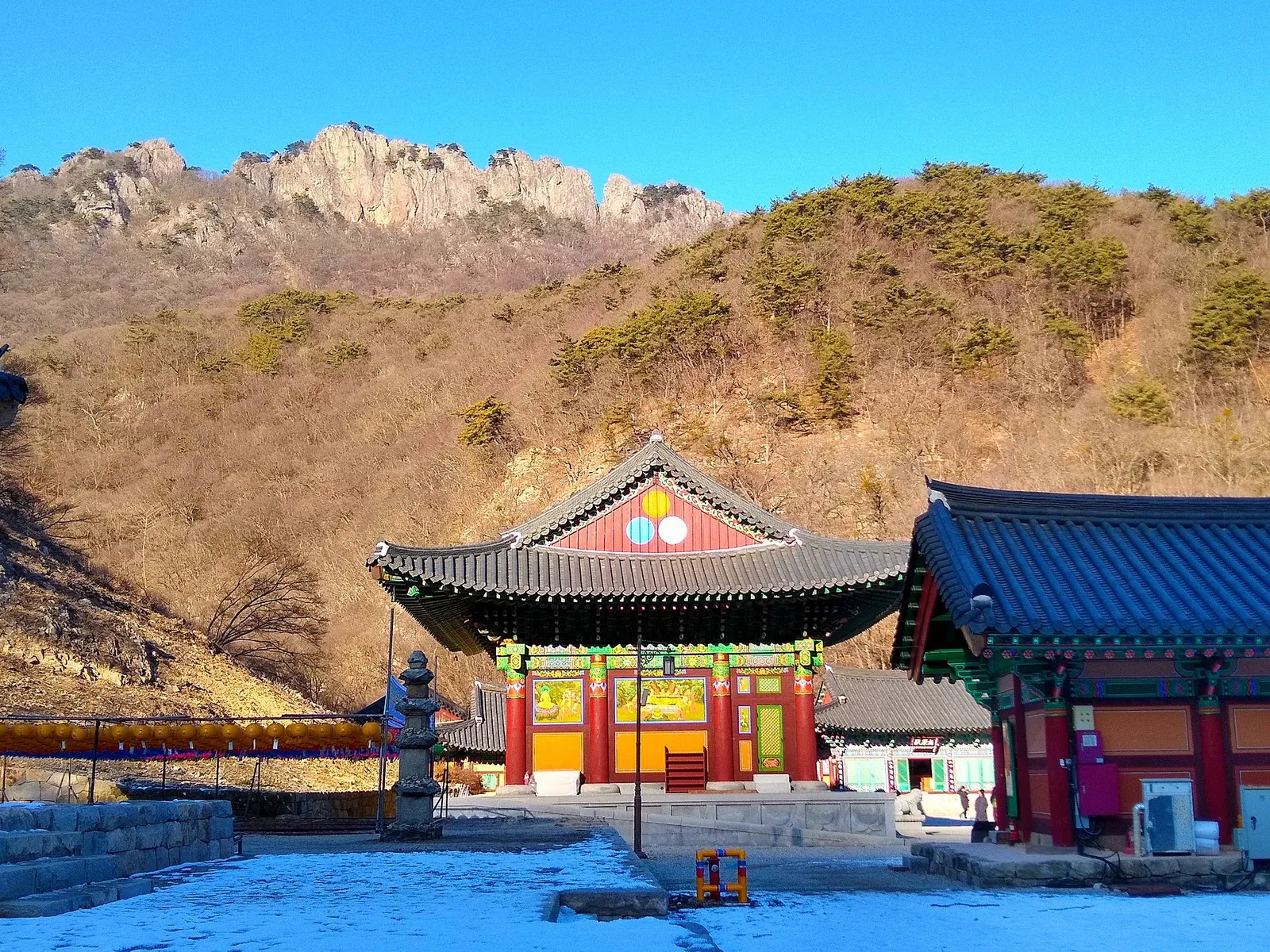
A hall of Naejangsa beneath the rocky crest of the Naejangsan horseshoe
Photograph: Lance Vanlewen — opens in a new tab · CC BY-SA 4.0 — opens in a new tab
Changes: Resized and converted to WebP; displayed with responsive crops. · Original photograph and licence details ↗ — opens in a new tab
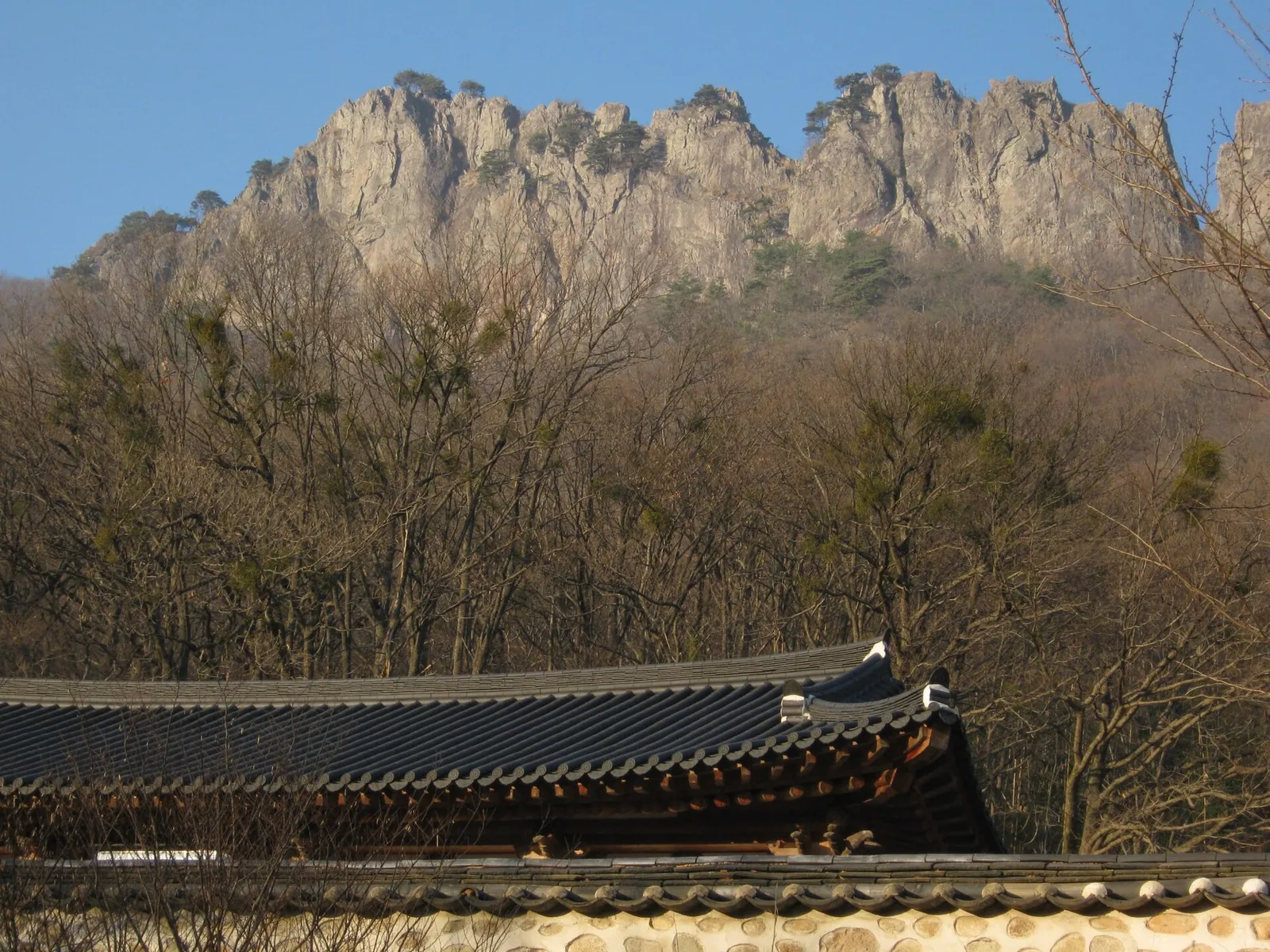
The cliffs of the Naejangsan ridge above a temple roof after the leaves have fallen
Photograph: gary4now — opens in a new tab · CC BY 3.0 — opens in a new tab
Changes: Resized and converted to WebP; displayed with responsive crops. · Original photograph and licence details ↗ — opens in a new tab
Ssanghwacha, the herbal tonic tea served on Jeongeup's Ssanghwacha Street (photographed elsewhere)
Photograph: 국립국어원 — opens in a new tab · CC BY-SA 2.0 kr — opens in a new tab
Changes: Resized and converted to WebP; displayed with responsive crops. · Original photograph and licence details ↗ — opens in a new tab