Busan and South Gyeongsang · South Gyeongsang
Haeinsa guide: Tripitaka Koreana, Sori-gil walk, templestay, Daegu bus
Haeinsa sits high on the slopes of Gayasan in Hapcheon County, South Gyeongsang, and it is the temple that keeps the Tripitaka Koreana: the Buddhist canon carved on more than 80,000 wooden printing blocks in the 13th century. UNESCO counts 81,258 blocks and lists them on its Memory of the World Register. The plain wooden halls that hold them, Janggyeong Panjeon, have been a World Heritage Site since 1995. VisitKorea calls Haeinsa one of Korea's three largest temples, founded in 802. The temple is only part of the trip. Below it the Hongnyudong valley carries the Sori-gil, an easy streamside path. Above it are the granite ridges of Gayasan National Park. The real decision is whether to come for an afternoon from Daegu or to stay the night and see the temple at dawn.
- Suggested time
- Long day trip from Daegu, or 1 night
- Where to stay
- The village by the Haeinsa bus terminal (Chiin-ri, Gaya-myeon), a templestay at Haeinsa, or Daegu for a day trip
- Season and timing
- Autumn is the classic season. VisitKorea explains that the Hongnyudong valley takes its name from the way the autumn leaves make its water look crimson. Its 2026 foliage forecast gives no date for Gayasan; nationwide, peak colour was expected from mid-October to early November, with Jirisan forecast to peak on 5 November. VisitKorea also lists azaleas in spring and a cool, shaded valley in summer. In winter, KNPS warns of ice on the stairs of the summit trails, and its trail entry cut-offs are an hour earlier from November to March. Every April, according to a 2024 VisitKorea column, Haeinsa holds a ceremony in which monks carry Tripitaka blocks around the courtyard on their heads.
The short answer
From Daegu, Haeinsa works as a day trip: take the bus from Daegu's Seobu Intercity Bus Terminal, which the templestay office times at about 1 hour 30 minutes to the Haeinsa bus terminal. Give the temple and Janggyeong Panjeon three hours, and add the lower Sori-gil if you have time. Stay one night if you want more than that. Sleep in the small village by the Haeinsa bus stop, or book a templestay at the temple through templestay.com. Walk the whole Sori-gil (6 km, about 2 hours 30 minutes one way by KNPS times) or climb Sangwangbong (4 km and about 2 hours 30 minutes one way from Haeinsa) the next morning. Hikers need an early start: in October the Haeinsa-side trail closes to new walkers at 14:00.
Day trip or overnight: how to plan Haeinsa
Everything a first-time visitor needs is in one valley on the Hapcheon side of Gayasan. The road climbs from the Sori-gil trailhead up the Hongnyudong valley to a small village of restaurants and lodgings around the Haeinsa bus terminal. From there the templestay office reckons about 30 minutes on foot up to its templestay quarters at the temple, with Janggyeong Panjeon at its highest point. The trail to the summit starts just past the temple's first gate, the Iljumun.
A day trip from Daegu covers the temple comfortably. It does not leave much time for the valley walk, and a summit climb on top of that is too much. An overnight changes the trip. You can be in the temple courtyard before the day visitors arrive, listen to the evening sounding of the temple's four Dharma instruments, and still walk or climb the next morning. If you stay at the temple itself, the templestay schedule makes the choice for you: dinner at 17:30 and the morning ceremony at 03:40.
The times below are the Korea National Park Service (KNPS) course figures for Gayasan, one way. Plan the walk back as well.
- Half a day, easy: Haeinsa and Janggyeong Panjeon, plus the barrier-free last stretch of the Sori-gil from Gilsangam hermitage to Yeongsangyo bridge (0.9 km, about 20 minutes).
- Full day, easy: the whole Sori-gil, 6 km along the Hongnyudong valley to Yeongsangyo near the temple, in three sections that add up to about 2 hours 30 minutes.
- Full day, hiking: Haeinsa to Sangwangbong, 4 km and about 2 hours 30 minutes one way, steep and stepped in its upper half.
- Short summit with the best view of the temple: Namsan Jeilbong (1,010 m) from Dwaejigol, 2.6 km and about 1 hour 30 minutes one way. KNPS gives about 2 hours 30 minutes for the round trip.
Haeinsa and Janggyeong Panjeon: what you are looking at
VisitKorea dates Haeinsa to 802, when the monks Suneung and Ijung founded it, and explains that the name comes from *Haein Sammae*, an image in the Avatamsaka (Flower Garland) Sutra. The Korea Heritage Service (KHS) calls it the "Temple of Dharma". Korean Buddhism has three "jewel" temples, standing for the Buddha, his teaching (the Dharma) and the community of monks. Haeinsa is the Dharma jewel because it keeps the scriptures.
The canon itself has a wartime story. KHS explains that the first Goryeo edition of the Tripitaka was burned by Mongol invaders in 1232. The court set up an office to carve a new set in 1236 and finished it in 1251. The blocks were kept on Ganghwa Island and later moved to Haeinsa, in 1398. UNESCO counts 81,258 blocks in the canon. It also lists 5,987 woodblocks of other scriptures, carved between 1098 and 1958, that Haeinsa made itself. UNESCO calls it the only complete Tripitaka canon still extant on the Asian mainland.
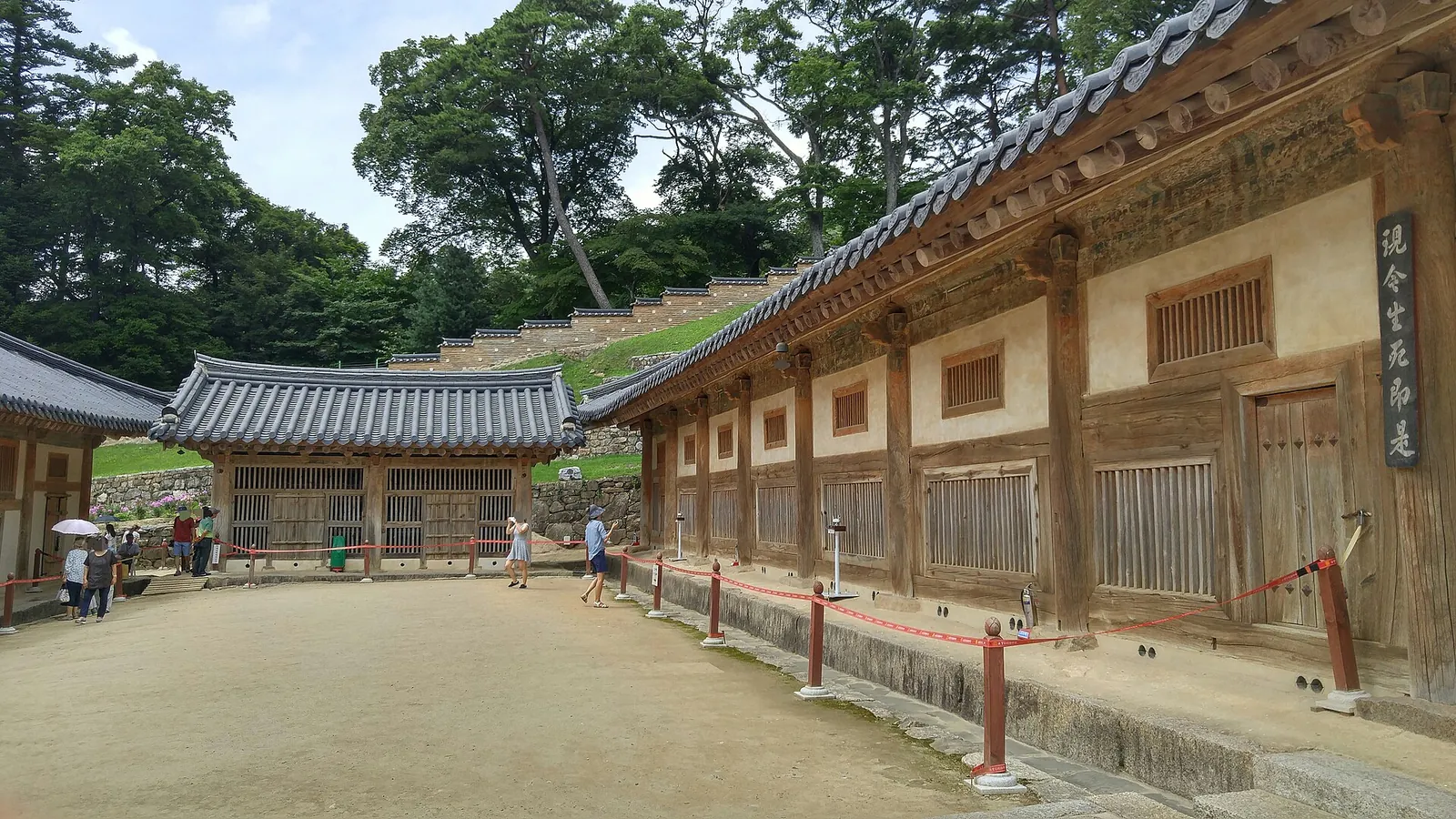
Janggyeong Panjeon sits on the highest terrace, above the main hall, which is unusual. KHS puts it at 655 m on the slope of Gayasan. There are four buildings: two long halls back to back, the Sudarajang in front and the Beopbojeon behind, both 60.44 m long, with two small annexes at the ends of the courtyard between them. Look at the walls. The slatted windows are sized differently front and back, and upper and lower, to move air through the shelves. KHS says the clay floors have layers of salt, charcoal and lime underneath to absorb moisture. As a result, the halls stay 0.5 to 2 degrees cooler and 5 to 10 per cent drier than the air outside. KHS adds that seven fires hit the temple between 1695 and 1871 and none reached the depositories, and that in 1951 Air Force Colonel Kim Young-hwan refused an order to bomb Haeinsa.
When we checked on 2026-10-03, VisitKorea listed Haeinsa as open from 08:30 to 18:00 in summer and 08:30 to 17:00 in winter, every day. It gave admission as 3,000 won for adults, 1,500 won for teenagers and 700 won for children, but the page carries no recent update date, so confirm at the ticket booth. A 2024 VisitKorea column (last updated April 2024) said that viewing the Tripitaka Koreana required a reservation on the temple's website, with places released at 12:00 every Monday, and that liquids, water bottles, lighters, photography and touching the shelves were not allowed. We could not reach the temple's site (haeinsa.or.kr) to confirm the current arrangement. The same column asks visitors not to wear slippers, high heels, shorts, sleeveless tops or leggings anywhere in the temple.
Make time for the local food
What to eat and where to look
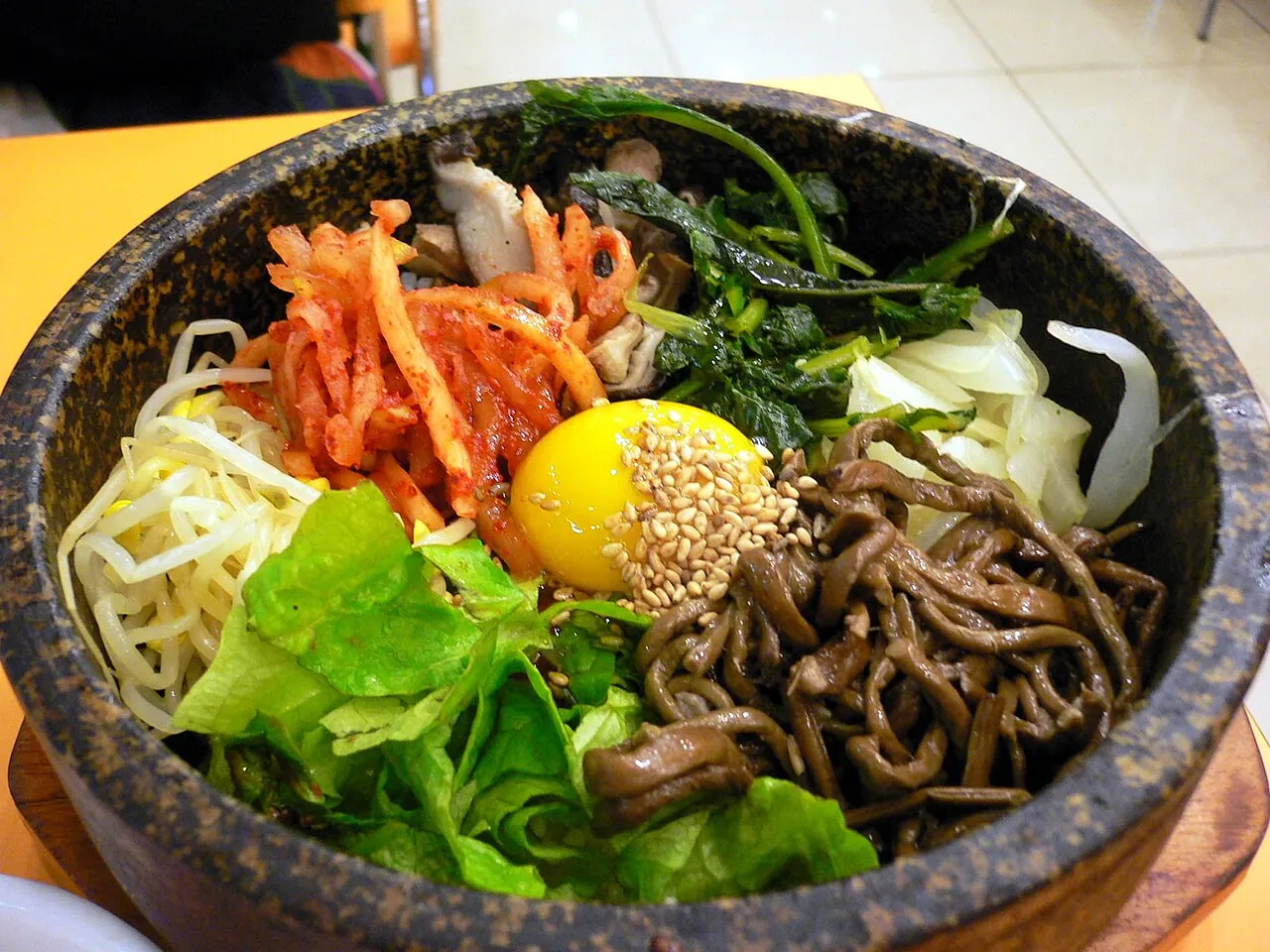
Sanchae bibimbap (wild mountain vegetable bibimbap)
Rice topped with seasoned wild greens and mountain vegetables, mixed at the table. VisitKorea's listing for Busan Sikdang, in front of Haeinsa, names it as the house speciality, made with wild vegetables, deodeok root and mushrooms gathered on Gayasan.
- Where to look
- The restaurants of the village by the Haeinsa bus terminal. VisitKorea listed Busan Sikdang at 8 Chiin 1-gil, Gaya-myeon, open 07:00–19:00 every day when we checked.
- Fit it into your day
- A quick lunch before or after the temple, or an early breakfast before the climb.
Bibimbap usually comes with gochujang (chilli paste); ask for it on the side if you do not like heat.
Sanchae jeongsik (wild vegetable set meal)
A full table of rice, soup and many small dishes of wild greens. VisitKorea lists a special set and a wild-vegetable hanjeongsik at Busan Sikdang. The side dishes include seasoned wild vegetables, grilled deodeok, green onion pancake and acorn jelly salad (dotorimuk).
- Where to look
- The same restaurant row by the Haeinsa bus terminal and along Chiin 1-gil.
- Fit it into your day
- The evening meal on an overnight, shared between two or more people.
Seasoned side dishes are often made with fish sauce or salted seafood; vegetarians should ask before ordering.
Deodeok gui (grilled deodeok root)
Deodeok, a mountain root, flattened and grilled with a sweet chilli glaze. VisitKorea lists a grilled-deodeok set meal at Busan Sikdang, with deodeok also among the side dishes of its other sets.
- Where to look
- Set-menu restaurants in the village below the temple.
- Fit it into your day
- A hot dinner after the Sangwangbong climb.
The glaze is based on gochujang and can be spicy.
Pyogo mushroom set meal
A set meal built around shiitake (pyogo) mushrooms. VisitKorea lists it at Busan Sikdang alongside the wild-vegetable sets.
- Where to look
- Busan Sikdang and the other restaurants by the Haeinsa bus terminal.
- Fit it into your day
- A lighter, less spicy alternative to the deodeok set.
Menus and prices change; check what is offered on the day.
Temple meals on a templestay
Templestay guests eat with the temple. The Haeinsa pilgrimage programme lists dinner at 17:30 and breakfast at 06:00. VisitKorea describes templestay as a way to eat Korean temple food, a vegetarian diet.
- Where to look
- Included in a templestay booked through templestay.com.
- Fit it into your day
- Dinner on day one and breakfast on day two of the stay.
Meals are at fixed times, and the temple asks guests to keep noble silence and follow its rules.
Gayasan Sori-gil and the Hongnyudong valley
The Sori-gil ("sound path") restores the old way up the Hongnyudong valley. VisitKorea describes it as a 6 km walk from the Hapcheon Theme Park of the Tripitaka Koreana to Yeongsangyo bridge near Haeinsa, open around the clock and free. KNPS rates it a low-lying path that anyone can walk. It has three sections. From the trailhead to Nongsanjeong pavilion it is 4.1 km, about 1 hour 40 minutes, through farmland and then pine forest, crossing the stream four times. From Nongsanjeong to Gilsangam hermitage is 1.0 km, about 30 minutes, with a short rocky climb and a rockfall zone to pass with care. From Gilsangam to Yeongsangyo is 0.9 km, about 20 minutes, past the Nakhwadam pool. KNPS calls this last stretch the highlight of the walk, and it is built as a barrier-free path.
The valley has its own history. VisitKorea and KNPS both link Nongsanjeong to Choe Chiwon, the Silla scholar who withdrew to this valley, and VisitKorea notes a rock opposite the pavilion carved with his handwriting. KNPS counts several of Gayasan's "19 scenic spots" along the path, including Nongsanjeong, Hongnyudong itself and Nakhwadam. VisitKorea describes the valley between the park entrance and Haeinsa as 4 km long.
Walk it uphill, finishing at the temple, so the walk ends where the visit starts. We could not find an official bus or shuttle between the two ends of the trail. If you walk only one way, ask your guesthouse or the KNPS visitor centre about getting back, or walk just the upper sections from Yeongsangyo.
Climbing Gayasan: Sangwangbong and Namsan Jeilbong
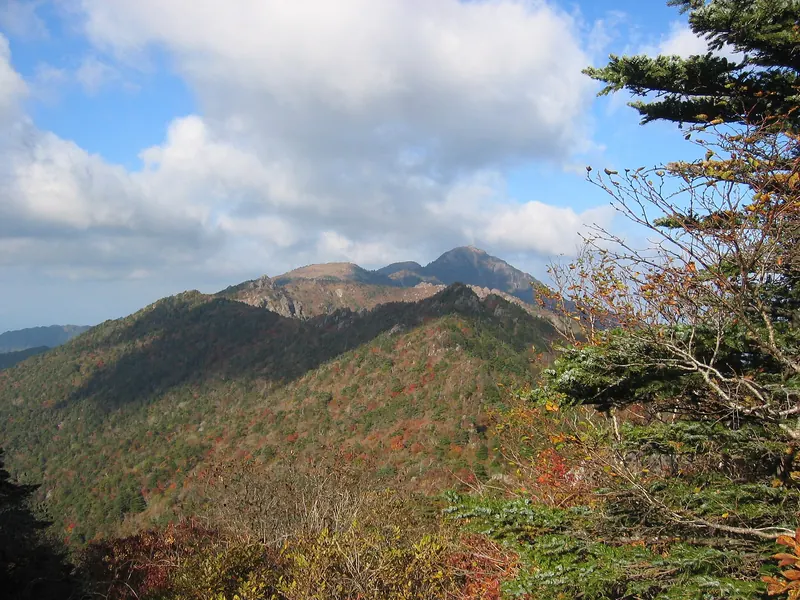
Sangwangbong is the summit. VisitKorea and KHS both give Gayasan's height as 1,430 m. KNPS Course 1 starts by Haeinsa's Iljumun gate: turn right towards Yongtap Seonwon to the trailhead and the Tosingol visitor centre. It is 3 km and about 2 hours to Jungbong, then 1 km and about 30 minutes to the top. The upper part is steep, with stone and wooden stairs and iron stairways that KNPS warns are slippery in winter ice and summer rain. About 100 m off the trail by the first iron stairway stands a standing stone Buddha (Treasure No. 264). On a clear day, KNPS says, you can see the Deogyusan range and Jirisan's Cheonwangbong from the top.
Namsan Jeilbong, across the valley, is the shorter climb, and its view looks back onto Haeinsa. KNPS Course 2 starts at the Dwaejigol visitor centre at about 600 m, so the 1,010 m summit is only 2.6 km away. That is 1.9 km and about 1 hour along a stream, then 0.7 km and about 30 minutes of steep steps that freeze in winter. KNPS Course 1, from Cheongnyangdong, is 2.3 km but steep from the start. It passes Cheongnyangsa temple and three Treasures: a seated stone Buddha, a three-storey stone pagoda and a stone lantern.
KNPS limits when you may start up each trail and when you must leave the summit. When we checked on 2026-10-03, its entry-hours page listed the Tosingol trailhead (towards Sangwangbong) as open for entry from 04:00 to 14:00 from April to October and from 05:00 to 13:00 from November to March. Hikers had to leave Sangwangbong by 16:30 in summer and 15:30 in winter. Cheongnyangdong and Dwaejigol (towards Namsan Jeilbong) took walkers until 15:00 in summer and 14:00 in winter, with the same summit times. The rocky Manmulsang ridge, which KNPS calls the finest on the mountain, starts on the other side of the range, at Baegundong in Seongju (North Gyeongsang). It is not a walk from Haeinsa.
A templestay at Haeinsa
Haeinsa is on templestay.com as a temple that takes foreign guests, and when we checked it listed two programmes. The Tripitaka Koreana Pilgrimage runs at weekends (Saturday to Sunday). Healing Haein: A Quiet Retreat runs on weekdays only. The pilgrimage schedule ran from check-in at 13:30–14:30 through an orientation, traditional woodblock printing and a temple tour to dinner at 17:30. The evening ceremony followed at 18:30, with lights out at 21:30. On the second day you leave for the main hall at 03:10 for the 03:40 morning ceremony, have breakfast at 06:00, make a string of 108 prayer beads at 09:00 and check out at 11:00. The ceremonies were marked optional. The temple notes that the schedule may change.
When we checked on 2026-10-03, the pilgrimage programme listed 100,000 won per adult in a four-person bunk room, 110,000 won in a twin room, 125,000 won in a VIP twin and 130,000 won for a single room or a one-person ondol (floor-heated) room. Teenagers and children paid 10,000 won less, and pre-school children were not accepted. Refunds were 100 per cent up to three days before, falling to nothing on the day.
The house rules are short and strict. Bedding and a temple vest and trousers are provided. Bring a T-shirt to wear under the vest (sleeveless tops are not allowed), plus your own towel, toiletries and warm layers. Wear sneakers or hiking shoes, because flip-flops and slippers are not permitted. Wear socks in the halls, keep quiet, and do not drink or smoke. VisitKorea notes that templestays are also a way to eat Korean temple food, which is vegetarian.
Getting there and getting around
The usual approach is through Daegu. Both the templestay office and VisitKorea send visitors to Daegu's Seobu Intercity Bus Terminal for the bus to Haeinsa. The templestay office times the ride at about 1 hour 30 minutes to the Haeinsa bus terminal. From Seoul or Busan it gives the route as KTX to Dongdaegu, then Daegu Metro Line 1 towards Seolhwa-Myeonggok, about 20 minutes, to the Seobu terminal. It puts the whole trip at about 2.5–3 hours from Seoul and 2–2.5 hours from Busan. We could not confirm the bus timetable on an official page, so check departures at the terminal.
From the Haeinsa bus terminal, the templestay office says it is about 30 minutes on foot or 5 minutes by taxi to the templestay quarters. It recommends a taxi if you have luggage. It also says the Seongbo Museum stop, one before the terminal, is closer to the temple. Drivers can park at the temple: when we checked, VisitKorea listed 2,000 won for small cars and 4,000 won for mid-sized cars.
Once you are there, the village, the temple, the upper Sori-gil and the Sangwangbong trail are all linked by footpaths. You need transport only to reach the lower end of the Sori-gil, or the Namsan Jeilbong trailheads if you do not want to walk the road.
Practical questions
Can I see the Tripitaka Koreana woodblocks at Haeinsa?
The woodblocks stay in Janggyeong Panjeon, the 15th-century depositories on the temple's top terrace. A 2024 VisitKorea column said that viewing them required a reservation on the temple's website, released every Monday at 12:00, with no photography and no touching the shelves. We could not reach the temple's site to confirm the current rules, so check before you go.
Is Haeinsa a day trip from Daegu?
Yes. VisitKorea and the templestay office both route visitors by bus from Daegu's Seobu Intercity Bus Terminal, and the templestay office puts the ride at about 1 hour 30 minutes. A day trip covers the temple and a short walk. Stay overnight if you want the full Sori-gil or a summit.
How long is the Gayasan Sori-gil?
VisitKorea gives 6 km from the Hapcheon Theme Park of the Tripitaka Koreana to Yeongsangyo bridge near Haeinsa. KNPS times its three sections at 1 hour 40 minutes, 30 minutes and 20 minutes, about 2 hours 30 minutes one way. VisitKorea lists it as free and open around the clock.
How hard is the climb to Sangwangbong?
KNPS gives 4 km and about 2 hours 30 minutes one way from Haeinsa. The second half is steep, with stairs and iron stairways that ice over in winter. When we checked, you had to start by 14:00 from April to October and by 13:00 from November to March.
How much is a templestay at Haeinsa?
When we checked on 2026-10-03, the weekend Tripitaka Koreana Pilgrimage on templestay.com started at 100,000 won per adult in a four-person bunk room and rose to 130,000 won for a single room. A weekday retreat was also listed.
What should I wear at Haeinsa?
VisitKorea asks visitors not to wear slippers, high heels, shorts, sleeveless tops or leggings in the temple. Templestay guests also need socks in the halls and closed shoes, not flip-flops.
Sources and checks before you travel
Reference sources for the version dated 3 October 2026. Confirm opening times, access, transport and conditions for your travel dates.
- VisitKorea: Hapcheon Haeinsa Temple ↗ — opens in a new tab
- VisitKorea: K-Temple Tours (Haeinsa section) ↗ — opens in a new tab
- UNESCO Memory of the World: Printing woodblocks of the Tripitaka Koreana and miscellaneous Buddhist scriptures ↗ — opens in a new tab
- Korea Heritage Service: Haeinsa Temple Janggyeong Panjeon ↗ — opens in a new tab
- VisitKorea: UNESCO World Heritage introduction ↗ — opens in a new tab
- VisitKorea: Memory of the World Register ↗ — opens in a new tab
- VisitKorea: Gayasan National Park (Hongnyu-dong, Cheongnyang-dong Area) ↗ — opens in a new tab
- VisitKorea: Gayasan Sori-gil ↗ — opens in a new tab
- VisitKorea: Hongryudonggyegok Valley ↗ — opens in a new tab
- Korea National Park Service: Gayasan trail courses ↗ — opens in a new tab
- Korea National Park Service: designated entry hours ↗ — opens in a new tab
- Templestay (Jogye Order): Haeinsa temple information ↗ — opens in a new tab
- Templestay (Jogye Order): Haeinsa Tripitaka Koreana Pilgrimage ↗ — opens in a new tab
- VisitKorea: Templestay ↗ — opens in a new tab
- VisitKorea: Busan Sikdang ↗ — opens in a new tab
- VisitKorea: Dals Garden ↗ — opens in a new tab
- VisitKorea: Airport transportation guide ↗ — opens in a new tab
- VisitKorea: [Korea Beyond Seoul] Fly to Daegu International Airport ↗ — opens in a new tab
- VisitKorea: 2026 Fall Foliage Forecast ↗ — opens in a new tab
Photo credits
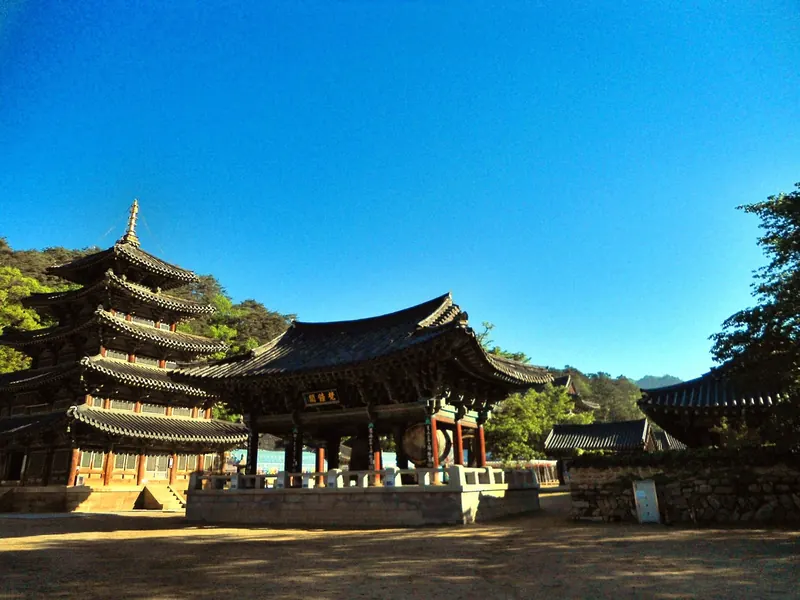
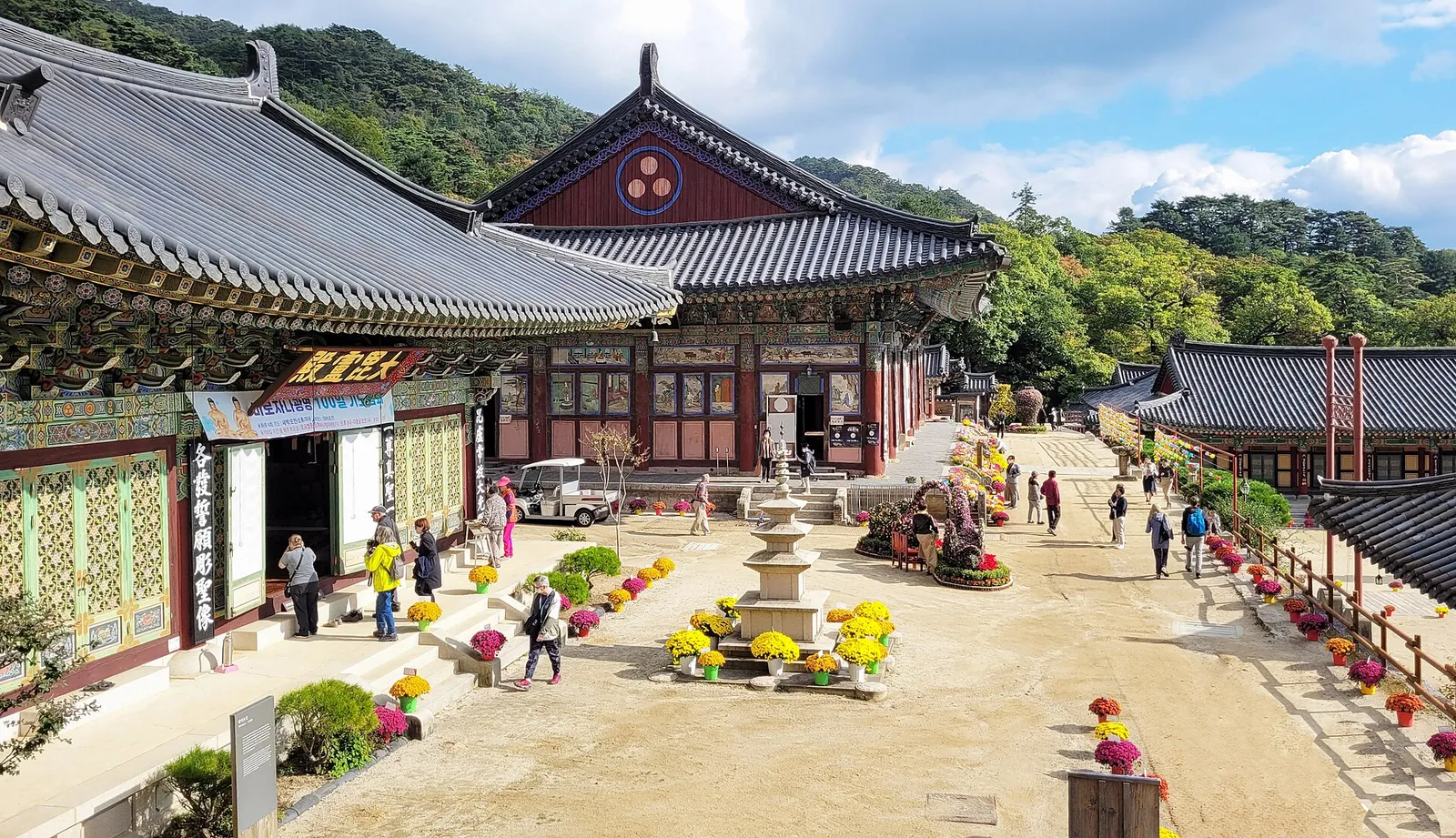
The upper courtyard of Haeinsa on a clear day, with the forested slopes of Gayasan behind the halls.
Photograph: Bernard Gagnon — opens in a new tab · CC0 — opens in a new tab
Changes: Resized and converted to WebP; displayed with responsive crops. · Original photograph and licence details ↗ — opens in a new tab
Janggyeong Panjeon, the 15th-century depositories that hold the Tripitaka Koreana woodblocks at Haeinsa.
Photograph: SpongeFan0304 — opens in a new tab · CC BY-SA 4.0 — opens in a new tab
Changes: Resized and converted to WebP; displayed with responsive crops. · Original photograph and licence details ↗ — opens in a new tab
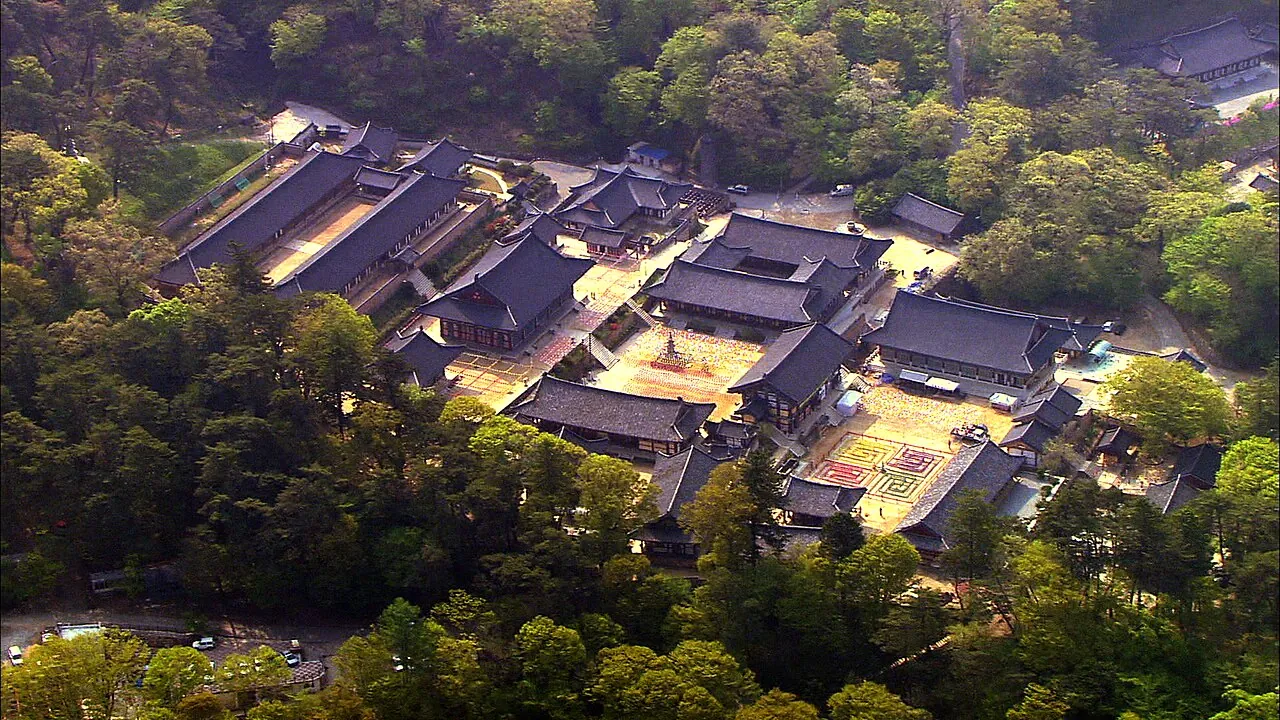
Haeinsa seen from above, its tiled roofs set into the forest of Gayasan National Park.
Photograph: 한국교육방송공사 — opens in a new tab · CC BY 4.0 — opens in a new tab
Changes: Resized and converted to WebP; displayed with responsive crops. · Original photograph and licence details ↗ — opens in a new tab
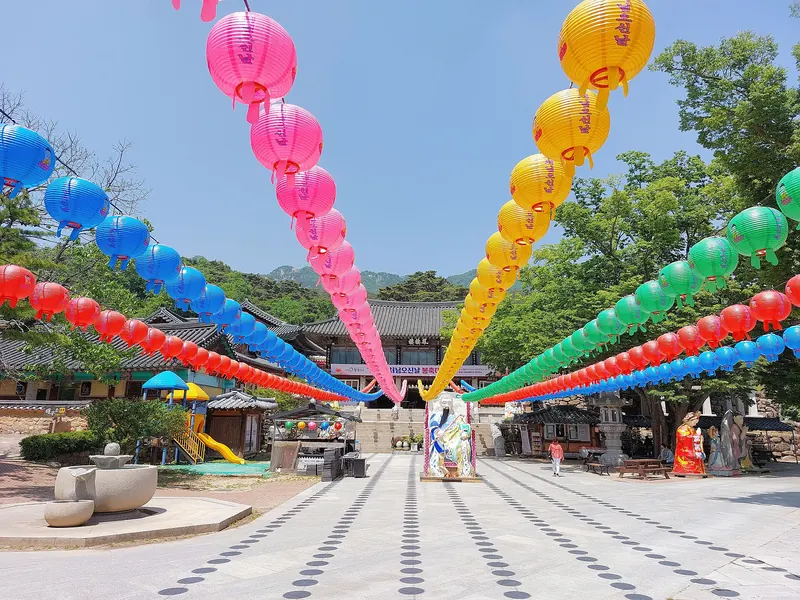
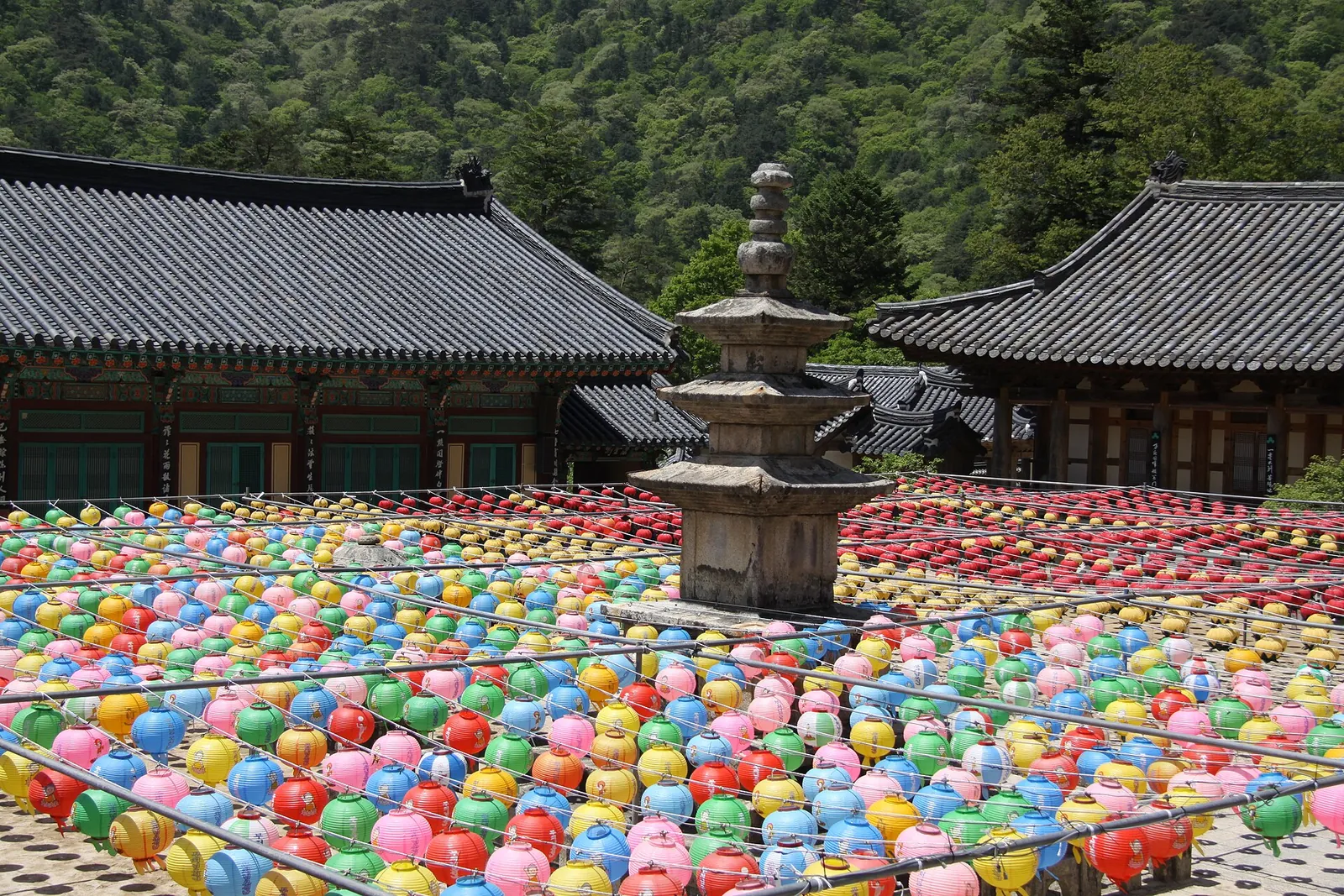
Lanterns fill the courtyard around Haeinsa's stone pagoda for Buddha's Birthday.
Photograph: Kwon jung sik — opens in a new tab · CC BY-SA 4.0 — opens in a new tab
Changes: Resized and converted to WebP; displayed with responsive crops. · Original photograph and licence details ↗ — opens in a new tab
Bibimbap topped with namul, seasoned vegetables and greens; this photo was not taken at Haeinsa.
Photograph: abex (a flickr user) — opens in a new tab · CC BY-SA 2.0 — opens in a new tab
Changes: Resized and converted to WebP; displayed with responsive crops. · Original photograph and licence details ↗ — opens in a new tab