Daegu and North Gyeongsang · North Gyeongsang
Andong and Hahoe Village guide: hanok nights, seowon and mask dance
Andong is the inland city of the Joseon scholar class: clan villages, Confucian academies and a food culture shaped by ancestral rites. Its best-known places, Hahoe Village and the seowon academies, lie well outside the modern city, and most visitors see them in a hurry between buses. The difference between a rushed day and a good one is where you sleep. Stay in a hanok inside Hahoe and you have the village lanes, the riverbank and Buyongdae cliff to yourself in the evening and early morning, after the day visitors have gone.
- Suggested time
- 2 days (1 night); 3 days with Dosanseowon and Bongjeongsa
- Where to stay
- A hanok guesthouse inside Hahoe Village for the overnight; central Andong near the old market for buses, restaurants and the eastern sights
- Season and timing
- Hahoe is open all year, with shorter hours from October to March. The Andong Maskdance Festival runs in late September and early October, and the Hahoe Seonyu Julbul Nori fireworks are held on select Saturdays in May and from August to October.
The short answer
Give Andong two days and one night, and spend that night in a hanok guesthouse inside Hahoe Village. Arrive by KTX-Eum from Seoul or Busan, or by bus from Daegu, take bus 210 or a taxi out to Hahoe, see the afternoon mask dance and Buyongdae, and visit Byeongsanseowon (also on bus 210) the next morning. Sleep in central Andong instead if you want Dosanseowon, Bongjeongsa and Woryeonggyo at night as well, and add a second night.
Why the night in Hahoe is the point
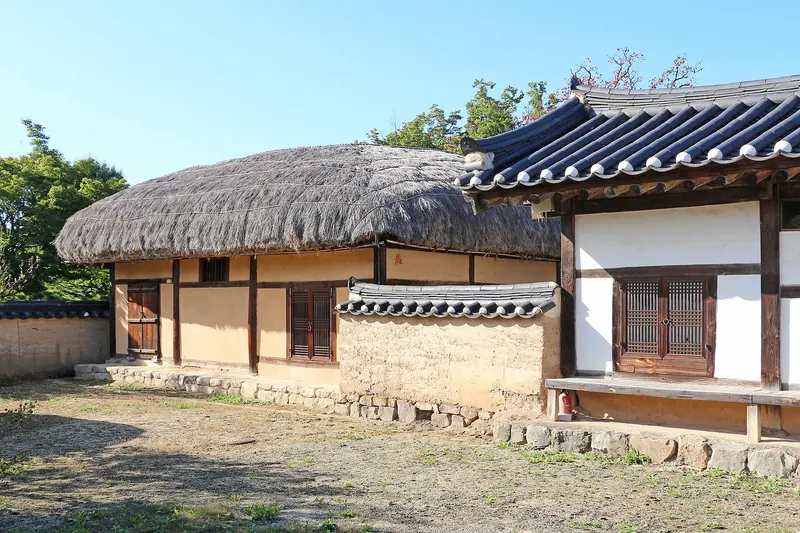
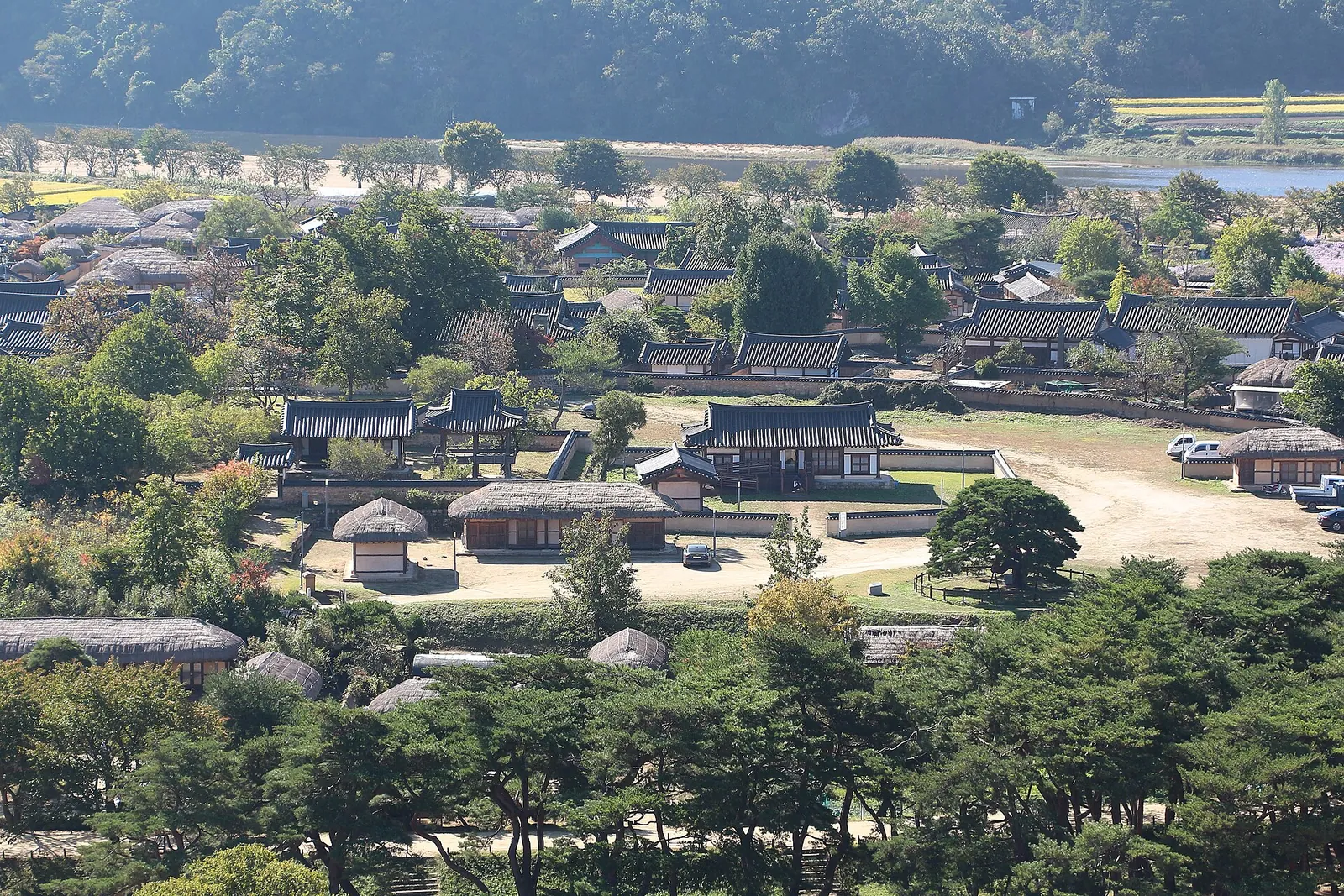
Hahoe is not a museum village. VisitKorea describes it as home to descendants of the Pungsan Ryu clan, who still make up around 70 percent of the villagers, with tile-roofed clan houses and thatched cottages packed inside a broad bend of the Nakdonggang River. It was designated a National Folklore Cultural Heritage in 1984 and is part of a UNESCO World Heritage listing. When we checked on 2026-10-03, VisitKorea listed opening hours of 09:00–18:00 from April to September and 09:00–17:00 from October to March (last admission 30 minutes before closing), and an adult ticket of 5,000 won.
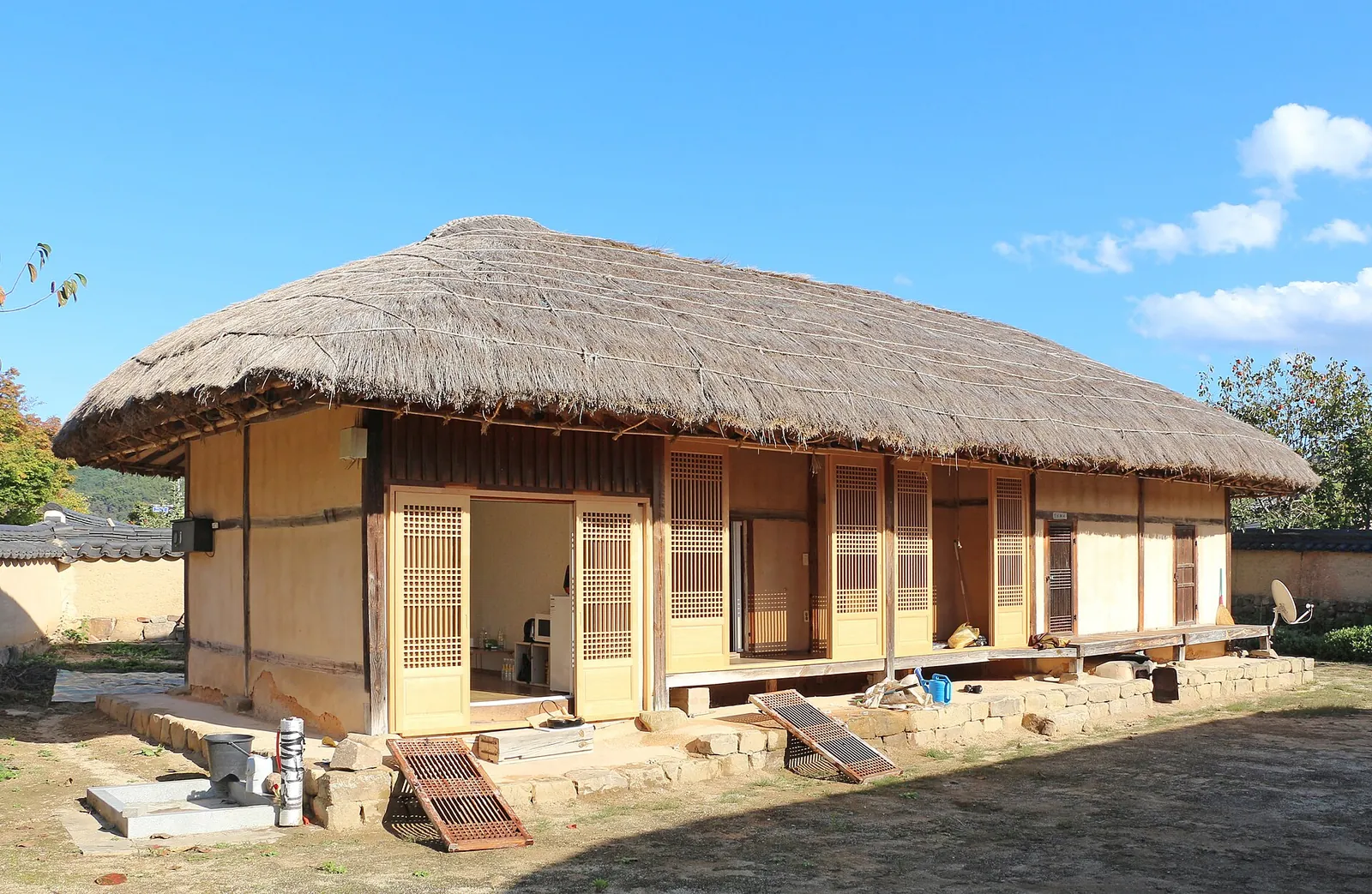
Those hours apply to day visitors. Several of the historic houses take overnight guests: VisitKorea lists Yangjindang, the head house of the Pungsan Ryu clan, Bukchondaek, which it calls the largest house in Hahoe, and Rakkojae, a hanok hotel with a thatched annex inside the village and a main building near the Hahoe Mask Museum. VisitKorea's own Andong guide makes the point plainly: the village's real charm appears after the day-trippers leave. Expect floor bedding, shared courtyards and old houses that people still live in; check bathroom arrangements and whether breakfast is included before you book, as these differ from house to house (Yangjindang's listing, for example, says breakfast is not available).
Central Andong is the practical alternative. It has the bus and train connections, more restaurants and the old market, but Hahoe is roughly half an hour away by road, so a downtown hotel turns the village into a day trip again.
Hahoe Village, Buyongdae and the mask dance
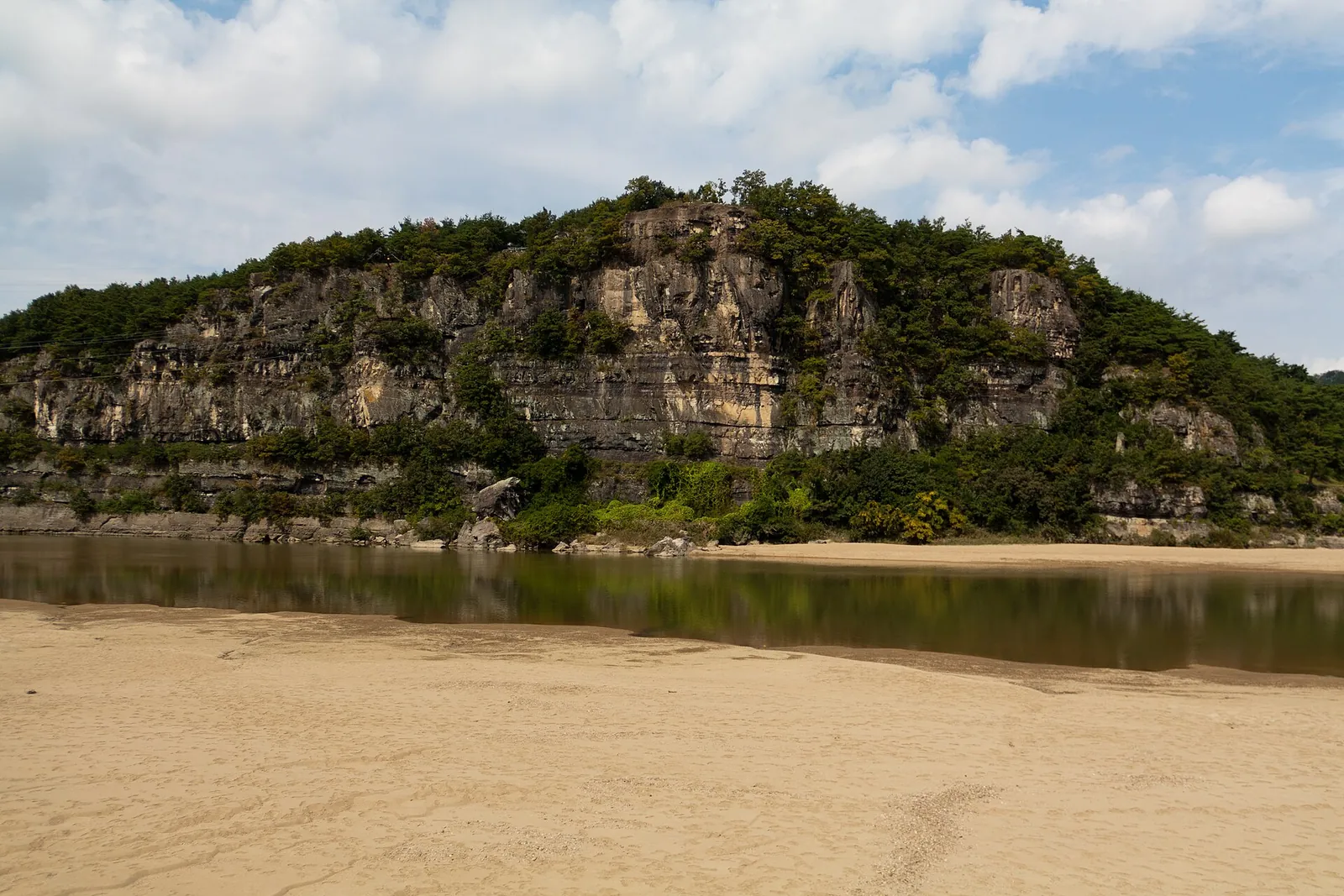
Walk the village lanes first, then cross to Buyongdae, a cliff about 64 metres high on the far bank. VisitKorea says the village's old name means lotus, after the way its houses spread out like a lotus flower, and the top of the cliff is where that shape makes sense. VisitKorea lists a ferry (narutbae) among the cliff's facilities; check at the village whether it is running before you plan the crossing.
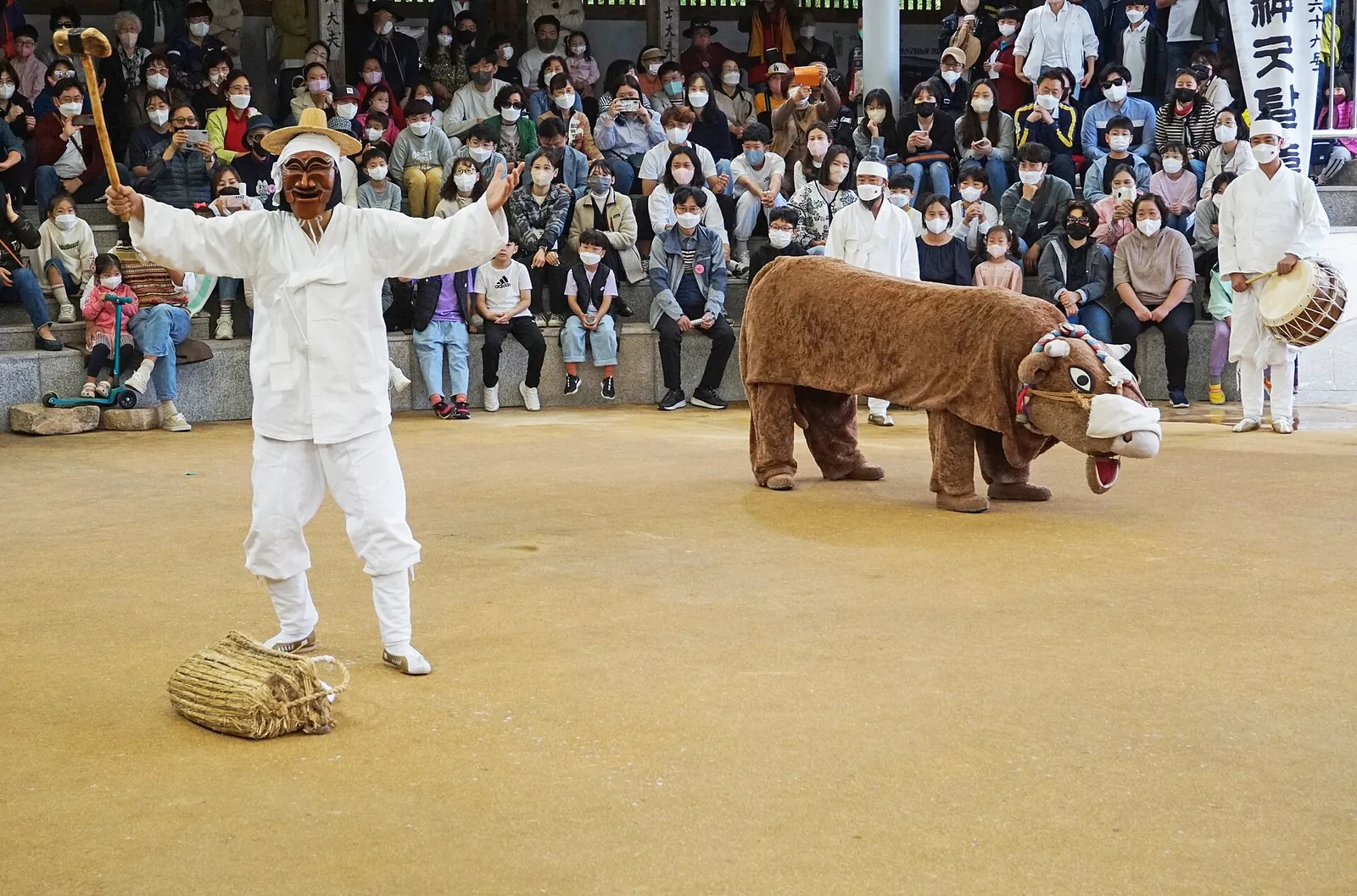
Hahoe Byeolsingut Tallori, the village mask dance drama, has been performed here for around 800 years according to VisitKorea, which notes that its satire of the aristocracy and the clergy is the heart of it and that it was added to UNESCO's Intangible Cultural Heritage list in 2022 as part of Korea's mask dance dramas. When we checked on 2026-10-03, VisitKorea's Andong guide listed a regular performance at the Hahoe Village Mask Dance Theater at 14:00 from Tuesday to Sunday, closed on Mondays. A day trip that arrives late in the afternoon misses it; an overnight stay lets you see it and still have the evening.
The Hahoe Mask Museum, by the village entrance, shows Hahoe masks alongside masks from around the world; VisitKorea listed it as free, open 09:30–18:00 and closed on 1 January, Seollal and Chuseok. If you are in Andong on one of the Seonyu Julbul Nori nights, VisitKorea says the traditional fireworks are held on select Saturdays in May and from August to October, with embers falling from ropes strung from Buyongdae over the river; it recommends booking online a month ahead, with a limited number of same-day tickets from 13:00 at the Hahoe ticket office.
Make time for the local food
What to eat and where to look
Andong jjimdak (braised chicken)
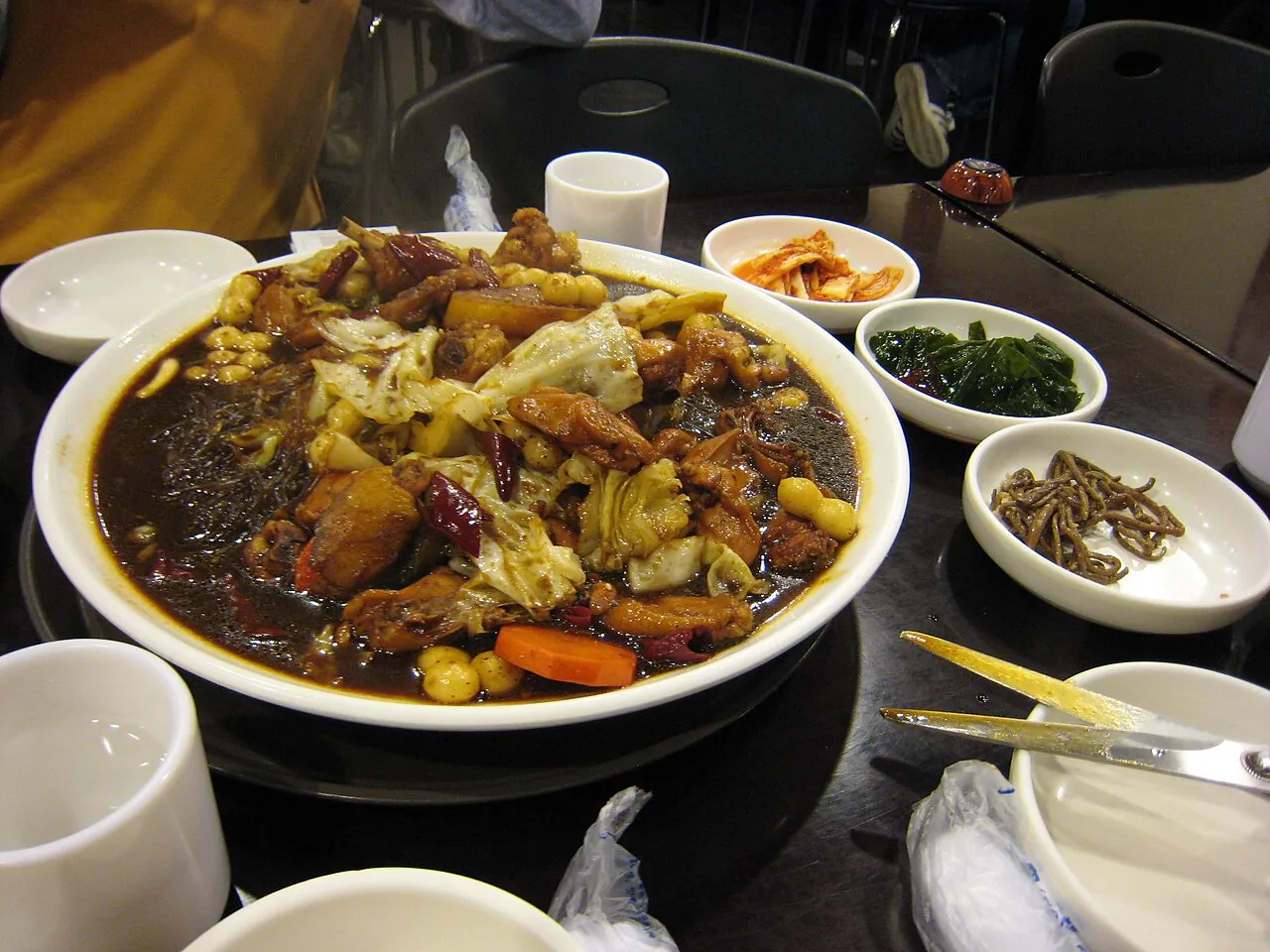
Chicken, glass noodles and vegetables braised in a sweet, savoury and mildly spicy soy-based sauce. VisitKorea traces it to the chicken alley of Andong's old market, where merchants adapted the seasoning of braised galbi; the Digital Andong Culture Encyclopedia calls it a modern fusion dish rather than an old tradition.
- Where to look
- Jjimdak Alley in Andong Old Market (30 Beonyeong-gil), where VisitKorea counts about 30 restaurants.
- Fit it into your day
- Lunch or dinner in central Andong for two or more; VisitKorea notes it is normally cooked as a whole-chicken dish for two to three people rather than as a single portion.
Usually cooked with red chilli and can be spicier than it looks; ask for it milder if needed. The alley is busy at weekends.
Heotjesabap ("fake ancestral-rite meal")
The dishes of a Confucian ancestral-rite table served without the rite: rice with namul vegetables, jeon pancakes, grilled fish and skewers, mixed with soy sauce rather than chilli paste and served with a clear soup. The Digital Andong Culture Encyclopedia explains that it recreates the custom of mixing leftover rite food into bibimbap, and that the restaurant version dates from the late 1970s.
- Where to look
- Restaurants on Seokju-ro near Woryeonggyo; VisitKorea lists Heotjesabap Kkachi Gumeongjip (203 Seokju-ro) and Heotjesabap (201 Seokju-ro), both open 11:00–20:00 when we checked on 2026-10-03.
- Fit it into your day
- Dinner after a dusk walk on Woryeonggyo.
The flavours are deliberately plain; the set usually includes fish, and versions vary by restaurant.
Andong gangodeungeo (salted mackerel)
Mackerel salted to survive the journey inland from the coast, then grilled until crisp outside and moist within. VisitKorea says the fish once took two days to reach Andong from Ganggu port in Yeongdeok.
- Where to look
- Korean set-meal restaurants across Andong, and some heotjesabap restaurants, which serve it alongside.
- Fit it into your day
- An easy lunch for one: VisitKorea notes that many restaurants serve a salted-mackerel set for a single diner.
It is salty by design; eat it with plenty of rice.
Andong guksi and Andong soju
Andong guksi are soft noodles made from wheat flour and soybean powder, with a mild flavour. Andong soju is the city's distilled spirit, which VisitKorea describes as over 40 percent alcohol by volume; the Andong Soju & Traditional Food Museum covers its history.
- Where to look
- Noodle restaurants in central Andong; soju in shops and restaurants across the city.
- Fit it into your day
- Noodles for a light lunch; soju in small measures with dinner.
Andong soju is far stronger than the green-bottle soju sold across Korea.
Byeongsanseowon: the academy framed by the river
Byeongsanseowon is the reason to stay out at Hahoe rather than return to town. VisitKorea's history says the scholar Yu Seong-nyong (Seoae) moved the school here in 1572, and it took the name Byeongsanseowon in 1614. Its setting is the point: the Nakdonggang in front, Byeongsan (Hwasan) Mountain behind, the arrangement Korean geomancy considered ideal. VisitKorea's market feature describes sitting on the floor of Ipgyodang, the lecture hall, and watching the river and mountain framed by the pillars of Mandaeru pavilion, and a grove of about 120 crape myrtles that flower red from summer into early autumn.
Bus 210 serves both Hahoe and Byeongsanseowon, according to VisitKorea's Andong guide, so the two can share a morning without a car. Come early, before tour groups. The academy is a quiet place of study; keep voices down. VisitKorea's feature listed hours of 09:00–18:00 in summer and 09:00–17:00 in winter.
Dosanseowon, Bongjeongsa and Woryeonggyo: the second day
Dosanseowon is tied to Toegye Yi Hwang, the scholar on the 1,000-won note. VisitKorea says the lecture hall Dosanseodang, which Yi Hwang designed himself and built in 1561, is the oldest building on the site, and the academy his followers built to honour him received a royal charter in 1575 and was completed in 1576. When we checked on 2026-10-03, VisitKorea listed opening hours of 09:00–18:00 in summer and 09:00–17:00 in winter, and an adult fee of 2,000 won. Its guide lists Express 3 and bus 512 to the academy.
Bongjeongsa, also a UNESCO site, holds Geungnakjeon Hall, which VisitKorea describes as Korea's oldest surviving wooden building; buses Express 2 and 310 run there. Manhyujeong pavilion, known for its narrow wooden bridge from the drama *Mr. Sunshine*, is on bus 610.
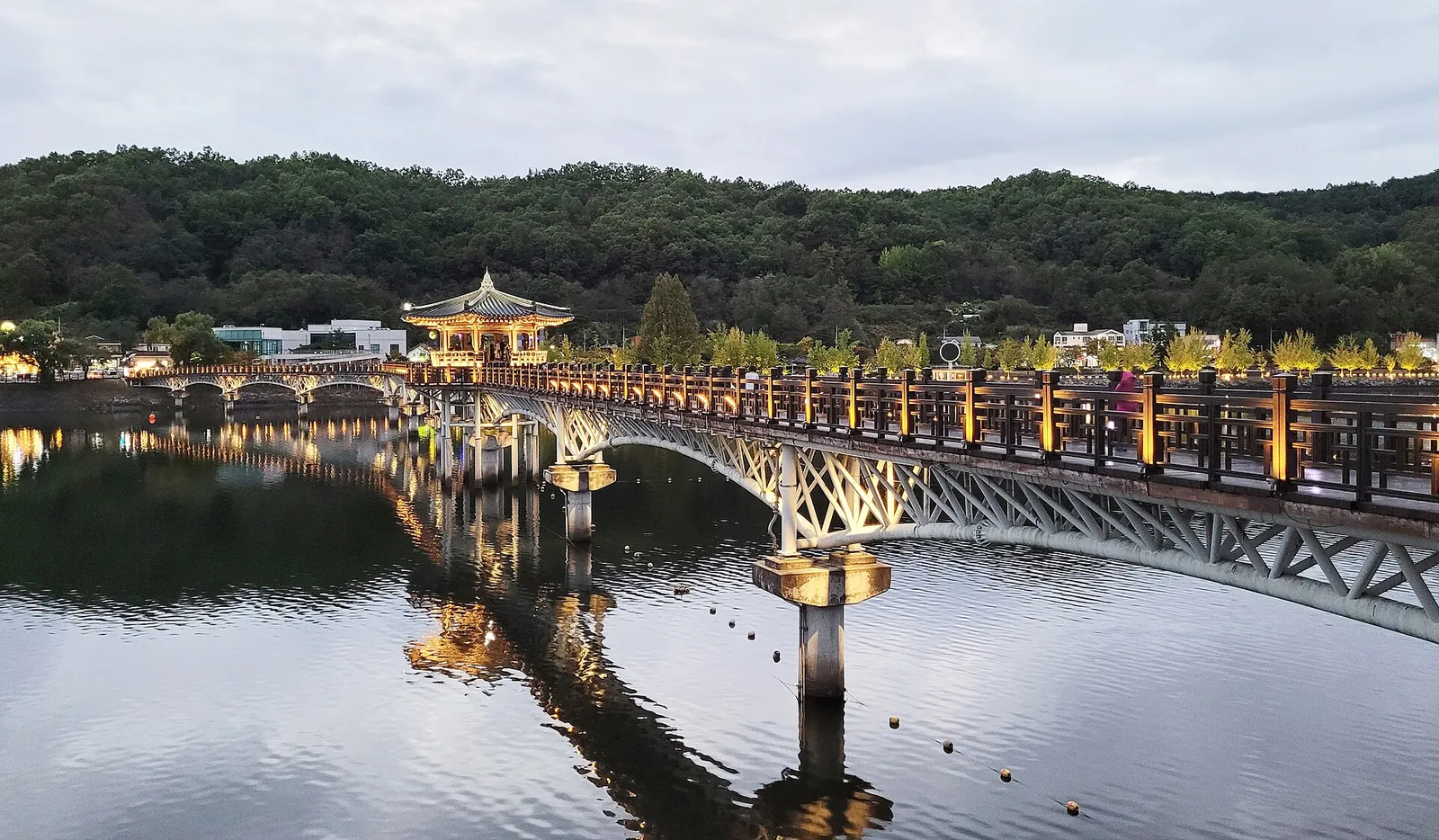
End the day at Woryeonggyo, the wooden footbridge on the city's edge that VisitKorea calls Korea's longest wooden pedestrian bridge and that is lit after dark; bus 112 goes there, and it is open around the clock. The Andong-style restaurants on nearby Seokju-ro make it a natural place for dinner.
VisitKorea's own advice matches ours: Hahoe, Byeongsanseowon and Woryeonggyo can be done in a day, but Dosanseowon, Bongjeongsa and Manhyujeong are spread out and justify an overnight stay. We could not verify bus frequencies to the outlying sights; check routes on Andong's bus information system before you rely on a return bus, or use a taxi.
Getting there and getting around without a car
VisitKorea's Andong guide gives about 1 hour 50 minutes by KTX-Eum from Seoul Station, Cheongnyangni or Sangbong to Andong Station, and about 1 hour 40 minutes from Busan's Bujeon station. From Daegu, it lists a Mugunghwa train from Dongdaegu or an intercity bus to Andong Bus Terminal, about 1 hour 20 minutes. Express and intercity buses also run from Seoul Express Bus Terminal and Dong Seoul Terminal. Check current times with Korail and the bus operators before you travel.
Local buses reach the main sights: Express 2, 210, Pungcheon 2 and the Hahoe shuttle for Hahoe; 210 for Byeongsanseowon. The other option is the city's Andong Tourist Taxi: when we checked on 2026-10-03, VisitKorea listed 125,000 won for a four-seat car for up to five hours within a 10-km radius of Andong Station, with a 2026 discount that may end when funding runs out. VisitKorea also says free guided commentary in English, Japanese and Chinese can be booked at major sites such as Hahoe and Dosanseowon.
A workable two-day plan
This is an editorial suggestion, not a timetable. Check performance days and bus times before you go.
- Day 1 — Into Hahoe: arrive in Andong in the morning, take bus 210 or a taxi to Hahoe, see the 14:00 mask dance (not on Mondays), walk the village and Buyongdae, and sleep in a village hanok.
- Day 2 — Byeongsanseowon and the city: the academy early, back to central Andong for jjimdak at the old market, then Woryeonggyo at dusk and heotjesabap on Seokju-ro.
- Day 3 (optional): Dosanseowon and Bongjeongsa, or continue north to Yeongju or east to Cheongsong.
Practical questions
Is a day trip to Andong enough?
A day covers Hahoe Village, Byeongsanseowon and Woryeonggyo if you start early. Stay overnight, ideally in Hahoe, to see the village after the day visitors leave, or if you also want Dosanseowon, Bongjeongsa and Manhyujeong, which are spread out across the city.
Can I stay overnight inside Hahoe Village?
Yes. VisitKorea lists hanok stays in historic houses such as Yangjindang and Bukchondaek, and the Rakkojae hanok hotel with an annex inside the village. Rooms, bathrooms and breakfast vary by house, so check before you book.
When is the Hahoe mask dance performed?
When we checked on 2026-10-03, VisitKorea listed the regular Hahoe Byeolsingut Tallori performance at the Hahoe Village Mask Dance Theater at 14:00 from Tuesday to Sunday, with no show on Mondays.
How do I get from Andong to Hahoe Village without a car?
VisitKorea lists buses Express 2, 210 and Pungcheon 2 and the Hahoe shuttle bus. Bus 210 also serves Byeongsanseowon. Taxis and the city's bookable tourist taxi are the alternative.
When is the Andong Maskdance Festival?
VisitKorea listed the 2026 festival from 24 September to 4 October, at Jungang Line 1942 Andong Station (the former station), Mask Dance Park and the old downtown, with free entry and charges for some programmes. Dates change each year; check the festival's official site.
Can I order Andong jjimdak on my own?
It is normally cooked as a whole chicken for two to three people. Solo travellers will find a salted-mackerel set meal easier to order.
Sources and checks before you travel
Reference sources for the version dated 3 October 2026. Confirm opening times, access, transport and conditions for your travel dates.
- VisitKorea: Andong Travel Guide (updated May 2026) ↗ — opens in a new tab
- VisitKorea: Andong Hahoe Village [UNESCO World Heritage] ↗ — opens in a new tab
- VisitKorea: Byeongsanseowon Confucian Academy [UNESCO World Heritage] ↗ — opens in a new tab
- VisitKorea: Andong Old Market Union (Traditional Markets feature) ↗ — opens in a new tab
- VisitKorea: Dosanseowon Confucian Academy [UNESCO World Heritage] ↗ — opens in a new tab
- VisitKorea: Hahoe Byeolsingut Tallori (Mask Dance Drama of Hahoe) ↗ — opens in a new tab
- VisitKorea: Hahoe Mask Museum ↗ — opens in a new tab
- VisitKorea: Buyongdae Cliff ↗ — opens in a new tab
- VisitKorea: Woryeonggyo Bridge ↗ — opens in a new tab
- VisitKorea: Andong Maskdance Festival ↗ — opens in a new tab
- VisitKorea: Andong Market Jjimdak Alley ↗ — opens in a new tab
- VisitKorea: Heotjesabap Kkachi Gumeongjip ↗ — opens in a new tab
- VisitKorea: Heotjesabap (restaurant) ↗ — opens in a new tab
- Digital Andong Culture Encyclopedia (Academy of Korean Studies): Andong food ↗ — opens in a new tab
- VisitKorea: Yangjindang, Bukchondaek and RakKoJae Andong (accommodation listings) ↗ — opens in a new tab
- VisitKorea: Fly to Daegu International Airport and explore Daegu & Gyeongsangbuk-do ↗ — opens in a new tab
- VisitKorea: Express Bus & Intercity Bus ↗ — opens in a new tab
- VisitKorea: Andong Soju & Traditional Food Museum ↗ — opens in a new tab
Does this experience fit your route?
If you only have a day from Seoul, a guided trip to Hahoe saves working out buses. If you can stay a night, the train and a village hanok usually give you more.
Check dates and details on Viator ↗ — opens in a new tabAffiliate link · Book with ViatorPhoto credits
Hahoe Village from above: tiled yangban houses and thatched cottages packed inside the river bend
Photograph: Bernard Gagnon — opens in a new tab · CC0 — opens in a new tab
Changes: Resized and converted to WebP; displayed with responsive crops. · Original photograph and licence details ↗ — opens in a new tab
One of Hahoe's thatched-roof houses, the homes that sit alongside the tiled clan residences
Photograph: Bernard Gagnon — opens in a new tab · CC0 — opens in a new tab
Changes: Resized and converted to WebP; displayed with responsive crops. · Original photograph and licence details ↗ — opens in a new tab
Andong jjimdak: chicken, glass noodles and vegetables braised in a soy-based sauce, served for sharing
Photograph: karendotcom127 — opens in a new tab · CC BY 2.0 — opens in a new tab
Changes: Resized and converted to WebP; displayed with responsive crops. · Original photograph and licence details ↗ — opens in a new tab
Hahoe Byeolsingut Tallori at the mask dance theatre in Hahoe Village
Photograph: Bernard Gagnon — opens in a new tab · CC0 — opens in a new tab
Changes: Resized and converted to WebP; displayed with responsive crops. · Original photograph and licence details ↗ — opens in a new tab
Buyongdae cliff across the Nakdonggang River from Hahoe Village
Photograph: Own work — opens in a new tab · CC BY-SA 3.0 — opens in a new tab
Changes: Resized and converted to WebP; displayed with responsive crops. · Original photograph and licence details ↗ — opens in a new tab
Woryeonggyo, the wooden footbridge across the water on the edge of central Andong
Photograph: Bernard Gagnon — opens in a new tab · CC0 — opens in a new tab
Changes: Resized and converted to WebP; displayed with responsive crops. · Original photograph and licence details ↗ — opens in a new tab