Sulawesi · South Sulawesi
Rammang-Rammang guide: karst river boat, Leang-Leang cave art, stays
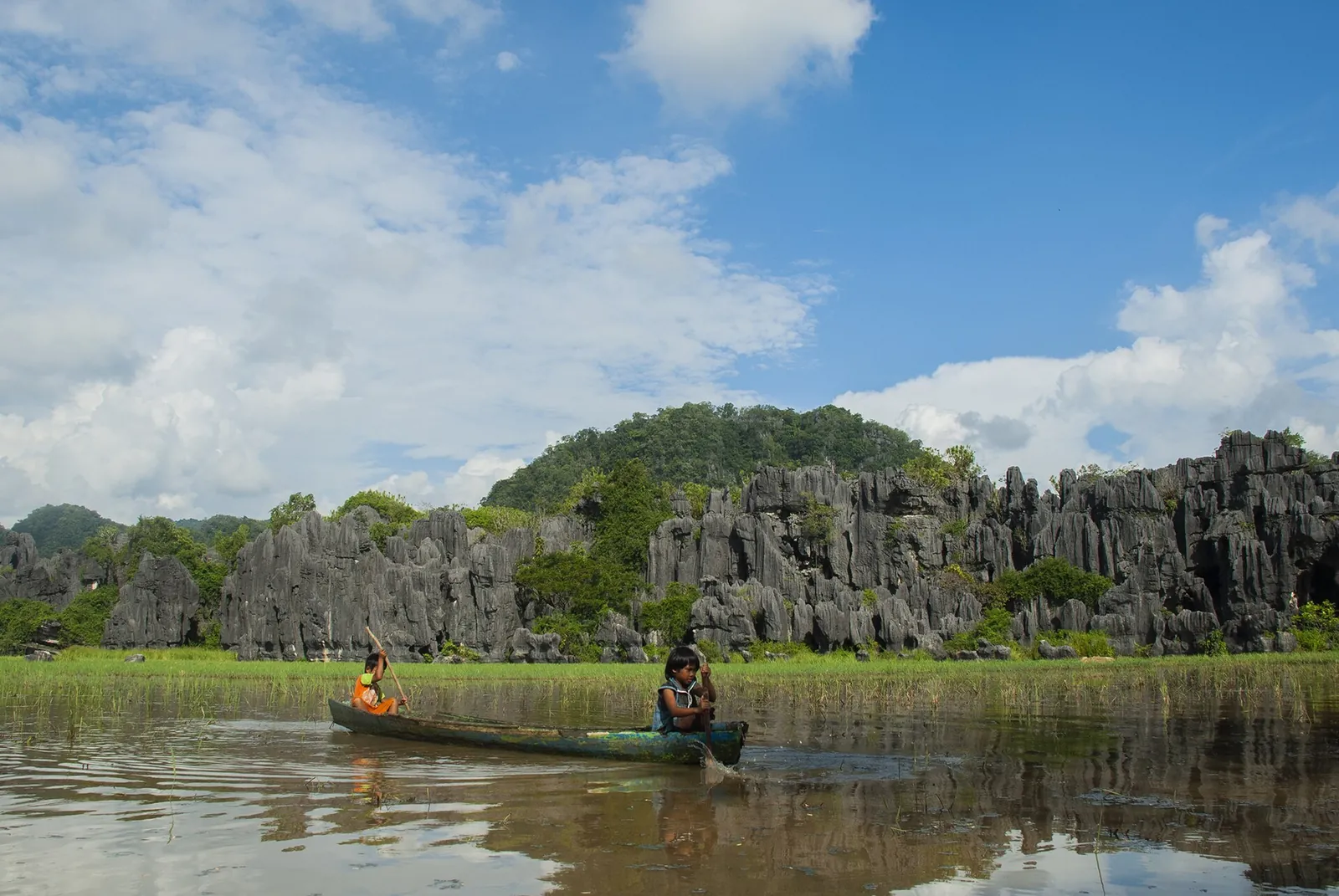
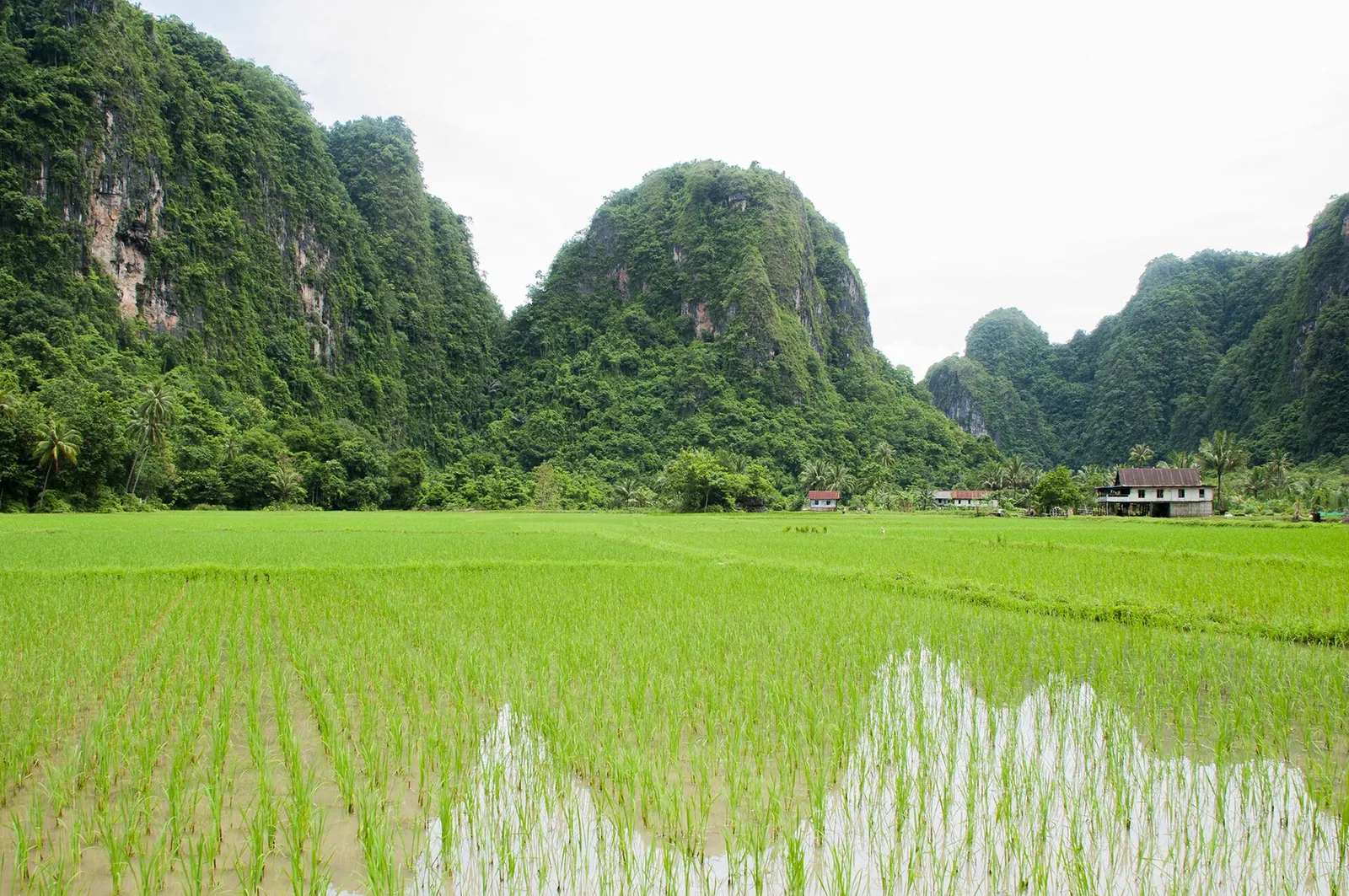
Rammang-Rammang is a community-run tourism village in Salenrang, Bontoa district, Maros Regency, about an hour's drive north of Makassar's airport. Limestone towers rise straight out of rice fields, fish ponds and a nipah-lined river, and a small boat takes you upstream to Kampung Berua, a hamlet enclosed by the cliffs. The name means cloud or mist in Makassarese, and the place is at its best early in the morning, when the haze still hangs in the valley. It sits inside the Maros Pangkep UNESCO Global Geopark, whose caves hold some of the oldest dated rock art in the world — and the Leang-Leang archaeological park is only a short drive away.
- Suggested time
- 1 day, ideally with 1 night in the village
- Where to stay
- A homestay or the eco-lodge at Rammang-Rammang (Dermaga 2, Salenrang); Makassar for more choice
- Season and timing
- Come early in the day: the Ministry of Tourism says the karst is most dramatic in the morning or after rain, when mist covers the valley — the origin of the village's name. We could not find an official month-by-month weather guide for Maros, so check the forecast and expect heat and strong sun by late morning on the open river and paddy paths.
The short answer
Give it one full day, or better, one night. Sleep in a homestay or the eco-lodge by Dermaga 2 so you can take the boat in the morning mist; otherwise leave Makassar early. Do the boat ride to Kampung Berua, walk the paddy dikes to the Kingkong stone or up to Padang Ammarung, and have a village lunch. In the afternoon drive about 6 km to the Leang-Leang archaeological park for the cave art, and if time is left, about 7 km more to Bantimurung's waterfall and butterflies — the same one-day circuit Maros Regency itself promotes. Fly into Makassar (UPG) and hire a car with driver.
Day trip from Makassar or a night in the village
Rammang-Rammang is close enough to Makassar for a day trip. The Ministry of Tourism puts it 32 kilometres, about an hour's drive, from Sultan Hasanuddin International Airport, and the ministry's village-tourism portal gives about 30 minutes. From central Makassar, allow extra time for city traffic on top of that.
The reason to sleep in the village is the light. The ministry describes the karst as most dramatic in the morning or after rain, when mist hangs over the fields, and it calls the morning a favourite time for photographs. By the time a day-tripper from Makassar has reached the jetty, much of that has usually burnt off and the open river is bright and hot. One night lets you take the boat early, walk before the heat and leave the afternoon for Leang-Leang.
Accommodation is simple and run by local people. The ministry's village portal lists several homestays — among them Homestay Ammarrung on the hill above Kampung Berua and lodgings at Dermaga 2 — and an eco-lodge by the river at Dermaga 2, built of wood with a rumbia-thatch roof in a mix of Sasak (Lombok) and Bugis styles. Book directly or through a platform before you go, and confirm the exact jetty: Dermaga 1 and Dermaga 2 are different starting points. If you want a conventional hotel, the regency itself suggests the hotel at Bantimurung, or stay in Makassar.
The jolloro boat to Kampung Berua
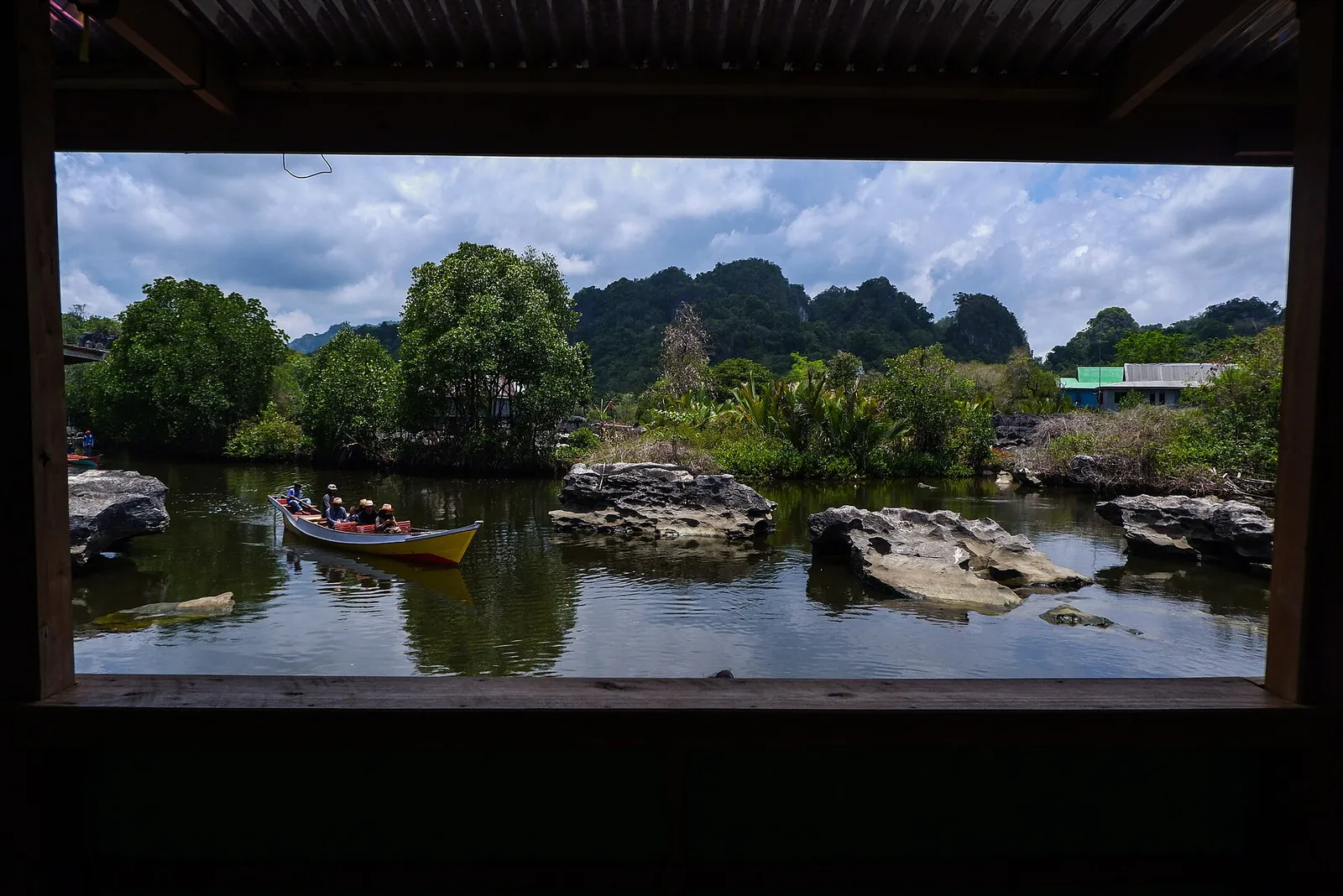
The core of a visit is the boat. Narrow motorised boats called jolloro leave from Dermaga 1 or Dermaga 2 and follow the river (the English version of the ministry's article calls it the Pute River) upstream between banks of nipah palm and mangrove, through gaps in the karst and past rock formations locals call sosokeng and sepa'labbua. The boat is also the main way in to Kampung Berua, a settlement of farmers and fish-pond keepers in a basin ringed by cliffs.
Boats are hired per boat, not per seat. An older English version of the ministry's article quoted around IDR 250,000 for a boat taking six to eight people from Dermaga II to Kampung Berua; when we checked on 2026-10-03, the current Indonesian version of the same article gave no fare at all. Treat that figure as a guide only, agree the price, the stops and the waiting time at the jetty before you set off, and carry cash.
Sit low, keep cameras and phones in a dry bag and bring a hat: there is little shade on the water. The village is a working community, and the ministry's own visiting advice is to ask your guide what is and is not appropriate, greet people, keep litter with you and ask before photographing homes or picking plants.
Make time for the local food
What to eat and where to look
Sayur pappa
A local vegetable dish that, according to the Ministry of Tourism, is often served to visitors as lunch in Rammang-Rammang.
- Where to look
- Village kitchens and stalls in Kampung Berua; ask your homestay or boatman to arrange it.
- Fit it into your day
- Lunch in Kampung Berua after the morning boat and walk.
Village meals are cooked to order; arrange it in the morning and ask about ingredients if you avoid fish or meat.
Nipah juice and fish crackers
Jus buah nipah, made from the fruit of the nipah palms that line the river, and keripik mujair, crisp chips of tilapia from the villagers' fish ponds, are both village products, the ministry says.
- Where to look
- Stalls at the jetties and in Kampung Berua and Kampung Laku.
- Fit it into your day
- A drink on the boat stop and crackers to take home.
Keep the crackers' packaging away from the river; take your litter back with you.
Café food by the river
The village portal points hungry visitors to a riverside café near Dermaga 2 for simple dishes such as nasi goreng, avocado juice and fried banana with cheese.
- Where to look
- On the river bank on the way back to Dermaga 2.
- Fit it into your day
- A quick lunch if you are heading on to Leang-Leang.
Menus and opening times are informal; do not count on a late dinner without asking your homestay.
Coto Makassar and other Makassar dishes
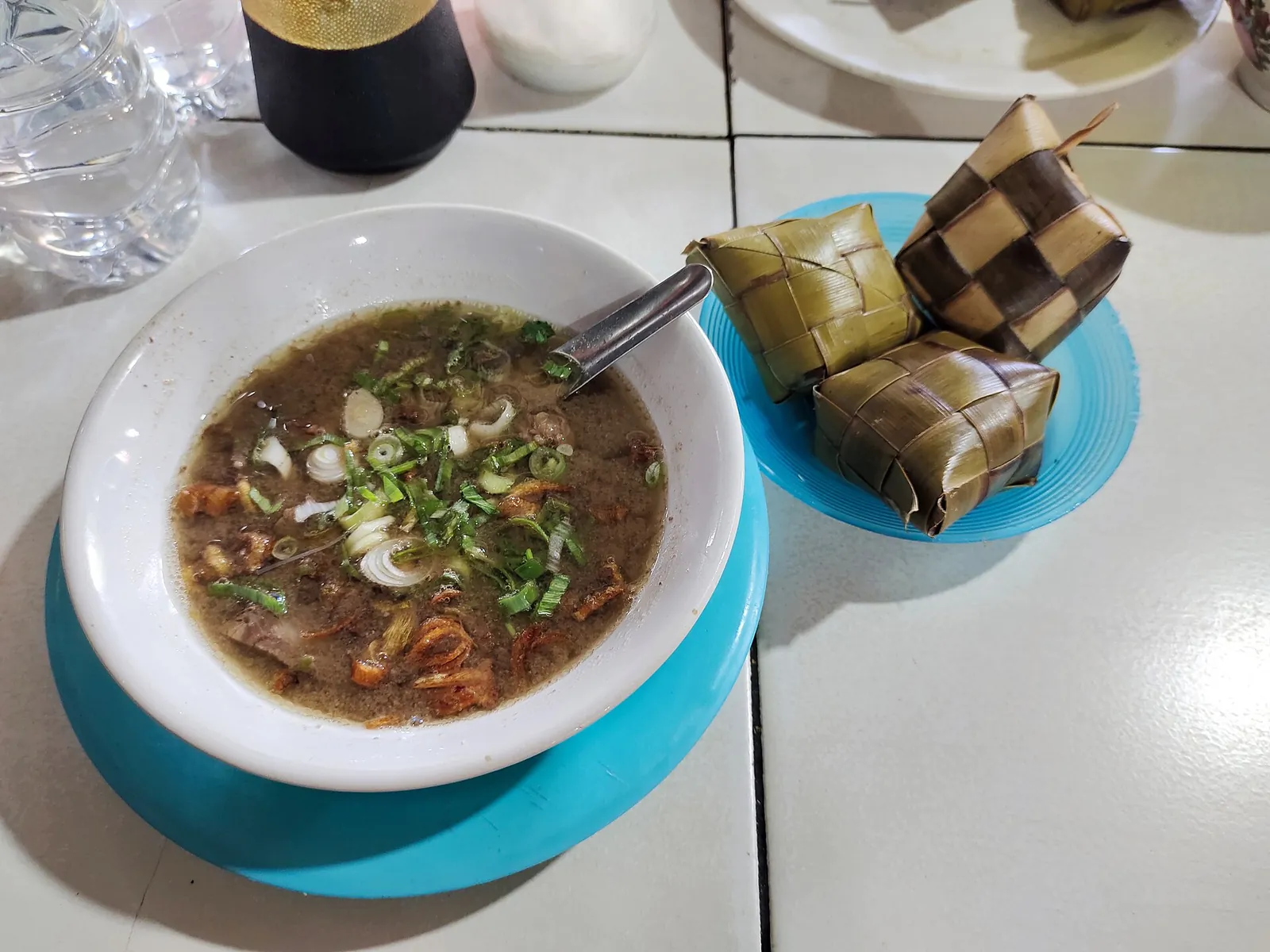
Back in the city, the Ministry of Tourism recommends coto Makassar (a rich beef soup), pallubasa, sop konro and the sweet es pisang ijo, with jalangkote pastries as a snack.
- Where to look
- Long-running coto and konro restaurants in Makassar.
- Fit it into your day
- Dinner in Makassar on the evening of a day trip.
Coto and pallubasa are made with beef and offal; ask for meat only if you prefer.
Walks from Kampung Berua: Kingkong stone, Padang Ammarung and the caves
Kampung Berua is the starting point for short walks along the raised edges of the rice fields. About ten minutes on foot from the jetty, the ministry says, is a limestone face that looks like a giant ape's head, known as the Kingkong stone. The site is also called Situs Pasaung Kingkong Stone, and the ministry's village portal notes red prehistoric hand stencils still visible on the cave wall there — a first, small taste of the rock art the wider karst is famous for.
For the view over the whole basin, walk out to Padang Ammarung, a level plain on top of a karst hill. The ministry describes the route as paddy dikes, a small bridge and then a scramble up rock to the top, where residents keep small huts for visitors to rest in. Wear shoes with grip; the limestone is sharp and slippery after rain.
Gua Berlian (Leang Berlian, the 'diamond cave') in Kampung Berua has stalactites and stalagmites that glitter when light reaches them; the ministry suggests about 15:00–17:00 local time as the best time to see the effect, with a local guide explaining how the formations grew. A similar cave, Gua Kunang-Kunang ('firefly cave'), is at Dermaga 2. Do not touch the formations: the village asks visitors not to, because handling stops them growing.
Beyond Berua, the portal describes Kampung Laku, with the stone labyrinth, the Hutan Batu (stone forest) and a stone garden, and Kampung Massaloeng, a culture hamlet where traditional arts such as anggaru, akkacapi and ammanca are kept up. Ask in the village which of these can be fitted into your day.
Leang-Leang: the cave-art half of the day
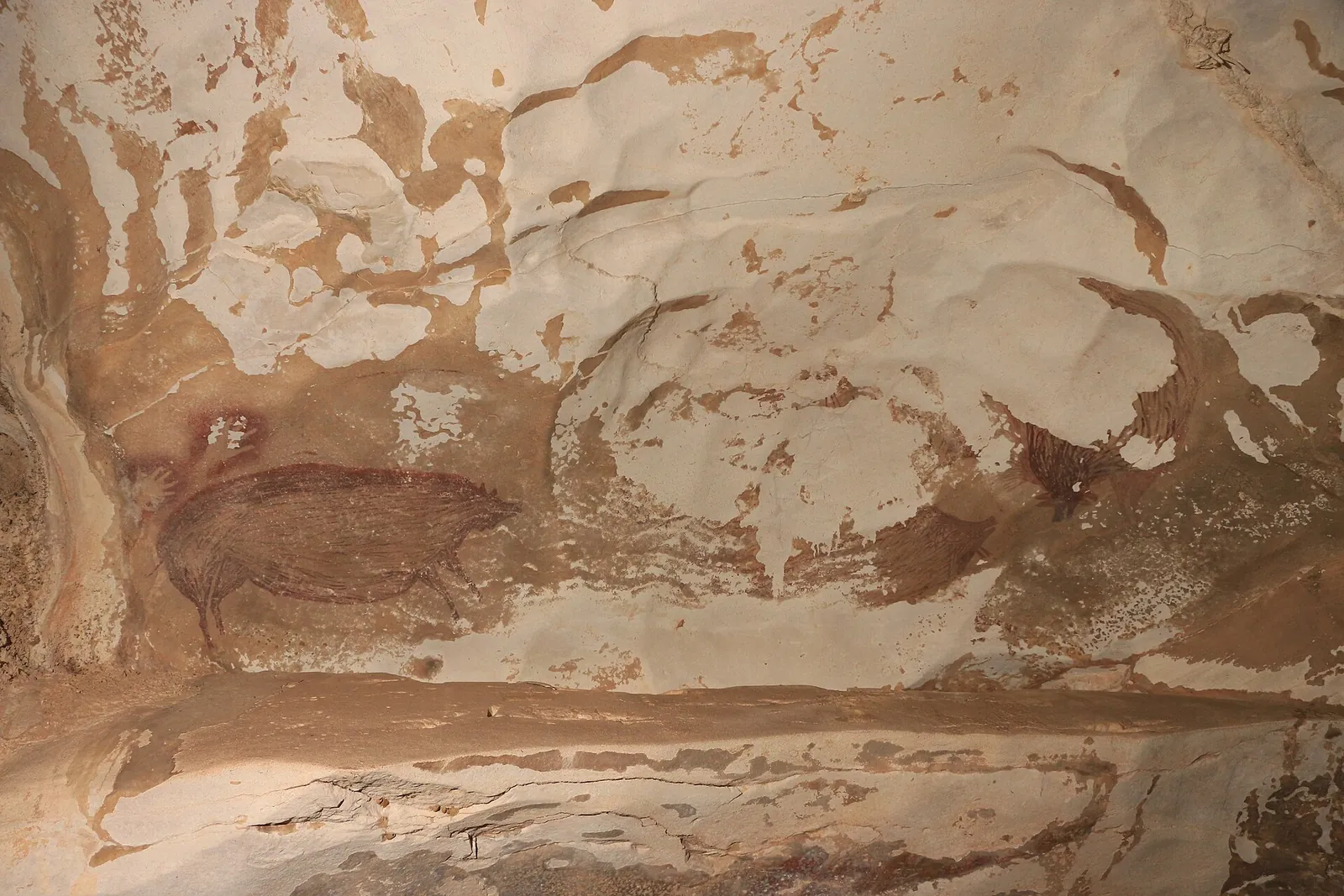
The Maros karst is one of the most important places in the world for early art. In 2014, researchers publishing in Nature dated a hand stencil in Leang Timpuseng, in the Maros karst, to at least 39,900 years ago — then the oldest known hand stencil anywhere — and the Ministry of Tourism cites the same age. The UNESCO geopark page names a painting of pigs at Leang Tedongnge, at least 45,500 years old, as its oldest find. In 2024 a Nature paper dated a scene of human-like figures with a pig at Leang Karampuang to at least 51,200 years ago, which the authors describe as the earliest known surviving example of representational art and visual storytelling.
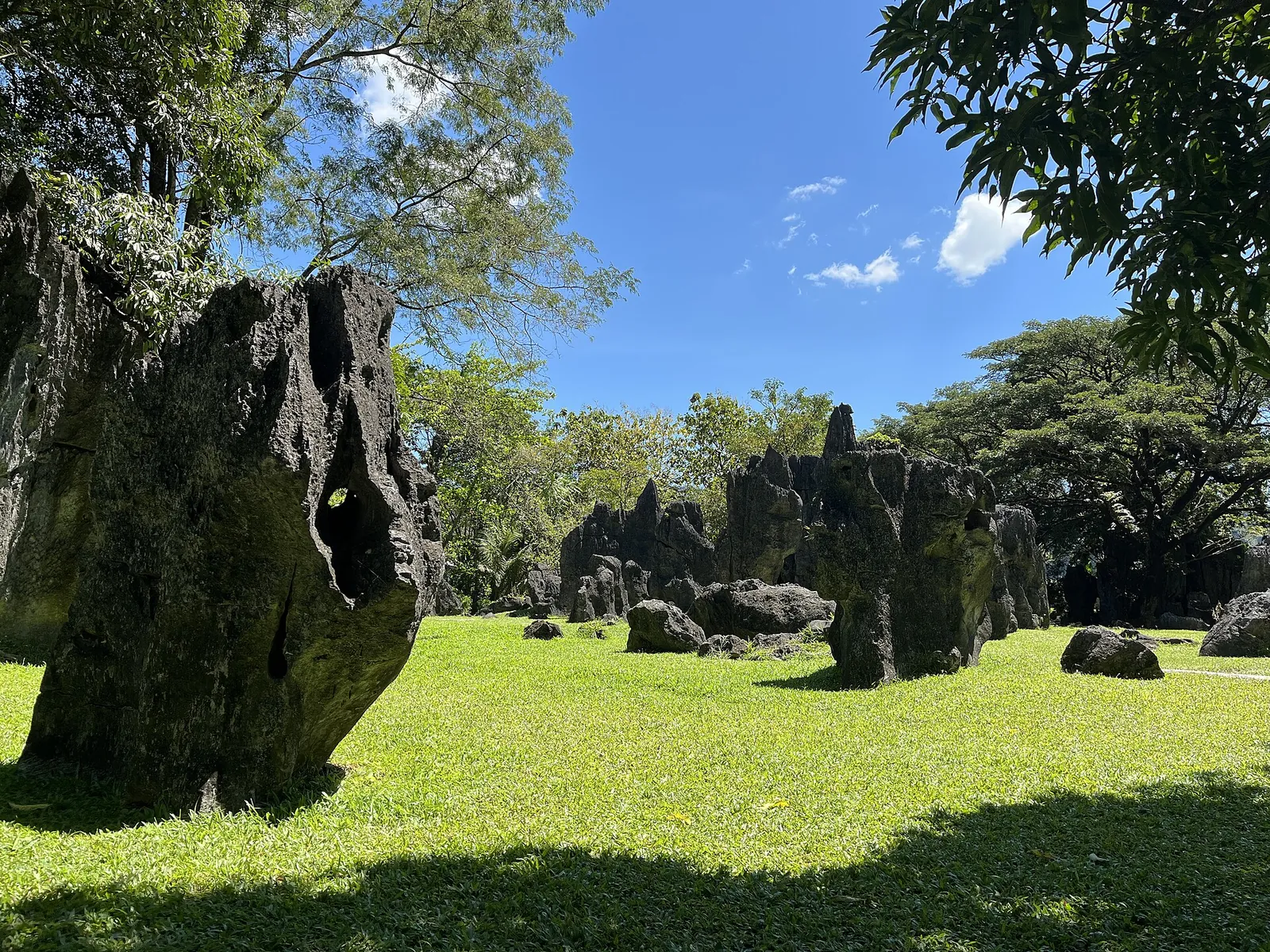
Those dated caves are research sites, and we could not confirm public access to them. For visitors, the place to go is the Leang-Leang Archaeological Park (Taman Arkeologi Leang-Leang, formerly Taman Purbakala Leang-Leang) in Bantimurung district. Maros Regency gives the distance from Rammang-Rammang as about 6 km, and the Ministry of Tourism describes Leang-Leang as a complex of prehistoric caves among karst hills, with some of the world's oldest figurative art on the walls. The park itself, with limestone pinnacles standing on lawns, is a pleasant stop even before you reach the paintings.
Painted cave walls are fragile. Stay behind barriers, never touch the art, do not use flash and follow the site staff. We could not find current official opening hours or ticket prices for the park, so check locally on the day.
Adding Bantimurung and the wider geopark
Maros Regency's own one-day circuit runs Rammang-Rammang, then Leang-Leang, then Bantimurung, about 7 km further. Bantimurung is the best-known part of the Bantimurung-Bulusaraung National Park, which the Ministry of Tourism puts at about 43,750 hectares of karst, lowland forest and lower montane forest. Its waterfall is about 15 metres high and 20 metres wide, there is a butterfly breeding centre and butterfly museum, and Goa Mimpi, the 'dream cave', is known for its stalactites and stalagmites. The ministry notes that it is a favourite weekend outing, so go on a weekday if you can.
All of this sits inside the Maros Pangkep UNESCO Global Geopark, designated in 2023. UNESCO gives its area as 5,077.25 km², more than half of it sea, and counts 572 caves in the karst. Official descriptions of how big the karst is do not agree — the ministry's English pages call it the second-largest karst area in the world after South China, while the current Indonesian village article says third after South China and Vietnam — so take any ranking you see on signs loosely.
With more time, the ministry suggests the multi-tiered Lacolla waterfall in Cenrana district, about 39 km or an hour's drive from Rammang-Rammang, reached by winding stairs along the cliff. Makassar is also the gateway to Tana Toraja and to the beaches of Tanjung Bira in the far south of the province.
Why the village matters: tourism instead of quarries
Rammang-Rammang's tourism is run by the community. The ministry's village portal says local people turned the area into a destination as a way of protecting it from three mining operations, and that the income from tourism is split 94% to residents, 5% to the local tourism group (Pokdarwis) and 1% to the village budget. Rammang-Rammang was named among the 75 best tourism villages in the national Anugerah Desa Wisata Indonesia awards in 2023.
In practice that means paying the boatmen, guides, homestays and food stalls directly is the most useful thing you can do. Buy the village's own products — nipah-leaf weaving, fish crackers and nipah juice — rather than bringing everything from Makassar.
Practical questions
How far is Rammang-Rammang from Makassar airport?
The Ministry of Tourism gives 32 kilometres, about an hour's drive, from Sultan Hasanuddin International Airport; its village portal says about 30 minutes.
How much is the boat at Rammang-Rammang?
Boats are hired per boat. An older English version of the ministry's article quoted around IDR 250,000 for six to eight people; the current version gives no fare, so agree the price at the jetty.
Can I combine Rammang-Rammang and Leang-Leang in one day?
Yes. Maros Regency gives about 6 km between them and promotes a one-day circuit of Rammang-Rammang, Leang-Leang and Bantimurung, about 7 km further.
Where can I see the cave art?
At the Leang-Leang Archaeological Park in Bantimurung district, and there are red hand stencils at the Kingkong stone site near Kampung Berua. The caves with the oldest dated art, such as Leang Karampuang, are research sites.
Can I stay overnight in Rammang-Rammang?
Yes. The ministry's village portal lists several homestays and an eco-lodge by the river at Dermaga 2. Staying lets you take the boat in the morning mist.
Is Rammang-Rammang a UNESCO site?
It lies within the Maros Pangkep UNESCO Global Geopark, designated in 2023. That is a geopark designation, not World Heritage status.
Sources and checks before you travel
Reference sources for the version dated 3 October 2026. Confirm opening times, access, transport and conditions for your travel dates.
- Ministry of Tourism: 6 things in Rammang-Rammang Tourism Village (Indonesian, current) ↗ — opens in a new tab
- Ministry of Tourism: Rammang-Rammang Tourism Village (English version) ↗ — opens in a new tab
- Ministry of Tourism village portal (Jadesta): Desa Wisata Rammang-Rammang ↗ — opens in a new tab
- Jadesta: Gua Kunang-Kunang and Gua Berlian ↗ — opens in a new tab
- Jadesta: Situs Pasaung Kingkong Stone ↗ — opens in a new tab
- Jadesta: Eco-lodge Rammang-Rammang ↗ — opens in a new tab
- Maros Regency: One Day Trip Maros ↗ — opens in a new tab
- Maros Regency: Gau Maraja Leang-Leang 2025 ↗ — opens in a new tab
- Maros Regency: Rammang-Rammang in ADWI 2023 top 75 ↗ — opens in a new tab
- Ministry of Tourism: 9 Instagrammable places in and around Makassar ↗ — opens in a new tab
- Ministry of Tourism: Leang Timpuseng site ↗ — opens in a new tab
- UNESCO: Maros Pangkep UNESCO Global Geopark ↗ — opens in a new tab
- Ministry of Tourism: Geopark Maros Pangkep ↗ — opens in a new tab
- Nature (2014): Pleistocene cave art from Sulawesi, Indonesia ↗ — opens in a new tab
- Nature (2024): Narrative cave art in Indonesia by 51,200 years ago ↗ — opens in a new tab
- Ministry of Tourism: Bantimurung Bulusaraung National Park ↗ — opens in a new tab
Photo credits
A boat on the river at Rammang-Rammang, with the karst towers of Maros behind
Photograph: rahmatrahimnur — opens in a new tab · CC BY-SA 4.0 — opens in a new tab
Changes: Resized and converted to WebP; displayed with responsive crops. · Original photograph and licence details ↗ — opens in a new tab
Rice fields between the karst hills at Rammang-Rammang, Salenrang village
Photograph: rahmatrahimnur — opens in a new tab · CC BY-SA 4.0 — opens in a new tab
Changes: Resized and converted to WebP; displayed with responsive crops. · Original photograph and licence details ↗ — opens in a new tab
The river and karst towers at Rammang-Rammang, framed by a riverside shelter
Photograph: Mamansukirman06 — opens in a new tab · CC BY-SA 4.0 — opens in a new tab
Changes: Resized and converted to WebP; displayed with responsive crops. · Original photograph and licence details ↗ — opens in a new tab
The karst pinnacles of the Leang-Leang Archaeological Park, Maros
Photograph: Rahmaziz — opens in a new tab · CC BY 4.0 — opens in a new tab
Changes: Resized and converted to WebP; displayed with responsive crops. · Original photograph and licence details ↗ — opens in a new tab
The pig painting at Leang Tedongnge in the Maros-Pangkep karst, dated to at least 45,500 years ago
Photograph: Basran Burhan — opens in a new tab · CC BY-SA 4.0 — opens in a new tab
Changes: Resized and converted to WebP; displayed with responsive crops. · Original photograph and licence details ↗ — opens in a new tab
Coto Makassar, the beef soup of Makassar, served with ketupat
Photograph: Rulwarih — opens in a new tab · CC BY 4.0 — opens in a new tab
Changes: Resized and converted to WebP; displayed with responsive crops. · Original photograph and licence details ↗ — opens in a new tab