Kerala and the south · Kerala
Munnar travel guide: 2 nights for tea hills and Eravikulam
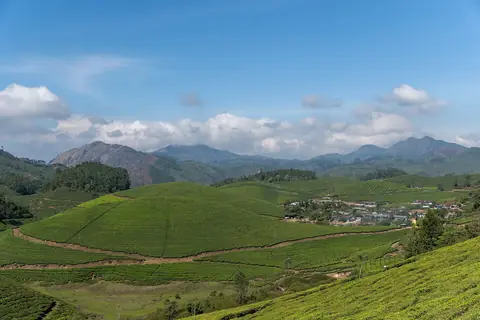
Munnar stands about 1,600 m up in the Western Ghats, where three mountain streams, the Muthirapuzha, Nallathanni and Kundala, meet; the name means three rivers in Malayalam. European planters started the first plantations in the late 19th century, and tea now covers the slopes in clipped green rows. Above the town, Eravikulam National Park protects the grasslands of the Nilgiri tahr, a rare mountain goat, beneath Anamudi, the highest peak in South India. Two nights give you an afternoon at the tea museum, a day in the park and the sandalwood forest of Marayoor, and a morning at the lakes of Mattupetty and Kundala; a third night adds the long road to Top Station or a dawn jeep to Kolukkumalai.
- Suggested time
- 2 nights (3 days)
- Where to stay
- Munnar town, near the bus terminal and the KDHP Tea Museum; Chithirapuram and Pallivasal, down the valley on the Kochi road
- Season and timing
- Go in January: it falls between the southwest monsoon from June to September, Kerala's main rainy season, and the northeast monsoon from October to December, and Eravikulam is open. February and March also miss both monsoons, but the park is closed then for the calving season. Kerala Tourism gives Munnar's average rainfall as 275 cm.
The short answer
Book two nights (three days) in Munnar town or a few kilometres down the valley at Chithirapuram; The Munnar Queen, a resort at Chithirapuram 7 km from town, lists its Executive room for two at INR 8,499 a night with breakfast and taxes on its own tariff page. Book the Eravikulam National Park time slot first: the park sells tickets by date and slot, entry runs from 08:00 to 14:00, and the park closes each year for the Nilgiri tahr's calving season, from 1 February to 1 April on its booking page. Foreign visitors pay on the booking site with its third payment option, which takes cards issued outside India, or reserve at the counter in Munnar. Two key prices, checked on 17 October 2026: foreign visitors pay INR 500 to enter Eravikulam (INR 200 for Indian adults), and the District Tourism Promotion Council's five-seat speed boat on Mattupetty lake costs INR 1,080. The model stay below comes to about INR 23,278 for two, plus GST on two dinners, before the road from Kochi and local taxis.
Town, valley or estate: choosing your base in the hills
Munnar town sits where the three rivers meet, with the bus terminal at its centre and Mount Carmel Church, established in 1898, among the hills around it. It is the base for an early start to Eravikulam, 13 km up the road, and for the KDHP Tea Museum in the Nallathanni Estate. KTDC, the state tourism corporation, runs Tea County here, about half a kilometre from the bus terminal; its tariff for 1 April 2026 to 31 March 2027 lists breakfast at INR 500 plus GST and lunch or dinner at INR 700 plus GST per person, and its restaurant is where this guide prices two dinners.
Chithirapuram, a few kilometres down the valley towards Pallivasal, is one of the first places in the Munnar hills where people settled: old bungalows and granite cottages stand among the tea, and in the mornings you can watch the tea pluckers walk into the plantations. The Munnar Queen, a resort 7 km from Munnar town, lists its Executive room for one or two guests at INR 8,499 a night including breakfast and taxes on its own tariff page; it is the room priced in this guide's budget. The resort adds 20% at Diwali and Christmas.
Further out, Chinnakanal, with its waterfalls and the Anayirangal dam among tea plantations and evergreen forest, suits a longer stay with a car. The where-to-stay guide for India explains how foreign guests are registered at check-in.
Eravikulam National Park: the Nilgiri tahr and Anamudi
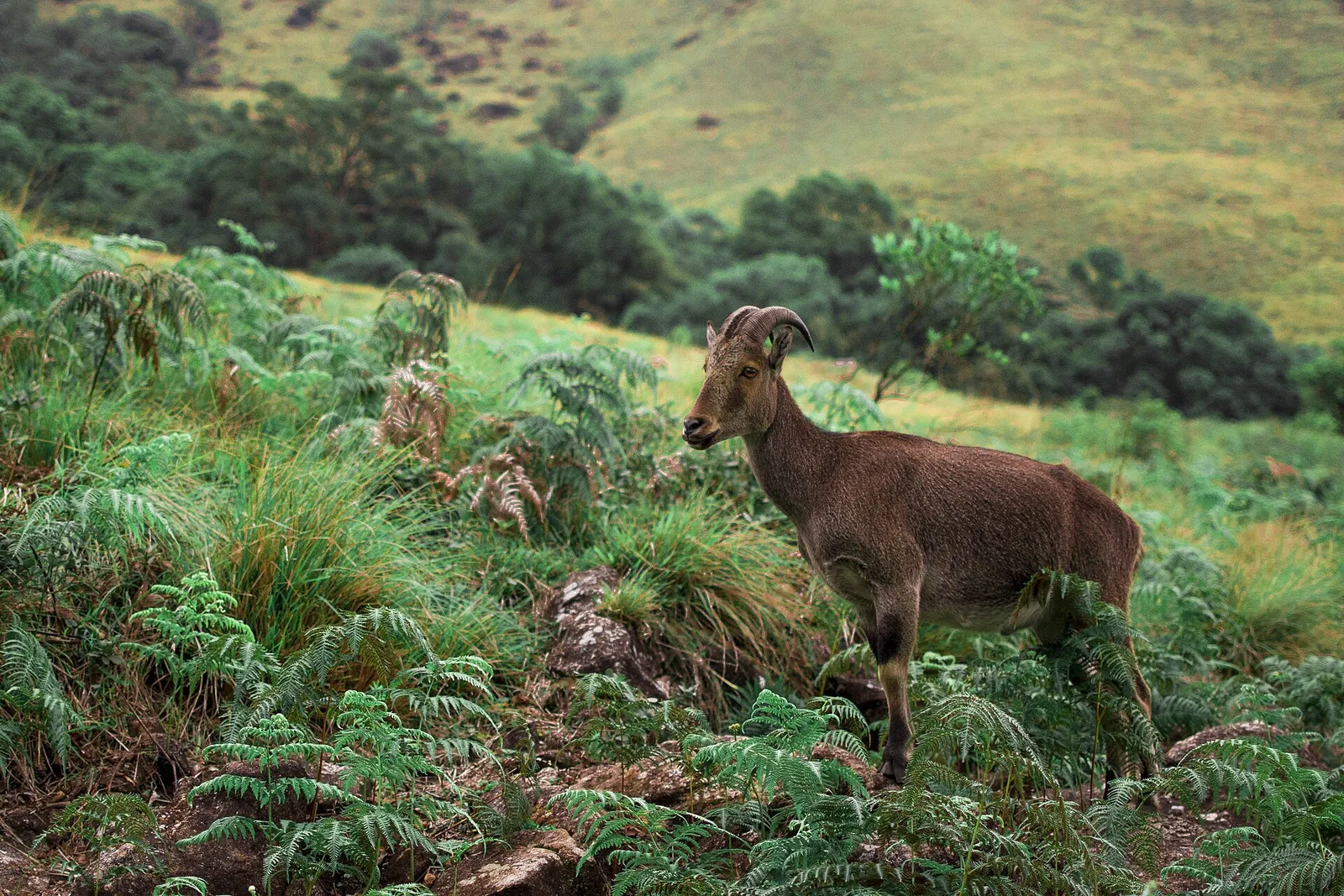
Eravikulam National Park covers 97 sq km of grassland and forest. Its fame is the Nilgiri tahr, an endangered mountain goat: around one-third of the world's population lives in this park, and DTPC Idukki says the park has been its safe haven since 1975. The visitor area is the Rajamala tourism zone at the southern edge, where herds of tahr graze on the grassland; elephants, Nilgiri langurs, Nilgiri martens, lion-tailed macaques and small-clawed otters also live in the park, and Anamudi, at 2,695 m the highest peak in South India, rises inside it. Eravikulam is a UNESCO World Heritage Site. In a flowering year the slopes turn blue with Neelakurinji, a shrub that blooms once in twelve years, and Eravikulam and Top Station are the places Kerala Tourism names to see it; it gives no year for the next flowering.
The park's own booking site lists entry from 08:00 to 14:00, at INR 500 for foreign nationals and INR 200 for Indian adults, plus INR 50 for a still camera and INR 350 for a video camera. You open an account, enter your passport as ID, and choose the date, the number of people and a time slot. For payment, the site points foreign visitors to its third payment option, which takes cards issued outside India and, it says, no Indian bank card; the park's phone numbers are on the same site. Tickets can also be reserved, for an INR 50 fee, at the counter in the information centre in Munnar, open from 09:00 to 15:00.
The park closes every year for the calving season: its booking page gives the closure as 1 February to 1 April. A cancellation made more than 15 days before the visit refunds 50% of the amount, one between 15 days and 48 hours refunds 25%, and the camera fees are not refunded. Inside, the only road runs through the Rajamala zone, and everything else is on foot along trails and footpaths. The park bans food and drink, plastics, smoking and alcohol, and asks visitors to keep quiet; wildlife sightings are a matter of chance. Be at the park well before your slot.
The tea hills: the KDHP Tea Museum and Kolukkumalai
Tea arrived in Munnar in 1880, when a European planter called Sharp planted about 50 acres at Parvathy, now part of the Seven Mallay estate, Kerala Tourism says; by the 1920s the hills ran some 16 factories. The estates passed from James Finlay to Tata and, in 2005, to the Kanan Devan Hills Plantations Company (KDHP), which describes itself as the largest employee-owned tea company in the world.
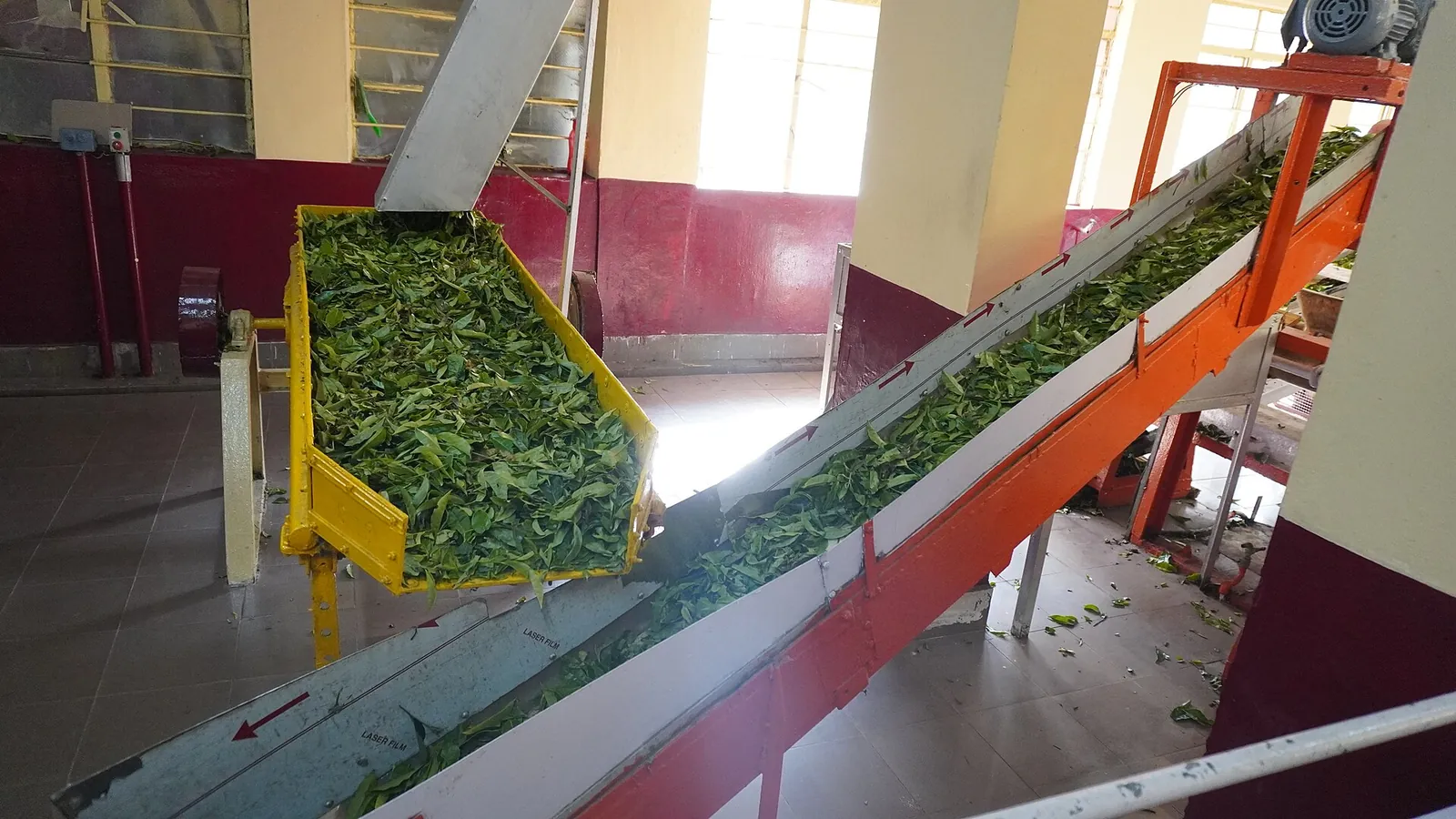
The KDHP Tea Museum in the Nallathanni Estate, a short drive from town, tells that story: a granite sundial of 1913 at the entrance, the original tea roller of 1905, a rotorvane once used for CTC processing, a Pelton wheel from a 1920s power plant, a wheel from the Kundala Valley Light Railway that ran between Munnar and Top Station, and an iron-age burial urn from the 2nd century BC. A miniature tea factory shows how the leaf is processed, and the visit ends at the tea-tasting counter and the factory outlet. Kerala Tourism, which still calls it the Tata Tea Museum, lists it as open from 10:00 to 17:00 on all days. Ask at the museum counter for the entry fee.
Kolukkumalai, about 38 km from Munnar, is the estate Kerala Tourism calls home to the highest tea plantations in the world, at about 7,900 ft, with views down to the plains of Tamil Nadu. Its two-storey factory, built in the 1930s, still processes tea by the traditional method rather than CTC, and you can tour it and taste the Broken Orange Pekoe and Flowery Orange Pekoe grades. The hilltop is reached only by jeep, about an hour and a half from town; DTPC Idukki lists a sunrise off-road jeep safari that leaves at 03:00 and returns by 09:30; ask at its information centre in Munnar for the fare and how to book.
Mattupetty, Kundala and the road to Top Station
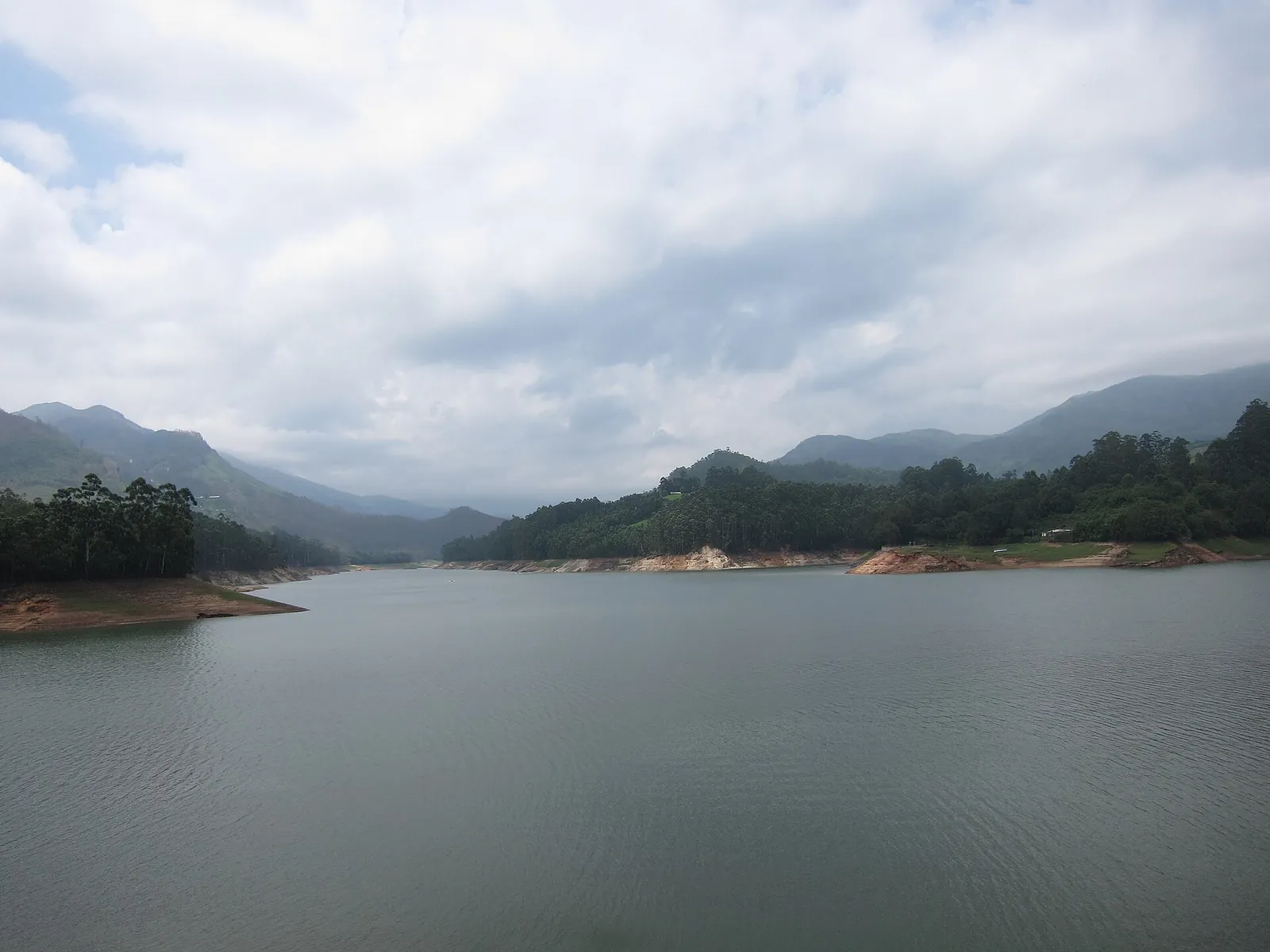
A winding 13 km road through the greenery leads to Mattupetty. Its masonry dam holds a calm lake on the edge of the forest, where elephants sometimes come down to drink, and the Indo-Swiss Livestock Project's dairy farm gives the place its nickname, the cattle village. DTPC Idukki's Mattupetty Boating Centre is open from 09:00 to 17:00 and lists a five-seat speed boat at INR 1,080, a ten-seat slow boat at INR 1,200 and a 20-seat big boat at INR 2,000.
Beyond the lake, Echo Point, between Munnar town and Top Station, is the place to call out across the hills and hear yourself come back, and Kundala, about 20 km from Munnar, has a dam that DTPC describes as Asia's first arch dam, built in 1946 for the Pallivasal hydroelectric project, with row boats, pedal boats and Kashmiri-style shikaras on its lake.
The road ends at Top Station, about 40 km from Munnar town and some 1,700 m up, where the cool breeze and the wild flowers keep you on the heights under a misty sky, with a wide view over Tamil Nadu. It was the terminus of the Kundala Valley Railway that carried tea from Munnar until the flood of 1924 washed it away; remains of the old station and ropeway still lie along the route.
DTPC's information centre in Munnar, open from 08:00 to 19:00, sells day tours that run from 09:00 to 17:00. Its Sandal Valley Tour is listed at INR 450 a person, and its second version takes in Eravikulam (ask whether the park ticket is included), a tea viewpoint, the Lakkom waterfalls, a coffee garden and the Marayoor sandalwood forest. The Village Tour down the valley costs INR 400 a person, and the Tea Valley Tour covers Mattupetty with a speed-boat ride, Echo Point, Kundala Lake, Top Station and the Tea Museum. Ask the information centre for the fare of the Tea Valley Tour and the Kolukkumalai jeep, and agree the price of any taxi or jeep, around Munnar or on the road from Kochi, before you set off.
Down the valley and over to Marayoor
On the Kochi road below town, Attukad, between Munnar and Pallivasal, is a spot of rocky hills and small waterfalls. Pallivasal, about 3 km from Chithirapuram, was the site of the first hydroelectric project in Kerala, and its Blossom International Park, about 3 km from Munnar town, has 16 acres of parkland and flowers, with boating and cycling.
Lockhart Gap has winding trails up to viewpoints over the valleys and plantations, prettiest in the orange light of the evening, and Pothamedu, about 6 km from town, is an easy hilltop walk through tea, coffee and cardamom.
Marayoor, about 40 km from Munnar, lies in the rain shadow, with a natural sandalwood forest of about 65,000 trees, a sandalwood depot run by the state Forest Department, 2,000-year-old megalithic burial chambers called muniyara, and the rock paintings of Ezhuthupara, a protected monument of the State Archaeological Department. The Chinnar Wildlife Sanctuary, about 60 km from Munnar, is crossed by the Munnar-Udumalpet road; its 90.44 sq km hold nearly a thousand species of flowering plants and the mugger crocodile, and a watchtower looks out over the forest. DTPC's Sandal Valley tours cover the sandalwood forest, Lakkom waterfalls and Chinnar in a day.
Getting there from Kochi: buses, taxis and the ghat road
Cochin International Airport (COK) is one of the e-Visa airports and the gateway for Kochi, the backwaters and Munnar. Munnar is reached by road: Kerala Tourism gives about 119 km from Cochin International Airport and about 120 km from Ernakulam Junction, the nearest railhead, suggests Ernakulam town as the starting point, and says public buses run to Munnar from almost all major bus stations in the state. On the way you pass Adimaly, which Kerala Tourism calls the entry point of the Munnar hill station; its Neelakkurinji Biodiversity Knowledge Centre, at the Government High School, has 3D models of the evergreen forests and the houses of the Muthuvan tribal community. Ask your driver or hotel how long the road takes.
Ask at the bus stand for bus departures and fares. For a taxi, the UK Foreign Office says app-based taxis such as Uber and Ola are available in all airport terminal buildings, and prepaid taxis and hotel transfers are offered too. The Foreign Office also advises against travelling by road at night and in fog, so plan to reach the hills in daylight. The transport guide for India covers trains to Ernakulam and domestic flights to Kochi.
In the monsoon, which the UK Foreign Office puts at June to November in India, a window that takes in most of Kerala's two rainy seasons, rains can cause flash floods, landslides and road closures, particularly in mountainous areas, so on the ghat road to Munnar keep a spare day and follow the India Meteorological Department's warnings; the best-time guide sets out Kerala's two rainy seasons. Our Kochi guide covers the night before or after in the city.
Two nights in Munnar, day by day
This plan puts the tea museum on the afternoon you arrive, Eravikulam and Marayoor on DTPC's Sandal Valley Tour on the full day, and the lakes on the last morning. The South India itinerary joins Munnar to Kochi and the Kerala backwaters, and its ninth day adds Thekkady's Periyar Tiger Reserve, the usual next stop in the hills.
- Day 1: leave Kochi in the morning and climb through Adimaly to Munnar town; in the afternoon, the KDHP Tea Museum and its tasting counter, then dinner at Tea County if you sleep in town; from Chithirapuram, eat early and drive back before dark, or dine at your hotel.
- Day 2 (not between 1 February and 1 April): DTPC's Sandal Valley Tour from the information centre, 09:00 to 17:00, with the Rajamala zone of Eravikulam for the tahr and the grassland, a tea viewpoint, the Lakkom waterfalls, a coffee garden and Marayoor's sandalwood forest. Book your Eravikulam slot yourself and ask at the information centre which slot fits the tour. Dinner at Tea County or your hotel, on the same terms as day 1.
- Day 3: Mattupetty's boating centre when it opens at 09:00, Echo Point and Kundala Lake, then down the ghat road, with a sadya lunch at Kallar on the way to Kochi or the backwaters.
- With a third night: DTPC's Tea Valley Tour to Top Station, the 03:00 jeep to Kolukkumalai for sunrise over the highest tea, or the Village Tour down the valley.
Make time for the local food
What to eat and where to look
Sadya
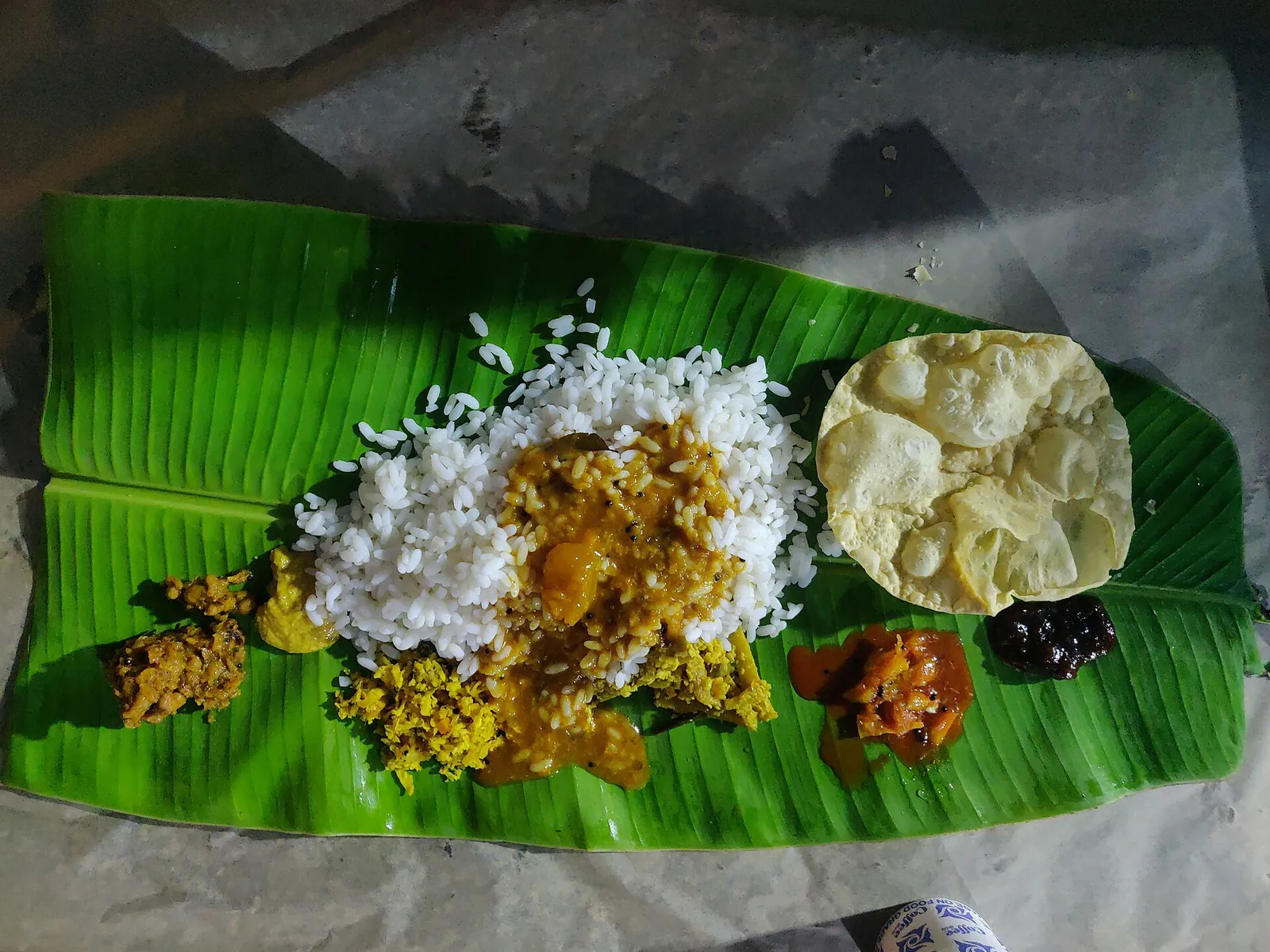
Kerala's vegetarian feast served on a banana leaf: rice with sambar, rasam, pickles, a run of vegetable dishes and payasam to finish. Bayovali Herbal Garden, a home kitchen in Kerala Tourism's Responsible Tourism ethnic cuisine scheme, lists a traditional sadya lunch at INR 200-250.
- Where to look
- Bayovali Herbal Garden, at the 60th Mile on the Aluva-Munnar road at Kallar, in Pallivasal panchayat; use the enquiry button on its Kerala Tourism listing before you go.
- Fit it into your day
- Lunch on the drive down on day 3.
Puttu and kadala curry
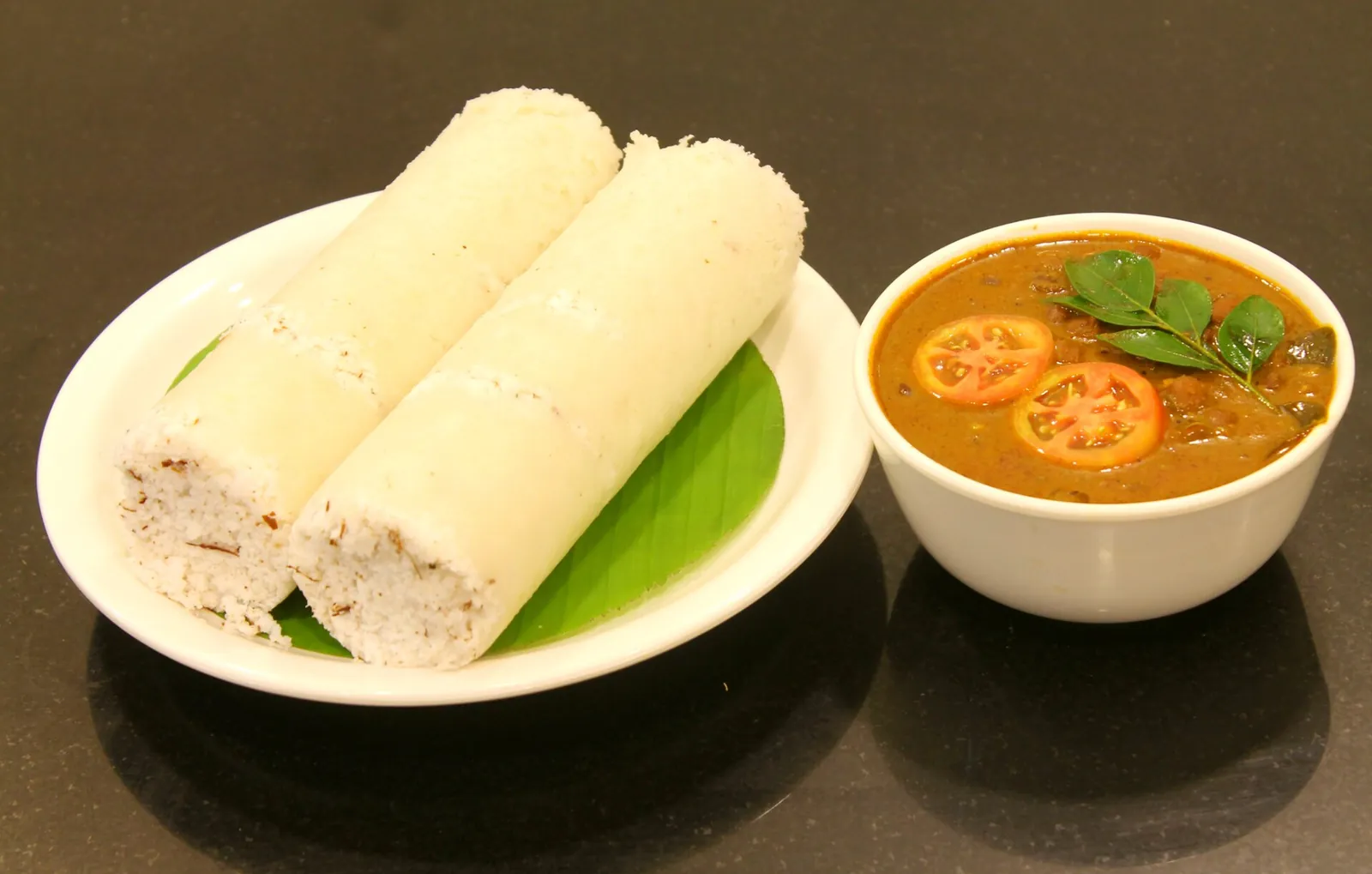
Steamed cylinders of coarse rice flour layered with grated coconut, eaten with a spicy curry of black chickpeas cooked with roasted coconut and shallots; Kerala Tourism calls it the go-to breakfast of most Keralites.
- Where to look
- The vegetarian restaurants of Munnar town, around the bus terminal and the market.
- Fit it into your day
- Breakfast before the drive to Eravikulam, if your room does not include it.
Munnar tea
The high-grown tea of the Kanan Devan hills, from the CTC grades of the estate factories to orthodox leaf; tasting the grades side by side shows how the processing changes the cup.
- Where to look
- The tea-tasting counter and factory outlet at the KDHP Tea Museum, Nallathanni Estate (10:00-17:00); or the tasting centre of the Kolukkumalai factory.
- Fit it into your day
- An afternoon cup at the end of the museum visit on day 1.
Appam with stew
Bowl-shaped pancakes of fermented rice batter and coconut, soft and spongy in the middle with thin, crisp, lacy edges, served with a mild stew of vegetables or meat in coconut milk, or with a chutney.
- Where to look
- The Kerala restaurants of Munnar town, around the bus terminal and the market.
- Fit it into your day
- Breakfast in town, or a dinner away from Tea County.
Kerala cooking uses coconut and coconut oil in almost everything, and curries are often hot with chilli; say so if you avoid coconut, nuts, dairy or gluten.
What two nights cost for two people
This model follows the plan above for two adults sharing a room, with prices checked on 17 October 2026.
- Room, The Munnar Queen, Chithirapuram, Executive room for two, 2 nights at INR 8,499 a night including breakfast and taxes: INR 16,998.
- Eravikulam National Park, two foreign visitors at INR 500 each: INR 1,000.
- DTPC Sandal Valley Tour on day 2, two people at INR 450 each: INR 900.
- Mattupetty boating, one five-seat speed boat from DTPC's boating centre: INR 1,080.
- Sadya lunch at Bayovali Herbal Garden, Kallar, on day 3, at INR 250 each, the top of its listed INR 200-250 range: INR 500.
- Two dinners at KTDC Tea County, two people at INR 700 each plus GST: INR 2,800 plus GST.
- Total: about INR 23,278 for two, plus GST on the dinners.
- Not included: the road from Kochi and back (bus or taxi), the taxi to Mattupetty and Kundala and the trips between Chithirapuram and town; lunch on days 1 and 2; the Tea Museum entry; camera fees at Eravikulam.
Practical questions
How many nights do I need in Munnar?
Two nights: the Tea Museum on the afternoon you arrive, a full day for Eravikulam and Marayoor on DTPC's Sandal Valley Tour, then the lakes at Mattupetty and Kundala before you drive down. Add a third night for Top Station, a sunrise jeep to Kolukkumalai or DTPC's Village Tour.
When is Eravikulam National Park closed?
Every year for the Nilgiri tahr's calving season; the park's booking page gives the closure as 1 February to 1 April.
How much is the Eravikulam ticket, and how do I book it?
The park's booking site lists INR 500 for foreign nationals and INR 200 for Indian adults, plus INR 50 for a still camera. Tickets are sold by date and time slot with your passport as ID, and entry runs from 08:00 to 14:00; foreign visitors pay with the site's third payment option, which takes cards issued outside India. Tickets can also be reserved for an INR 50 fee at the counter in Munnar's information centre, from 09:00 to 15:00.
How far is Munnar from Kochi?
Kerala Tourism gives about 119 km from Cochin International Airport and about 120 km from Ernakulam Junction, the nearest railhead. Public buses run from most major bus stations in the state, and taxis wait at the airport; Kerala Tourism gives no driving time.
Is Munnar worth visiting in the monsoon?
Only with a spare day: the southwest monsoon from June to September is Kerala's main rainy season, and landslides can close the ghat road. The best month is January, between the two monsoons and before Eravikulam's calving closure.
Can I visit a tea factory in Munnar?
Yes. The tea museum that the Kanan Devan Hills Plantations Company runs in the Nallathanni Estate, which Kerala Tourism lists as the Tata Tea Museum, has a miniature factory and a tasting counter and opens from 10:00 to 17:00 every day. The Kolukkumalai estate's 1930s factory, reached only by jeep, also offers tours and tastings.
Sources and checks before you travel
Reference sources for the version dated 17 October 2026. Confirm opening times, access, transport and conditions for your travel dates.
- Eravikulam National Park (Anaimudi Forest Development Agency): ticket booking ↗ — opens in a new tab
- Eravikulam National Park (Anaimudi Forest Development Agency): booking guide ↗ — opens in a new tab
- Kerala Tourism: Munnar ↗ — opens in a new tab
- Kerala Tourism: Munnar, the hill station ↗ — opens in a new tab
- Kerala Tourism: Eravikulam National Park ↗ — opens in a new tab
- Kerala Tourism: Mattupetty ↗ — opens in a new tab
- Kerala Tourism: Top Station ↗ — opens in a new tab
- Kerala Tourism: Kundala Valley Railway ↗ — opens in a new tab
- Kerala Tourism: Kolukkumalai ↗ — opens in a new tab
- Kerala Tourism: Chithirapuram ↗ — opens in a new tab
- Kerala Tourism: Attukad waterfall ↗ — opens in a new tab
- Kerala Tourism: Lockhart Gap ↗ — opens in a new tab
- Kerala Tourism: Pothamedu ↗ — opens in a new tab
- Kerala Tourism: Blossom International Park ↗ — opens in a new tab
- Kerala Tourism: Mount Carmel Church ↗ — opens in a new tab
- Kerala Tourism: Marayoor ↗ — opens in a new tab
- Kerala Tourism: Chinnar Wildlife Sanctuary ↗ — opens in a new tab
- Kerala Tourism: Neelakurinji ↗ — opens in a new tab
- Kerala Tourism: Neelakkurinji Biodiversity Knowledge Center ↗ — opens in a new tab
- Kerala Tourism: Tata Tea Museum ↗ — opens in a new tab
- Kanan Devan Hills Plantations (KDHP): Tea Museum ↗ — opens in a new tab
- Kanan Devan Hills Plantations (KDHP): home ↗ — opens in a new tab
- DTPC Idukki: Eravikulam National Park ↗ — opens in a new tab
- DTPC Idukki: Mattupetty Dam ↗ — opens in a new tab
- DTPC Idukki: Kundala Dam ↗ — opens in a new tab
- DTPC Idukki: tourism centres ↗ — opens in a new tab
- DTPC Idukki: tour packages ↗ — opens in a new tab
- KTDC: Tea County tariff ↗ — opens in a new tab
- KTDC: Tea County, reach us ↗ — opens in a new tab
- The Munnar Queen: tariff ↗ — opens in a new tab
- Kerala Tourism Responsible Tourism: Bayovali Herbal Garden ↗ — opens in a new tab
- Kerala Tourism: Kerala cuisine experience ↗ — opens in a new tab
- Kerala Tourism: puttu and kadala curry ↗ — opens in a new tab
- UK Foreign Office (FCDO): India safety and security ↗ — opens in a new tab
- India Meteorological Department: Statement on the climate of India 2025 ↗ — opens in a new tab
- India Meteorological Department: Northeast Monsoon 2024 report ↗ — opens in a new tab
- Official e-Visa site (Government of India): e-Visa ↗ — opens in a new tab
- Kerala Tourism: Echo Point ↗ — opens in a new tab
Does this experience fit your route?
Book the Eravikulam slot for your full day, then a room in Munnar town or Chithirapuram and DTPC's Sandal Valley Tour, and keep the last morning for the lakes.
Check dates and details on Viator ↗ — opens in a new tabAffiliate link · Book with ViatorPhoto credits
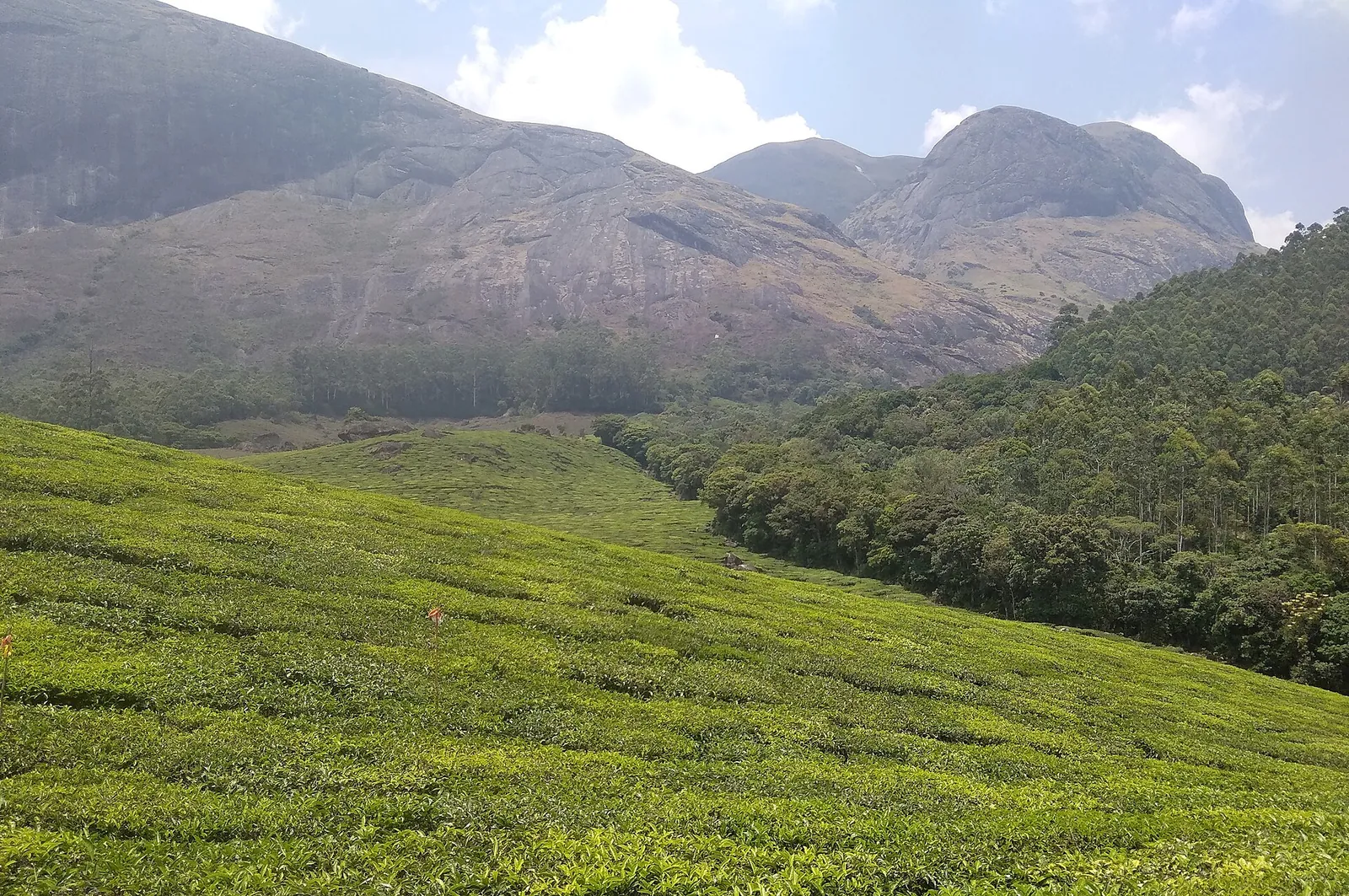
Tea gardens on the northern edge of Munnar town, looking north towards the high hills
Photograph: Shino jacob koottanad — opens in a new tab · CC BY-SA 4.0 — opens in a new tab
Changes: Resized and converted to WebP; displayed with responsive crops. · Original photograph and licence details ↗ — opens in a new tab
A Nilgiri tahr on the slopes of Eravikulam National Park
Photograph: Asheen Anoop — opens in a new tab · CC BY-SA 4.0 — opens in a new tab
Changes: Resized and converted to WebP; displayed with responsive crops. · Original photograph and licence details ↗ — opens in a new tab
Green leaf on its way through the processing line at the Tea Museum, Munnar
Photograph: Harvinder Chandigarh — opens in a new tab · CC BY-SA 4.0 — opens in a new tab
Changes: Resized and converted to WebP; displayed with responsive crops. · Original photograph and licence details ↗ — opens in a new tab
Mattupetty lake behind its dam, 13 km from Munnar
Photograph: കാക്കര — opens in a new tab · CC BY-SA 3.0 — opens in a new tab
Changes: Resized and converted to WebP; displayed with responsive crops. · Original photograph and licence details ↗ — opens in a new tab
A sadya on a banana leaf, photographed at Aluva, where the road to Munnar begins
Photograph: Ranjithsiji — opens in a new tab · CC BY-SA 4.0 — opens in a new tab
Changes: Resized and converted to WebP; displayed with responsive crops. · Original photograph and licence details ↗ — opens in a new tab
Puttu with kadala curry, Kerala's everyday breakfast
Photograph: Jackson John 10 — opens in a new tab · CC BY-SA 4.0 — opens in a new tab
Changes: Resized and converted to WebP; displayed with responsive crops. · Original photograph and licence details ↗ — opens in a new tab