Mekong Delta and Phu Quoc · Can Tho
Soc Trang travel guide: Bat Pagoda, Khmer temples and Ok Om Bok
Soc Trang is the Mekong Delta town where Khmer, Vietnamese and Chinese life sit side by side on the same few streets. Its draw is a cluster of Khmer Buddhist pagodas with curved naga roofs and saffron-robed novices, a family-run temple filled with clay statues, a 63-metre reclining Buddha, and in the tenth lunar month the delta's best-known Khmer long-boat race. Almost everything worth seeing lies within a few kilometres of the centre, about 60 km south of Can Tho on National Road 1.
- Suggested time
- 1 day from Can Tho, or 1 night
- Where to stay
- Central Soc Trang (now Soc Trang ward, Can Tho City); Can Tho's Ninh Kieu riverside for a day trip
- Season and timing
- Rainy season May to October, dry season November to April; around 27 °C on average. The Ok Om Bok festival and boat race fall on the 14th–15th days of the tenth lunar month, usually in November.
The short answer
Treat Soc Trang as a long day trip from Can Tho, or better, one night in the town. Start at Kh'leang Pagoda and the Khmer culture museum opposite it, walk or ride along Ton Duc Thang Street to the Clay Pagoda and Som Rong Pagoda, eat bún nước lèo for lunch, and end at the Bat Pagoda, about 3 km south-east of the centre, at dusk when the fruit bats leave the trees. Staying the night lets you see the bats without a dark drive back and add Sa Lon (the 'Bowl Pagoda') 12 km out of town the next morning. Come on the full moon of the tenth lunar month, usually November, for Ok Om Bok and the ghe ngo boat race on the Maspero River, and book a room well ahead.
Why Soc Trang, and a day trip or a night?
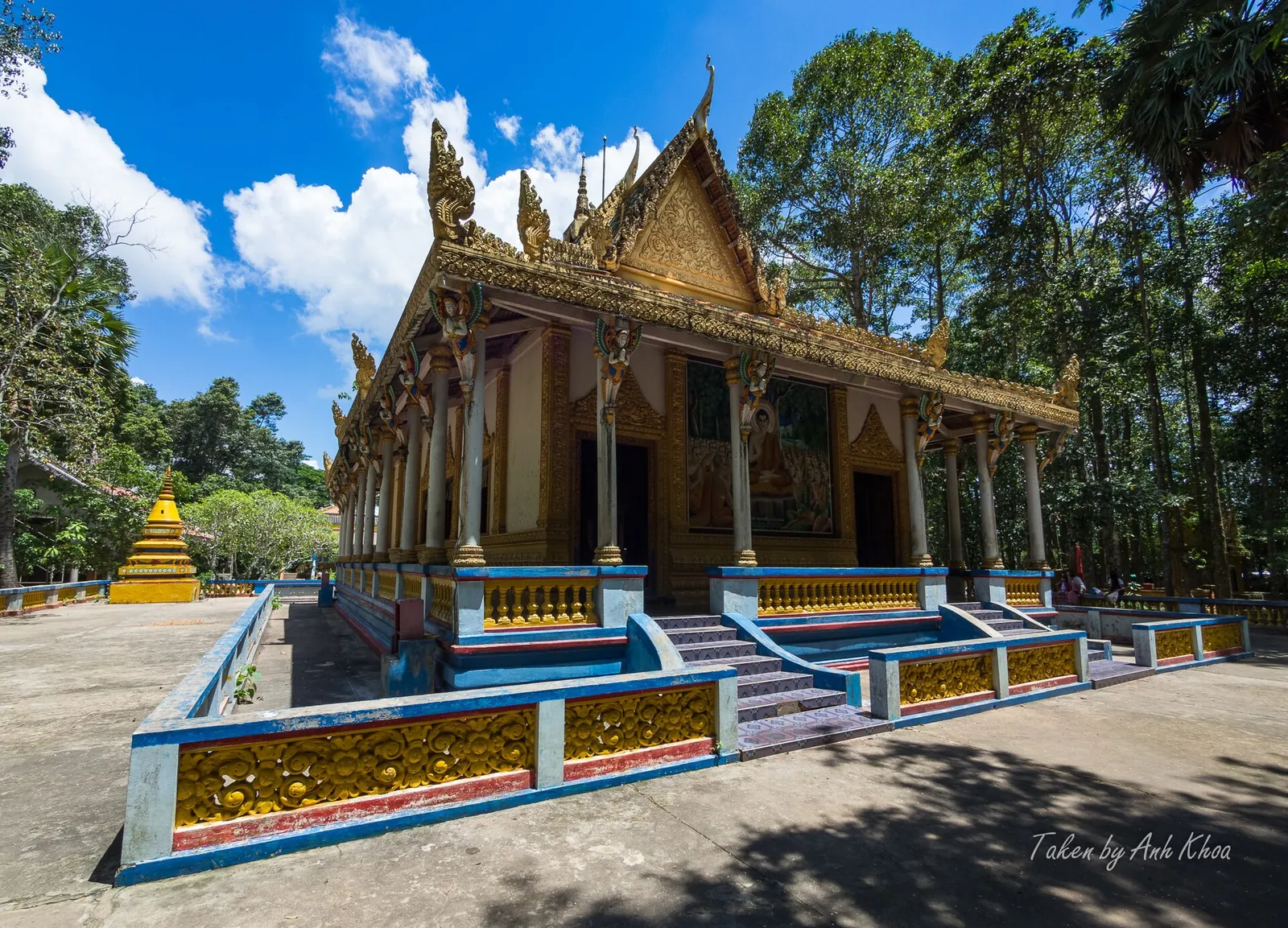
Soc Trang sits near the mouth of the Hau River, the southern branch of the Mekong, and VnExpress International describes it as a meeting point of Chinese, Kinh, Khmer and Cham heritage. You feel this within a single street: Ton Duc Thang Street in the centre runs past a 16th-century Khmer pagoda, a family temple filled with clay statues and a modern Khmer complex crowned by a giant reclining Buddha.
Since the June 2025 reorganisation of Vietnam's provinces, the former Soc Trang province has been part of an enlarged Can Tho City, together with Hau Giang. The town keeps its name as Soc Trang ward, but addresses and booking sites may now show Can Tho, and the Bat Pagoda's area belongs to the new Phu Loi ward.
From Can Tho, Soc Trang is about 60 km down National Road 1, so a day trip is realistic: you can see the town's main pagodas between a mid-morning arrival and dusk. The catch is the Bat Pagoda, whose bats are at their most visible at dusk. If you want that moment without a night drive, or want to add the outlying pagodas, sleep one night in the centre. VnExpress's travel handbook notes that the sights are not far from the centre, so a hotel in town works as a base for everything.
Kh'leang Pagoda, the Khmer museum and the Clay Pagoda
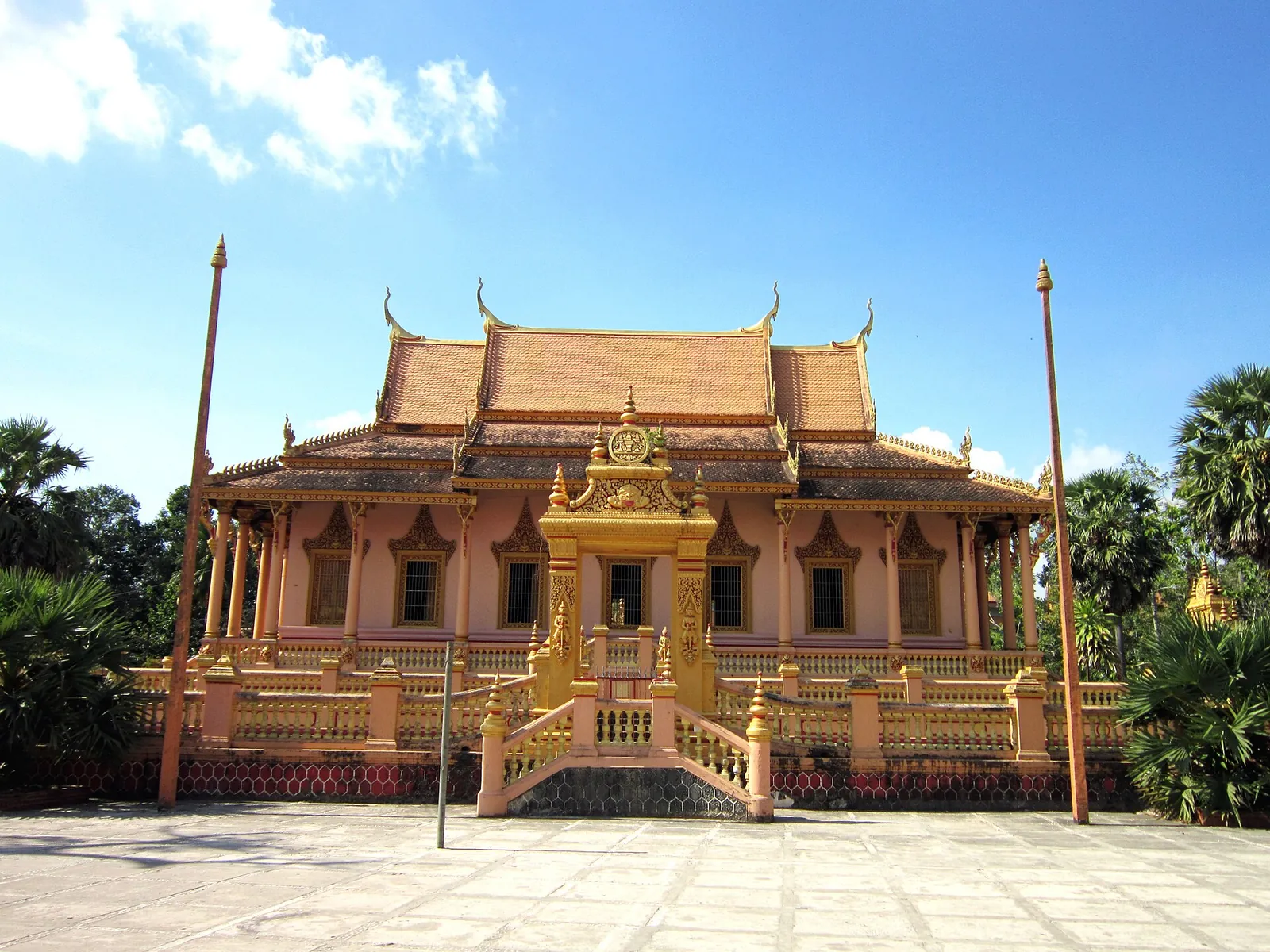
Kh'leang Pagoda (Chùa Khléang), at 53 Ton Duc Thang Street, is the place to begin. According to the pagoda's own records, as summarised on Vietnamese Wikipedia, it was first built of wood and leaves in 1532 on the orders of a Khmer king touring the lower Hau River, and the pagoda took its name from Srok Kh'leang, the Khmer name for the land that is now Soc Trang. The present main hall stands on a three-stepped platform under a triple-tiered roof with naga and celestial dancer figures, in grounds of sugar palms. It has been a national architectural and artistic relic since 1990.
Opposite it, the Soc Trang Khmer museum occupies a Khmer-style building from the late 1930s that began as the Samacum assembly hall. VnExpress's handbook puts its collection at almost 13,000 items, more than half of them donated by local Khmer families, and the museum covers the town's three communities, Kinh, Khmer and Chinese. Opening hours and admission were not available from an official source when we checked on 2026-10-03, so go in the morning and treat it as a possible bonus.
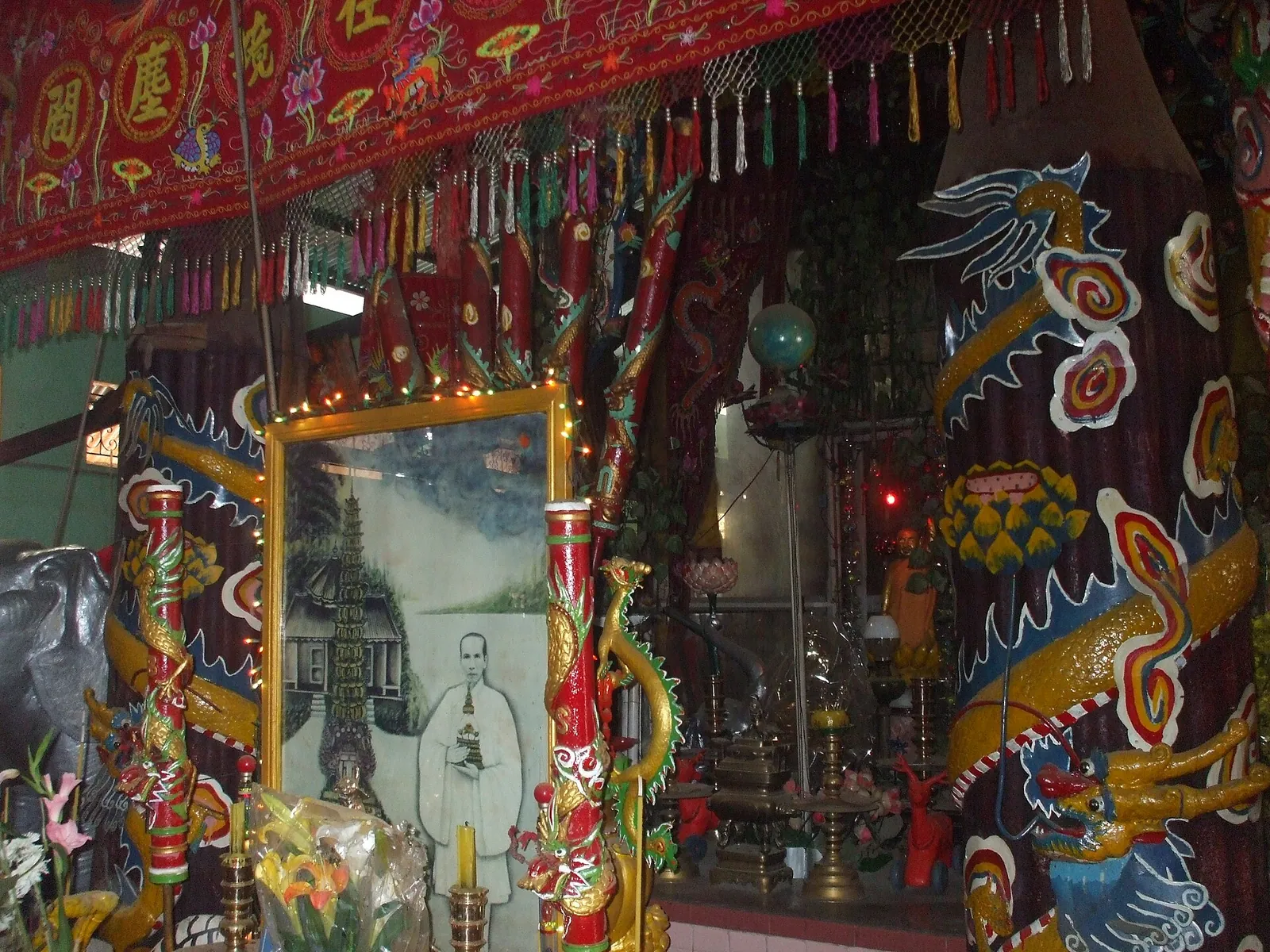
A short way along the same street, at number 286, the Clay Pagoda (Chùa Đất Sét, officially Bửu Sơn Tự) is a different world: a small, crowded family temple of the Bửu Sơn Kỳ Hương tradition rather than a Khmer monastery. Its fourth keeper, Ngô Kim Tòng, spent 42 years, from 1928 until his death in 1970, modelling more than a thousand Buddhas, deities and sacred animals from clay mixed with incense powder, then painted and varnished them to look like wood. Look for the giant candles cast in 1940, each of the six largest made from 200 kg of wax; according to the temple's history, two smaller ones have been burning since 1970. The temple has no monks and is run by the family.
Make time for the local food
What to eat and where to look
Bún nước lèo
Soc Trang's signature Khmer noodle soup. Vietnam's tourism authority describes a broth of slow-cooked fish stock, originally flavoured with Khmer prohok and now with fermented river fish (mắm bò hóc), poured over rice noodles with prawns, roast pork, pork crackling and fish balls, then topped with herbs, crunchy soybeans and shredded banana blossom. Lemongrass and fingerroot give it its scent.
- Where to look
- Noodle shops and breakfast stalls in central Soc Trang; in Can Tho, Vietnam's tourism authority points to Bun Nuoc Leo Soc Trang Phi Long at 12 De Tham Street.
- Fit it into your day
- Lunch after the Kh'leang and Clay Pagoda morning, before Som Rong.
The fermented-fish broth is pungent; contains fish, shellfish and pork.
Bánh cống
A traditional Khmer snack from Soc Trang, named after the deep cylindrical ladle it is fried in. A batter of rice flour and soybean or mung bean is filled with minced pork, jicama, taro or wood-ear mushroom, topped with a whole shrimp and deep-fried. It is eaten wrapped in lettuce and herbs with a sweet-and-sour fish-sauce dip and pickles.
- Where to look
- Roadside fryers and snack stalls in town in the afternoon.
- Fit it into your day
- Two or three as an afternoon snack before heading out to the Bat Pagoda.
Deep-fried; contains shrimp and pork, and the dip contains fish sauce.
Bánh pía
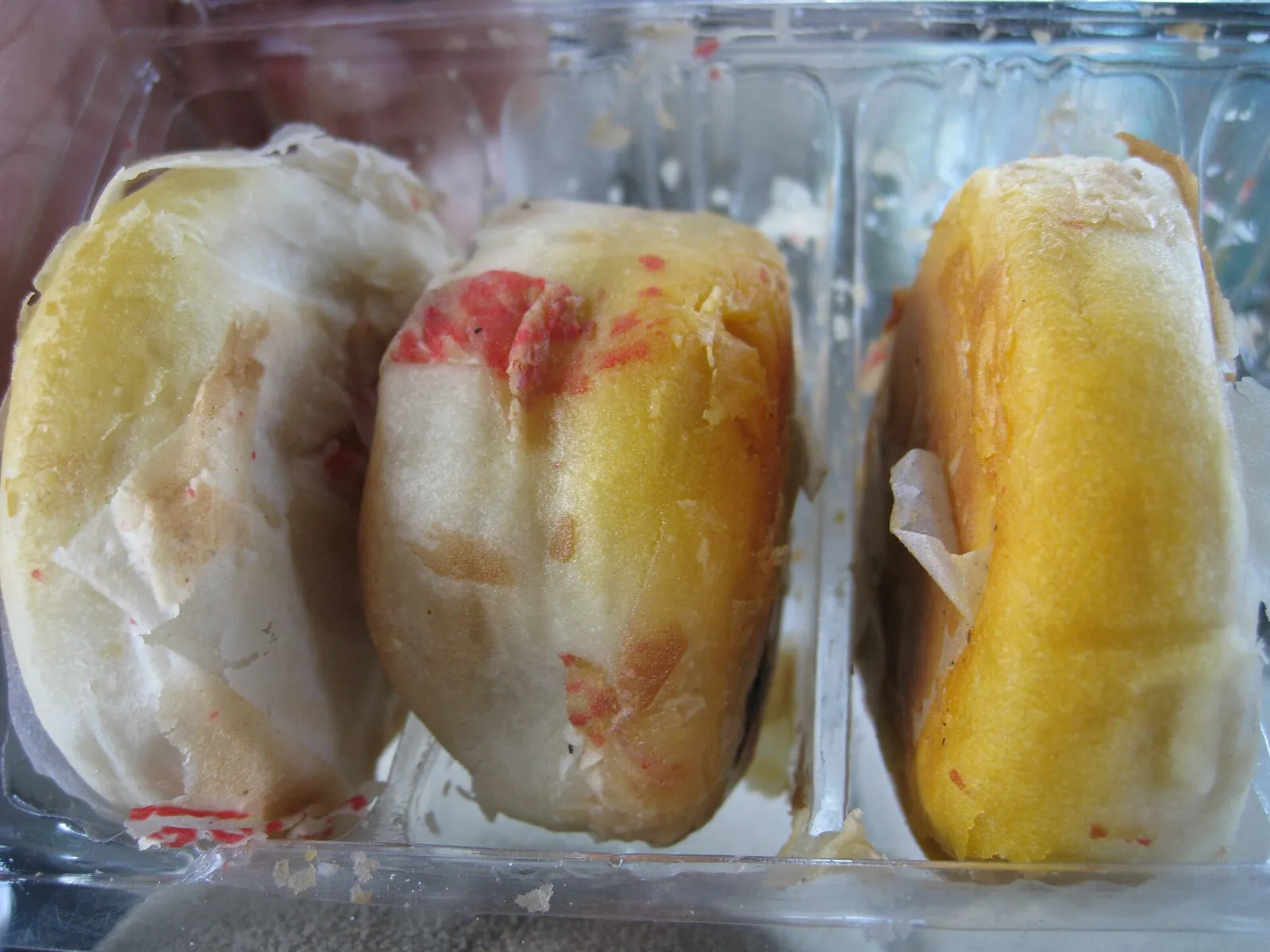
Soc Trang's famous flaky pastry, created by Chinese immigrants. The many-layered wheat-flour crust was once filled only with mung bean and pork fat; bakeries now add durian, taro and salted egg yolk.
- Where to look
- Bakeries and specialty shops in town; VnExpress's handbook says the bakeries are concentrated in Chau Thanh, just outside the centre.
- Fit it into your day
- Buy a box to take back to Can Tho or onward on the bus.
Traditional fillings contain lard, and many versions contain salted egg yolk or durian; check the label.
Mì sụa and bún gỏi dà
Two local plates beyond the famous noodle soup. Mì sụa, from the town's Chinese community, is a yellow soybean noodle, stir-fried in its savoury form or cooked into a sweet soup. Bún gỏi dà puts the ingredients of a fresh spring roll (noodles, shrimp, boiled pork and herbs) into a bowl to be shovelled up, with a broth served alongside or poured over.
- Where to look
- Small eateries in the centre of town.
- Fit it into your day
- A light lunch or dinner on the night you stay in town.
Bún gỏi dà contains shrimp and pork; mì sụa is often served with chilli soy sauce or a lime-chilli fish sauce.
Som Rong Pagoda and the Bat Pagoda at dusk
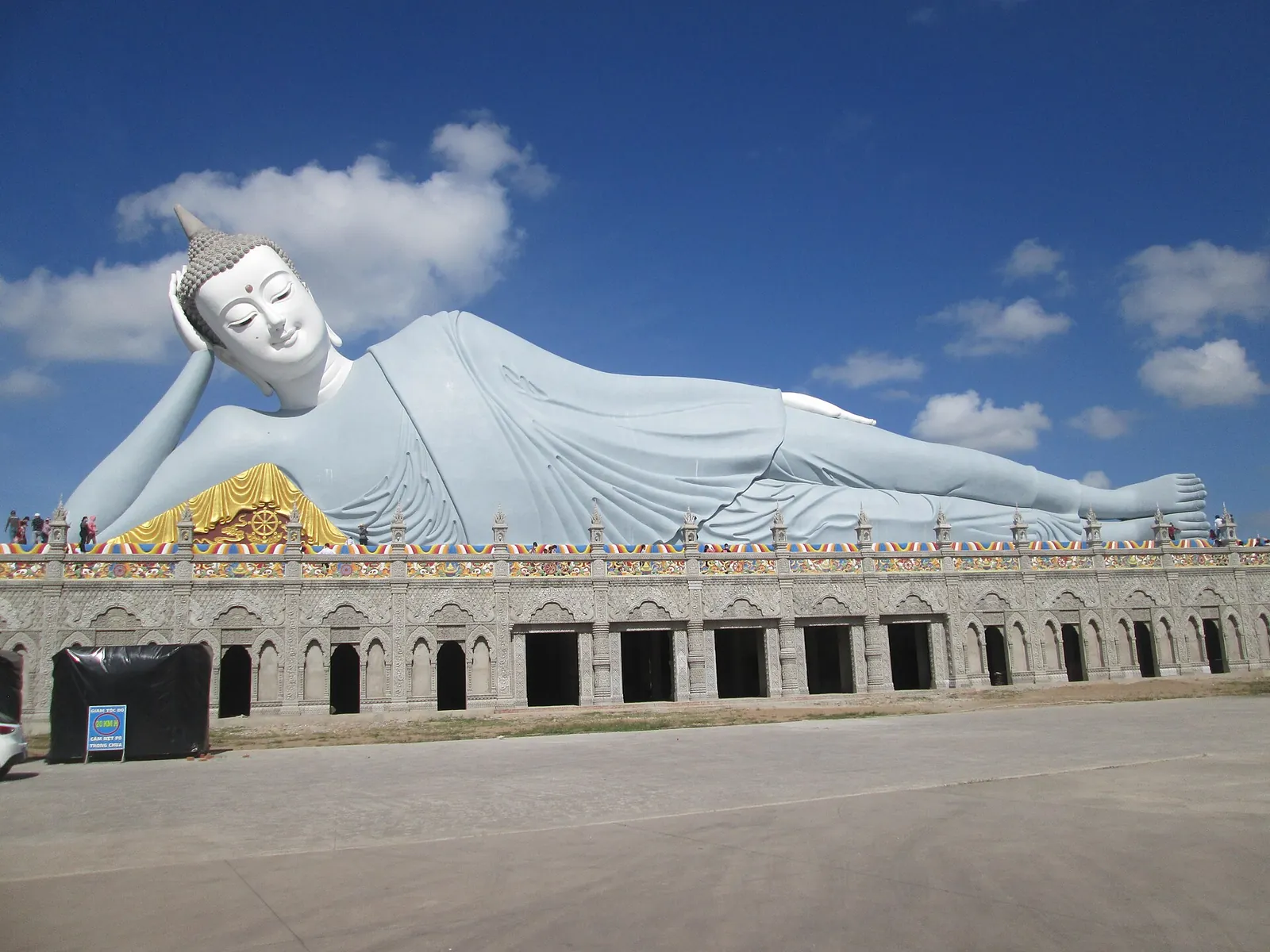
Som Rong Pagoda (Botum Vongsa Som Rong), at 367 Ton Duc Thang Street, dates from about 1785 but is now best known for its reclining Buddha: 63 m long and 22.5 m high, set on a pedestal 28 m above the ground, and visible from across town. VnExpress International reports that it was built between October 2017 and 2021 and that the provincial culture department calls it the largest reclining Buddha in Vietnam. The pagoda is also unusual for its grey colour scheme, including a stupa about 25 m high at the entrance, where most Khmer temples are painted gold and yellow.
Finish the day at the Bat Pagoda (Chùa Dơi, also called Ma Toc or Mahatup), on Van Ngoc Chinh Street about 3 km south-east of the centre. Founded in 1569 as a thatched building, it has been a national relic since 1999; its main hall burned in 2007 and was restored in 2009. Inside are a monolithic stone Buddha and columns carved with praying Khmer maidens, and the four-hectare grounds hold stupas, a sala and dormitories for the monks and novices who study here.
The bats are large fruit bats with a wingspan of up to about 1.5 m. They roost in the old trees, fly out to feed at dusk and return around 3 to 4 a.m. Do not expect the dense clouds of older photographs: the deputy abbot told VnExpress International that their numbers have fallen sharply because of hunting. Arrive in the late afternoon, look up into the trees before the light goes, and stay quiet. This is a working monastery; dress for a temple, with shoulders and knees covered, and remove your shoes where others do.
Ok Om Bok and the ghe ngo boat race
Ok Om Bok, the Khmer moon-worship festival, is held on the 14th and 15th days of the tenth lunar month, which usually falls in November. Families give thanks to the moon, seen as the god who governs the harvest, with the ritual of feeding flattened rice (đút cốm dẹp), and the festival also brings floating lanterns and Rom Vong dancing. VnExpress's handbook names Soc Trang and Tra Vinh as the places where the festival is most special.
The moon offering is followed by the ghe ngo race on the Maspero River in the centre of town. Each long boat, 25 to 30 m long and shaped like a snake, belongs to a pagoda and carries 40 to 60 rowers; VnExpress International saw a model kept beside a life-sized boat at the Bat Pagoda. At the 2024 race on 15 November, 60 teams from Soc Trang and five neighbouring provinces competed, men over 1,200 m and women over 1,000 m, while tens of thousands of spectators lined both banks.
The lunar date moves each year and the official programme is announced locally, so check the dates before you book. Book a room in town early if you want to stay for the race; otherwise a day trip from Can Tho is the fallback. The races are held in the afternoon, so bring water and a hat.
Beyond the centre: Sa Lon, Bon Mat and the floating market at Nga Nam
With a second morning, pick one or two of these rather than all of them. Outside town the distances grow, so a car with driver or a hired motorbike is the realistic way to reach them.
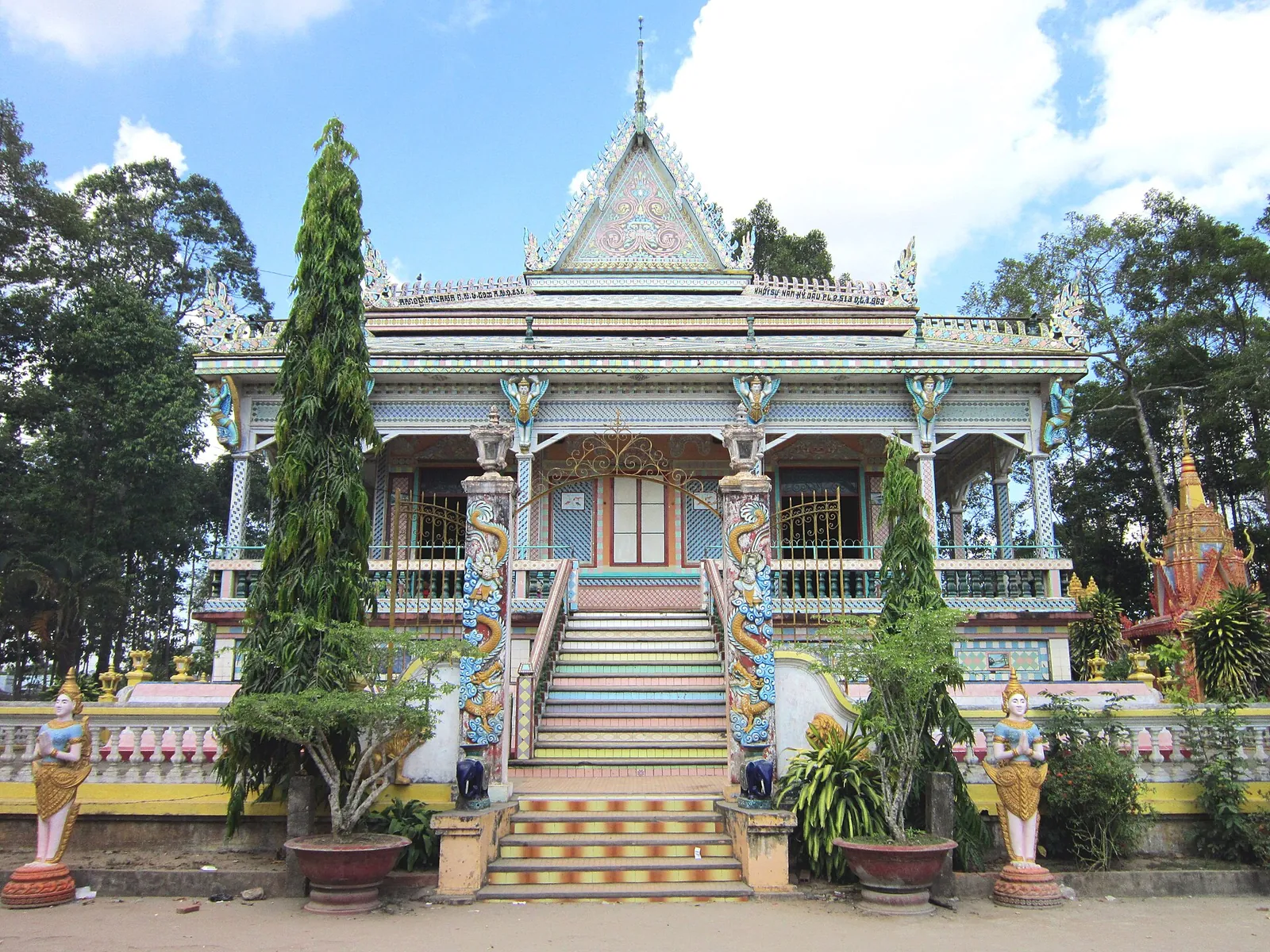
- Sa Lon Pagoda (Chùa Chén Kiểu), on National Road 1 at Tam Loc, about 12 km from the centre: rebuilt from 1969 after war damage, and nicknamed the 'Bowl Pagoda' because, short of materials, the monks and villagers decorated its walls with donated porcelain bowls and plates.
- Bon Mat Pagoda (Buôl Pres Phek), in Phu Tan, Chau Thanh: a Khmer pagoda in 6.5 ha of grounds, named after the legend of a four-faced Buddha statue found by Khmer settlers clearing the land.
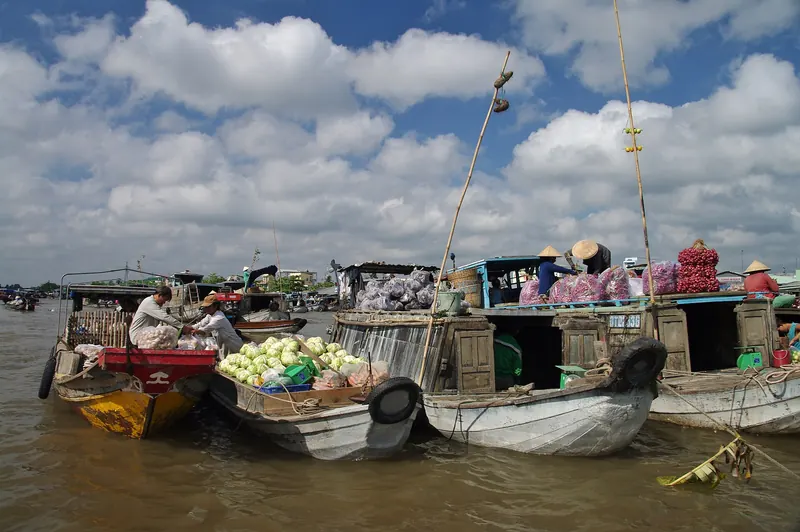
- Nga Nam floating market, about 60 km from the centre where five waterways meet: on ordinary days it trades in the morning, and in the days before Tết it can run all day.
- Tan Long stork garden, near Nga Nam: a privately run bird garden with egrets, storks and cormorants, at its best in the light of sunset.
- Con My Phuoc, an islet in Ke Sach about 25 km away, reached by the Nhon My ferry: orchards of rambutan, longan, durian and mango, and bee farms.
Getting there and getting around
Soc Trang lies on National Road 1, which links Can Tho with Bac Lieu and Ca Mau, so it fits naturally on a road trip south through the delta. From Can Tho the distance is about 60 km. VnExpress's handbook notes that limousine minibuses run from Can Tho International Airport to Soc Trang, bookable at the airport, and take about 1 hour 15 minutes.
From Ho Chi Minh City, buses leave from Mien Tay Bus Station and take about four to five hours for a distance that sources put at roughly 210 to 230 km. Several bus companies run the route; compare current times with the operator before you travel.
In town, Kh'leang, the museum, the Clay Pagoda and Som Rong all lie along or near Ton Duc Thang Street and can be linked with short taxi or motorbike rides; the Bat Pagoda is about 3 km from the centre. If you come on a day trip with a driver from Can Tho, agree in advance that you will stay until dusk at the Bat Pagoda.
Practical questions
Can I visit Soc Trang as a day trip from Can Tho?
Yes. Soc Trang is about 60 km from Can Tho on National Road 1, and the main pagodas are close together. The limitation is the Bat Pagoda, best seen at dusk, which means driving back to Can Tho after dark; staying one night in Soc Trang avoids that.
When can I see the bats at the Bat Pagoda?
In the late afternoon and at dusk, when the fruit bats roost in the old trees and then fly out to feed. They return around 3 to 4 a.m. Their numbers are much lower than in the past, so do not expect a sky full of bats.
When is Ok Om Bok in Soc Trang?
On the 14th and 15th days of the tenth lunar month, usually in November, with the ghe ngo boat race on the Maspero River. In 2024 the race was held on 15 November. The lunar date changes every year, so check before you travel.
How do I get from Ho Chi Minh City to Soc Trang?
By bus from Mien Tay Bus Station, which takes about four to five hours. Alternatively, fly to Can Tho and take a limousine minibus from the airport, about 1 hour 15 minutes.
Is Soc Trang still a province?
Not since 2025. Under the June 2025 reorganisation, Soc Trang and Hau Giang were merged into Can Tho City. The town is now Soc Trang ward, and addresses often show Can Tho.
What should I wear to the pagodas?
Cover your shoulders and knees, take your shoes off before entering halls where others do, and keep your voice down. These are working monasteries where monks and novices live and study.
Sources and checks before you travel
Reference sources for the version dated 3 October 2026. Confirm opening times, access, transport and conditions for your travel dates.
- VnExpress: Soc Trang travel handbook (Cẩm nang du lịch Sóc Trăng) ↗ — opens in a new tab
- Vietnam Tourism: Dining in the Delta ↗ — opens in a new tab
- Vietnam Tourism: Vietnam's new provincial system ↗ — opens in a new tab
- VnExpress International: A peek inside Soc Trang's iconic Bat Pagoda ↗ — opens in a new tab
- VnExpress International: Discover serenity at these four Khmer pagodas in Soc Trang ↗ — opens in a new tab
- VnExpress International: Vietnam's largest reclining Buddha, the icon of Som Rong Pagoda ↗ — opens in a new tab
- VnExpress: tens of thousands watch the delta's biggest ghe ngo race (2024) ↗ — opens in a new tab
- VnExpress: Can Tho plans a tourist street on the Maspero River ↗ — opens in a new tab
- VnExpress: the Clay Pagoda, unique in Vietnam ↗ — opens in a new tab
- Wikipedia (Vietnamese): Chùa Đất Sét ↗ — opens in a new tab
- Wikipedia (Vietnamese): Chùa Khléang ↗ — opens in a new tab
- Wikipedia (Vietnamese): Chùa Dơi ↗ — opens in a new tab
- Wikipedia (Vietnamese): Bảo tàng Khmer Sóc Trăng ↗ — opens in a new tab
- Wikipedia (Vietnamese): Chùa Sà Lôn ↗ — opens in a new tab
Does this experience fit your route?
Soc Trang's pagodas are best seen on your own; save the guided boat morning for Can Tho's floating market.
Browse relevant experiences on Viator ↗ — opens in a new tabAffiliate link · Book with ViatorPhoto credits
The main hall of the Bat Pagoda (Chùa Dơi, Mahatup), where fruit bats roost in the old trees around it.
Photograph: Tran Anh Khoa (zorrotran) — opens in a new tab · CC BY-SA 2.0 — opens in a new tab
Changes: Resized and converted to WebP; displayed with responsive crops. · Original photograph and licence details ↗ — opens in a new tab
Kh'leang Pagoda on Ton Duc Thang Street, one of Soc Trang's oldest Khmer pagodas.
Photograph: Bùi Thụy Đào Nguyên — opens in a new tab · CC BY-SA 3.0 — opens in a new tab
Changes: Resized and converted to WebP; displayed with responsive crops. · Original photograph and licence details ↗ — opens in a new tab
The 63-metre reclining Buddha at Som Rong Pagoda, visible from across town.
Photograph: Huynhdat1909 — opens in a new tab · CC BY-SA 4.0 — opens in a new tab
Changes: Resized and converted to WebP; displayed with responsive crops. · Original photograph and licence details ↗ — opens in a new tab
Inside the Clay Pagoda (Bửu Sơn Tự), where the statues and dragons are modelled from clay.
Photograph: Bùi Thụy Đào Nguyên — opens in a new tab · CC BY-SA 3.0 — opens in a new tab
Changes: Resized and converted to WebP; displayed with responsive crops. · Original photograph and licence details ↗ — opens in a new tab
The main hall of Sa Lon, the 'Bowl Pagoda', about 12 km outside Soc Trang.
Photograph: Bùi Thụy Đào Nguyên — opens in a new tab · CC BY-SA 3.0 — opens in a new tab
Changes: Resized and converted to WebP; displayed with responsive crops. · Original photograph and licence details ↗ — opens in a new tab
Bánh pía, the flaky filled pastry Soc Trang is known for.
Photograph: Nguyễn Thanh Quang — opens in a new tab · CC BY-SA 3.0 — opens in a new tab
Changes: Resized and converted to WebP; displayed with responsive crops. · Original photograph and licence details ↗ — opens in a new tab