Ho Chi Minh City and the Southeast · Ho Chi Minh City
Cholon guide: Saigon's Chinatown temples, Binh Tay Market and food
Cholon (Chợ Lớn, "big market") grew up between the 17th and 19th centuries as a separate Chinese trading town west of Saigon, and the two were only joined in 1956. It is still where Ho Chi Minh City's Hoa community worships, trades and eats. The visit is not one sight but a short walk between assembly halls built by Cantonese, Chaozhou and Hakka migrants, a wholesale market under a clock tower, and an evening of noodle shops and hotpot tables on the pavement.
- Suggested time
- Half a day, or an afternoon plus dinner
- Where to stay
- District 1 for most visitors; a Cholon hotel near Nguyen Trai or An Duong Vuong for food-focused stays
- Season and timing
- Warm all year; the rainy season runs from May to November, with April and May the hottest months. Temples are busiest at Lunar New Year, on full-moon days and at Thien Hau's festival on the 23rd day of the third lunar month.
The short answer
Give Cholon half a day from a hotel in District 1, or an afternoon that runs into dinner. Start at Thien Hau Temple and the other assembly halls on Nguyen Trai Street in the late morning or afternoon, walk or take a short ride to Binh Tay Market, then stay for a Hoa dinner of wonton noodles, hu tieu or hotpot. Sleep in District 1 for a first trip; a hotel in Cholon itself only makes sense if you want early temple mornings and local food on your doorstep.
Where Cholon is, and whether to sleep there
Cholon is not a neighbourhood with a gate or a clear edge. It spreads across what the city has long called Districts 5 and 6, with Chinese restaurants and family businesses reaching into Districts 10 and 11 as well. The temple strip on Nguyen Trai Street sits in District 5; Binh Tay Market, about seven kilometres southwest of the city centre, is further west in District 6. Plan it as two clusters joined by one short ride rather than a single walk.
Most first-time visitors are better off sleeping in District 1, where the national tourism site's own hotel list is concentrated, and coming out for half a day. Staying in Cholon pays off for travellers who want to be in the temples soon after they open, eat breakfast dumplings among locals and avoid the evening ride back. The same official list includes large hotels in District 5, on Tran Binh Trong and An Duong Vuong, so a Cholon base is a real option rather than a compromise.
The assembly halls on Nguyen Trai Street
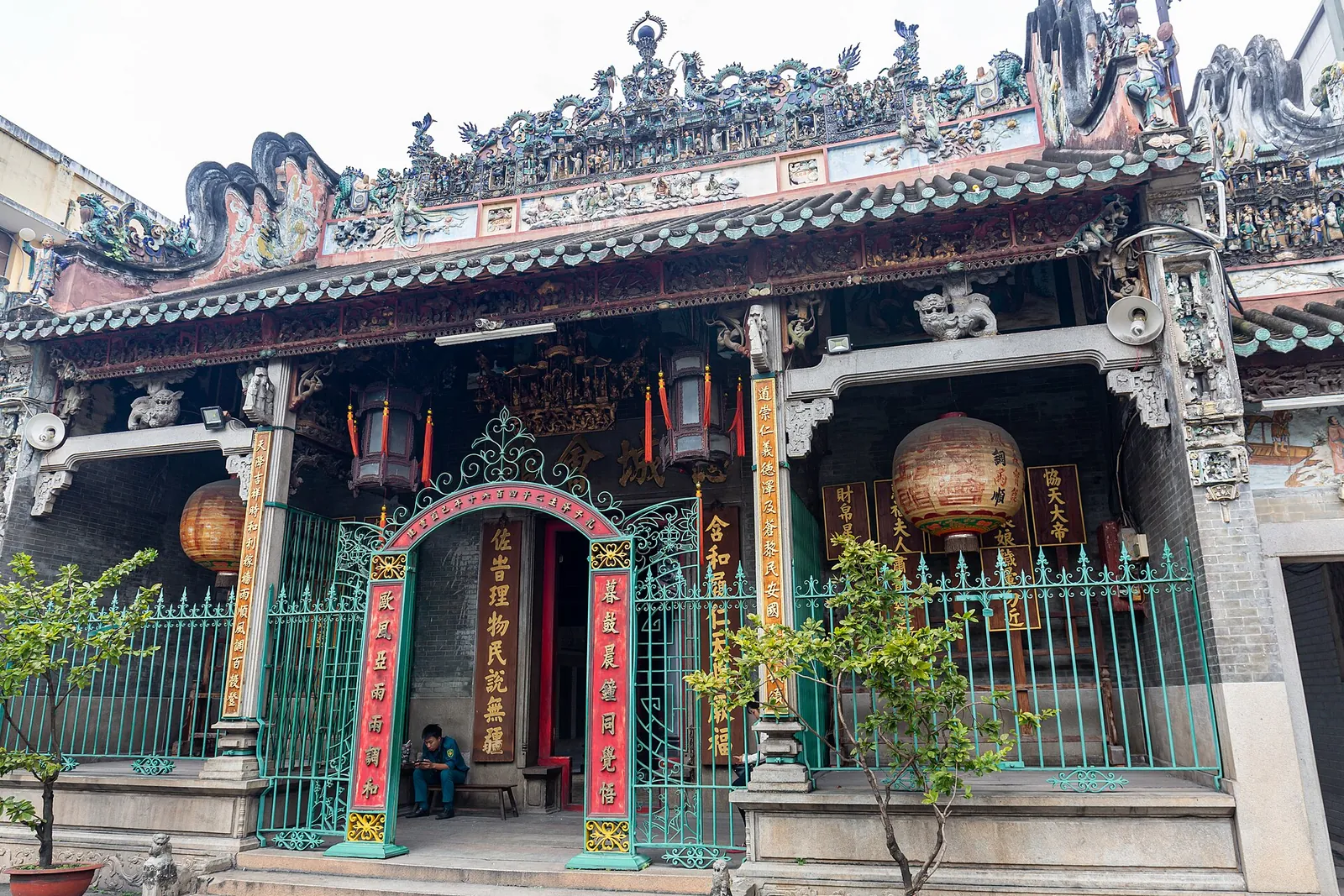
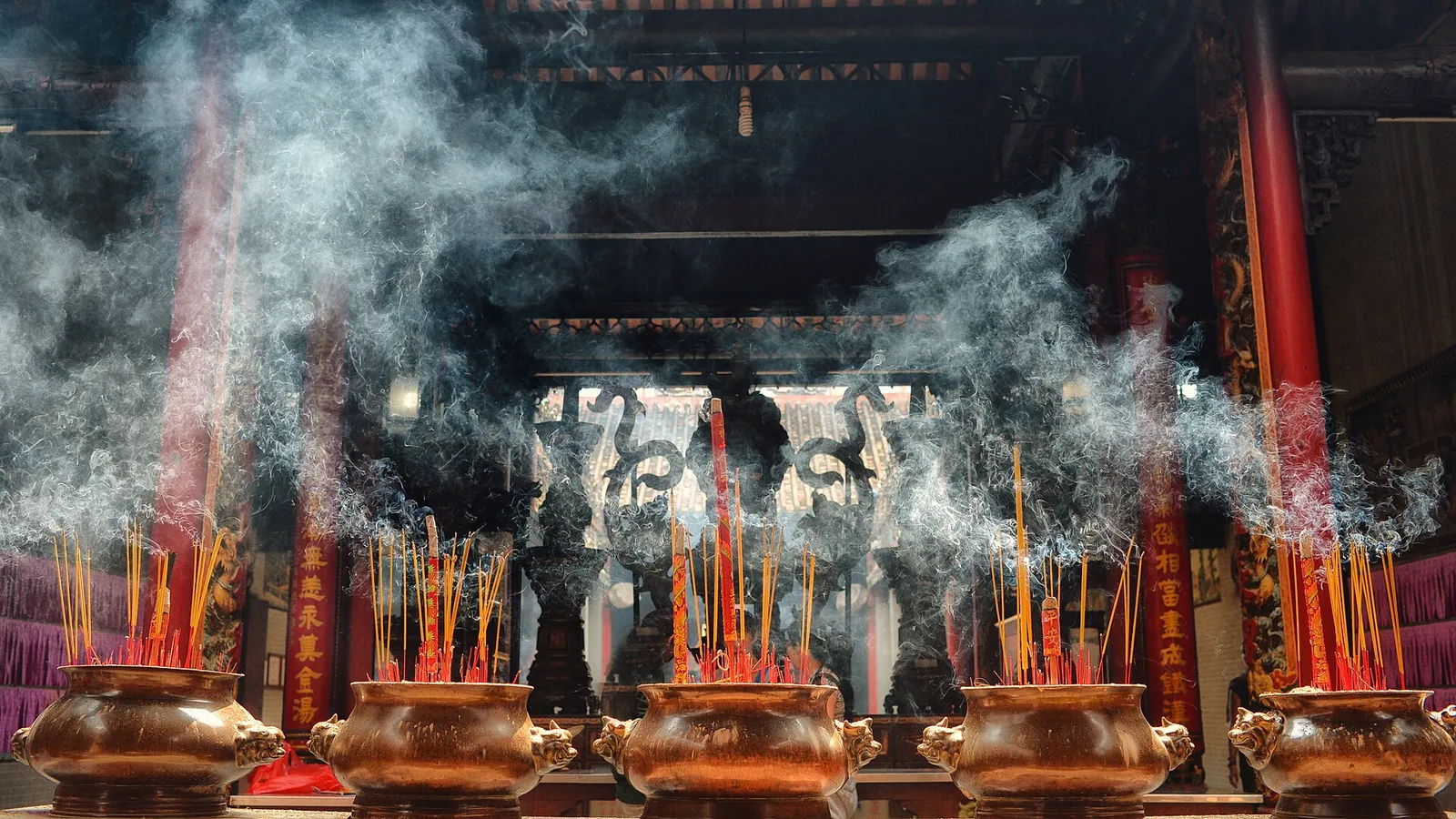
The temples of Cholon are mostly hoi quan, assembly halls built by merchants from one region of southern China as a place to worship, meet and lodge. Vietnamese call many of them chùa (pagoda), which is why the same building often has two or three names. Start with Tue Thanh Assembly Hall, better known as Thien Hau Temple or Ba Thien Hau Pagoda, at 710 Nguyen Trai Street. It was founded by Cantonese traders who arrived in the 1760s and dedicated it to Thien Hau, the sea goddess who protected them on the voyage. Look up at the ceramic roof figures added in 1908, then at the brick reliefs in the courtyard and the incense hung high above the floor, each offering carrying a visitor's written wishes.
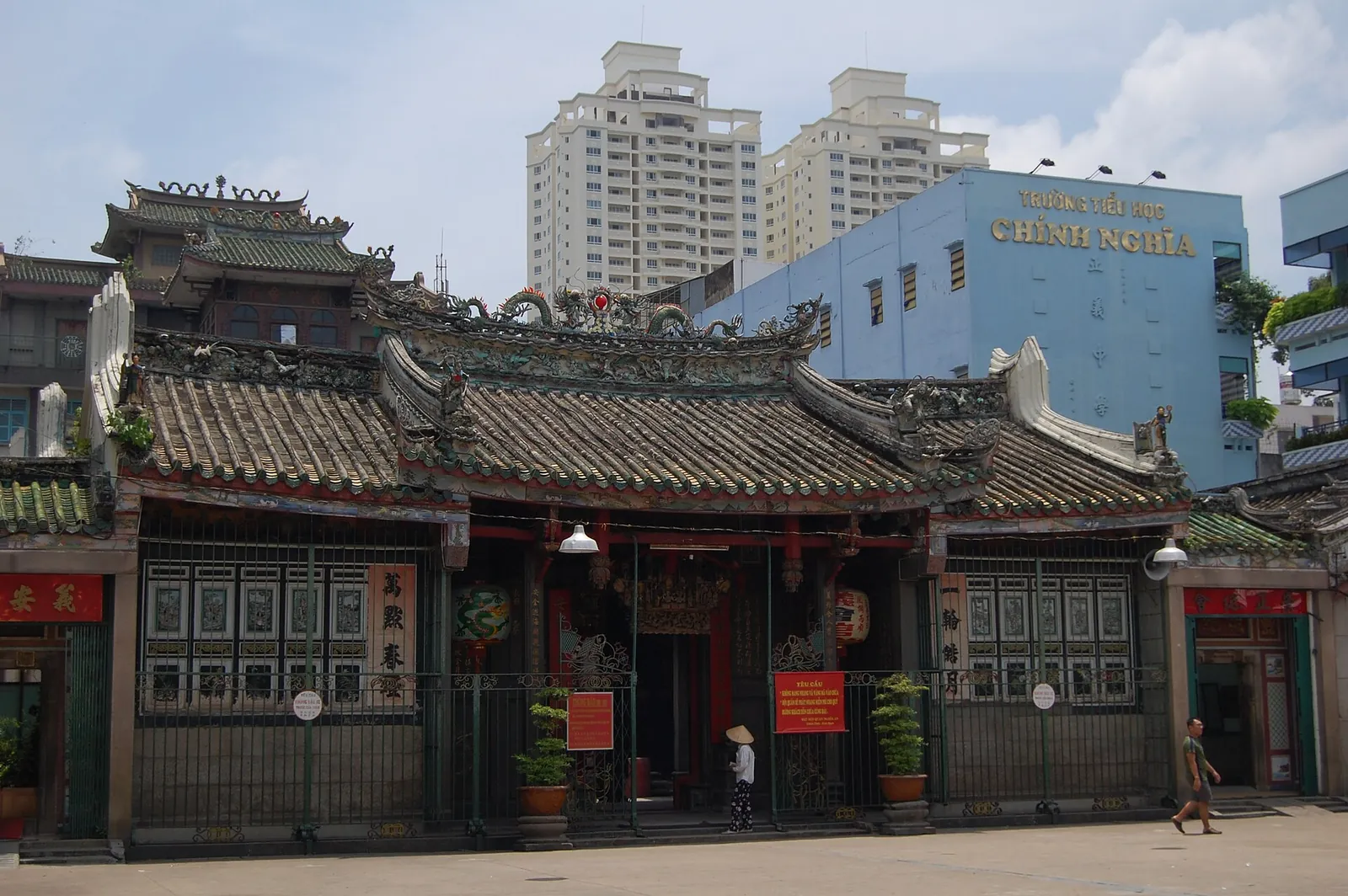
A short walk along the same street, at 676–678 Nguyen Trai, Nghia An Assembly Hall (Ong Pagoda, or Quan De Shrine) was built in the 19th century by Chaozhou and Hakka migrants and is dedicated to the red-faced general Quan Cong (Guan Yu). Beside the altar stands his red horse; after the Lunar New Year, local families crouch beneath it for luck. The hall was listed as a national architectural and artistic relic in 1993.
These are working places of worship, not museums. Dress modestly, keep your voice down, do not step in front of people praying and ask before photographing anyone at an altar. Lunar New Year, full-moon days and Thien Hau's festival on the 23rd day of the third lunar month bring crowds, lion dance troupes and a lot of incense smoke; come on an ordinary weekday morning if you want to look at the carving in peace. We could not find official opening hours or admission rules for these halls, so check on arrival.
Make time for the local food
What to eat and where to look
Wonton noodles (mì hoành thánh)
Thin egg noodles in clear broth with thin-skinned pork or shrimp wontons. The national news site VnExpress describes it as a popular dish in Chinatown, often made with handmade noodles.
- Where to look
- Cantonese noodle shops in District 5 — a wooden stand with Chinese motifs at the front is a common sign of a Cantonese kitchen.
- Fit it into your day
- A quick lunch between the temples and Binh Tay Market.
Usually pork-based; wontons often contain shrimp.
Hu tieu (rice noodle soup)
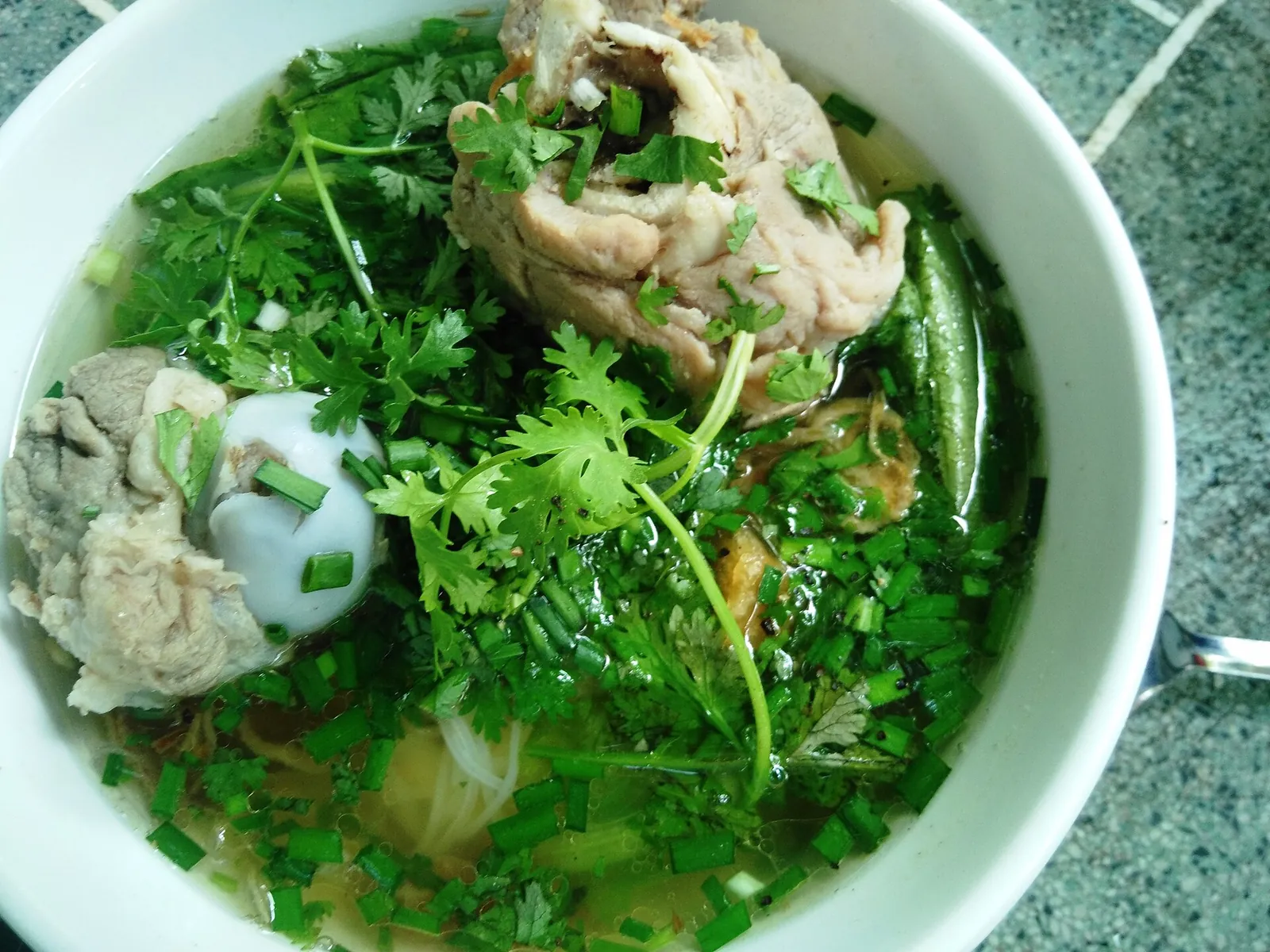
The noodle soup most closely tied to Ho Chi Minh City, with Chinese, Cambodian and Vietnamese roots according to the national tourism site. Cholon has its own versions, including a satay noodle soup with venison served behind Binh Tay Market for more than 60 years.
- Where to look
- Noodle shops and carts across Districts 5 and 6, including the streets behind Binh Tay Market.
- Fit it into your day
- A breakfast or early lunch before the market.
Broths are usually made with bones; satay versions can be spicy and contain peanuts.
Tam tinh hotpot and Hakka home cooking
A Hakka family hotpot of clear pork-bone broth with Chaozhou fried pork rolls, meat-stuffed tofu and other toppings, kept alive by a few family restaurants in District 5 alongside dishes such as salt-steamed chicken and taro pork belly.
- Where to look
- Family restaurants in the alleys of District 5, where tables spill onto the pavement in the evening.
- Fit it into your day
- An evening meal for two or more; order one pot and a few side plates.
Pork in broth and toppings; weekend evenings fill with large family groups and service can be slow.
Chinatown snacks: chive cakes, steamed buns and dim sum
Fried or steamed chive cakes, Chaozhou willow-leaf cakes, steamed buns with char siu, custard or salted egg, and Cantonese dim sum such as xiu mai. The Hoa community's bakeries also make Hong Kong-style egg tarts and pineapple buns.
- Where to look
- Bakeries, bun counters and Cantonese dim sum restaurants around Cholon.
- Fit it into your day
- Breakfast before the temples, or a snack to carry between sights.
Fillings often contain pork, dried shrimp or egg; ask before buying if you avoid any of them.
Binh Tay Market and the streets around it
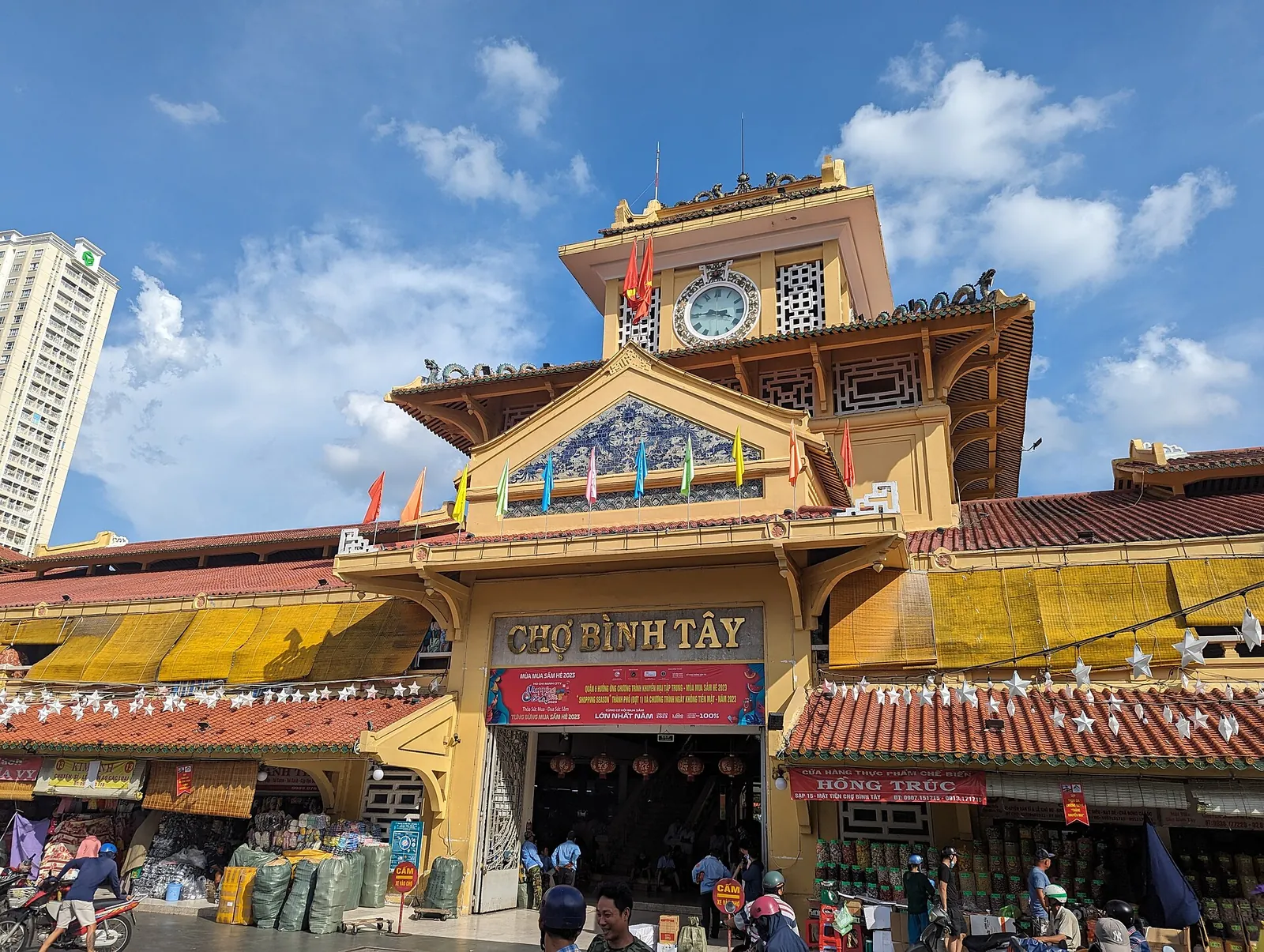
Binh Tay Market was built in 1928 with money from Quach Dam, a Chinese rice trader whose statue still stands inside, and it is the landmark most people mean by Cholon. The building is laid out around a central courtyard under a clock tower, in a plan that reflects the eight-trigram bagua motif. It closed in November 2016 for a two-year restoration and reopened on 15 November 2018 with around 1,500 stalls, newly painted interiors, new wiring and fire-safety equipment.
This is first a wholesale market. The stalls sell textiles, clothing, cosmetics, packaged goods and Chinese-style delicacies, with some souvenirs, but this has long been the busiest wholesale market in the city, so expect sacks being carried and deals being done more than browsing. Walk the courtyard and the outer corridors, keep out of the way of porters, and look for packaged delicacies if you want something to take home.
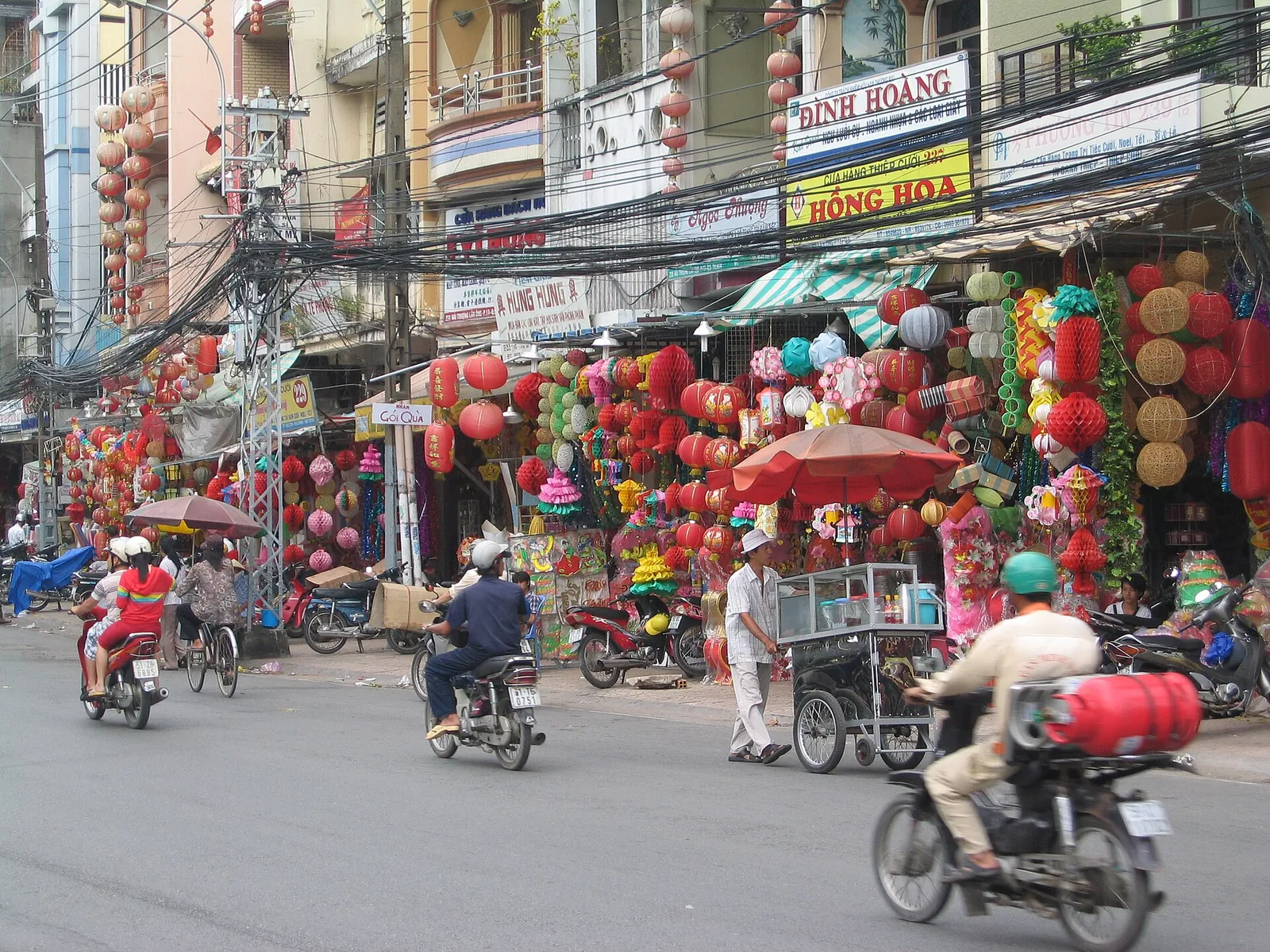
City authorities have discussed a pedestrian night street on the four streets around the market to grow the evening economy; we could not confirm whether it is running now, so do not plan an evening around it. The national tourism site describes Cholon simply as an area that is "great for exploring on foot", and the streets between the market and Nguyen Trai, including the rows of old Chinese shophouses on Hai Thuong Lan Ong, are the best argument for walking at least part of the way.
Getting there and getting around
From District 1, a taxi or ride-hailing car is the simplest way to reach either cluster. The national tourism site recommends Vinasun and Mai Linh as trusted taxi companies, and notes that ride-hailing apps such as Grab work once you have a Vietnamese SIM card. Ask for Thien Hau Temple (Chùa Bà Thiên Hậu, Nguyễn Trãi) or Binh Tay Market (Chợ Bình Tây) by their Vietnamese names; show the written name if the driver hesitates.
Between the temples and the market, a car ride is short; walking takes longer in the heat but passes through shophouse streets you would otherwise miss. A sensible order is temples first, while the halls are calm, then the market, then food. Local buses cover much of the city, and a private hop-on hop-off route links District 1 with Districts 5 and 6, stopping at Thien Hau, Nghia An, Cha Tam Church, the Cho Lon Mosque and Binh Tay Market; check the operator's current route and ticket before relying on it.
Traffic in Cholon is dense. Cross streets slowly and steadily, carry water, and treat a shophouse café as part of the visit rather than wasted time.
A half-day or evening plan
This is an editorial suggestion, not a timetable. Opening times for the temples were not published on an official page we could read.
- Late morning: Thien Hau Temple on Nguyen Trai, then Nghia An Assembly Hall a short walk away.
- Lunch: wonton noodles, hu tieu or a plate of steamed buns and chive cakes in the streets nearby.
- Early afternoon: a ride to Binh Tay Market; walk the courtyard and the surrounding lanes.
- Evening (optional): stay on for a Hoa dinner — tam tinh hotpot, roast meats or dim sum — before a taxi back to District 1.
- Lunar New Year: expect crowds and lion dance troupes at the halls; leave more time for everything.
What to combine it with
Cholon pairs naturally with a District 1 morning of the cathedral, post office and Ben Thanh Market, but not with Cu Chi or the Mekong Delta on the same day: both are long trips out of the city and deserve their own day. If Hoa food is the point of your trip, pair Cholon with a separate evening for the city's broader street food, from banh mi to banh xeo and com tam.
If you are heading on to the Mekong Delta and Can Tho, Cholon makes a good last afternoon in the city before you leave: it needs no early start, and it ends naturally with dinner. Keep the delta itself for days of its own.
Practical questions
How much time do I need for Cholon?
Half a day covers Thien Hau Temple, Nghia An Assembly Hall and Binh Tay Market at an easy pace. Add the evening if you want a proper Hoa dinner rather than a quick bowl of noodles.
Is Cholon the same as District 5?
Not exactly. Cholon is the historic Chinese town that grew up west of Saigon; today it is usually described as covering Districts 5 and 6, with its food and family businesses reaching into Districts 10 and 11.
How do I get to Cholon from District 1?
A taxi or ride-hailing car is the simplest option. Ask for Thien Hau Temple on Nguyen Trai Street or Binh Tay Market by their Vietnamese names. Local buses and a hop-on hop-off route also serve the area.
Is Binh Tay Market worth visiting if I don't want to shop?
Yes, for the 1928 building, the courtyard and clock tower and the sight of a working wholesale market. It is a working wholesale market first; some stalls sell souvenirs and packaged delicacies.
When is the best time to visit the temples?
An ordinary weekday morning is calmest. Lunar New Year, full-moon days and Thien Hau's festival on the 23rd day of the third lunar month are the most atmospheric but also the most crowded.
Should I stay in Cholon or in District 1?
District 1 suits most first visits because it is close to the main sights and has the widest choice of hotels. Stay in Cholon if your trip is about food and temples and you want early mornings there.
Sources and checks before you travel
Reference sources for the version dated 3 October 2026. Confirm opening times, access, transport and conditions for your travel dates.
- Vietnam Tourism: Ho Chi Minh City ↗ — opens in a new tab
- Vietnam Tourism: 7 must-see attractions in HCMC ↗ — opens in a new tab
- Vietnam Tourism: Ho Chi Minh City itinerary ↗ — opens in a new tab
- Vietnam Tourism: Eating like a local in HCMC ↗ — opens in a new tab
- Vietnam Tourism: A traveller's guide to Vietnam's airports ↗ — opens in a new tab
- VnExpress International: Ba Thien Hau Pagoda, a slice of China in Saigon ↗ — opens in a new tab
- VnExpress International: Crawling under a wooden horse for luck in Saigon pagoda ↗ — opens in a new tab
- VnExpress International: Saigon's Chinatown market back in business ↗ — opens in a new tab
- VnExpress International: Life in HCMC's Chinatown 100 years ago ↗ — opens in a new tab
- VnExpress International: December food fest to promote Saigon's Chinatown ↗ — opens in a new tab
- VnExpress International: Hop-on hop-off bus tour launched in HCMC's Chinatown ↗ — opens in a new tab
- VnExpress International: HCMC plans to open night street in Chinatown ↗ — opens in a new tab
- VnExpress International: Hakka Chinese hotpot, a 40-year legacy in HCMC's Chinatown ↗ — opens in a new tab
- VnExpress International: Five delectable Chinatown snacks ↗ — opens in a new tab
- VnExpress International: Hong Kong's signature cakes shine at Saigon's Chinatown ↗ — opens in a new tab
- VnExpress International: 5 variations for noodle lovers in Saigon ↗ — opens in a new tab
- VnExpress International: Saigon eatery serves noodle soup with venison for 60 years ↗ — opens in a new tab
Does this experience fit your route?
If you would rather not navigate Cholon's noodle shops and bakeries alone, a guided food tour can help. Check that it really goes to District 5 or 6, how many stops it makes and whether it replaces dinner.
Browse relevant experiences on Viator ↗ — opens in a new tabAffiliate link · Book with ViatorPhoto credits
Binh Tay Market's clock tower and main entrance; the market was built in 1928 and restored between 2016 and 2018.
Photograph: Syced — opens in a new tab · CC0 — opens in a new tab
Changes: Resized and converted to WebP; displayed with responsive crops. · Original photograph and licence details ↗ — opens in a new tab
Thien Hau Temple (Tue Thanh Assembly Hall), founded by Cantonese merchants on Nguyen Trai Street.
Photograph: Balon Greyjoy — opens in a new tab · CC0 — opens in a new tab
Changes: Resized and converted to WebP; displayed with responsive crops. · Original photograph and licence details ↗ — opens in a new tab
Incense burners inside Thien Hau Temple; the hall is busiest at Lunar New Year and on full-moon days.
Photograph: frank mckenna frankiefoto — opens in a new tab · CC0 — opens in a new tab
Changes: Resized and converted to WebP; displayed with responsive crops. · Original photograph and licence details ↗ — opens in a new tab
Nghia An Assembly Hall (Ong Pagoda), built by Chaozhou and Hakka migrants and dedicated to Quan Cong.
Photograph: Darren On The Road — opens in a new tab · CC BY 2.0 — opens in a new tab
Changes: Resized and converted to WebP; displayed with responsive crops. · Original photograph and licence details ↗ — opens in a new tab
Lantern stalls and shophouses on Hai Thuong Lan Ong Boulevard in Cholon.
Photograph: Ken Marshall — opens in a new tab · CC BY 2.0 — opens in a new tab
Changes: Resized and converted to WebP; displayed with responsive crops. · Original photograph and licence details ↗ — opens in a new tab
Hu tieu Nam Vang, one of the rice noodle soups eaten across Ho Chi Minh City.
Photograph: Phương Huy ( thảo luận ) — opens in a new tab · Public domain — opens in a new tab
Changes: Resized and converted to WebP; displayed with responsive crops. · Original photograph and licence details ↗ — opens in a new tab