Gangwon · Gangwon State
Yangyang travel guide: surf beaches, Naksansa Temple and where to stay
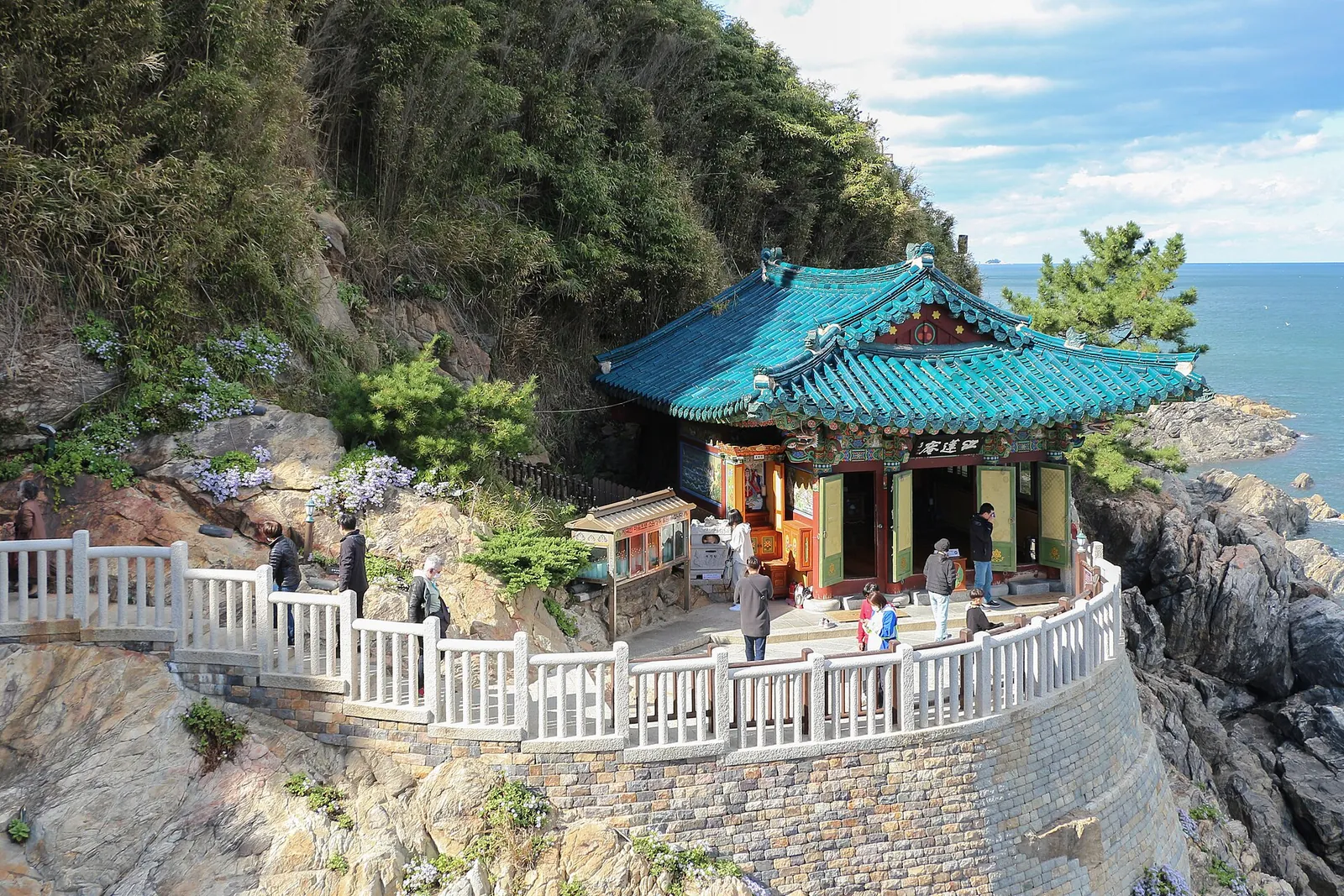
Yangyang is the stretch of Gangwon's east coast between Sokcho and Gangneung, and it has two quite different reasons to stop. In the north, Naksansa Temple sits on a headland above the East Sea, with a hermitage built into the sea cliff and a pavilion that VisitKorea counts among the Eight Sights of Gwandong. Further south, around Ingu, Jukdo and Hajodae, the shallow sandy beaches have turned Yangyang into Korea's best-known surf coast, with surf schools, board rental and cafés along the shore. There is no big town to anchor a stay, so the choice is less about sights than about which beach you wake up on.
- Suggested time
- 2–3 nights for surfing; 1 night or a day trip for Naksansa
- Where to stay
- Ingu and Jukdo beaches for surfing; Naksan Beach for the temple and bus links
- Season and timing
- Beaches are open for supervised swimming only in high summer (VisitKorea lists July to August at Ingu and Hajodae; Naksan Beach ran from 11 July to 24 August in 2025). Surfyy Beach is listed as open year-round. Mid-October brings the Yangyang Pine Mushroom and Salmon Festival (16 to 18 October 2026) and autumn colour in Osaek's Jujeongol Valley.
The short answer
Stay two or three nights if you want to surf; one night, or a day from Sokcho, is enough for Naksansa Temple and Naksan Beach alone. Surfers and anyone who wants a quiet beach base should sleep in the south around Ingu and Jukdo or near Hajodae; temple visitors and first-timers without a car do better at Naksan Beach, which is walkable to Naksansa and close to Sokcho. Come by express or intercity bus from Seoul Express Bus Terminal or Dong Seoul Terminal to Yangyang, then use local buses or taxis along the coast. Pick Sokcho instead if you want a livelier town base, and Gangneung if you want a city with a railway station.
Yangyang, Sokcho or Gangneung: who should stay here
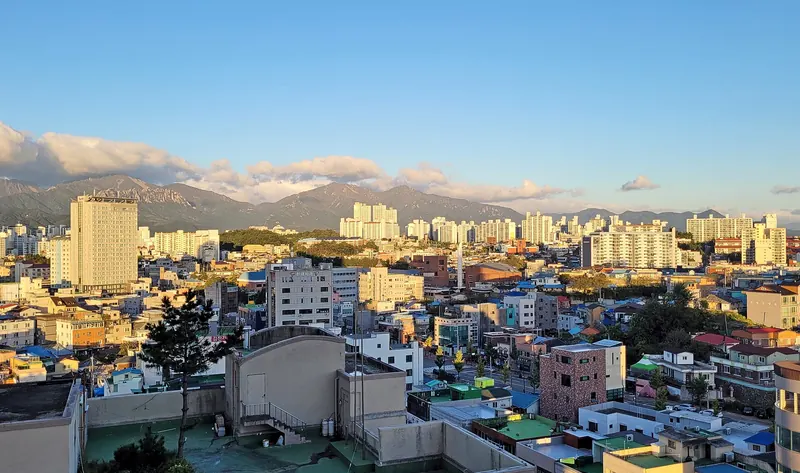
Yangyang county runs roughly from Naksansa Temple, just south of Sokcho, down the coast past Hajodae to Jukdo and Ingu, with the Seoraksan foothills and the Osaek valley inland. Unlike its neighbours it has no compact city centre: the county town of Yangyang-eup has the bus terminal and a traditional market, while the places you come for are spread out along the coast and the hills behind it. That shapes the decision.
Stay in Yangyang if your trip is about the sea itself — surf lessons, a beach you can walk out to before breakfast, or a quiet few days with a book. VisitKorea describes Ingu Beach as wide, quiet and shallow, popular with novice surfers, with surf shops and accommodation behind it, and Yangyang's own smart-tourism project runs live surf webcams at 13 beaches in the county. Stay in Sokcho if you want a larger town with more restaurants and evening life, and treat Naksansa as a short hop south. Stay in Gangneung if you want a city with a railway station, and visit Yangyang's beaches as a day out.
Within Yangyang, the two sensible bases are Naksan Beach in the north and the Ingu–Jukdo stretch in the south. Naksan suits travellers without a car: VisitKorea places the beach about five minutes on foot from the Naksan bus terminal and lists cafés, restaurants and accommodation along it, and Naksansa is at its northern end. Ingu and Jukdo suit surfers who want to be in the water early and stay out until the light goes.
Surfing at Ingu, Jukdo and Surfyy Beach
Yangyang's surf scene is built on shallow, sandy beaches rather than reef breaks, which is why it works for learners. Jukdo is a small former island — VisitKorea gives its circumference as about 1 kilometre — now joined to the mainland and covered in pine and bamboo. Jukdo Beach lies to its north and Ingu Beach to its south. A path circles the island past Jukdojeong Pavilion and the Jukdo Observatory, both free and open around the clock when we checked; it is a good sunrise walk before a session. VisitKorea also lists Waveworks, a coworking space at Jukdo Beach, for travellers who want to mix remote work with surfing.
Surfyy Beach, just north of Hajodae Beach, is a 1-kilometre stretch designated for surfing. VisitKorea calls it the first of its kind in Korea and says it runs the largest surf school, with around 1,000 boards, lessons for beginners to advanced surfers, board and wetsuit rental, surf yoga and SUP. When we checked on 3 October 2026, VisitKorea listed introductory surf lessons at 50,000 to 60,000 won, beach yoga at 30,000 won and SUP at 30,000 to 40,000 won, with the surf school running from 10:00 to 18:00; it notes that rates change with the season, so confirm before you book.
If you are learning, take a lesson rather than renting a board on the first day: the instructor chooses the beach and the time for the conditions, and covers where to paddle out. Check the county's surf webcams the evening before. Outside July and August, beaches are not staffed for swimmers, so stay inside the area your school uses.
- Ingu Beach: shallow and popular with novice surfers; 12 Inguhang-gil, Hyeonnam-myeon
- Jukdo: island walk, pavilion and observatory between Jukdo Beach and Ingu Beach
- Surfyy Beach: surf school, rental, yoga and SUP; 119 Hajodaehaean-gil, Hyeonbuk-myeon
- Dongho Beach: a small beach near Yangyang International Airport with a surf shop, lessons and rental, according to VisitKorea
Make time for the local food
What to eat and where to look
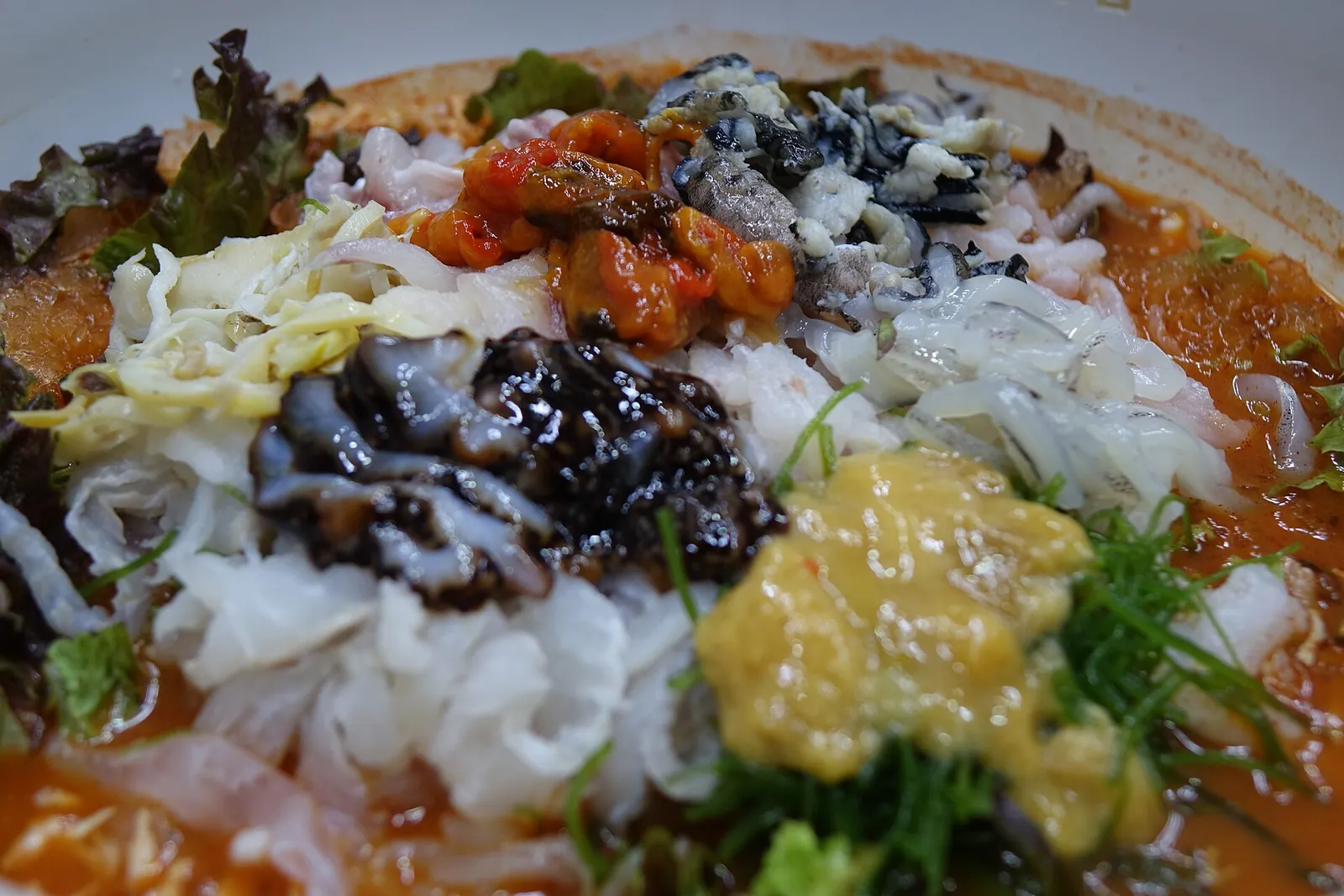
Jogae mulhoe (cold raw clam soup)
A cold, spicy soup poured over boiled venus clams and thinly sliced lettuce, carrot and cucumber. VisitKorea notes that in Yangyang it is called jjaebok mulhoe, from the local name for the East Sea venus clam.
- Where to look
- Seafood restaurants near the ports and beaches. VisitKorea lists Jeongin Hoesikdang at 32 Naksansa-ro, near Naksan Beach, for mul hoe and fish stews, open 07:00 to 21:00 when we checked.
- Fit it into your day
- A summer lunch after the beach or the temple.
Raw and lightly cooked seafood; ask for it less spicy if you need to.
Jogaetang (venus clam soup)
A clear, slightly sweet clam soup, also called jjaebok-tang in Yangyang. VisitKorea describes the clam meat as chewy, with little fishy smell.
- Where to look
- Seafood restaurants along the coast.
- Fit it into your day
- A warm dinner on cooler evenings, or the morning after a late night.
Shellfish allergy; ask for the price per portion before ordering.
Seopguk (spicy mussel soup)
Wild mussels, called seop in the Gangwon dialect, boiled in a spicy broth with onions, mushrooms and chives. VisitKorea names Yangyang among the coastal towns where it is mainly eaten; some restaurants add ramyeon or noodles.
- Where to look
- Local seafood restaurants on the coast and in Yangyang-eup.
- Fit it into your day
- A winter or after-surf dinner.
Usually very spicy.
Buckwheat noodles (memil guksu)
Gangwon is known for buckwheat, and VisitKorea calls buckwheat noodles a Yangyang speciality. Expect noodles in a cold broth or with a spicy dressing, often with a buckwheat pancake on the side.
- Where to look
- VisitKorea lists Yeonggwangjeong Memilguksu at 446 Jinmi-ro, Ganghyeon-myeon, and Beombu Memil Guksu near Osaek.
- Fit it into your day
- A light lunch on a temple day or on the way to Osaek.
Some broths and pancakes contain wheat, egg or meat stock; ask if you have an allergy.
Pine mushrooms with hanu beef
Yangyang's autumn delicacy: wild pine mushrooms (songi), grilled or in hot pot. VisitKorea lists Deungbul Garden in Yangyang-eup for grilled pine mushrooms with Korean beef, and notes that the mushrooms are served only when they can be harvested.
- Where to look
- Deungbul Garden, 23 Powolladeul-gil, Yangyang-eup, and restaurants around the October festival.
- Fit it into your day
- A splurge dinner in festival season.
Wild pine mushrooms are expensive and seasonal; ask the price before ordering.
Naksansa Temple, Hongnyeonam and Uisangdae
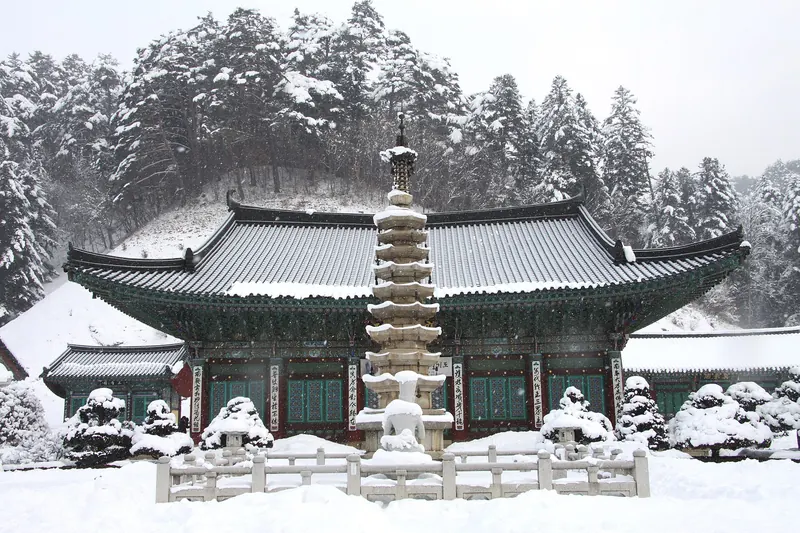
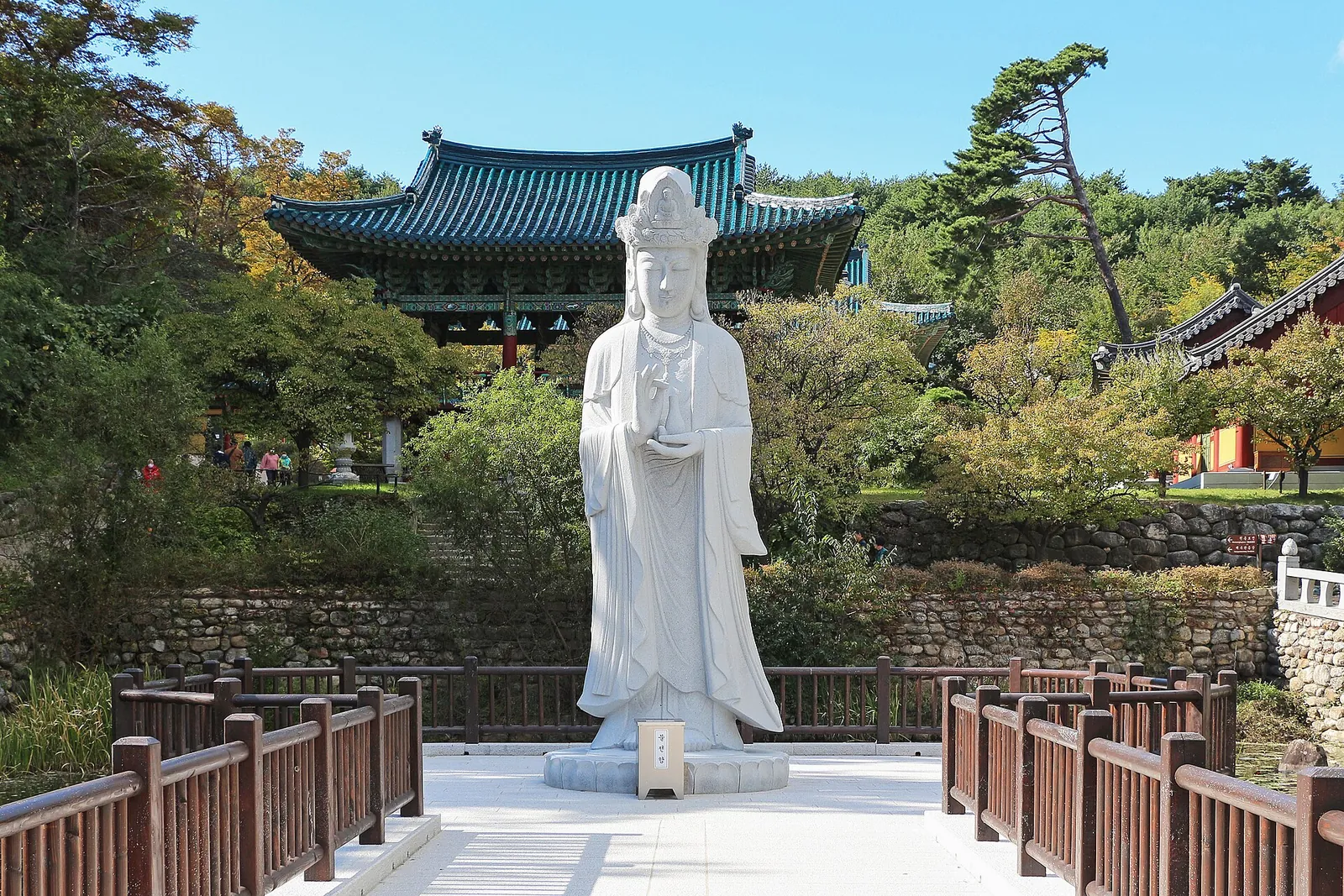
Naksansa was founded in 671 by the Silla monk Uisang, according to VisitKorea, and is regarded as one of Korea's three main centres of devotion to Avalokitesvara, the bodhisattva of compassion, alongside Bomunsa on Ganghwa and Boriam on Namhae. Much of what you see is recent: a forest fire in 2005 destroyed 20 buildings, including the hall that housed the temple bell. The grounds include a 16-metre statue of Avalokitesvara.
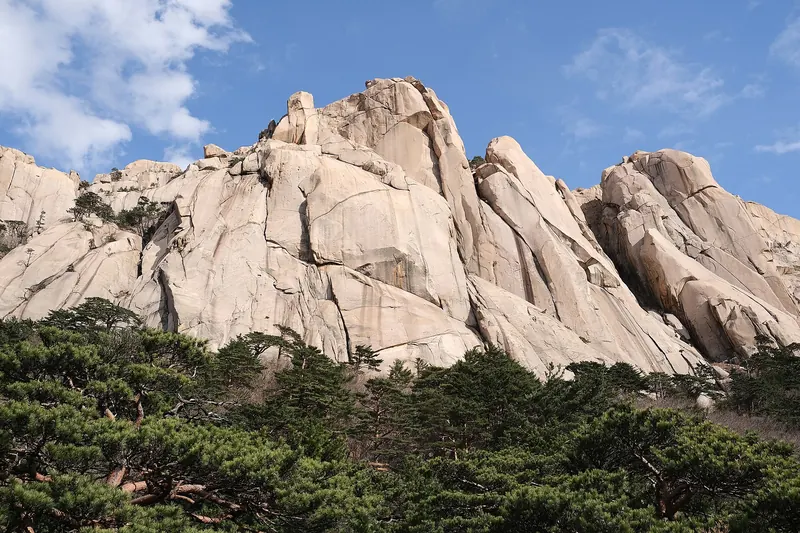
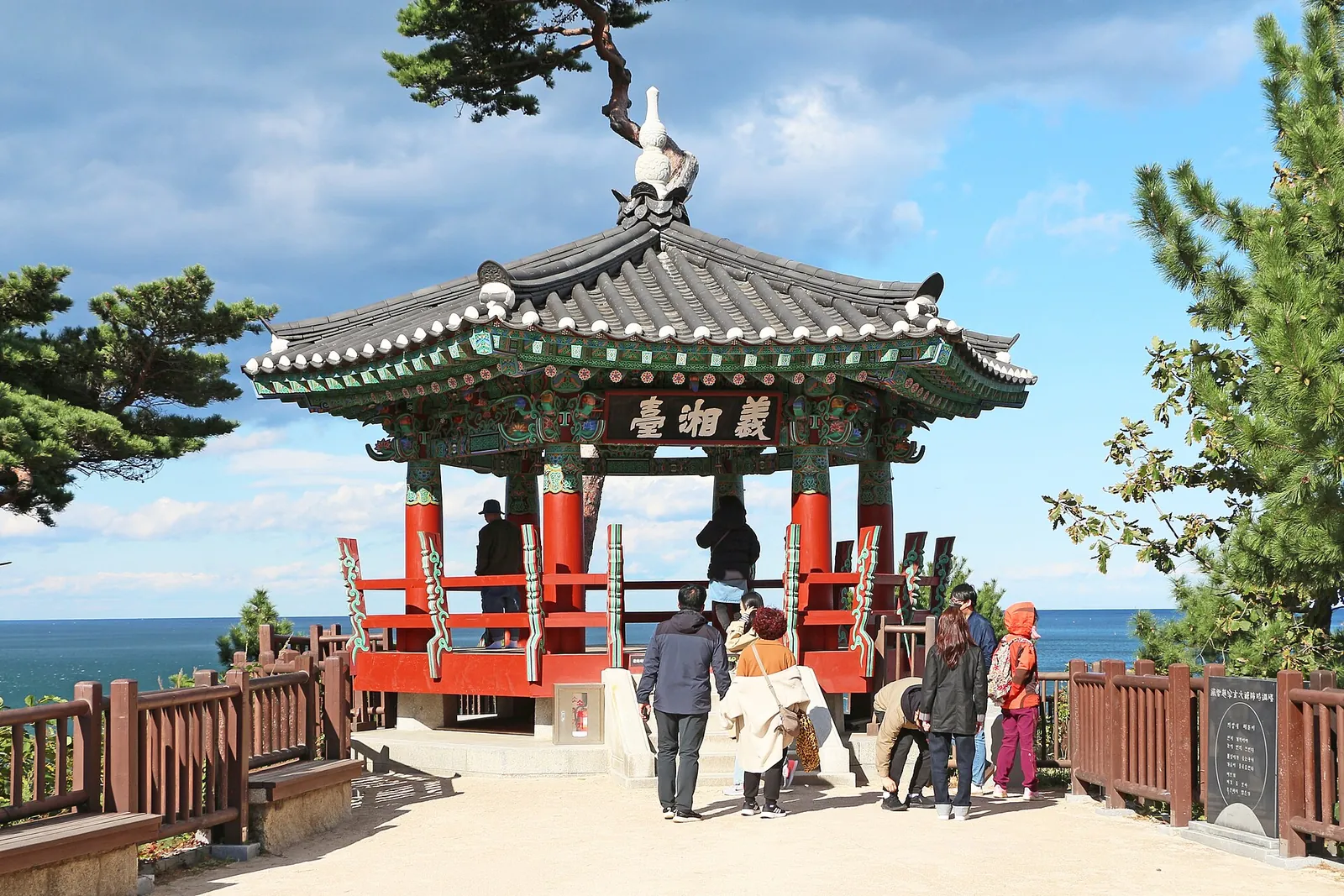
The best part is on the cliffs. A path leads from the main temple to Uisangdae, a hexagonal pavilion on a seaside cliff where Uisang is said to have meditated, restored in its present form in 1995 and one of the east coast's classic sunrise points. Beyond it, the path continues to Hongnyeonam Hermitage and its Gwaneumgul Cave, set on the rocks right above the water. Together they are designated Scenic Site No. 27 under the name 'Uisangdae Pavilion and Hongnyeonam Hermitage of Naksansa Temple, Yangyang'.
When we checked on 3 October 2026, VisitKorea listed Naksansa as open daily from 06:00 to 17:30, with visitors required to leave the grounds by 18:30, and the Uisangdae listing gave entry as free; parking was listed at 4,000 won. For sunrise at Uisangdae, sleep at Naksan Beach the night before. The temple also runs templestay programmes, booked through its own website. Dress modestly and keep quiet around the hermitage, which is an active place of prayer.
Hajodae and the coast between the beaches
Hajodae is a rocky headland in Hyeonbuk-myeon, roughly midway along the county's coast, with rock stacks, pine forest and a pavilion on top of the cliff. VisitKorea explains that the name comes from Ha Ryun and Jo Jun, two late-Goryeo officials who became founding ministers of the Joseon dynasty; the current pavilion is a 1998 restoration. An old pine on the cliff became famous from the broadcast footage of the national anthem.
Wooden deck paths link the pavilion with a white unmanned lighthouse and the Hajodae Observatory along the Hajodae Trail. When we checked, VisitKorea listed the trail as open from 06:00 to 20:00 between April and September and 07:00 to 18:00 between October and March. Hajodae Beach, about a kilometre to the northwest, is around 1.5 kilometres long and, VisitKorea notes, slightly warmer than other east-coast beaches because two streams flow in nearby; swimming is supervised in July and August.
Combine Hajodae with Surfyy Beach, which is next door, or stop on the way between Naksan and Ingu. Without a car, a taxi between the headlands is the practical option; VisitKorea's airport guide puts Hajodae about 10 minutes by taxi from Yangyang International Airport.
Naksan Beach and Yangyang-eup
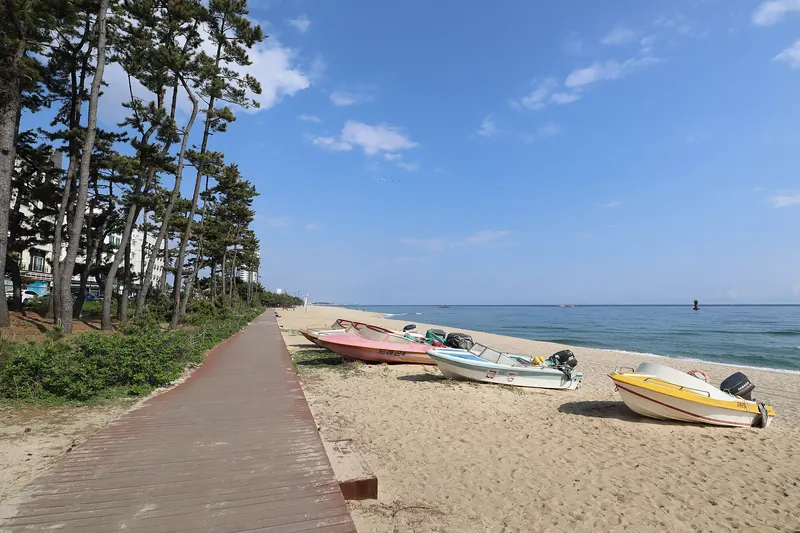
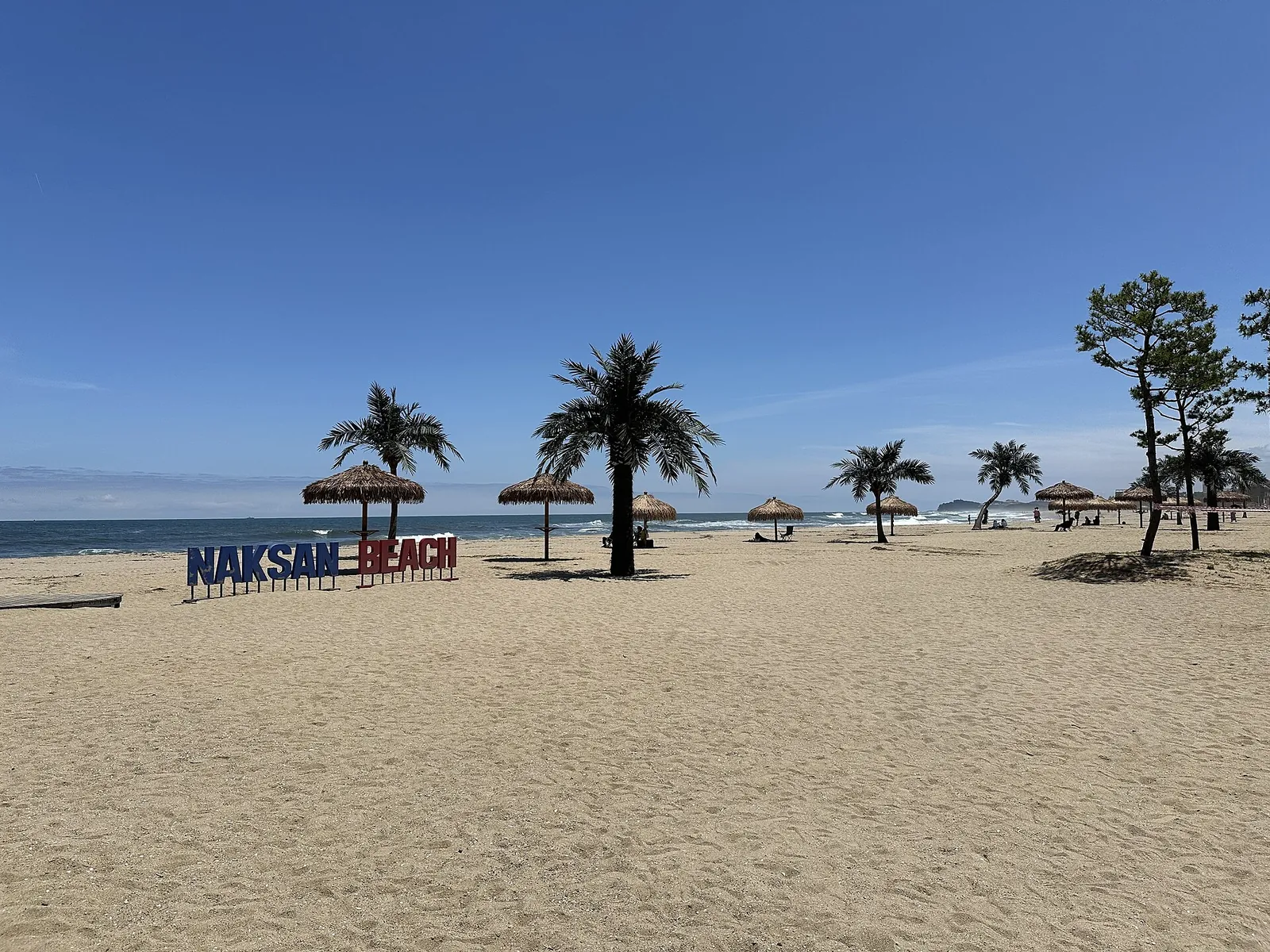
Naksan Beach is Yangyang's classic family beach. VisitKorea describes 4 kilometres of sand backed by pine trees, water less than 1.5 metres deep, and more than a million visitors a year since it opened in 1963. Naksanhang Port and the temple hill close its northern end; a lagoon at the mouth of Namdaecheon, the stream that comes down from Seoraksan, closes the southern end. It is also a winter sunrise spot, busiest on New Year's Day.
Inland, the county town of Yangyang-eup has the intercity bus terminal and the Yangyang Traditional Market at 9 Nammun 5-gil. VisitKorea notes that the market grew up as a meeting point for produce from the mountains and the sea, with goods that change with the season; its Korean name marks it as a market held on dates ending in 4 and 9. The Namdaecheon riverbanks are the venue for the autumn festival.
Inland: Osaek and the Seoraksan side of Yangyang
Yangyang's Seo-myeon district reaches up into the southern part of Seoraksan National Park. Osaek is known for its carbonated, iron-rich mineral spring, about 20 kilometres west of Yangyang, and for Jujeongol Valley, where VisitKorea describes a 7-kilometre trail from the spring to Yongsopokpo Falls that is known for maple colour in autumn. When we checked, VisitKorea listed the valley entry hours as 03:00 to sunset in summer and 04:00 to sunset in winter, with free entry.
Above Osaek, Osaengnyeong Pass (Hangyeryeong on the Inje side) is a 1,004-metre pass on National Road 44 and the start of the shortest route to Daecheongbong, Seoraksan's highest peak. That climb is a serious full-day hike; see our Seoraksan guide before attempting it. Trail access can be restricted in bad weather, so check the national park's notices on the day.
Autumn: the Pine Mushroom and Salmon Festival
Yangyang's main autumn event combines its two seasonal specialities: pine mushrooms (songi) from the hills and salmon returning up Namdaecheon. VisitKorea's listing gave the 2026 dates as 16 to 18 October, from 10:00 to 21:00 along Namdaecheon in Yangyang-eup, organised by the Yangyang-gun Cultural Foundation. Programmes include a pine mushroom treasure hunt in the forest and catching salmon by hand in the stream. Entry is free, though some programmes charge.
Festival weekends are the one time accommodation in the south of the county is not the issue — the centre of gravity moves to Yangyang-eup. Book early if your dates overlap and you want to stay near the river.
Practical questions
Is Yangyang good for beginner surfers?
Yes. VisitKorea describes Ingu Beach as shallow and popular with novice surfers, and Surfyy Beach runs a surf school with lessons for beginners. Take a lesson rather than renting a board on your first day.
Should I stay in Yangyang or Sokcho?
Stay in Yangyang for surfing and quiet beaches, in the south around Ingu and Jukdo or near Hajodae. Stay in Sokcho if you want a larger town with more restaurants; Naksansa is a short trip south from there.
What are Naksansa Temple's opening hours?
When we checked on 3 October 2026, VisitKorea listed 06:00 to 17:30, with visitors required to leave by 18:30. Uisangdae was listed as free to enter, and parking at 4,000 won.
How do I get to Yangyang from Seoul?
VisitKorea lists Yangyang among the routes from both Seoul Express Bus Terminal and Dong Seoul Terminal. From the Yangyang terminal, use local buses or a taxi along the coast; Naksan Beach also has its own bus terminal.
When can I swim at the Yangyang beaches?
Supervised swimming is in high summer: VisitKorea lists July to August at Ingu and Hajodae, and Naksan Beach ran from 11 July to 24 August in 2025. Outside that window there are no lifeguards.
When is the Yangyang Pine Mushroom and Salmon Festival?
VisitKorea's listing gave 16 to 18 October 2026, along Namdaecheon in Yangyang-eup, with free entry and some paid programmes.
Sources and checks before you travel
Reference sources for the version dated 3 October 2026. Confirm opening times, access, transport and conditions for your travel dates.
- VisitKorea: Naksansa Temple ↗ — opens in a new tab
- VisitKorea: Uisangdae Pavilion ↗ — opens in a new tab
- VisitKorea: Naksan Beach ↗ — opens in a new tab
- VisitKorea: Best Summer Beach Destinations ↗ — opens in a new tab
- VisitKorea: Ingu Beach ↗ — opens in a new tab
- VisitKorea: Jukdojeong Pavilion and Jukdo Observatory ↗ — opens in a new tab
- VisitKorea: Yangyang Surfyy Beach ↗ — opens in a new tab
- VisitKorea Smart Tourism City: Yangyang – GOGO YANGYANG ↗ — opens in a new tab
- VisitKorea: Hajodae Scenic Point ↗ — opens in a new tab
- VisitKorea: Hajodae Trail ↗ — opens in a new tab
- VisitKorea: Hajodae Beach ↗ — opens in a new tab
- VisitKorea: Yangyang Dongho Beach ↗ — opens in a new tab
- VisitKorea: Yangyang Traditional Market ↗ — opens in a new tab
- VisitKorea: Yangyang Pine Mushroom and Salmon Festival ↗ — opens in a new tab
- VisitKorea: Seoraksan Osaek Jujeongol Valley ↗ — opens in a new tab
- VisitKorea: Osaek Mineral Spring ↗ — opens in a new tab
- VisitKorea: Osaengnyeong (Hangyeryeong) Pass ↗ — opens in a new tab
- VisitKorea: Express Bus and Intercity Bus ↗ — opens in a new tab
- VisitKorea: Airport Transportation Guide ↗ — opens in a new tab
- VisitKorea: International Flights ↗ — opens in a new tab
- VisitKorea: Cold Raw Clam Soup (Jogaemulhoe) ↗ — opens in a new tab
- VisitKorea: Clam Soup (Jogaetang) ↗ — opens in a new tab
- VisitKorea: Mussel Soup (Seopguk) ↗ — opens in a new tab
- VisitKorea: Jeongin Hoesikdang ↗ — opens in a new tab
- VisitKorea: Deungbul Garden ↗ — opens in a new tab
- VisitKorea: Korean vegetable dishes (buckwheat) ↗ — opens in a new tab
- VisitKorea: Osaek Greenyard Hotel ↗ — opens in a new tab
Does this experience fit your route?
Yangyang is best done independently: a bus from Seoul, a beach base and a surf lesson booked locally. A guided day from Seoul makes sense only if you want Seoraksan and Naksansa in one go — check the time it leaves at the temple.
Browse relevant experiences on Viator ↗ — opens in a new tabAffiliate link · Book with ViatorPhoto credits
Hongnyeonam Hermitage on the sea cliffs at Naksansa Temple, Yangyang
Photograph: Bernard Gagnon — opens in a new tab · CC0 — opens in a new tab
Changes: Resized and converted to WebP; displayed with responsive crops. · Original photograph and licence details ↗ — opens in a new tab
Naksan Beach, Yangyang's classic family beach
Photograph: Grapesurgeon — opens in a new tab · CC BY-SA 4.0 — opens in a new tab
Changes: Resized and converted to WebP; displayed with responsive crops. · Original photograph and licence details ↗ — opens in a new tab
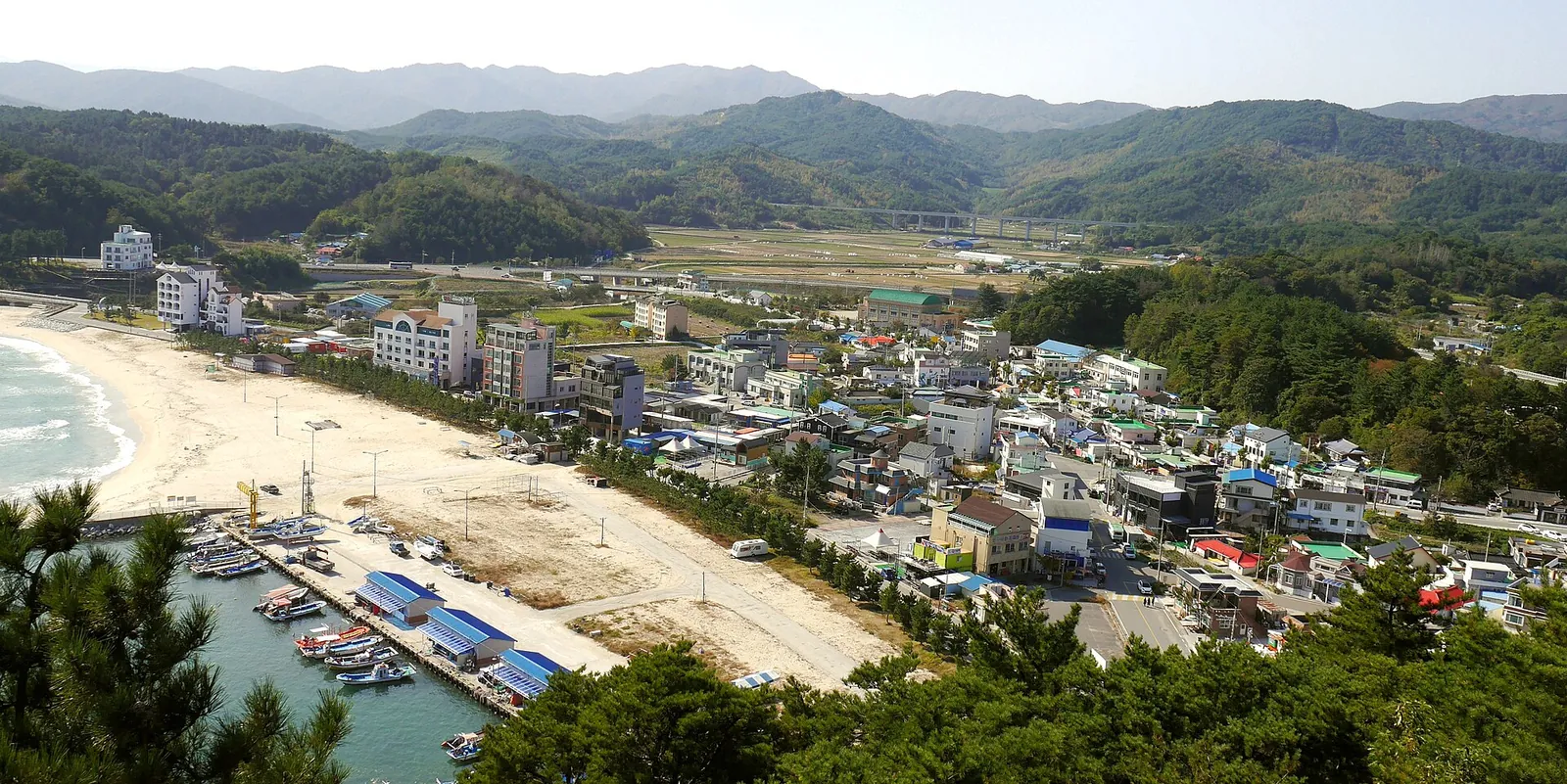
Ingu Beach and its small port on Yangyang's southern coast
Photograph: EasyKL — opens in a new tab · CC BY-SA 3.0 — opens in a new tab
Changes: Resized and converted to WebP; displayed with responsive crops. · Original photograph and licence details ↗ — opens in a new tab
Uisangdae Pavilion, a classic sunrise point at Naksansa Temple
Photograph: Bernard Gagnon — opens in a new tab · CC0 — opens in a new tab
Changes: Resized and converted to WebP; displayed with responsive crops. · Original photograph and licence details ↗ — opens in a new tab
A bodhisattva statue in the grounds of Naksansa Temple
Photograph: Bernard Gagnon — opens in a new tab · CC0 — opens in a new tab
Changes: Resized and converted to WebP; displayed with responsive crops. · Original photograph and licence details ↗ — opens in a new tab
Mulhoe, the cold raw seafood soup served along the Gangwon coast (photographed at a restaurant in Goseong)
Photograph: 최광모 — opens in a new tab · CC0 — opens in a new tab
Changes: Resized and converted to WebP; displayed with responsive crops. · Original photograph and licence details ↗ — opens in a new tab