Gangwon · Gangwon State
Odaesan guide: Woljeongsa fir forest, Seonjae-gil trail and temple stay
Odaesan is one of Korea's highest mountain parks. Its main peak, Birobong, rises to 1,563 metres, and the Korea National Park Service describes it as a holy site of the Manjusri faith. You do not need the summit, though. The best of Odaesan is lower down, in the valley of the Odaecheon stream. There a kilometre-long avenue of old firs leads to Woljeongsa, a temple founded in 643. A nine-kilometre forest path, once used by monks, follows the stream up to Sangwonsa, which keeps what VisitKorea calls Korea's oldest bronze bell. This guide treats Odaesan as a walk and a temple stay rather than a climb. It covers which stretch to walk, where to sleep and how to get there without a car.
- Suggested time
- 1 night (temple stay); a long day trip is possible but rushed
- Where to stay
- Woljeongsa Templestay, or Jinbu town by the KTX station
- Season and timing
- Autumn is the peak. The park service treats 1 October to 15 November as its high-demand period, and on 3 October 2026 at 11:00 it reported the Iljumun, Woljeongsa and Sangwonsa car parks full, so come by bus or early in the morning. The Odaesan Culture Festival runs at Woljeongsa and in the fir forest from 8 to 10 October 2026. Summer is cool under the trees, but heavy rain can flood parts of Seonjae-gil. In winter the snow lingers in the shaded valley, and the park service advises crampons on Seonjae-gil until April.
The short answer
Give it one night, ideally at Woljeongsa itself. Take the KTX Gangneung Line to Jinbu (Odaesan) Station and the Jinbu town bus towards Sangwonsa. Walk the fir forest from the Iljumun gate to the temple and see the stone pagoda. Then either walk the 9 km Seonjae-gil up the valley to Sangwonsa (about three and a half hours by the park service's timings) or ride the bus up and walk back down. Book Woljeongsa's year-round Relaxing Templestay at least two or three days ahead, check in by 15:00, and you get the evening chanting, the 04:20 dawn service and a quiet fir forest early in the morning. Without a temple stay, sleep in Jinbu or at a Pyeongchang resort. Climb Birobong (6.8 km return from Sangwonsa) only if you want a real hike as well.
Woljeongsa and the fir forest: the first two hours
Start where the temple's own visitors start, at the Iljumun (One-Pillar Gate). From there VisitKorea describes a path of about 1 km to Geumganggyo Bridge, lined with more than 1,700 fir trees. It is the walk most people picture when they think of Odaesan. Walk it in the early morning, before the day visitors arrive, and the temple appears at the far end.
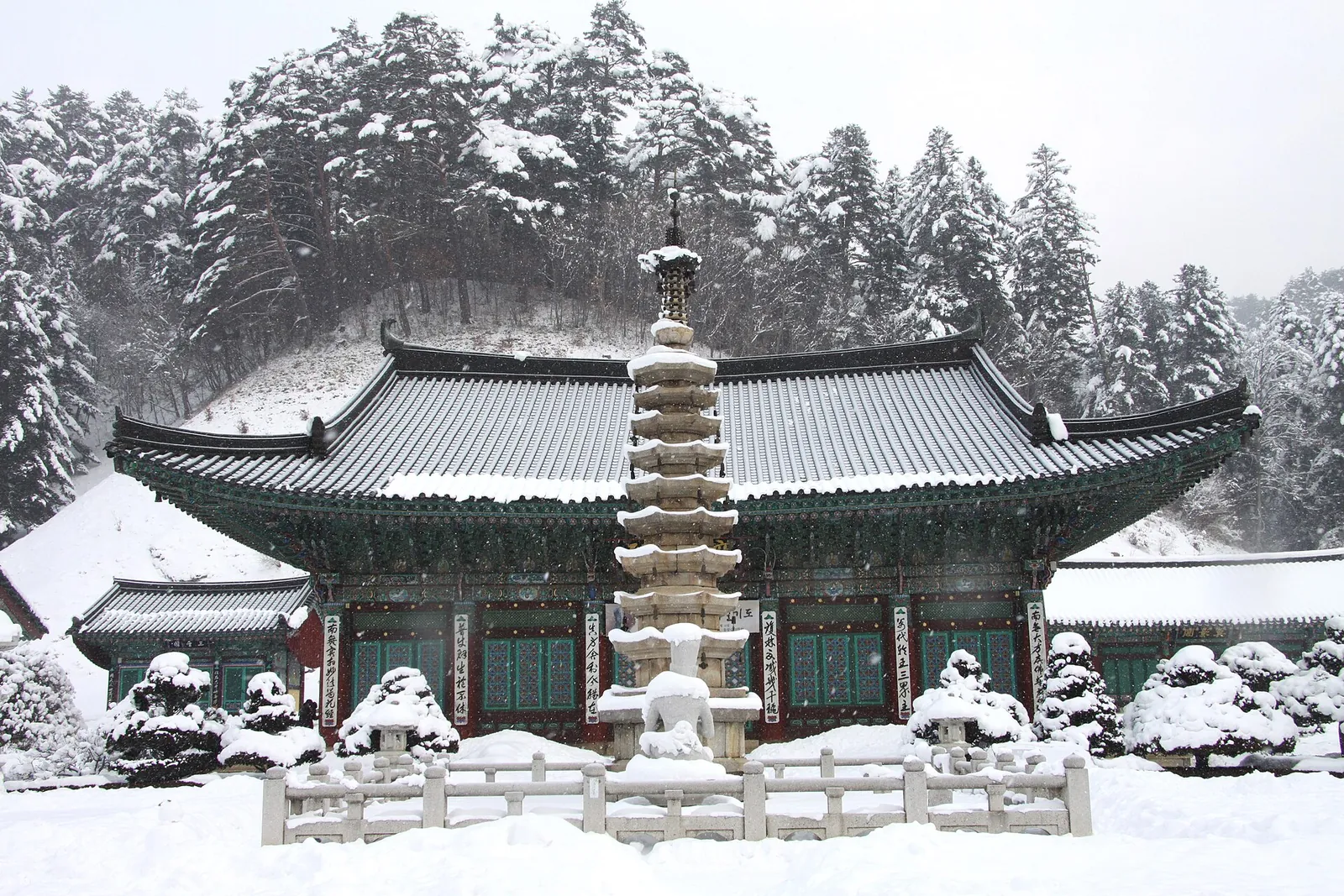
Woljeongsa was founded in 643, under Silla's Queen Seondeok, by the monk Jajang. Templestay Korea's temple page says he came to Odaesan after meeting Manjusri in China and brought relics of the Buddha with him. It also says the temple was completely destroyed during the Korean War and later rebuilt, so most of the buildings date from that rebuilding. The thing to look at is older: the octagonal nine-storey stone pagoda in front of the main hall, Jeokgwangjeon. Templestay Korea says it is traditionally attributed to Jajang but in style belongs to the Goryeo period. In front of it sits a stone bodhisattva with its hands held out together, making an offering to the Buddha.
VisitKorea lists the temple grounds as open 24 hours, all year. After the temple, decide how far up the valley to go. The temple's Odaesan Culture Festival takes over the temple grounds, the fir forest and the Nature Meditation Village from 8 to 10 October 2026, according to the festival's official site. Expect it to be busier than usual on those days.
Seonjae-gil: the monks' path to Sangwonsa
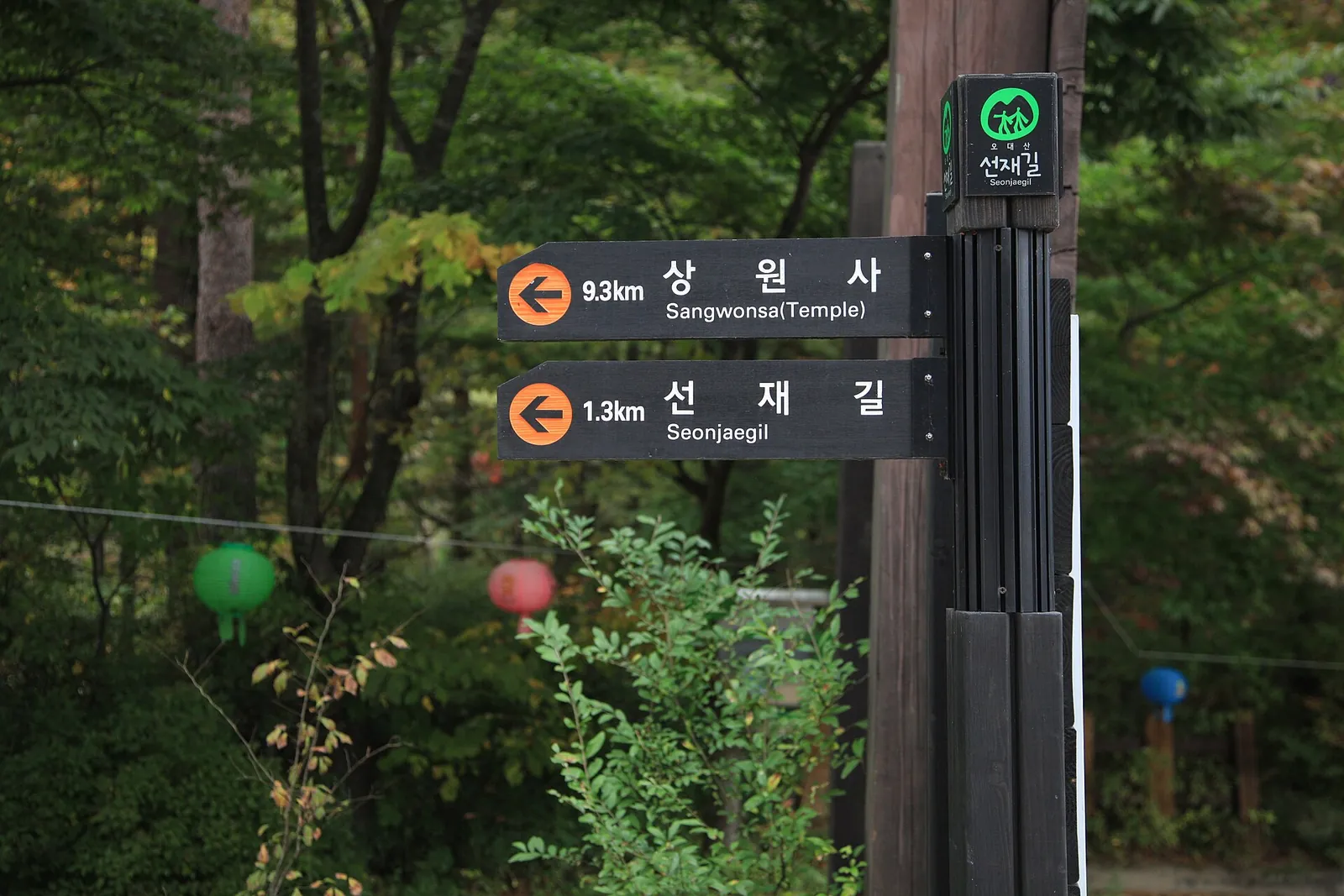
Seonjae-gil is a 9 km forest path from Woljeongsa to Sangwonsa. The Korea National Park Service says monks and Buddhist pilgrims used it before a road was built in the late 1960s. Most of it is level, it follows the Odaecheon under the trees, and the park service rates the whole route easy and recommends it for families with children and older walkers. It is best known for its autumn colour along the stream.
The park service splits it into two stretches. Woljeongsa (Iljumun) to Dongpigol is 5.4 km, about 2 hours 10 minutes, through tall oak and maple forest on an earth path, with wooden steps and decks. The decks were built around the trees rather than cutting them, so you sometimes have to duck. Dongpigol to Sangwonsa is 3.6 km, about 1 hour 20 minutes. It passes a native-plant garden where the park has restored about 30 rare species of the mountain, then a bamboo-grass stretch, then a short section on the unpaved road before the path continues to Sangwonsa. Along the way the park service points out old slash-and-burn farm sites, a traditional log footbridge (seopdari) and the line of an old forest railway.
Without a car, the easiest plan is to take the Jinbu bus up to Sangwonsa and walk back down the valley to Woljeongsa. You finish near the restaurants and the bus stop, with no bus to catch at the top. Walking the other way also works, but check the time of the last bus down before you set off. The park service notes that the route stays open during the spring and autumn wildfire-prevention closures (1 February to 15 May and 15 November to 15 December, varying with the weather), when many mountain trails shut.
- Woljeongsa (Iljumun) – Dongpigol: 5.4 km, about 2 h 10 min, mostly level forest path.
- Dongpigol – Sangwonsa: 3.6 km, about 1 h 20 min, past the native-plant garden.
- Winter to April: snow lingers in the shade, so the park service advises crampons and gaiters.
- After heavy summer rain: the stream can flood parts of the path, so the park service asks walkers to call the Odaesan office (+82-33-332-6417) first.
Make time for the local food
What to eat and where to look
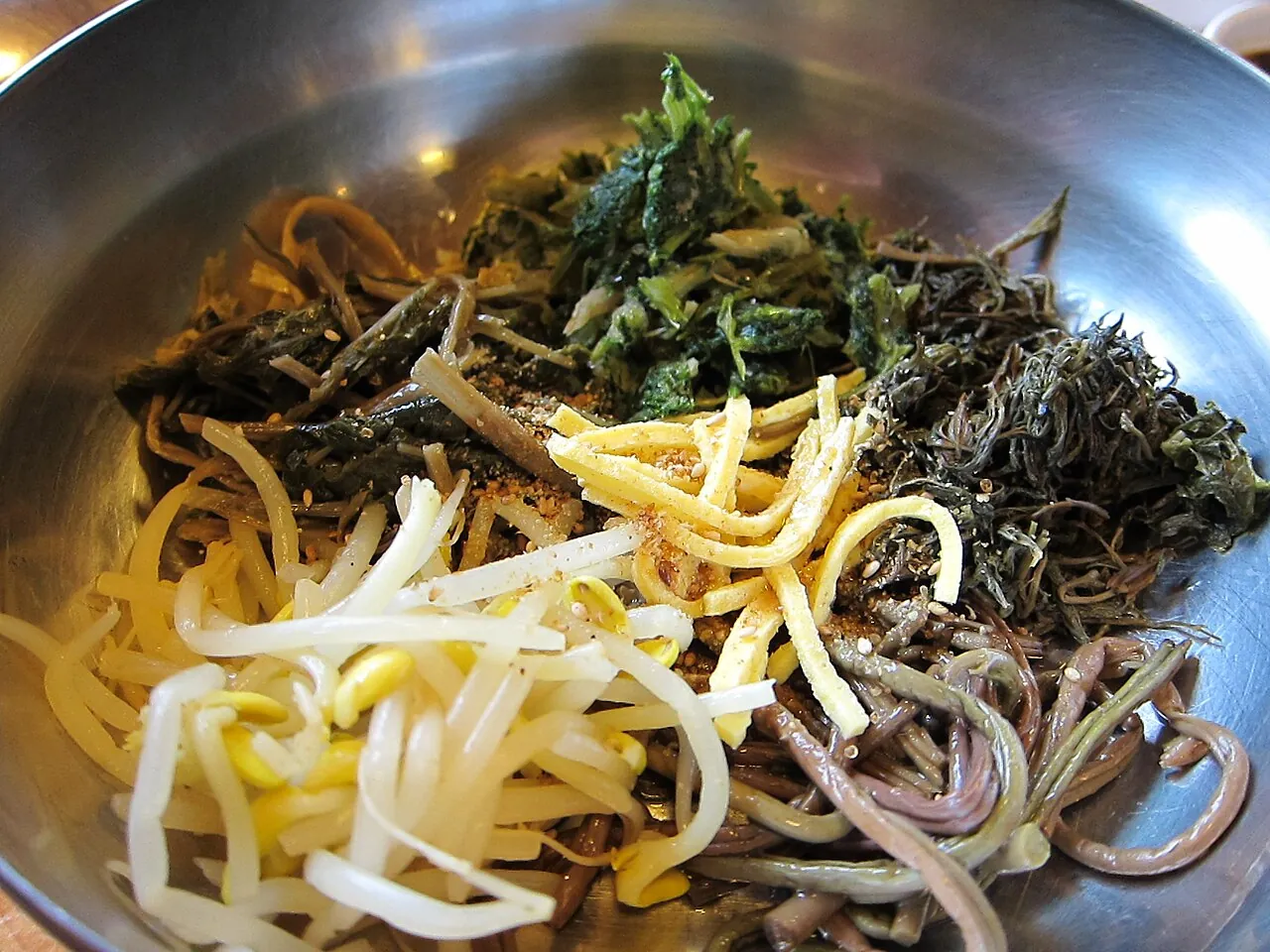
Sanchae jeongsik (wild-vegetable set meal)
A table of seasonal mountain greens and mushrooms, each seasoned differently, with rice, doenjang soup and side dishes. VisitKorea describes Odaesan Minsok Sikdang, at the entrance to Woljeongsa, as known for this set: the owner gathers the wild vegetables and mushrooms in the mountains, and the soybean paste is made in-house.
- Where to look
- Odaesan Minsok Sikdang, 152 Odaesan-ro, Jinbu-myeon, at the Woljeongsa entrance. When we checked on 2026-10-03, VisitKorea listed it as open 08:00–19:00 (last order 18:45), every day.
- Fit it into your day
- Lunch after the fir forest walk, or a late lunch after walking Seonjae-gil down from Sangwonsa.
If you avoid fish, ask whether the soup and side dishes use fish stock.
Gondeure-bap (thistle rice)
Rice cooked with gondeure, a mountain thistle. Odaesan Minsok Sikdang serves it on its own and as a set meal. Elsewhere in Pyeongchang, VisitKorea describes it mixed like bibimbap with makjang (Gangwon-style soybean paste), and a Daegwallyeong restaurant cooks it in a hot stone bowl.
- Where to look
- The same restaurant row at the Woljeongsa entrance; VisitKorea's listing for Odaesan Minsok Sikdang names gondeure-namul-bap and a gondeure set.
- Fit it into your day
- A lighter lunch than the full jeongsik, good before a long walk.
Makjang is strongly flavoured, so add it a little at a time.
Temple meals (gongyang) at Woljeongsa
If you stay at the temple, meals are part of the programme: dinner at 17:00, breakfast at 06:30 and lunch at 11:00 on the Relaxing Templestay schedule.
- Where to look
- Only for Templestay guests, in the temple dining hall.
- Fit it into your day
- Dinner and breakfast on a one-night stay, with lunch before check-out.
Meal times are fixed and dinner is early, at 17:00. Eat lunch on the way if you arrive in the afternoon.
Trout from the Odaecheon (songeohoe and maeuntang)
VisitKorea notes that Pyeongchang has a thriving trout-farming industry. Trout is eaten raw in slices with vinegared chilli paste or soy and wasabi, mixed into a vegetable salad, or cooked in a spicy stew. In winter the Pyeongchang Trout Festival is held on the frozen Odaecheon in Jinbu.
- Where to look
- Restaurants serving trout in Pyeongchang County, and in winter the festival grounds at 3562 Gyeonggang-ro, Jinbu-myeon.
- Fit it into your day
- Dinner in Jinbu if you sleep in town rather than at the temple.
Raw freshwater fish is not for everyone. Ask for the spicy stew (maeuntang) if you prefer it cooked.
Sangwonsa, the bronze bell and the climb to Birobong
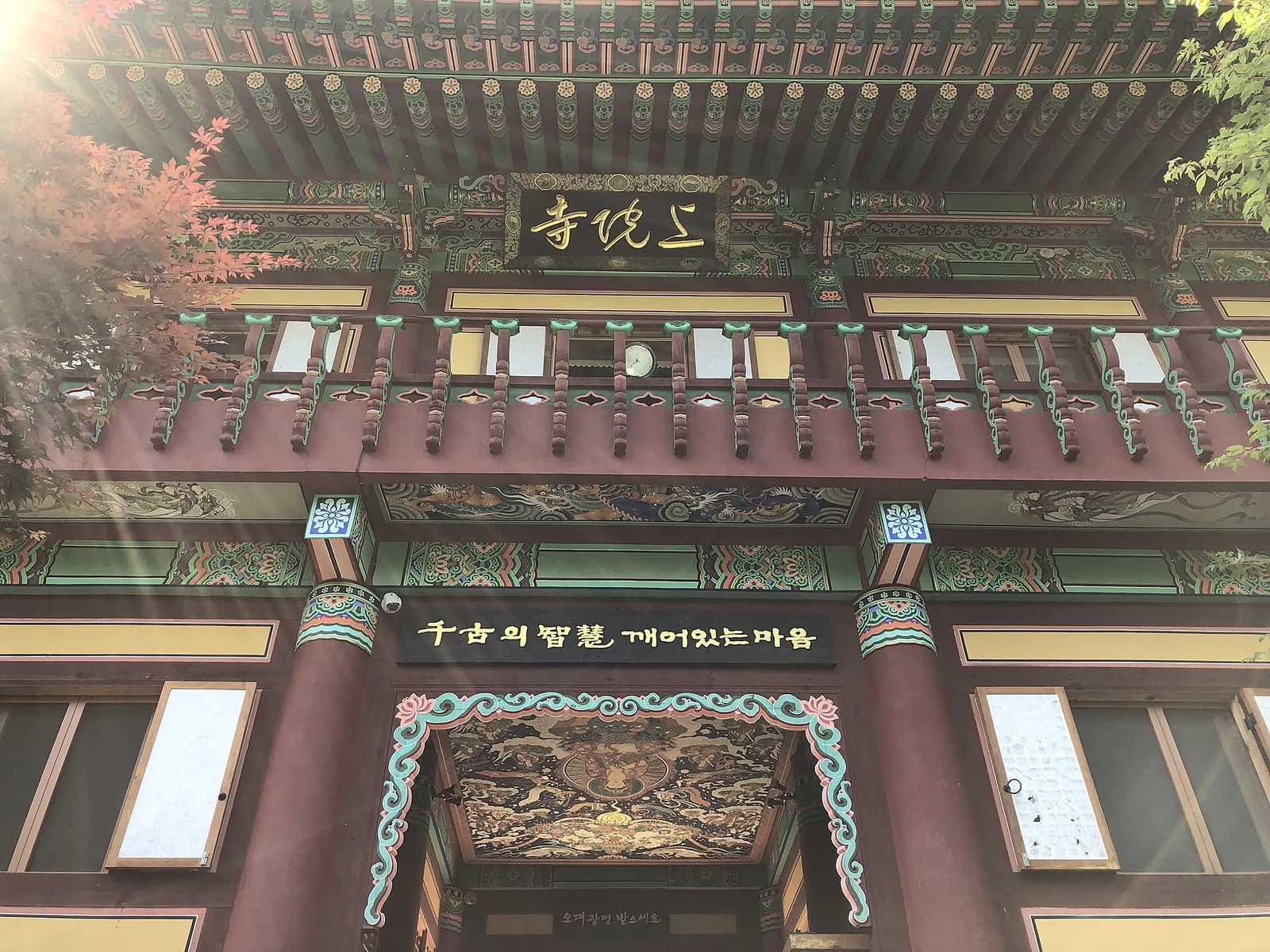
Sangwonsa sits about 8 km north of Woljeongsa. VisitKorea says it was founded by Jajang, rebuilt in 705, burned in 1946 and restored in 1947. Its treasure is the Bronze Bell of Sangwonsa, a National Treasure that VisitKorea calls the oldest bronze bell in the country. It was cast in the 24th year of King Seongdeok's reign and is 1.67 m tall. The temple also keeps a statue of the Child Manjusri, connected by legend with King Sejo of Joseon. When we checked on 2026-10-03, VisitKorea listed Sangwonsa's hours as two hours before sunrise until before sunset.
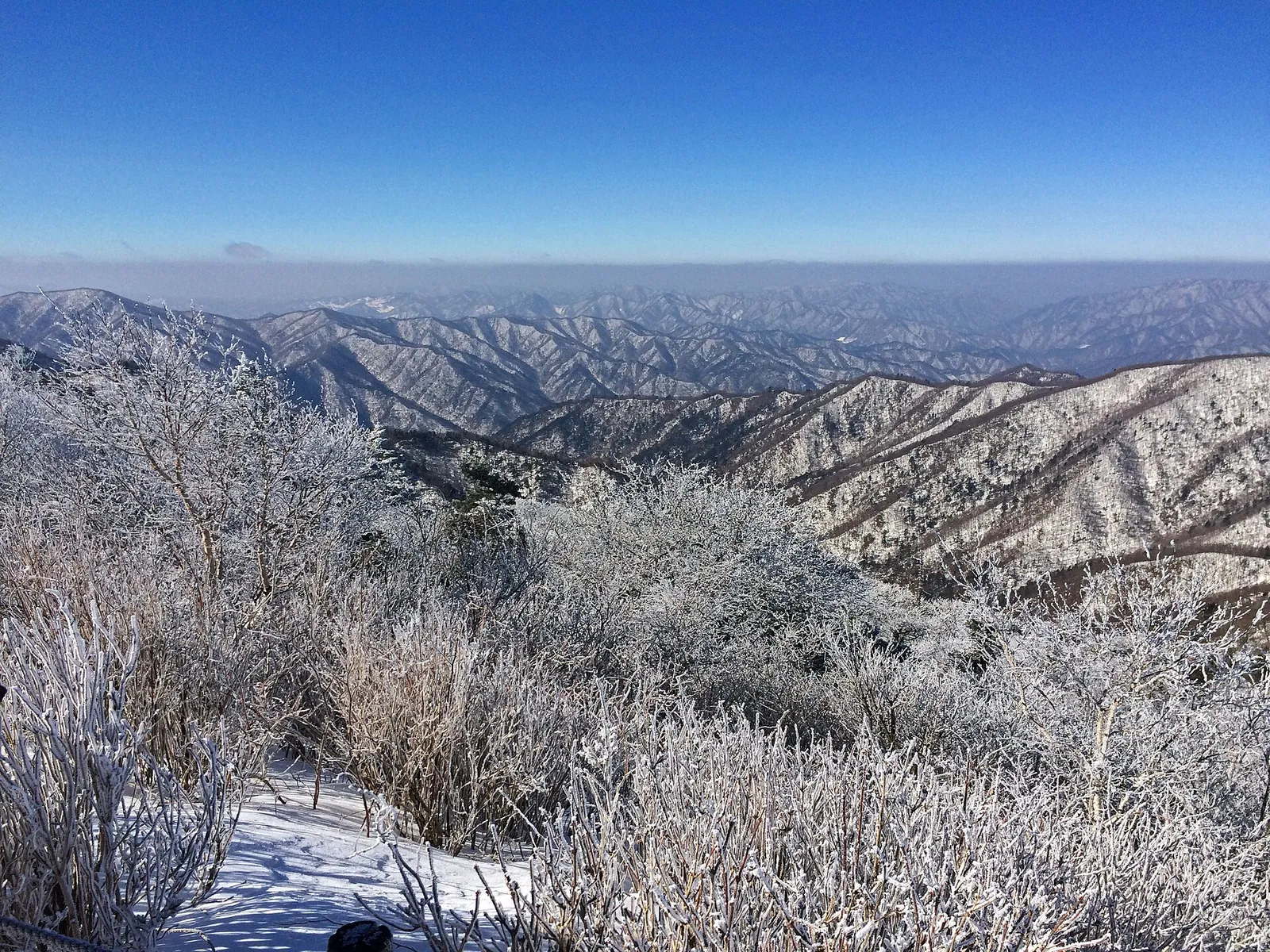
Above Sangwonsa is the climb. The park service's Birobong course goes from Sangwonsa past Jungdae (Sajaam hermitage) and Jeokmyeolbogung to the 1,563 m summit. It is 6.8 km there and back and takes 3 hours 10 minutes to 3 hours 30 minutes. The first 1.3 km to Jungdae takes about 30 minutes on gentle earth paths, and the park service calls it the park's best course for all ages. From Jungdae it is 2.1 km and about 1 hour 10 minutes to the top, flat as far as Jeokmyeolbogung and then uphill. The last 400 m are steep wooden stairs.
Templestay Korea describes Jeokmyeolbogung as holding true relics of the Buddha, and it makes a good turning point if you came for the temples rather than the summit. During the wildfire-prevention periods the park service allows walkers only from the Sangwonsa car park as far as Jeokmyeolbogung, so the summit is closed then. Check the park's closure notices before you plan the climb.
A night at Woljeongsa: what the Templestay involves
Staying overnight is what makes Odaesan more than a day trip. Templestay Korea lists Woljeongsa as a temple for foreign visitors. Its year-round Relaxing Templestay (휴식형) is a one-night stay that leaves most of the time to you. On Woljeongsa's own Templestay page, check-in and room allocation run from 15:00 to 15:30. A temple orientation follows at 16:30, dinner at 17:00, optional evening chanting at 18:20, and lights out from 21:00 to 04:00. The next morning brings an optional dawn service at 04:20 and breakfast at 06:30, with check-out by noon after lunch. The temple says the schedule can change with the weather and temple events. The temple also offers an Experience Templestay (체험형).
Book through the temple's Templestay site, which links to an English booking page on templestay.com. The temple asks for booking and payment at least two or three days before your date and says check-in must be by 15:00. Its FAQ says Templestay guests who show the check-in text message at the ticket booth do not pay parking or entrance charges. Prices are on the booking page and are not quoted here.
The real reward is the timing. At 05:00 the day visitors are hours away, and you can walk the fir forest almost alone after the dawn service.
The Annals of the Joseon Dynasty come home: the museum by the road
VisitKorea notes that Odaesan held one of the archives where the Veritable Records of the Joseon Dynasty were kept. The National Museum of the Annals of the Joseon Dynasty, at 176 Odaesan-ro, tells that story. Its welcome page says the Odaesan copy of the Annals and the royal protocols (uigwe) has returned to Odaesan after 110 years away. Its timeline gives the removal as 1909–1932, the return to Korea as 1973–2011, and the opening of the museum on 12 November 2023. Woljeongsa donated the building in 2022, and the museum reopened in full in May 2025 after remodelling.
When we checked on 2026-10-03, the museum's visitor page listed free admission until further notice. Hours were 09:30–17:30 from March to October and 09:30–17:00 from November to February, with last entry 30 minutes before closing. It closes on Mondays, 1 January, and the days of Seollal and Chuseok. Children aged six and under must come with an adult. It is on the same road as the temple, so it makes a good rainy-day stop or a stop on the way out of the valley.
Getting there without a car
The park service's directions for Seonjae-gil and Birobong go by rail: from Cheongnyangni in Seoul take the KTX to Jinbu (Odaesan) Station, then the Jinbu town bus towards Sangwonsa. Get off at Woljeong car park for the fir forest and Seonjae-gil, or ride to the Sangwonsa terminus for Sangwonsa and Birobong. A taxi from Jinbu is the alternative. The park service gives about 2 hours 10 minutes from Seoul to the Woljeongsa end and 2 hours 40 minutes to Sangwonsa. It also gives a bus route from Dong Seoul Terminal to Jinbu intercity bus terminal, with the same town bus onward, and reminds travellers to check bus frequencies. VisitKorea's rail guide notes that the Gangneung Line also starts from Seoul Station.
Pyeongchang County's sightseeing taxi also starts at KTX Jinbu (Odaesan) Station. VisitKorea lists the Woljeongsa fir forest and Odaesan among its stops, with packages that include the return KTX fare, entrance fees and the taxi. It suits travellers who want to combine Odaesan with the Pyeongchang highlands in one day.
If you drive, aim to arrive before mid-morning in October. On 3 October 2026 the park service posted at 11:00 that all three car parks on the Woljeong side were full. Odaesan's other face, the Sogeumgang valley with its waterfalls and rock formations, is on the Gangneung side of the mountain and is reached separately. Treat it as a second trip, not part of the temple walk.
Practical questions
How long is the Woljeongsa fir forest walk?
About 1 km each way, from the Iljumun gate to Geumganggyo Bridge by the temple, according to VisitKorea. It is the gentlest walk in the park and ends at the temple.
Is Seonjae-gil difficult?
No. The park service rates the whole 9 km route easy and mostly level, and recommends it for families and older walkers. It takes about 3 hours 30 minutes in total (2 h 10 min plus 1 h 20 min). In winter and early spring you need crampons, and after heavy rain parts can flood.
Do I need to climb Birobong to see Odaesan?
No. The fir forest, Woljeongsa, Seonjae-gil and Sangwonsa are all in the valley. Birobong is a separate 6.8 km return climb from Sangwonsa, about 3 to 3.5 hours, with steep stairs near the top.
Can I do a temple stay at Woljeongsa as a foreigner?
Yes. Templestay Korea lists Woljeongsa as a temple for foreign visitors, and the temple links to an English booking page. The Relaxing Templestay runs all year. Book and pay at least two or three days ahead, and check in by 15:00.
How do I get to Woljeongsa from Seoul without a car?
Take the KTX Gangneung Line to Jinbu (Odaesan) Station, then the Jinbu town bus towards Sangwonsa, or a taxi. Get off at Woljeong car park for the temple and fir forest. The park service gives about 2 hours 10 minutes from Cheongnyangni. Check bus times locally.
When is the best time to visit Odaesan?
October, for autumn colour along the Odaecheon. It is also the busiest time: the park service treats 1 October to 15 November as high season, and on 3 October 2026 the car parks were full by 11:00. In summer the forest path stays cool, and in winter the valley is snowy and you need crampons.
Sources and checks before you travel
Reference sources for the version dated 3 October 2026. Confirm opening times, access, transport and conditions for your travel dates.
- Korea National Park Service: Odaesan National Park (main page) ↗ — opens in a new tab
- Korea National Park Service: Odaesan courses (Seonjae-gil, Birobong) ↗ — opens in a new tab
- Korea National Park Service: Odaesan transport (bus and train) ↗ — opens in a new tab
- Korea National Park Service: Odaesan fees (요금안내) ↗ — opens in a new tab
- VisitKorea: Odaesan National Park ↗ — opens in a new tab
- VisitKorea: Woljeongsa Temple & Needle Fir Forest ↗ — opens in a new tab
- VisitKorea: Odaesan Seonjaegil Trail ↗ — opens in a new tab
- VisitKorea: Sangwonsa Temple ↗ — opens in a new tab
- Templestay Korea: Woljeongsa ↗ — opens in a new tab
- Woljeongsa Templestay: regular programmes (상시프로그램) ↗ — opens in a new tab
- Woljeongsa Templestay FAQ: check-in time ↗ — opens in a new tab
- Woljeongsa Templestay FAQ: check-in text and ticket office ↗ — opens in a new tab
- Odaesan Culture Festival 2026 (official site) ↗ — opens in a new tab
- National Museum of the Annals of the Joseon Dynasty: visitor information ↗ — opens in a new tab
- National Museum of the Annals of the Joseon Dynasty: history ↗ — opens in a new tab
- National Museum of the Annals of the Joseon Dynasty: welcome ↗ — opens in a new tab
- VisitKorea: Odaesan Minsok Sikdang ↗ — opens in a new tab
- VisitKorea: Ssangdungine Gabyusl Sikdang ↗ — opens in a new tab
- VisitKorea: Gohyang Iyagi ↗ — opens in a new tab
- VisitKorea: Sliced Raw Trout (Songeohoe) ↗ — opens in a new tab
- VisitKorea: Pyeongchang Trout Festival ↗ — opens in a new tab
- VisitKorea: Pyeongchang Sightseeing Taxi Platform ↗ — opens in a new tab
- VisitKorea: Train ↗ — opens in a new tab
- VisitKorea: Airport transportation guide ↗ — opens in a new tab
- VisitKorea: Kensington Hotel Pyeongchang ↗ — opens in a new tab
- VisitKorea: Sogeumganggyegok Valley ↗ — opens in a new tab
Does this experience fit your route?
Odaesan is easy on your own by KTX and the Jinbu bus, and a temple stay is booked directly with Woljeongsa. Book a tour only if you want a guided day from Seoul, and check that it really goes to Woljeongsa.
Browse relevant experiences on Viator ↗ — opens in a new tabAffiliate link · Book with ViatorPhoto credits
Woljeongsa after snowfall: the octagonal nine-storey stone pagoda stands in front of the main hall.
Photograph: Leejiwoong35 — opens in a new tab · CC BY-SA 4.0 — opens in a new tab
Changes: Resized and converted to WebP; displayed with responsive crops. · Original photograph and licence details ↗ — opens in a new tab
A signpost near Woljeongsa: Sangwonsa is 9.3 km up the valley, the start of Seonjae-gil 1.3 km away.
Photograph: https://www.flickr.com/photos/phploveme/ — opens in a new tab · CC BY-SA 2.0 — opens in a new tab
Changes: Resized and converted to WebP; displayed with responsive crops. · Original photograph and licence details ↗ — opens in a new tab
Sangwonsa, the upper temple, about 8 km north of Woljeongsa and the start of the Birobong climb.
Photograph: 배윤석 — opens in a new tab · CC BY-SA 4.0 — opens in a new tab
Changes: Resized and converted to WebP; displayed with responsive crops. · Original photograph and licence details ↗ — opens in a new tab
The view from Birobong (1,563 m), the highest peak of Odaesan, on a frosty winter day.
Photograph: Lcarrion88 — opens in a new tab · CC BY-SA 4.0 — opens in a new tab
Changes: Resized and converted to WebP; displayed with responsive crops. · Original photograph and licence details ↗ — opens in a new tab
Sanchae bibimbap, rice with seasoned mountain vegetables: an example of the dish, not photographed at Odaesan.
Photograph: Eugene Kim — opens in a new tab · CC BY 2.0 — opens in a new tab
Changes: Resized and converted to WebP; displayed with responsive crops. · Original photograph and licence details ↗ — opens in a new tab