Chungcheong · South Chungcheong
Gongju travel guide: Gongsanseong, King Muryeong's tomb and Buyeo
Gongju was Ungjin, the capital of the Baekje kingdom from 475 to 538, and two of the eight sites in the UNESCO-listed Baekje Historic Areas are here: Gongsanseong, the mountain fortress above the Geumgang River, and the royal tombs where King Muryeong was found in a grave that had never been robbed. Today it is a small riverside city with a compact old centre. The questions for a visit are simple: how to fit the fortress, the tombs and the museum into one day, and whether to spend the next day in Buyeo, Baekje's last capital, a short way downriver.
- Suggested time
- 1 full day and 1 night; add a second day for Buyeo
- Where to stay
- Gongju Hanok Village by the museum and the royal tombs, or the old town below Gongsanseong
- Season and timing
- Autumn is the high point: the Baekje Cultural Festival is held at sites in Gongju and Buyeo, and VisitKorea listed it for 3 to 11 October 2026. Gongsanseong and the royal tombs close an hour earlier from November to February (17:00 instead of 18:00). Chestnuts, Gongju's best-known crop, are an autumn and winter food.
The short answer
Give Gongju one full day and stay one night, then continue to Buyeo for a second day if you want the whole Baekje story. In Gongju, start at the Tomb of King Muryeong and Royal Tombs, continue to Gongju National Museum nearby to see what came out of the tomb, and spend the afternoon on the walls of Gongsanseong, with the view over the Geumgang at the end of the day. Sleep in the modern Gongju Hanok Village beside the museum or in a guesthouse in the old town. From Seoul, take an express bus from the Seoul Express Bus Terminal or Nambu Terminal; from Cheongju airport or KTX Osong Station, the C-Tour Bus runs to Gongju and on to Buyeo.
One day, one night, and where Buyeo fits
Gongju's three headline sights sit close together on the south bank of the Geumgang: the royal tombs and the national museum share a neighbourhood in Ungjin-dong, and Gongsanseong rises above the old town in Geumseong-dong; a taxi is the quickest link between the two. That makes a full day enough for the essentials. What a day trip from Seoul cannot do well is the end of the day: VisitKorea singles out Gongsanseong's night view, and the express bus back is long. The Gongju National Museum's transport page gives about 2 hours 20 minutes by bus from Seoul each way.
The better plan for most travellers is to sleep in Gongju and treat Buyeo as day two. Baekje moved its capital from Ungjin to Sabi, present-day Buyeo, around 538, and Buyeo holds four more of the eight Baekje Historic Areas sites: the Gwanbuk-ri archaeological site with Busosanseong Fortress and Nakhwaam Rock, the Neungsan-ri tombs, the Jeongnimsa Temple Site and the Buyeo outer city wall. Seeing Gongju first follows the kingdom's own chronology, and the C-Tour Bus that VisitKorea describes links Gongju Jonghap Bus Terminal with Buyeo Intercity Bus Terminal.
If you only have one day for Baekje, choose by interest: Gongju for King Muryeong's tomb and its finds and for a walk on intact fortress walls; Buyeo for temple and palace sites and the river cliffs of Busosanseong.
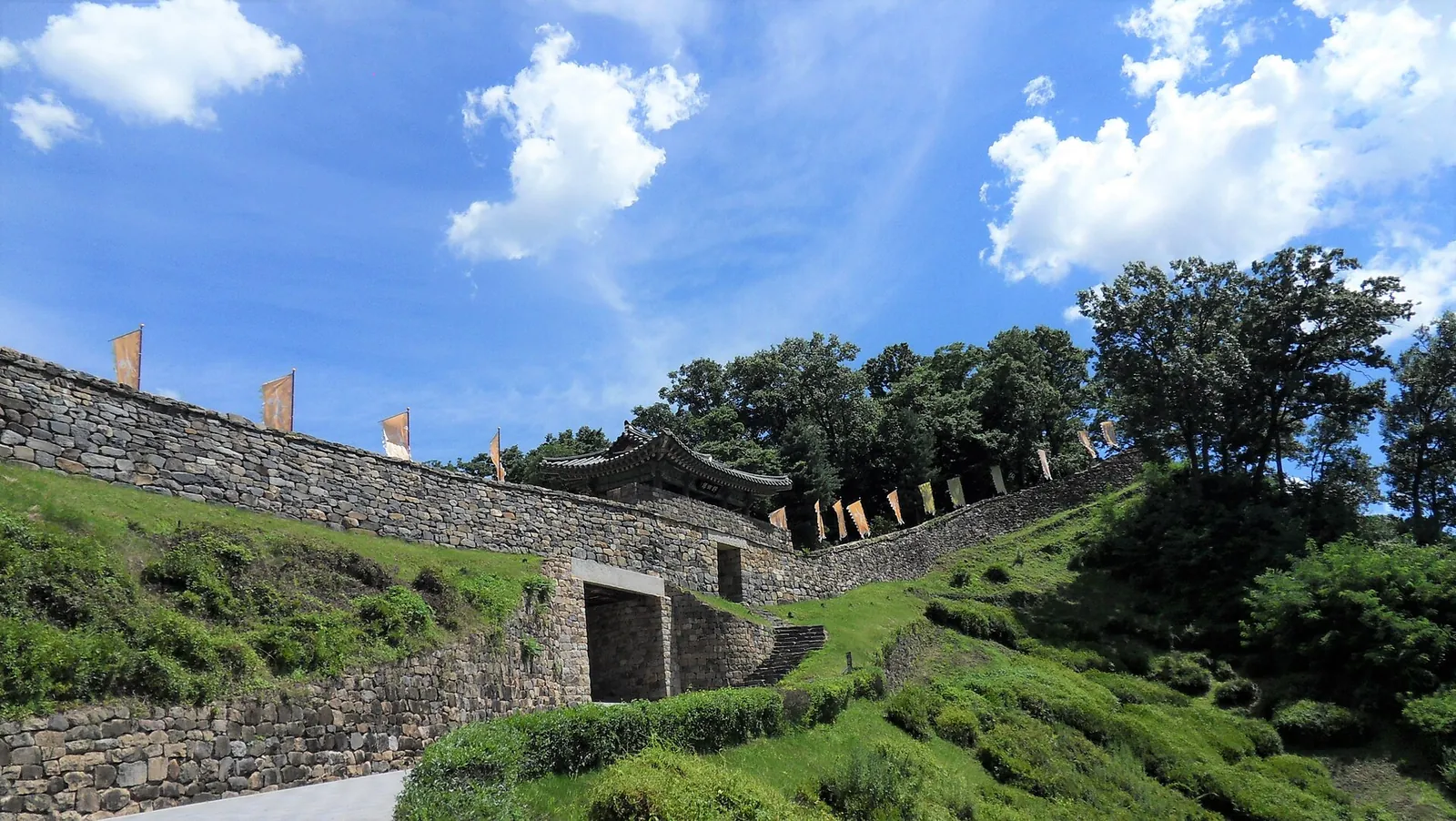
Gongsanseong Fortress
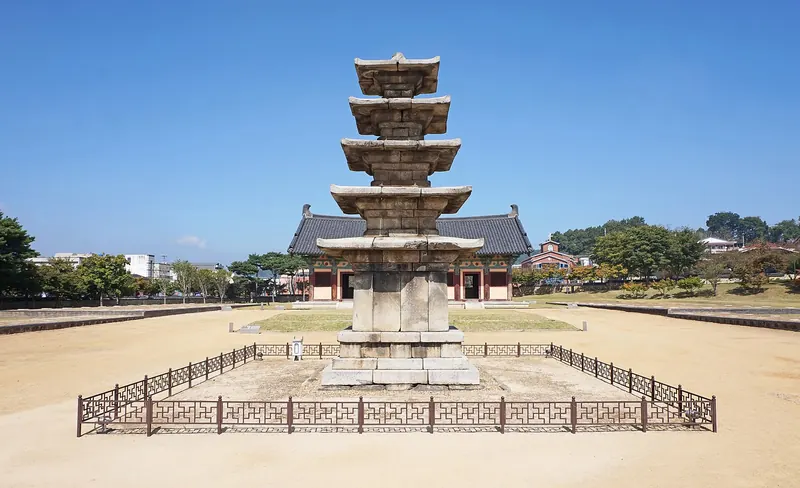
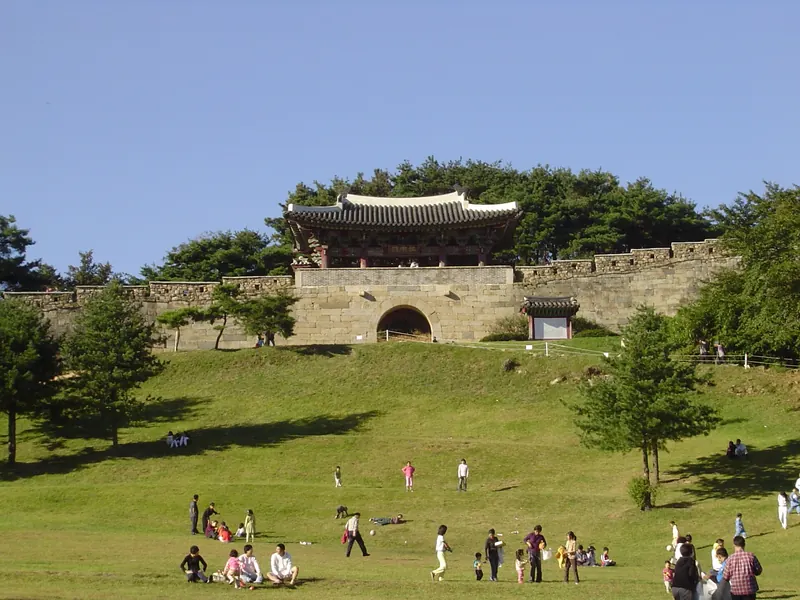
Gongsanseong was Ungjinseong in the Baekje period and took its present name after the Goryeo dynasty. It runs from the summit of Gongsan to a smaller peak to the west, above the Geumgang, and VisitKorea gives the length of its walls as 2.6 kilometres. Later dynasties kept using Gongju as a regional centre, so the fortress has layers of buildings and sites from long after Baekje — gate pavilions, pavilions on the ridge and excavated foundations — and the walk along the walls gives a wide view over the city centre and the river.
When we checked on 3 October 2026, VisitKorea listed opening hours of 9:00 to 18:00 from March to October and 9:00 to 17:00 from November to February, with last admission 30 minutes before closing, and an adult ticket of 3,000 won (teenagers 2,000 won, children 1,000 won). It listed the fortress as closed on New Year's Day and on the days of Seollal and Chuseok. The address is 280 Ungjin-ro; VisitKorea suggests about two hours, which is right for a loop of the walls with stops.
The path climbs and drops along the ridge, so wear proper shoes. Late afternoon is the best time: you finish on the walls with the river below, and the cafés and restaurants of the old town are at the foot of the fortress for dinner.
Make time for the local food
What to eat and where to look
Gongju chestnut desserts
Gongju is one of Korea's chestnut centres: VisitKorea says 2,184 farms grow them here, about 15% of national production, and the city is known for chestnut pastries, madeleines and éclairs made with local nuts.
- Where to look
- The chestnut bakery at 5-9 Baengmigoeul-gil facing Gongsanseong, which VisitKorea lists as Bakery Bammaeul (09:00 to 21:00 when last updated) and as Marron Village; chestnut sweet rice cakes at Sanseong Market.
- Fit it into your day
- A snack after the fortress walk, and a box of individually wrapped madeleines or pies to take on to Buyeo.
Pastries contain wheat, butter and eggs; VisitKorea's shop details date from 2023 to 2025, so check opening hours on a map app.
Gomanaru bapsang (rice set meal)
A single-menu set of pot rice made with Gongju rice, boiled pork slices, grilled marinated pork shoulder and grilled dried pollack, served with vegetable side dishes, at Gomanaru 1999 near Gongsanseong.
- Where to look
- Gomanaru 1999, 5-8 Baengmigoeul-gil, on the same street as the chestnut bakery below the fortress.
- Fit it into your day
- Lunch before the fortress walk. When we checked, VisitKorea listed 11:00 to 20:00 with a break from 14:30 to 17:00, closed on Tuesdays.
The set is pork-heavy; plan around the afternoon break.
Charcoal-grilled spicy pork
Restaurant Gomgol, behind an old gate in the old town, keeps a three-dish menu: charcoal-grilled spicy pork cooked for you, grilled fish and braised cutlassfish, with self-service wraps and side dishes. VisitKorea notes that single servings can be ordered.
- Where to look
- Restaurant Gomgol, 1-2 Bonghwangsan 1-gil, Banjuk-dong.
- Fit it into your day
- Dinner in the old town after Gongsanseong; useful for solo travellers because of the single servings. VisitKorea listed 11:00 to 21:00, closed on Mondays.
VisitKorea calls it always busy, so expect a wait at peak times.
Market food and chestnut makgeolli
Sanseong Market's food alley serves everyday dishes such as gimbap, janchi guksu (banquet noodles) and bulgogi, and VisitKorea names chestnut makgeolli and chestnut sweet rice cake as the local specialties.
- Where to look
- Gongju Sanseong Market, 22 Yongdang-gil, Sanseong-dong; vendors set their own hours.
- Fit it into your day
- A quick, cheap lunch between the museum and the fortress, or makgeolli with dinner.
Makgeolli is alcoholic; vendor hours and days off vary.
King Muryeong's tomb and the royal tombs
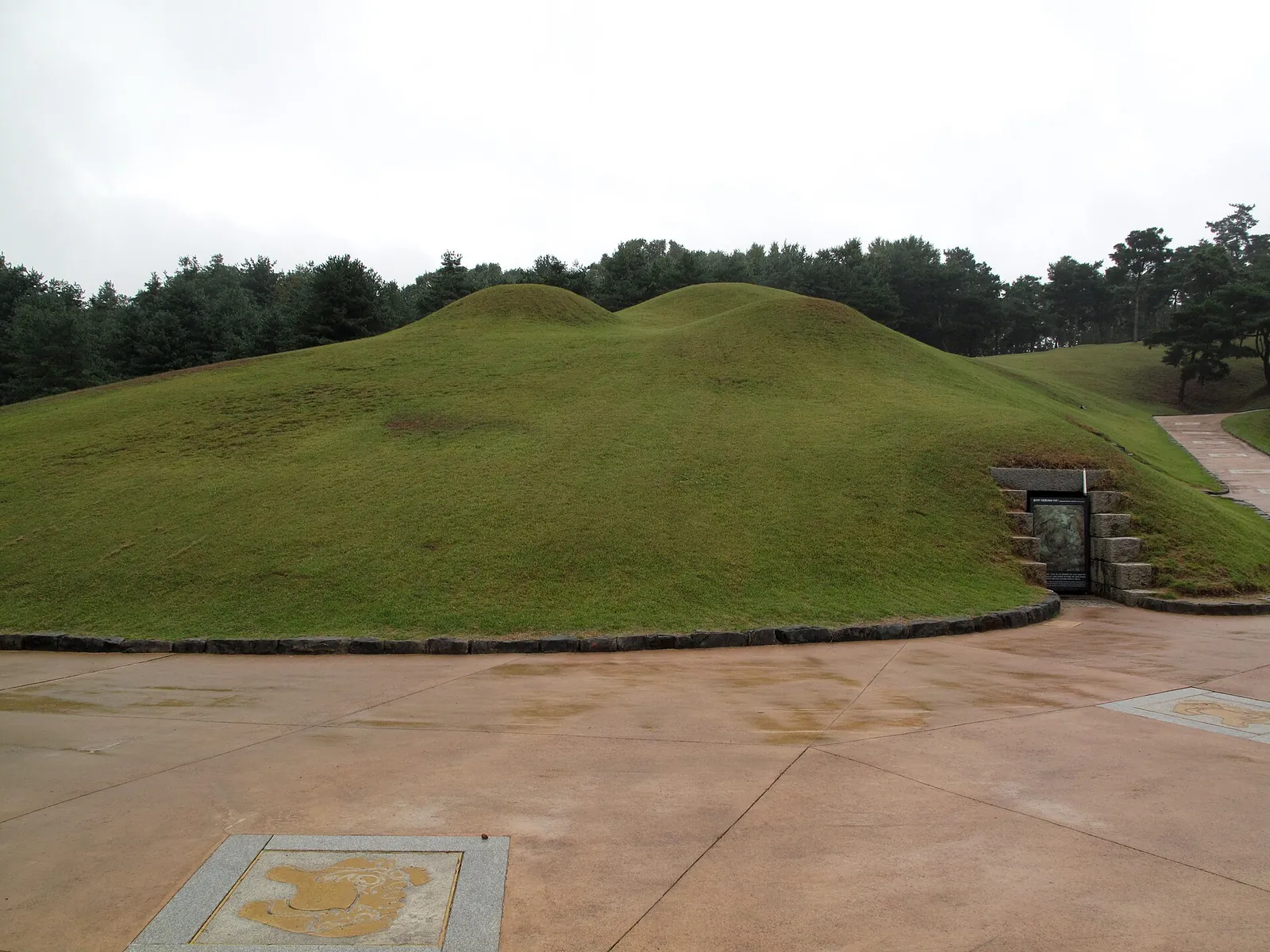
King Muryeong, who reigned from 501 to 523, was Baekje's 25th king, and his tomb is one of very few ancient Korean tombs whose occupants are identified. It was found intact, and VisitKorea reports thousands of artifacts recovered — its pages give figures of more than 4,600 and more than 5,200 — including gold crown ornaments. The site, officially the Tomb of King Muryeong and Royal Tombs at Songsan-ri, is believed to hold 17 royal graves from the Gongju period, of which seven have been found. Tombs 1 to 5 are traditional Baekje stone-chamber graves; tomb 6 and King Muryeong's tomb follow a Chinese-influenced design.
When we checked on 3 October 2026, VisitKorea listed the same seasonal hours as Gongsanseong (9:00 to 18:00 from March to October, 9:00 to 17:00 from November to February, last admission 30 minutes before closing) and an adult ticket of 3,000 won. Preschoolers and visitors aged 65 and over enter free, and entry is free for everyone on the last Wednesday of each month. The address is 37 Wangneung-ro.
Go in the morning and walk on to the museum afterwards: the tomb shows you the setting, the museum the contents.
Gongju National Museum
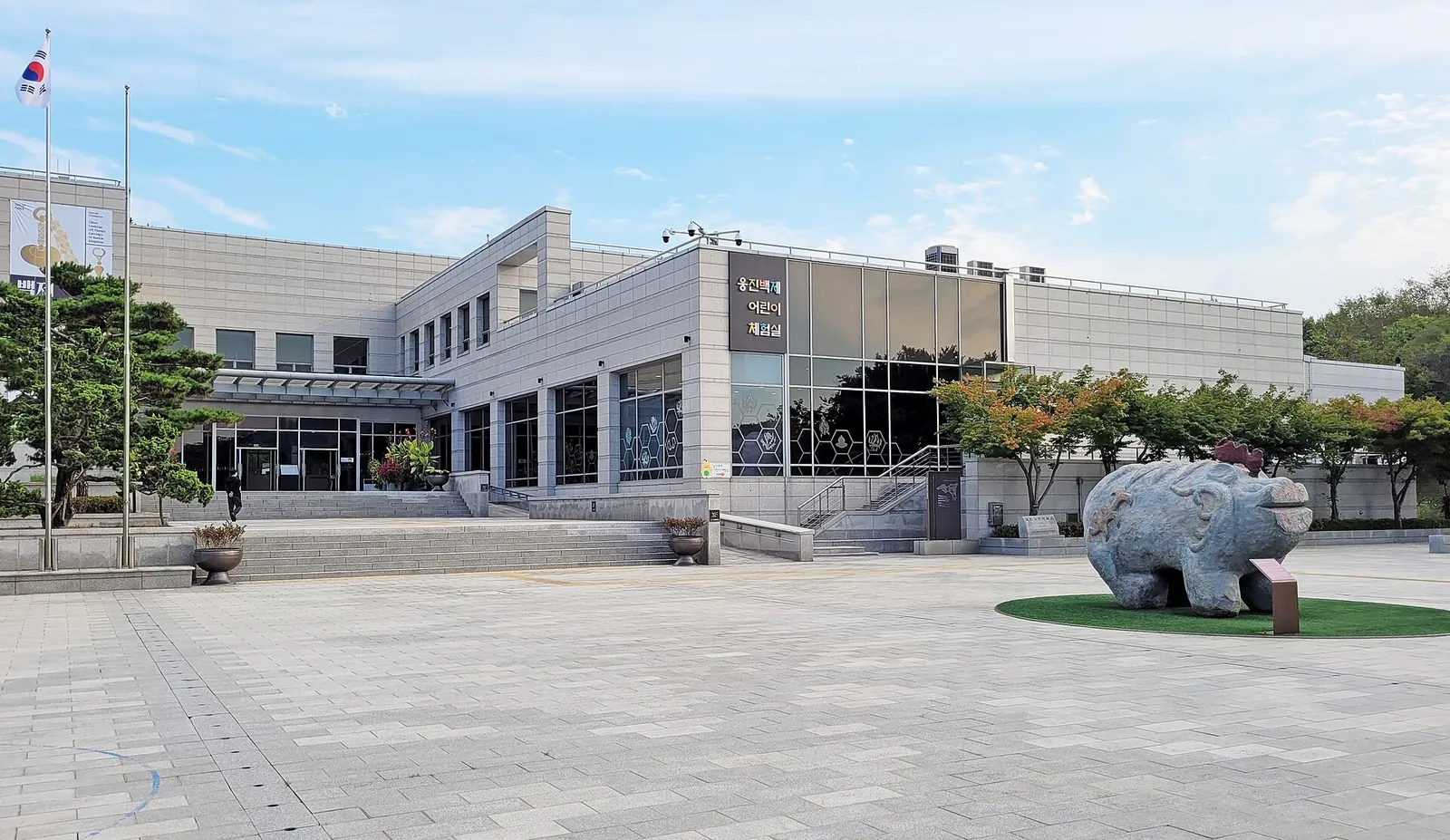
The museum's Ungjin Baekje Room displays the major artifacts excavated from the Tomb of King Muryeong, and VisitKorea calls that exhibition and the stone tomb guardian (jinmyosu) from the tomb the stars of the museum; a large stone version of it stands on the forecourt. VisitKorea counts more than 10,000 objects in the collection, including 19 National Treasures, excavated across South Chungcheong and Daejeon.
When we checked on 3 October 2026, the museum's own site listed opening hours of 9:00 to 18:00, free admission (special exhibitions may charge), and closure on Mondays, 1 January, Seollal and Chuseok. Its 2026 substitute-holiday notice is worth reading if you are visiting during the festival: it listed the museum as open on Monday 5 October and closed on Tuesday 6 October. The museum also noted that its volunteer guided tours are currently suspended. The address is 34 Gwangwangdanji-gil.
Magoksa and the old town
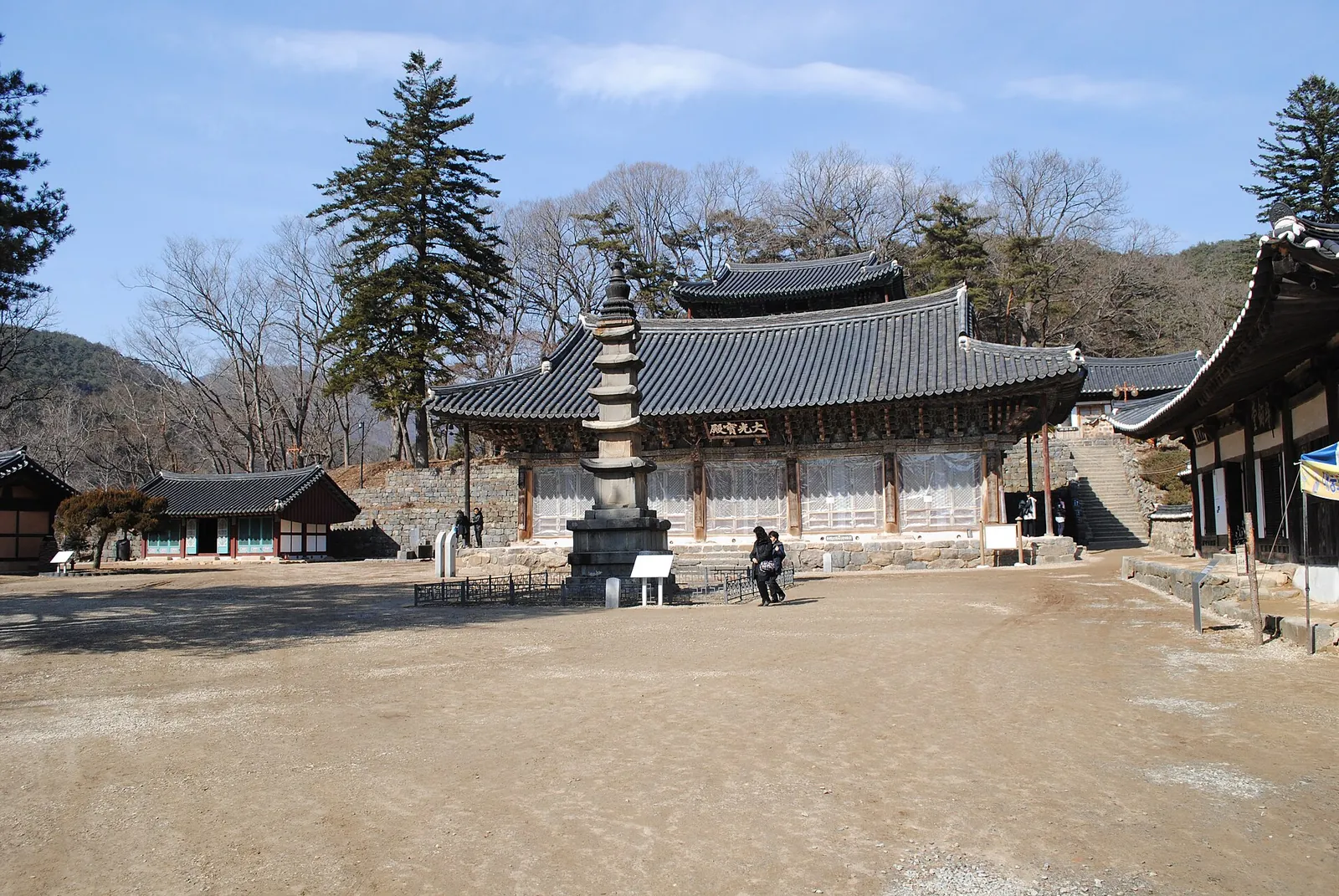
Magoksa, in the hills of Sagok-myeon outside the city, is one of the seven temples inscribed by UNESCO as Sansa, Buddhist Mountain Monasteries in Korea. VisitKorea dates its founding to 640 and notes that the river and mountains around it form a taegeuk shape; Yeongsanjeon Hall, rebuilt in 1650 after the Imjin War, is its oldest building. When we checked on 3 October 2026, VisitKorea listed the temple as open 24 hours and free, with a templestay programme charged separately. Allow about two hours on site plus the road out; it makes a good half-day if you have a car or a second day in Gongju rather than Buyeo.
Back in town, the old centre around Banjuk-dong and Jung-dong has a few sights that fit between meals: Jungdong Catholic Church, a red-brick Gothic church built in 1897, and the Former Gongju-eup Office, a two-storey brick building from 1923 that VisitKorea lists as open 10:00 to 17:00 and closed on Mondays. Gongju Sanseong Market, opened in 1937 and roofed against the weather, is the place for a cheap lunch and local chestnut products.
Getting to Gongju and around
The bus is the practical way in, and it is what the Gongju National Museum's own directions recommend. VisitKorea's bus guide lists Gongju among the routes from the Seoul Express Bus Terminal (Express Bus Terminal Station, Seoul Subway Lines 3, 7 and 9) and from Seoul Nambu Terminal (Nambu Terminal Station, Line 3), the terminal that also serves Buyeo. The Gongju National Museum's transport page gives about 2 hours 20 minutes for both routes and frequent direct buses from Daejeon, about 30 minutes from Yuseong; by train, it suggests travelling to Daejeon and continuing by intercity bus.
From central Korea's other gateway, VisitKorea describes the C-Tour Bus, which began in June 2026 on a route from Cheongju International Airport via KTX Osong Station to Gongju Jonghap Bus Terminal and Buyeo Intercity Bus Terminal, bookable at terminals or in the Tmoney GO and Bustago apps; it says the bus runs eight times a day. VisitKorea also lists an intercity bus ticket kiosk at Cheongju airport for direct buses to Gongju, about an hour away.
In town, the royal tombs, the museum and Gongju Hanok Village are all in Ungjin-dong; Gongsanseong and the old town are on the other side of the centre, so use a taxi or local bus between the two clusters. VisitKorea lists Gongju among the cities with a public bike-share system. Check bus times in an app on the day; routes change.
- Morning: Tomb of King Muryeong and Royal Tombs, then Gongju National Museum nearby.
- Lunch: Sanseong Market's food alley, or a set meal near Gongsanseong.
- Afternoon: the walls of Gongsanseong, timed to finish before the last admission.
- Evening: dinner in the old town and the night view of the fortress; next morning, the bus to Buyeo.
Practical questions
Is Gongju worth visiting, or should I go only to Buyeo?
Go to Gongju if King Muryeong's tomb, its museum finds and a walk on fortress walls appeal to you; Buyeo has the later palace and temple sites. With two days, do both: Gongju first, then Buyeo, following Baekje's own move from Ungjin to Sabi around 538.
How many days do I need in Gongju?
One full day covers the royal tombs, the national museum and Gongsanseong. Stay one night so you are not racing the last bus to Seoul, and add a second day for Buyeo or Magoksa.
How do I get from Seoul to Gongju?
By bus. VisitKorea lists Gongju routes from the Seoul Express Bus Terminal and Seoul Nambu Terminal, and the Gongju National Museum gives about 2 hours 20 minutes for the trip. From Daejeon, direct buses take around 30 minutes from Yuseong.
How much are tickets for Gongsanseong and King Muryeong's tomb?
When we checked on 3 October 2026, VisitKorea listed 3,000 won for adults at each site, with hours of 9:00 to 18:00 from March to October and 9:00 to 17:00 from November to February. Gongju National Museum is free apart from some special exhibitions.
When is the Baekje Cultural Festival?
VisitKorea's listing gave 3 to 11 October 2026, at sites in Gongju (including Geumgang-Singwan Park, Mireuseom Island and Gongsanseong) and Buyeo, with free entry. Programmes in Gongju were listed from 11:00 to 22:00.
Can I fly into Cheongju instead of Incheon?
Yes. VisitKorea describes the C-Tour Bus from Cheongju International Airport via KTX Osong Station to Gongju and Buyeo, and direct intercity buses from the airport to Gongju, about an hour away.
Sources and checks before you travel
Reference sources for the version dated 3 October 2026. Confirm opening times, access, transport and conditions for your travel dates.
- VisitKorea: Gongju Gongsanseong Fortress ↗ — opens in a new tab
- VisitKorea: Gongju Tomb of King Muryeong and Royal Tombs ↗ — opens in a new tab
- VisitKorea: UNESCO World Heritage cultural sites (Baekje Historic Areas, Sansa) ↗ — opens in a new tab
- VisitKorea: Fly to Cheongju International Airport and discover central Korea ↗ — opens in a new tab
- VisitKorea: Unique transportation (C-Tour Bus) ↗ — opens in a new tab
- VisitKorea: Express bus and intercity bus ↗ — opens in a new tab
- Gongju National Museum: general information ↗ — opens in a new tab
- Gongju National Museum: transportation ↗ — opens in a new tab
- VisitKorea: Gongju National Museum ↗ — opens in a new tab
- VisitKorea: Baekje Cultural Festival ↗ — opens in a new tab
- VisitKorea: Magoksa Temple ↗ — opens in a new tab
- VisitKorea: Buyeo Naseong Fortress ↗ — opens in a new tab
- VisitKorea: Gongju Hanok Village ↗ — opens in a new tab
- VisitKorea: Bonghwangjae Hanok Guesthouse ↗ — opens in a new tab
- VisitKorea: Gongju Sanseong Market ↗ — opens in a new tab
- VisitKorea: Gongju chestnut merch ↗ — opens in a new tab
- VisitKorea: An autumn culinary journey through Korea's seasonal flavors ↗ — opens in a new tab
- VisitKorea: Gomanaru 1999 ↗ — opens in a new tab
- VisitKorea: Restaurant Gomgol ↗ — opens in a new tab
- VisitKorea: Former Gongju-eup Office and Jungdong Catholic Church ↗ — opens in a new tab
- VisitKorea: Gongju Baekje history merch ↗ — opens in a new tab
- VisitKorea: Bicycle ↗ — opens in a new tab
Does this experience fit your route?
Gongju is easy on your own by bus, and better with a night there. A guided day from Seoul makes sense if you want Gongju and Buyeo together without managing the connections — check how long it leaves at the royal tombs and on the fortress walls.
Check dates and details on Viator ↗ — opens in a new tabAffiliate link · Book with ViatorPhoto credits
Geumseoru, the west gate pavilion of Gongsanseong Fortress, with the fortress wall running uphill
Photograph: Ashy Minivet — opens in a new tab · CC0 — opens in a new tab
Changes: Resized and converted to WebP; displayed with responsive crops. · Original photograph and licence details ↗ — opens in a new tab
The grassy mounds of the Tomb of King Muryeong and Royal Tombs at Songsan-ri
Photograph: G41rn8 — opens in a new tab · CC BY-SA 4.0 — opens in a new tab
Changes: Resized and converted to WebP; displayed with responsive crops. · Original photograph and licence details ↗ — opens in a new tab
Gongju National Museum, with a stone version of the tomb guardian from King Muryeong's tomb on the forecourt
Photograph: Bernard Gagnon — opens in a new tab · CC0 — opens in a new tab
Changes: Resized and converted to WebP; displayed with responsive crops. · Original photograph and licence details ↗ — opens in a new tab
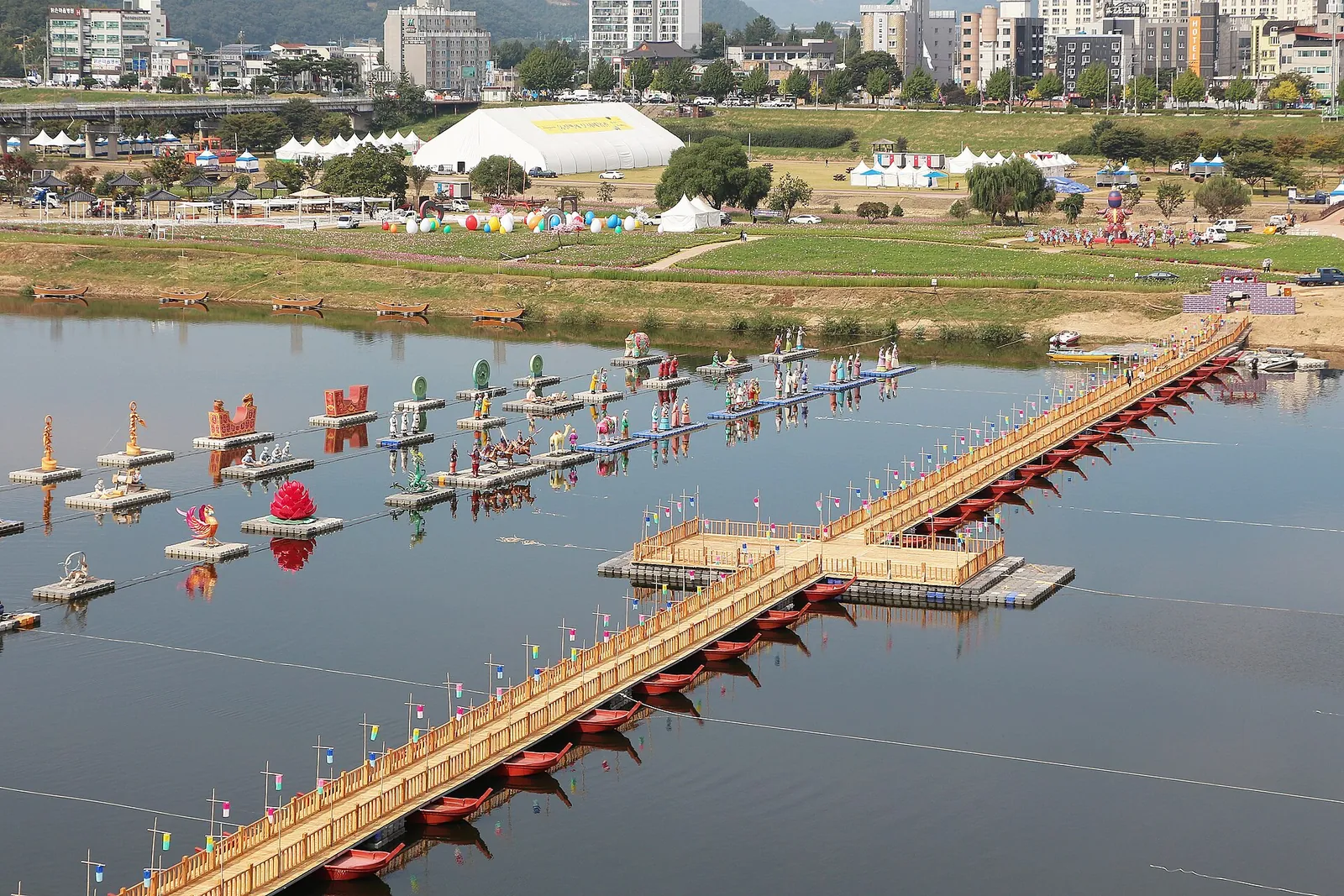
The Geumgang in Gongju during the Baekje Cultural Festival, with a floating walkway across the river
Photograph: Bernard Gagnon — opens in a new tab · CC0 — opens in a new tab
Changes: Resized and converted to WebP; displayed with responsive crops. · Original photograph and licence details ↗ — opens in a new tab
The courtyard of Magoksa, the UNESCO-listed mountain temple outside Gongju
Photograph: Jjw — opens in a new tab · CC BY-SA 3.0 — opens in a new tab
Changes: Resized and converted to WebP; displayed with responsive crops. · Original photograph and licence details ↗ — opens in a new tab