Chungcheong · North Chungcheong
Songnisan guide: Beopjusa's wooden pagoda, Sejo-gil and Munjangdae
Songnisan is a granite range in the middle of Korea, on the border of North Chungcheong and North Gyeongsang, and most people come for one temple. Beopjusa, at the foot of the mountain in Boeun County, is one of the seven mountain monasteries that UNESCO lists together as Sansa, Buddhist Mountain Monasteries in Korea. Its Palsangjeon is the only five-storey wooden pagoda left in Korea, and behind it stands a gilt-bronze Maitreya Buddha 33 metres tall. From the temple, a level forest path follows the stream up the valley, and steeper trails climb to the rock platform of Munjangdae. The Korea National Park Service (KNPS) says Songnisan was made the country's sixth national park in 1970. The trip works best when you treat the temple and the valley as one unhurried day, and add the summit only if you want a proper hike.
- Suggested time
- 1 night (or a long day trip)
- Where to stay
- The Songnisan tourist village in Sanae-ri, Songnisan-myeon, at the park entrance; Cheongju if you have a car
- Season and timing
- Autumn is the busiest season: VisitKorea's page on the Songnisan Special Tourist Zone says most visitors come for the red mountain in autumn. Its 2026 foliage forecast does not give a date for Songnisan, but expected peak colour across the country from mid-October to early November. VisitKorea describes Mansugyegok Valley as a popular summer and forest-bathing spot. KNPS sets earlier trail cut-offs from November to March than from April to October, and in winter you should check the park notices for ice before climbing.
The short answer
Give Songnisan one night in the tourist village at the park entrance, or a long day trip if you only want the temple. Arrive in the afternoon, walk the forest path to Beopjusa and spend the late afternoon in the temple courtyard. Next morning, walk the Sejo-gil up the valley: KNPS lists it as 4 km to Bokcheonam hermitage, about 1 hour 20 minutes, at the easiest grade. Fit hikers can continue to Munjangdae instead, which KNPS gives as 6.6 km and about 3 hours 30 minutes one way from the Songnisan Experience Learning Center, at a middle grade. Without a car, take an express bus to Songnisan from Seoul's Central City Terminal or Nambu Terminal, both of which VisitKorea lists for this route.
Temple day or hiking day: how to plan Songnisan
Almost everything a first-time visitor wants is on the Boeun side of the park, in a line up one valley. The tourist village of shops, restaurants and hotels is at the entrance. A forest path leads to Beopjusa, and the trails continue past the temple up the valley towards the peaks. KNPS measures the walks on this side from the Songnisan Experience Learning Center, the starting point in its course list.
Decide early what kind of day you want. If the temple is the point, you need half a day there plus the walk in, and the easy Sejo-gil makes a good second half. If you want the mountain, Munjangdae is the classic climb: a long morning up and an afternoon down. KNPS's highest-graded day course, a loop over Cheonwangbong (1,058 m, the park's highest peak) and Munjangdae, is 16.1 km and about 8 hours. Keep that for a separate, early day.
The KNPS figures below are from its course data for Songnisan. Where KNPS gives a time one way, remember to plan for the walk back as well.
- Easy, about 1 hour 20 minutes: Sejo-gil, from the Experience Learning Center past the reservoir and Sesimjeong to Bokcheonam hermitage, 4 km, easiest grade.
- Half a day or more, reasonably fit: to Munjangdae via Sesimjeong, 6.6 km and about 3 hours 30 minutes one way, middle grade.
- Full day, experienced hikers: the Cheonwangbong loop via Sesimjeong and Munjangdae, 16.1 km and about 8 hours, hardest grade.
- From the Gyeongsang side: Hwabuk Visitor Support Center to Munjangdae, 3.1 km and about 2 hours 30 minutes one way, middle grade. This is the Sangju side of the range, in North Gyeongsang, not the Beopjusa side.
Beopjusa: the wooden pagoda, the Maitreya and the main hall
The Jogye Order's official Sansa site says Beopjusa was founded in 553 by the monk Uisin. Its name, 'the temple where the Dharma stays', comes from the story that he came back from India with scriptures on a white donkey and stayed here. Most of the buildings burned during the Japanese invasions of the 1590s and were rebuilt in the 1620s. It is the head temple of the fifth diocese of the Jogye Order. The temple's own website lists three National Treasures and fourteen Treasures.
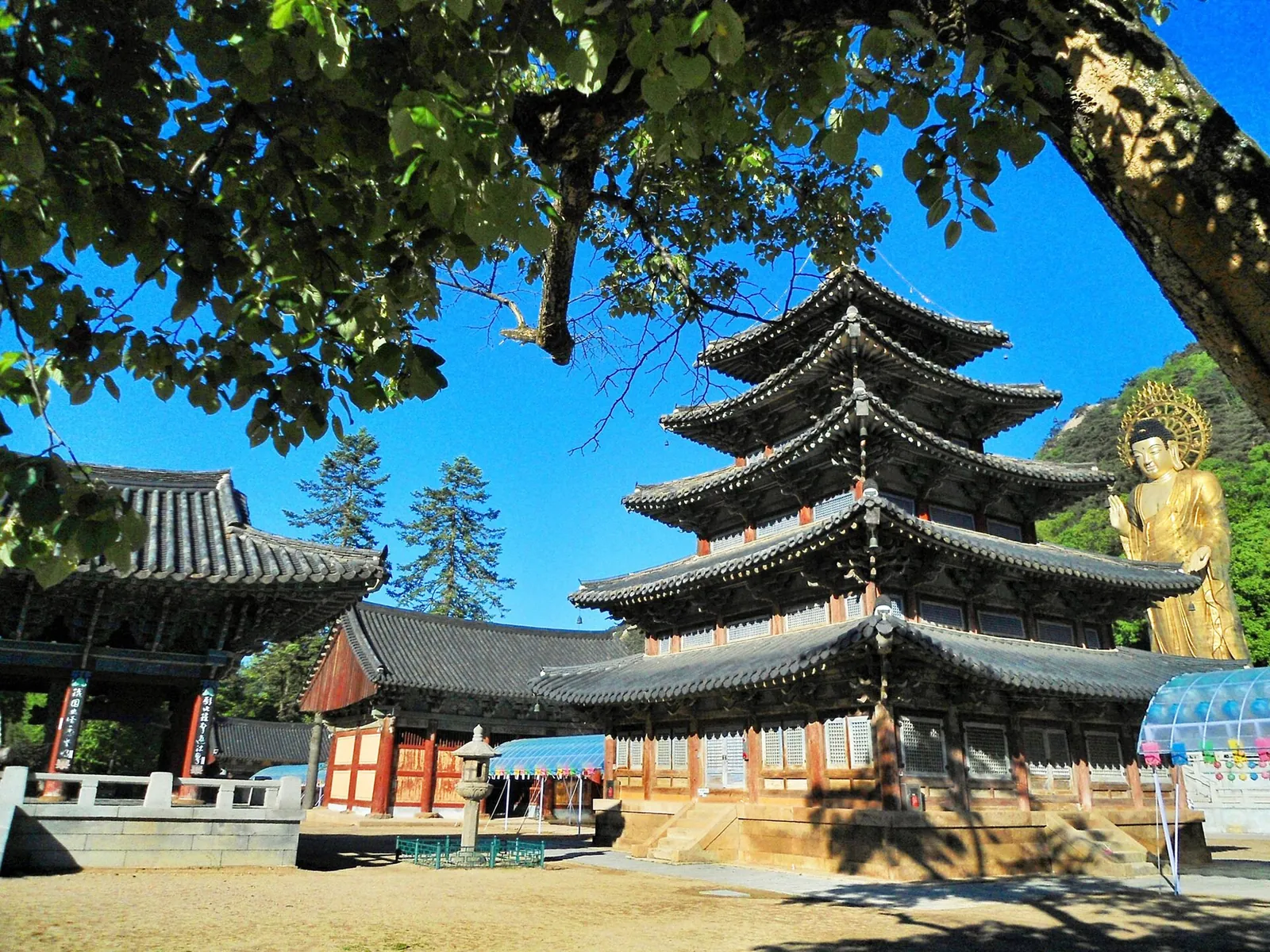
Start with Palsangjeon (National Treasure No. 55). According to the Sansa site, it is the only five-storey wooden pagoda left in Korea. It was restored in 1624 after being lost in the war of 1597. The ground floor is 11 m on each side, the whole structure is 22.7 m high including the finial, and each storey is narrower than the one below. Inside are the paintings of the eight great events of the Buddha's life that give the hall its name, with Buddha statues on the altars in front and figures of the five hundred arhats arranged in three rows.
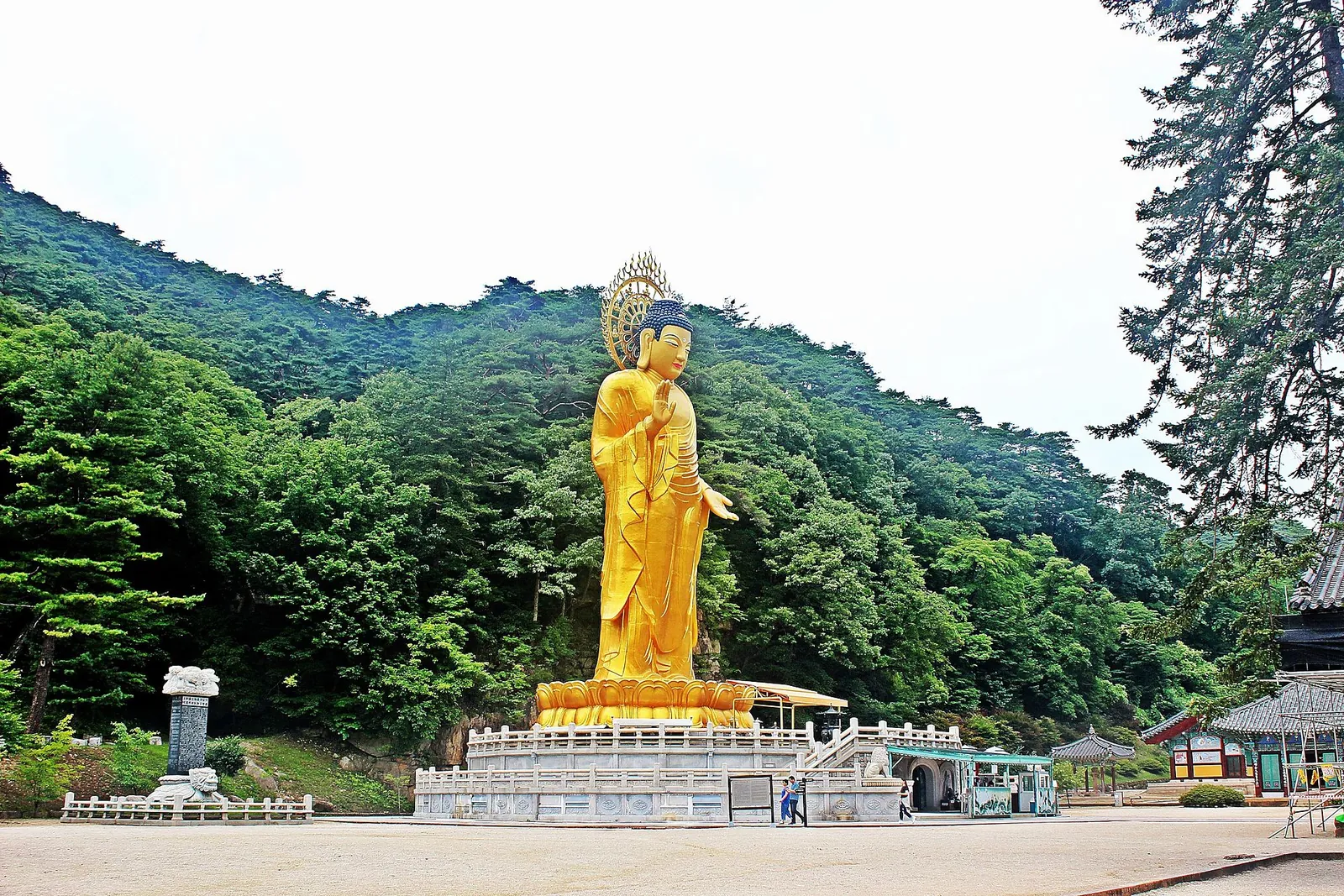
The giant gilt-bronze Maitreya stands beside it. VisitKorea gives its height as 33 m and says more than 100 tons of bronze went into it. The Sansa site gives the history. A two-storey Maitreya hall on this spot was pulled down in 1872. A new statue was begun in 1939 and finished in 1964, and the gilding was added in 2002. Also look at Daeungbojeon, the main hall. It is two storeys on the outside but open inside, about 19 m high, and the Sansa site says its clay Vairocana triad, 5.5 m tall, is the largest group of seated Buddhas in Korea. Two older National Treasures are thought to date from Unified Silla: the Twin-lion Stone Lantern (No. 5), in front of the main hall, and the Stone Lotus Basin (No. 64).
When we checked on 2026-10-03, VisitKorea listed Beopjusa as open from sunrise to sunset every day. Its Beopjusa page gave admission as 5,000 won for adults, 2,500 won for teenagers and 1,000 won for children aged 7–12, but VisitKorea's national-park page still showed 4,000 won for adults. Check the price at the ticket office. It is a working monastery: keep voices down in the halls and do not photograph people at prayer. VisitKorea lists Beopjusa among the temples that offer templestays, with booking through templestay.com.
Make time for the local food
What to eat and where to look
Sanchae jeongsik (wild mountain vegetable set meal)
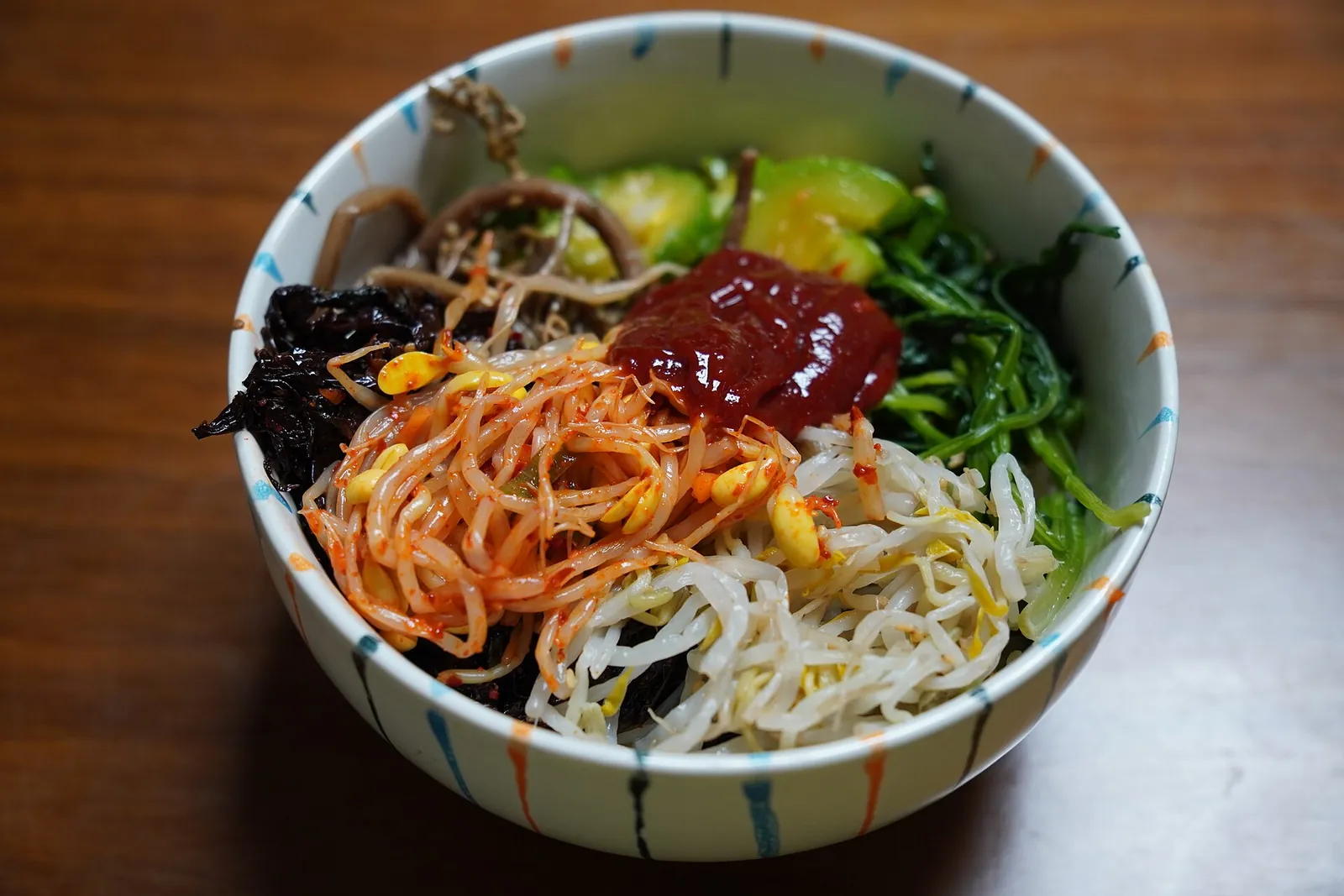
Rice, soup and a spread of seasoned wild greens, mushrooms and mountain roots. This is the standard meal in the restaurants at the park entrance. VisitKorea's listing for Deongnim Sanchae Sikdang, next to the car park of the Beopjusa tourist complex, describes a set made with mushrooms and vegetables from Songnisan.
- Where to look
- The restaurant rows of the tourist village on the way to Beopjusa. VisitKorea listed Deongnim Sanchae Sikdang at 287 Beopjusa-ro, open 07:30–19:30 when we checked.
- Fit it into your day
- Lunch after the temple, or an early breakfast before a Munjangdae start if a restaurant is already open.
Side dishes are often seasoned with fish sauce or salted seafood, so vegetarians should ask before ordering.
Hanjeongsik at Kyunghee Sikdang
A full Korean table of many small dishes. VisitKorea describes Kyunghee Sikdang, by the Beopjusa entrance, as a 70-year-old restaurant that serves nearly 40 side dishes. They include boiled beef slices, bracken, pickled persimmon, coral mushrooms, braised chestnuts and perilla chips, with its own mustard sauce and soybean paste.
- Where to look
- 11-4 Sanae 7-gil, Songnisan-myeon. VisitKorea listed 09:00–20:30 when we checked, closed over the Seollal and Chuseok holidays.
- Fit it into your day
- The evening meal on your overnight. Come hungry and share the table between two or more people.
A large set meal of many dishes; it is not a quick lunch before a hike.
Deodeok gui and mushroom jjigae
Deodeok, a mountain root, flattened and grilled with a sweet chilli glaze, and a mushroom stew. VisitKorea lists both as set meals at the tourist-village restaurant Deongnim Sanchae Sikdang, alongside bibimbap and seafood and green onion pancake.
- Where to look
- Restaurants in the tourist village between the car park and the temple path.
- Fit it into your day
- A hot dinner after the Munjangdae climb, or a lunch before the Sejo-gil.
The deodeok glaze is based on gochujang and can be spicy.
Boeun jujubes and jujube sweets
Boeun County, on the south-western side of Songnisan, is known for jujubes. VisitKorea credits the climate and soil for their flavour. It also describes a local company that makes jujube bread with red bean filling and jujube walnut pie, and mentions a Boeun Jujube Festival in October.
- Where to look
- Boeun-eup, the county town. VisitKorea lists Joeunga at 4 Samsan-ro, Boeun-eup. Dried jujubes are also sold as souvenirs in the region.
- Fit it into your day
- A snack with jujube tea, or a gift to take home.
Festival dates change each year; check Boeun County's announcements before planning around it.
Sejo-gil and the forest path: the easy valley walk
The walk to the temple is part of the visit. The Sansa site says the forest between Sanae-ri and Beopjusa is called the Ori forest, from an old distance measure of five *ri*. It names old pines, zelkovas, oaks and maples along the path, and pines and firs more than a century old between the Iljumun and Geumgangmun gates. At the entrance to the park stands the Jeongipum Pine, Natural Monument No. 103. VisitKorea gives its age as about 600 years. In the legend, its branches lifted to let King Sejo's sedan chair pass in 1464, and the king gave the tree a minister's rank.
Beyond the temple, the Sejo-gil (King Sejo's Road) continues up the valley past a reservoir to Sesimjeong, then to Bokcheonam, one of Beopjusa's hermitages. KNPS rates the 4 km as its easiest grade and times it at about 1 hour 20 minutes. The Sansa site notes that on the path to Sesimjeong you pass a Joseon royal notice banning tree-felling, a sign of how long these forests have been protected. Come back the same way, or turn this into the first part of the Munjangdae climb.
For a quieter valley, VisitKorea describes Mansugyegok, a 4 km valley of the Samgacheon stream, which rises on Cheonwangbong. It is popular in summer, and VisitKorea lists the valley as free and open around the clock.
Munjangdae and Cheonwangbong: the climb
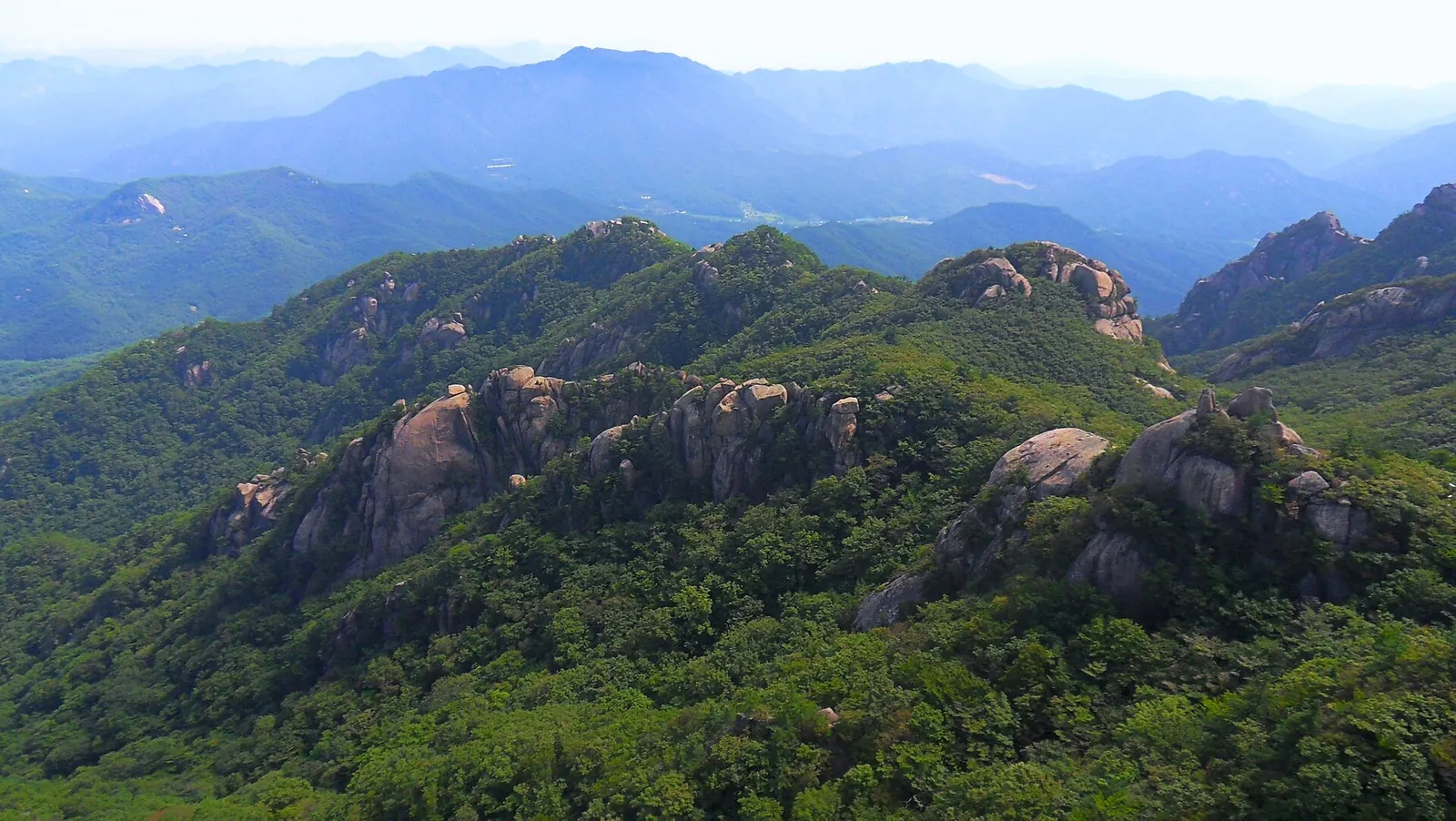
Munjangdae is a broad rock summit. VisitKorea gives its height as 1,054 m and says it is big enough for 50 adults to sit on. From the top you look along the ridge to Cheonwangbong and the other peaks. The usual route from the Beopjusa side follows the Sejo-gil to Sesimjeong and then climbs to Munjangdae. KNPS gives it as 6.6 km and about 3 hours 30 minutes one way, at the middle of its three grades. Wear proper hiking shoes. Combine Munjangdae with the ridge to Sinseondae and back down via Sesimjeong and the route becomes a 13.2 km, about 6 hours 15 minutes, middle-grade day. Add Cheonwangbong and it is the 16.1 km, 8-hour loop.
KNPS sets the latest time you may start up each trail. When we checked on 2026-10-03, the KNPS entry-hours page listed the Beopjusa–Munjangdae trail as open for entry from 04:00 to 15:00 from April to October, and from 05:00 to 14:00 from November to March. The Beopjusa–Cheonwangbong trail closed earlier, at 14:00 in summer and 12:00 in winter. Those are the latest start times, not finishing times, so if you want the summit, start in the morning. Check the KNPS Songnisan notices for closures before you go, especially in winter and after heavy rain.
Getting there and getting around
VisitKorea lists Songnisan Mountain as a destination from two Seoul terminals: the Central City Express Bus Terminal (Express Bus Terminal Station, Lines 3, 7 and 9) and the Seoul Nambu Terminal (Nambu Terminal Station, Line 3). It also lists Boeun as a destination. Check the current departures with the terminals before you travel. We could not confirm a timetable from an official page, so we do not give one here.
By car, VisitKorea's page on the Songnisan Special Tourist Zone says the Dangjin–Yeongdeok highway passes through the area and that the zone is about 30 minutes from Cheongju International Airport. When we checked, VisitKorea listed day parking at the Beopjusa car park at 7,000 won. Its national-park page showed lower rates for the park car parks (2,000 won for compact cars, 4,000 won for sedans, 5,000 won in peak season). Confirm the rate on arrival.
Once you are there, you do not need transport. The village, the temple and the Sejo-gil are joined by footpaths.
Practical questions
Is Songnisan worth a day trip from Seoul?
Yes, if Beopjusa and an easy walk are the goal. Buses run from Seoul's Central City and Nambu terminals, according to VisitKorea. The summit is much more comfortable with an overnight in the tourist village.
What is special about Beopjusa?
It is one of the seven UNESCO-listed Sansa mountain monasteries. Its Palsangjeon is the only five-storey wooden pagoda left in Korea (National Treasure No. 55), and beside it stands a gilt-bronze Maitreya that VisitKorea gives as 33 m tall.
How long is the Sejo-gil?
KNPS lists 4 km from the Songnisan Experience Learning Center to Bokcheonam hermitage, about 1 hour 20 minutes, at its easiest grade.
How hard is the hike to Munjangdae?
KNPS gives 6.6 km and about 3 hours 30 minutes one way from the Beopjusa side, at a middle grade, with steep, rocky sections. When we checked, entry was allowed until 15:00 from April to October and 14:00 from November to March.
How much is admission to Beopjusa?
When we checked on 2026-10-03, VisitKorea's Beopjusa page listed 5,000 won for adults, but another VisitKorea page still showed 4,000 won. Confirm at the ticket office.
Can I stay overnight at Beopjusa?
VisitKorea lists Beopjusa among the temples offering templestays, booked through templestay.com. Otherwise stay in the tourist village at the park entrance.
Sources and checks before you travel
Reference sources for the version dated 3 October 2026. Confirm opening times, access, transport and conditions for your travel dates.
- Korea National Park Service: Songnisan National Park ↗ — opens in a new tab
- Korea National Park Service: Songnisan trail courses ↗ — opens in a new tab
- Korea National Park Service: designated entry hours ↗ — opens in a new tab
- Sansa, Buddhist Mountain Monasteries in Korea (Jogye Order): Beopjusa ↗ — opens in a new tab
- Sansa (Jogye Order): Beopjusa setting ↗ — opens in a new tab
- Sansa (Jogye Order): Beopjusa history ↗ — opens in a new tab
- Sansa (Jogye Order): Beopjusa layout and buildings ↗ — opens in a new tab
- Beopjusa (official): cultural heritage list ↗ — opens in a new tab
- VisitKorea: Boeun Beopjusa Temple ↗ — opens in a new tab
- VisitKorea: Cultural Heritage Sites (Sansa) ↗ — opens in a new tab
- VisitKorea: Songnisan National Park (Chungcheongbuk-do section) ↗ — opens in a new tab
- VisitKorea: Songnisan National Park (Gyeongbuk section) ↗ — opens in a new tab
- VisitKorea: Songnisan Special Tourist Zone ↗ — opens in a new tab
- VisitKorea: Jeongipum Pine Tree ↗ — opens in a new tab
- VisitKorea: Mansugyegok Valley ↗ — opens in a new tab
- VisitKorea: Deongnim Sanchae Sikdang ↗ — opens in a new tab
- VisitKorea: Kyunghee Sikdang ↗ — opens in a new tab
- VisitKorea: Boeun Jujube Desserts ↗ — opens in a new tab
- VisitKorea: Templestay ↗ — opens in a new tab
- VisitKorea: Express Bus & Intercity Bus ↗ — opens in a new tab
- VisitKorea: 2026 Fall Foliage Forecast ↗ — opens in a new tab
Does this experience fit your route?
If you would rather not sort out the bus from Seoul, a guided day can take you to Beopjusa and the valley. Check the time in the park before you book.
Check dates and details on Viator ↗ — opens in a new tabAffiliate link · Book with ViatorPhoto credits
Palsangjeon, Korea's only surviving five-storey wooden pagoda, with the gilt-bronze Maitreya beside it at Beopjusa, Songnisan
Photograph: MeganYoungmee — opens in a new tab · CC BY-SA 3.0 — opens in a new tab
Changes: Resized and converted to WebP; displayed with responsive crops. · Original photograph and licence details ↗ — opens in a new tab
The 33-metre gilt-bronze Maitreya Buddha at Beopjusa, against the wooded slopes of Songnisan
Photograph: 최옥석 — opens in a new tab · CC BY-SA 4.0 — opens in a new tab
Changes: Resized and converted to WebP; displayed with responsive crops. · Original photograph and licence details ↗ — opens in a new tab
The Songnisan ridge seen from Munjangdae, the rock platform at the top of the climb from Beopjusa
Photograph: Ashy Minivet — opens in a new tab · CC0 — opens in a new tab
Changes: Resized and converted to WebP; displayed with responsive crops. · Original photograph and licence details ↗ — opens in a new tab
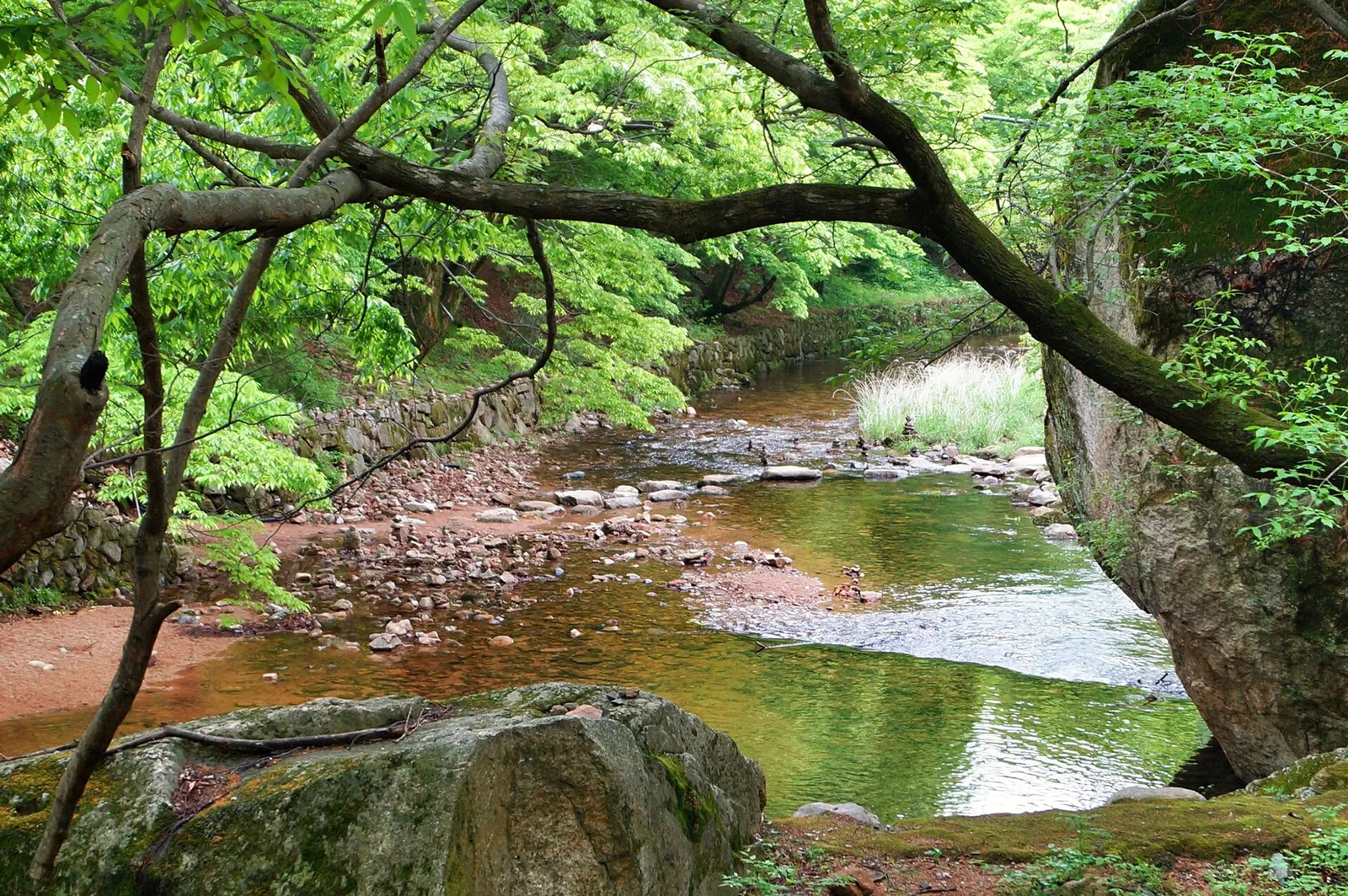
A forest stream in Songnisan National Park, near Beopjusa
Photograph: MeganYoungmee — opens in a new tab · CC BY-SA 3.0 — opens in a new tab
Changes: Resized and converted to WebP; displayed with responsive crops. · Original photograph and licence details ↗ — opens in a new tab
Sanchae bibimbap, rice with seasoned wild mountain vegetables, the kind of dish served in the restaurants at Songnisan (photographed elsewhere)
Photograph: Real rism — opens in a new tab · CC0 — opens in a new tab
Changes: Resized and converted to WebP; displayed with responsive crops. · Original photograph and licence details ↗ — opens in a new tab