Northern Mountains · Lao Cai
Bac Ha Sunday market: planning a trip from Sa Pa or Lao Cai
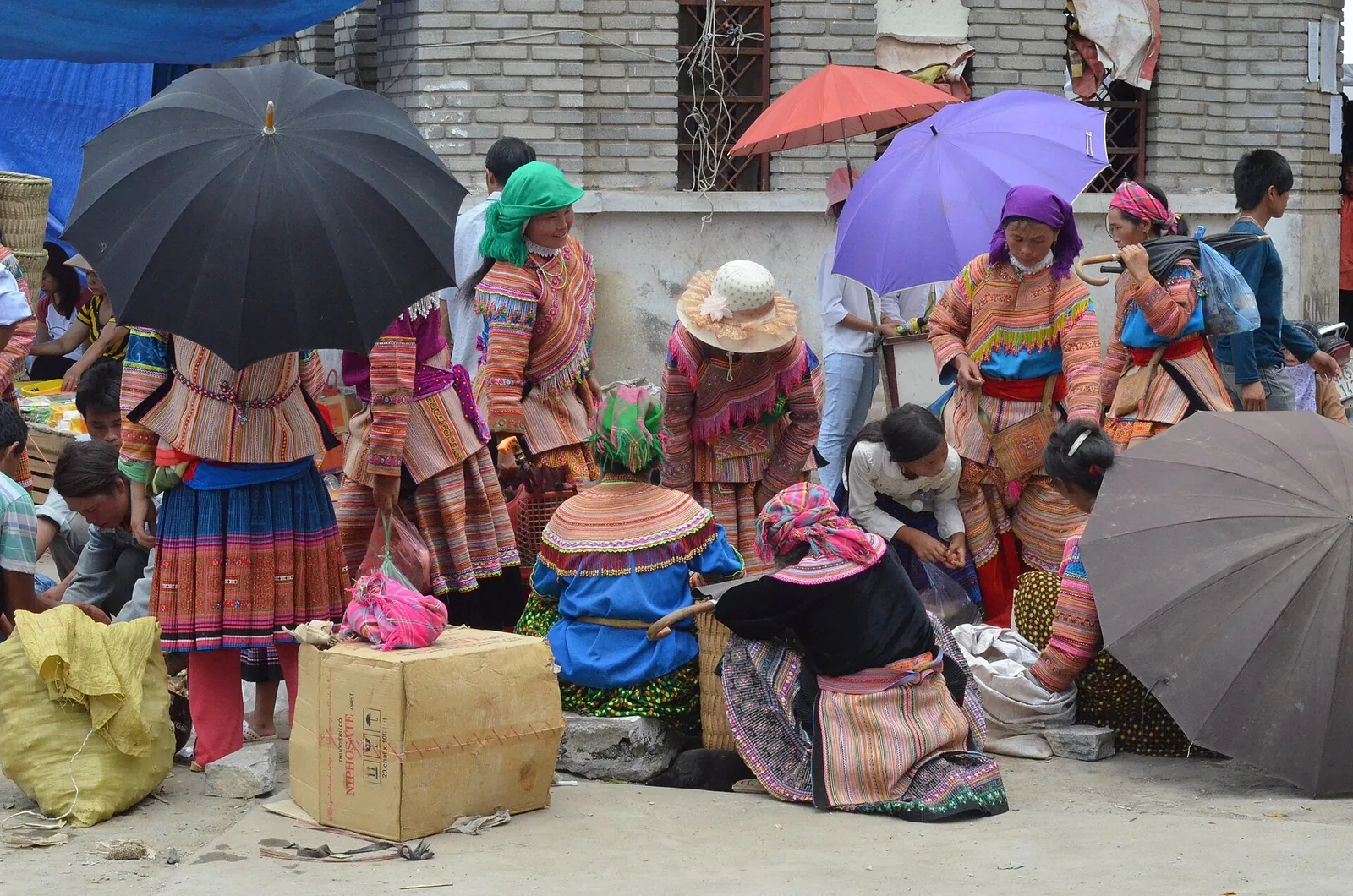
Bac Ha is a small highland town east of Lao Cai city, set between 1,000 and 1,500 metres above sea level, and for one morning a week it becomes the busiest place in the mountains. On Sundays, Flower Hmong, Tay, Dao, Nung, Phu La and other communities come in from the surrounding villages — some setting off the afternoon before — to sell buffalo and horses, chillies and honey, saddles and hand-embroidered clothes, and to eat thang co with a bowl of corn wine. The rest of the week Bac Ha is quiet: a plateau of plum orchards known as the 'white plateau' for its spring blossom, with the colonial-era palace of a local Tay ruler in the middle of town.
- Suggested time
- A Sunday day trip from Sa Pa or Lao Cai; one night (Saturday) for a slower visit
- Where to stay
- Sa Pa or Lao Cai city for a day trip; Bac Ha town or a Ta Chai homestay for a Saturday night
- Season and timing
- The market runs every Sunday all year. Plum blossom whitens the plateau in spring and the Tam Hoa plums are harvested in summer, when the horse races are held; from October to December mornings at market are cold. For Sa Pa and the north-west highlands, Vietnam's tourism authority describes April–June as warm and clear, September–November as cool and dry and late December to March as cold.
The short answer
Plan Bac Ha around a Sunday. The easiest way is a day trip from Sa Pa or Lao Cai city on a tour or with a hired car, leaving early so that you reach the market in the morning, when it is at its liveliest. If you want the market at first light and time for the villages, arrive on Saturday, sleep in Bac Ha town or a Tay homestay in nearby Ta Chai, and leave on Sunday afternoon. Allow two to three hours for the market itself, an hour for the Hoang A Tuong Palace, and add Ban Pho or the Na Hoi grassland if you stay overnight. From Hanoi it is a long road day each way, so treat it as part of a Sa Pa or northern loop rather than a separate trip.
A Sunday day trip or a Saturday night on the plateau
Everything in Bac Ha turns on the Sunday market. Vietnam's tourism authority describes it as a weekly market for 14 ethnic groups from the communes around the town and beyond, and as one of the largest markets of the northern border highlands. Villagers from further out set off the afternoon before, and the market fills from early morning, so the first hours are the ones to aim for.
Most international visitors come on a day trip from Sa Pa or Lao Cai city. That works: you arrive mid-morning, walk the market, see the palace and are back by evening. The trade-off is that you arrive with everyone else and leave as the town is winding down. Spending Saturday night in Bac Ha lets you be in the market as the first traders arrive, and gives you a quiet afternoon for the villages, which a day trip rarely allows. Vietnam's tourism authority reports that Tay families in Ta Chai, a village area close to the town, run homestays where guests can help with rice farming, plum picking and cooking; Bac Ha town itself has guesthouses and small hotels.
A note on names: since 1 July 2025 the old Bac Ha district has been abolished, and under National Assembly Standing Committee Resolution 1673/NQ-UBTVQH15 the former Bac Ha town and the communes of Na Hoi, Ban Pho, Thai Giang Pho, Hoang Thu Pho and Nam Mon were merged into a single Bac Ha commune of Lao Cai province. Maps and booking sites may still show the old district, town and commune names.
How to read the Sunday market
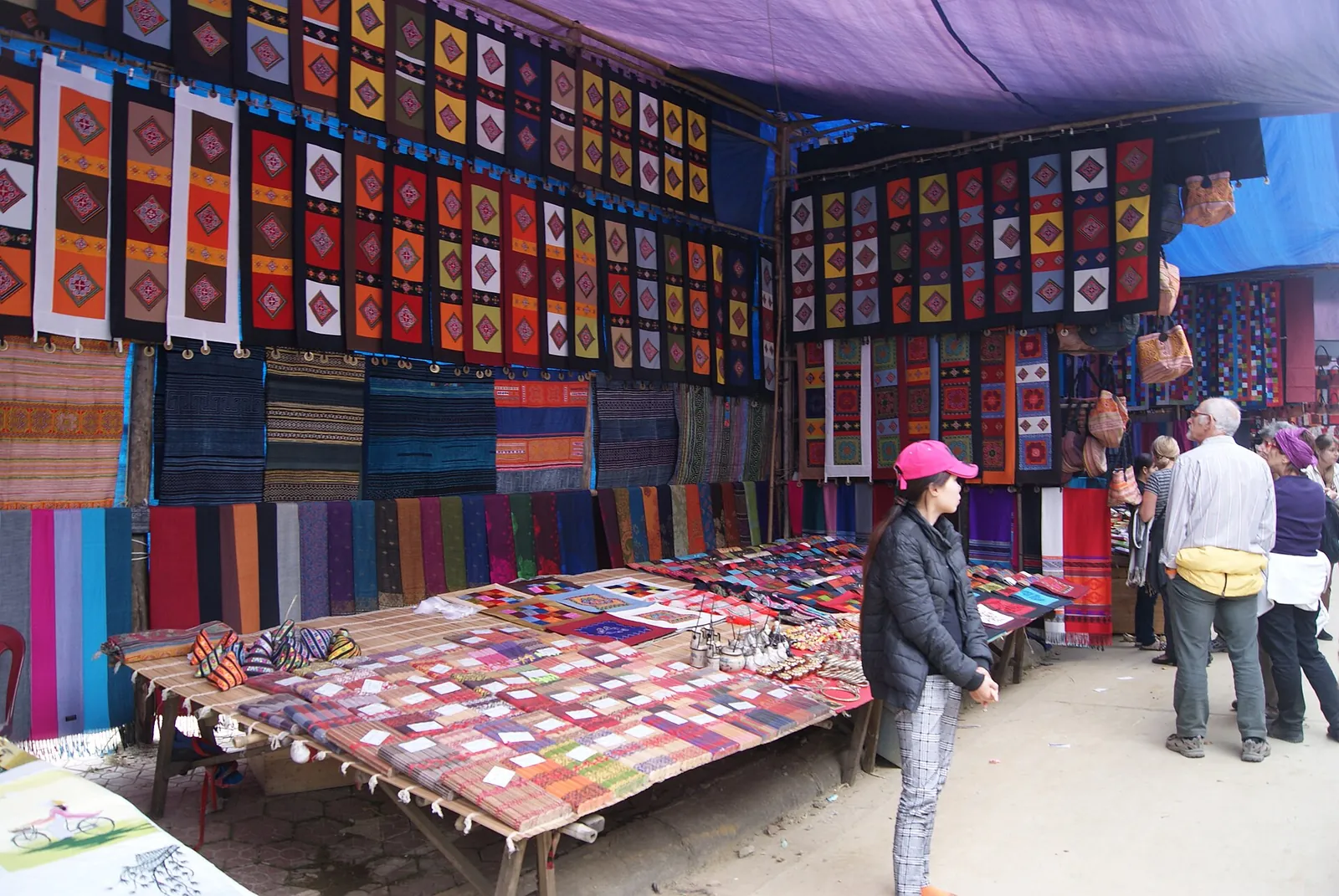
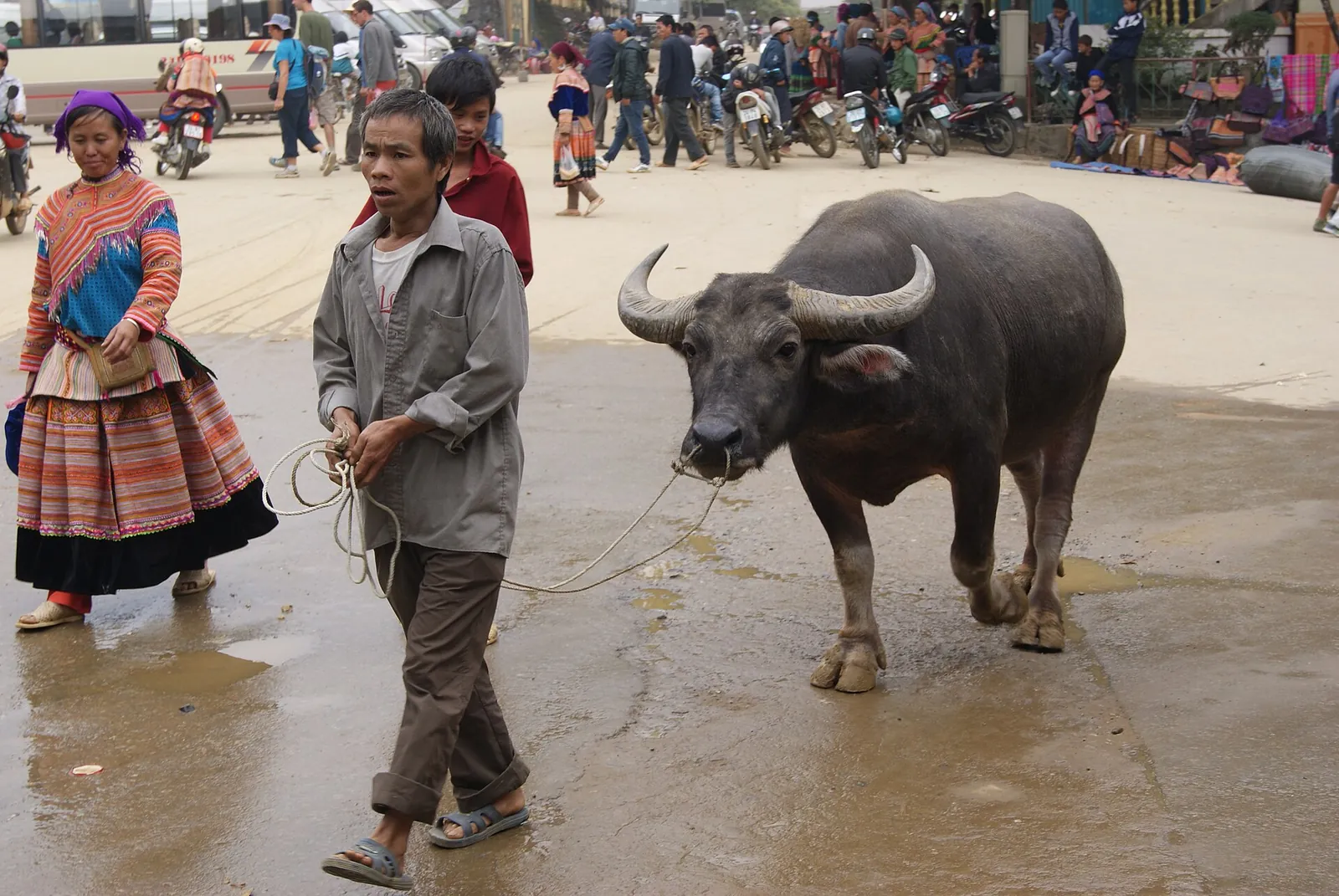
The market used to meet on a gently sloping hill; it has since moved to a purpose-built concrete site in the centre of town, divided into sections. Vietnam's tourism authority lists them: brocade and clothing, hand-woven and embroidered by local women and sold with silver and brass jewellery; vegetables and produce, bright with red chillies, greens and beeswax; tools and household goods such as ploughs, hoes, spades and knives; a food area with steaming pans of thang co; and the livestock market, with hundreds of buffalo, cattle and horses, plus corners for dogs and songbirds. Vietnam's tourism authority describes the livestock section as the most crowded part of the market.
Walk it in that order of interest rather than of position. Go to the livestock market first, while the trading is in full swing; then the textile rows, where Flower Hmong women in their layered, embroidered skirts and checked headscarves are both the sellers and the customers; then sit down in the food area once the morning chill has gone. Look out for the things made for local use rather than for visitors: wooden saddles made by Phu La craftsmen from nearby Na Hoi, dried chillies, Shan tuyet tea, wood-ear mushrooms, honey and orchids brought down from the hills.
This is a working market where people buy ploughs, sell animals and meet friends and relatives, not a show put on for tourists. Keep out of the way of animals being led through, ask before photographing people (especially close-ups), and bargain politely for textiles; if hand embroidery matters to you, ask the seller how a piece was made.
Make time for the local food
What to eat and where to look
Thang co
The Hmong stew of meat and offal simmered with spices in large pans. Traditionally it is made with horse meat; today beef, buffalo and pork versions are also cooked. Vietnam's tourism authority names Bac Ha, Muong Khuong and Sa Pa as the places where the dish was born.
- Where to look
- The food section of the Sunday market, where the pans steam from early morning.
- Fit it into your day
- A late breakfast or early lunch after the livestock market, shared at a long table.
Contains offal and usually horse meat — ask what is in the pan before you order.
Ban Pho corn wine (ruou ngo)
Corn spirit distilled by Hmong families in Ban Pho; local saying has it that thang co without Ban Pho corn wine does not count. Corn-wine making is one of the crafts the district promotes for visitors.
- Where to look
- Sellers in the market and households in Ban Pho village.
- Fit it into your day
- A small bowl with thang co; buy a bottle to take away at the end of the morning.
Strong spirit, often home-distilled; drink little, and not before a mountain drive or motorbike ride.
Men men and banh duc ngo
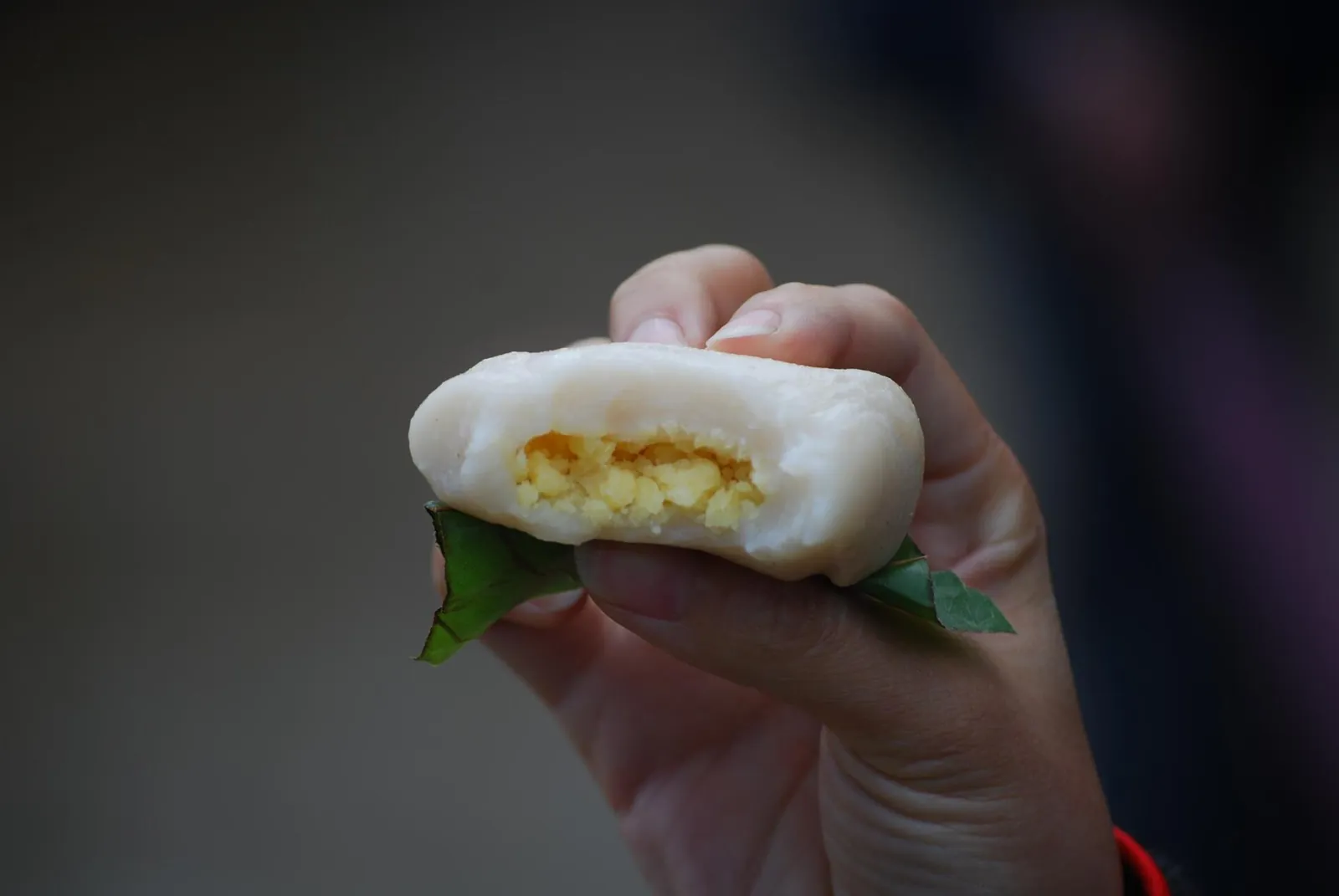
Men men is steamed ground maize, the Hmong staple; banh duc ngo is a soft cake of corn flour. Both are sold in the market's food area alongside other highland cakes such as banh day.
- Where to look
- Food stalls in the market.
- Fit it into your day
- Try a portion with thang co or as a snack while you walk the market.
Filling and plain on its own; best with a stew or broth.
Pho chua Bac Ha (sour rice noodles)
A tangy rice-noodle dish that is a Bac Ha speciality; the market also serves noodles cooked in broth and tossed noodles (pho nau, pho tron).
- Where to look
- Noodle stalls in the market's food section and small eateries in town.
- Fit it into your day
- A lighter lunch than thang co, or a second stop in the food area.
Toppings vary by stall; ask what is included if you have allergies.
Tam Hoa plums
Bac Ha's best-known fruit, grown in orchards across the plateau and sold in the market in summer; there is now a plum festival at the palace square.
- Where to look
- Market stalls in season, and orchards around Na Hoi.
- Fit it into your day
- Buy a bag at the market as a snack for the drive back.
Seasonal (summer only); wash before eating.
Hoang A Tuong Palace and Bac Ha temple
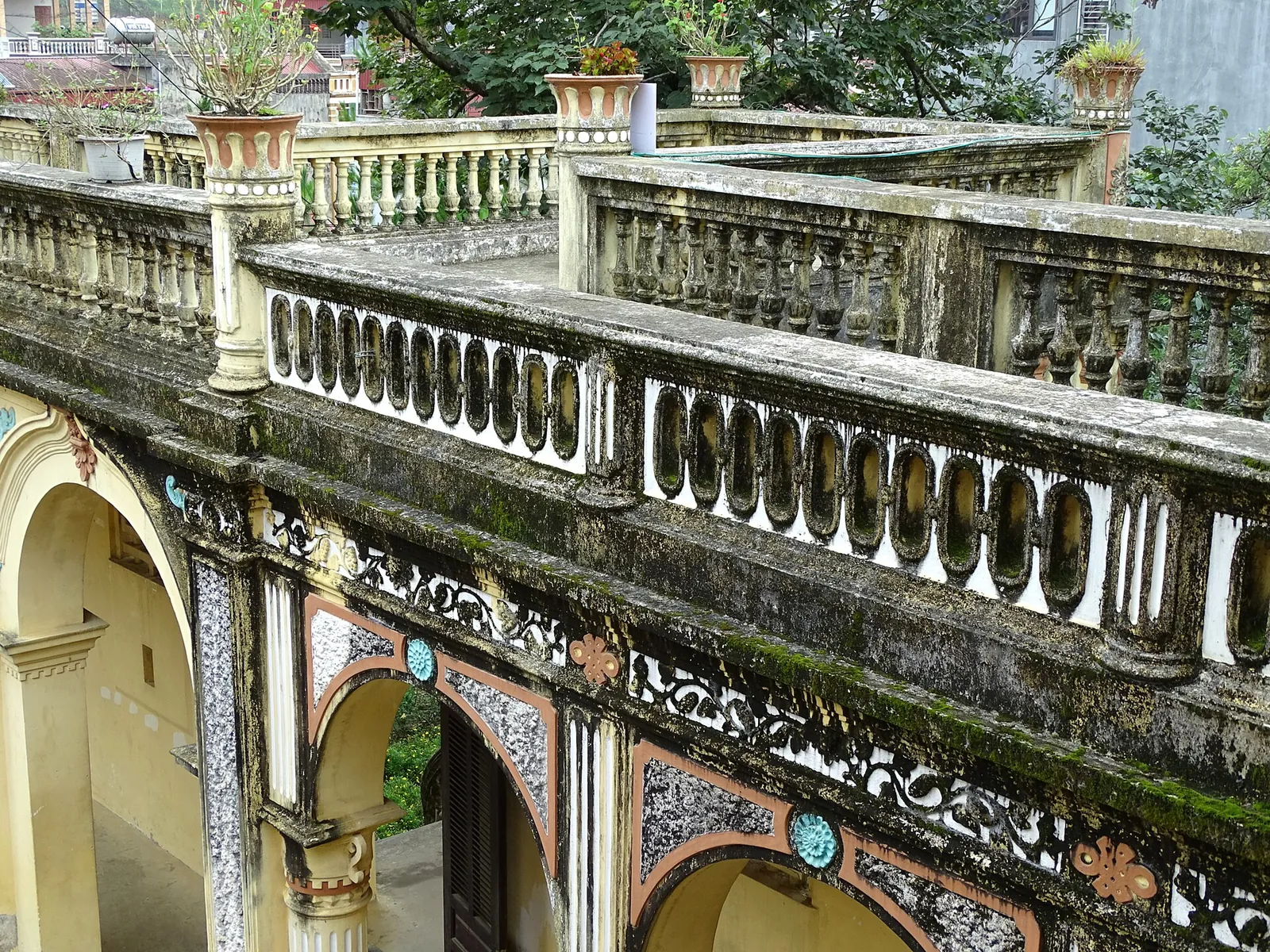
In the centre of town stands the Hoang A Tuong Palace (Dinh Hoang A Tuong), the residence of Hoang Yen Chao and his son Hoang A Tuong, Tay rulers who governed the area before 1945. Built between 1914 and 1921 to designs by French and Chinese architects, it mixes European and Asian styles in a closed rectangular layout on a hill: stairs curve up either side to a wide courtyard and a two-storey main house of about 420 square metres with arched doorways and decorated walls, flanked by wings once used for storage, guards and servants. The whole complex covers almost 4,000 square metres and is one of four national-level relics in the former district.
In mid-2024 Vietnam's tourism authority reported that the palace was being restored for visitors, and its square now hosts events such as the Tam Hoa plum festival. No official page with current opening hours or ticket prices was available when we checked on 2026-10-03, so ask locally or check with your tour.
Bac Ha temple (Den Bac Ha), built at the end of the 19th century, honours the brothers Vu Van Uyen and Vu Van Mat, who pacified this border region; it became a national historical and cultural relic in 2003, and its festival falls on the 7th day of the 7th lunar month. Dress modestly at the temple.
If you have time to spare in town, the small Ba Me Con mountain (Mother and Children) rises right in the centre; Vietnam's tourism authority suggests climbing it early in the morning for a view over the town in the mist.
Beyond the market: Ban Pho, Na Hoi and the villages
With a night in Bac Ha you can see the villages the market traders come from. Ban Pho, a Hmong village known for its corn wine, has been developing community tourism; the commune's chairman told Vietnam's tourism authority it received more than 55,000 visits in 2023. The Na Hoi grassland at Ngai Thau peak, about 3 km from the town centre, is a rolling meadow among pine hills where horses graze.
Further out, Hoang Thu Pho, about 10 km from town, has a viewpoint called the 'Heaven's Gate', a 20-minute walk from the commune centre, which Vietnam's tourism authority recommends for clear autumn views and sea-of-cloud mornings. Ban Lien, nearly 30 km away, has Tay villages and terraced rice fields, and the Ta Cu Ty waterfall is around 50 km by road plus a final stretch by motorbike and about 2 km on foot — one for a full extra day, not a Sunday add-on.
Other markets run on other days. Vietnam's tourism authority mentions the Can Cau market, usually held on Saturday morning in neighbouring Si Ma Cai (Can Cau commune became part of Si Ma Cai commune in 2025), which lets you see two highland markets on one weekend if you sleep in Bac Ha on Saturday.
Getting there from Sa Pa, Lao Cai and Hanoi
Bac Ha lies about 60–70 km by road from Lao Cai city (Vietnam's tourism authority gives both figures in different articles). Lao Cai is the railway and expressway hub for the region: Vietnam's tourism authority notes that overnight trains from Hanoi to Lao Cai are the most popular way into the Sa Pa area. Sa Pa itself is on the other side of Lao Cai city, so a day trip from Sa Pa goes down to Lao Cai and back up to the Bac Ha plateau; leave early on Sunday morning.
From Hanoi, the Bac Ha culture office's visitor site describes three options: driving up the Hanoi–Lao Cai expressway for about 200 km and then about 50 km of mountain road (about four to five hours in total by private vehicle); a direct coach from Hanoi's My Dinh bus station; or travelling to Lao Cai by train or coach and continuing by road. Operators and departure times change, so check them when you book.
Without your own driver, the simplest choices are a market tour from Sa Pa or Lao Cai, or a car with driver booked through your hotel. Agree the departure time, how long you will stay at the market and whether the palace or a village is included before you set off.
When to go: blossom, plums and horse races
Any Sunday works for the market, but the plateau changes a lot through the year.
- Spring: the plum orchards flower and turn the hillsides white — the origin of the 'white plateau' name.
- Summer: Hmong farmers bring the harvested Tam Hoa plums to market, and the traditional Bac Ha horse race, recognised as national intangible cultural heritage, is held. In 2026 the Bac Ha summer festival ran from 23 to 31 May, with the 19th traditional horse race, a plum festival at the Hoang A Tuong Palace square and evening folk performances at the market.
- Summer, in town: rows of golden-shower trees bloom yellow along the streets.
- Autumn: clear skies and cool days; the best season, according to Vietnam's tourism authority, for the views from Hoang Thu Pho.
- October to December: cold, misty mornings — wear layers and warm up over thang co and corn wine in the food area.
- Lunar New Year: the market fills with farmers buying kitchen utensils, ploughs and other tools for the new season.
Practical questions
Which day is the Bac Ha market?
Sunday, every week. It starts early in the morning and is liveliest in the first hours, so arrive as early as you can.
Can I visit Bac Ha as a day trip from Sa Pa?
Yes, that is how most visitors go. The road goes down to Lao Cai city and then up to the Bac Ha plateau, about 60–70 km from Lao Cai, so leave early on Sunday morning and expect a full day.
Is it worth staying the night in Bac Ha?
If you want the market at first light, or time for villages such as Ban Pho and the Na Hoi grassland, yes — arrive on Saturday. If the market is your only goal, a day trip is enough.
Is there another market nearby on Saturday?
Vietnam's tourism authority mentions the Can Cau market, usually held on Saturday morning north of Bac Ha, so you can combine the two over one weekend with a Saturday night in Bac Ha.
Who are the Flower Hmong?
A Hmong group known for the women's brightly embroidered skirts, jackets and headscarves, which give the Sunday market its colour. Many other communities — Tay, Dao, Nung, Phu La and more — come to the market too.
Is Bac Ha still a district?
No. Since 1 July 2025 Bac Ha town and five neighbouring communes have formed Bac Ha commune of Lao Cai province, so you may see both the old and new names.
Sources and checks before you travel
Reference sources for the version dated 3 October 2026. Confirm opening times, access, transport and conditions for your travel dates.
- Vietnam National Authority of Tourism: Bac Ha Sunday market (Cho phien Bac Ha, from Lao Cai newspaper) ↗ — opens in a new tab
- Vietnam National Authority of Tourism: Bac Ha market – special cultural feature in Lao Cai ↗ — opens in a new tab
- Vietnam National Authority of Tourism: Visiting Bac Ha – the white plateau ↗ — opens in a new tab
- Vietnam National Authority of Tourism: Bac Ha offers natural beauty, ethnic culture exploration ↗ — opens in a new tab
- Vietnam National Authority of Tourism: Highland experience in Bac Ha town (Trai nghiem du lich vung cao – thi tran Bac Ha) ↗ — opens in a new tab
- Vietnam National Authority of Tourism: Bac Ha Sunday market – the beauty of the white plateau (Cho phien Bac Ha: Net dep vung cao nguyen trang) ↗ — opens in a new tab
- Vietnam National Authority of Tourism: 5 places to explore in Bac Ha (Kham pha 5 diem du lich hap dan khi den Bac Ha) ↗ — opens in a new tab
- Vietnam National Authority of Tourism: Making Bac Ha a distinctive destination of the North-west (Dua Bac Ha thanh diem den dac sac) ↗ — opens in a new tab
- Vietnam National Authority of Tourism: Bac Ha Summer Festival 2026, 23–31 May ↗ — opens in a new tab
- Government portal: Resolution 1673/NQ-UBTVQH15 on Lao Cai's commune-level units (2025) ↗ — opens in a new tab
- Bac Ha Tourism (Bac Ha culture and information office): how to get to Bac Ha ↗ — opens in a new tab
- VietNamNet: Visiting Hoang A Tuong Palace in Bac Ha ↗ — opens in a new tab
- Vietnam Tourism: Sapa ↗ — opens in a new tab
- Vietnam Tourism: weather and climate in Vietnam ↗ — opens in a new tab
- Vietnam Tourism: a traveller's guide to Vietnam's airports ↗ — opens in a new tab
Does this experience fit your route?
A Sunday tour from Sa Pa takes care of the early start and the mountain road and gives you a guide to explain what is being traded. Before you book, check the pick-up time, how long you stay at the market and whether the palace is included.
Check dates and details on Viator ↗ — opens in a new tabAffiliate link · Book with ViatorPhoto credits
Flower Hmong traders at the Bac Ha Sunday market, Lao Cai province
Photograph: Peter Olshevsky — opens in a new tab · CC BY-SA 4.0 — opens in a new tab
Changes: Resized and converted to WebP; displayed with responsive crops. · Original photograph and licence details ↗ — opens in a new tab
The textile section of the Bac Ha Sunday market, where handmade brocade and clothing are sold
Photograph: Truth'soutthere — opens in a new tab · CC BY-SA 3.0 — opens in a new tab
Changes: Resized and converted to WebP; displayed with responsive crops. · Original photograph and licence details ↗ — opens in a new tab
Leading a water buffalo through Bac Ha on market day
Photograph: Truth'soutthere . — opens in a new tab · CC BY-SA 3.0 — opens in a new tab
Changes: Resized and converted to WebP; displayed with responsive crops. · Original photograph and licence details ↗ — opens in a new tab
The Hoang A Tuong Palace, built between 1914 and 1921 in the centre of Bac Ha
Photograph: Adam Jones from Kelowna, BC, Canada — opens in a new tab · CC BY-SA 2.0 — opens in a new tab
Changes: Resized and converted to WebP; displayed with responsive crops. · Original photograph and licence details ↗ — opens in a new tab
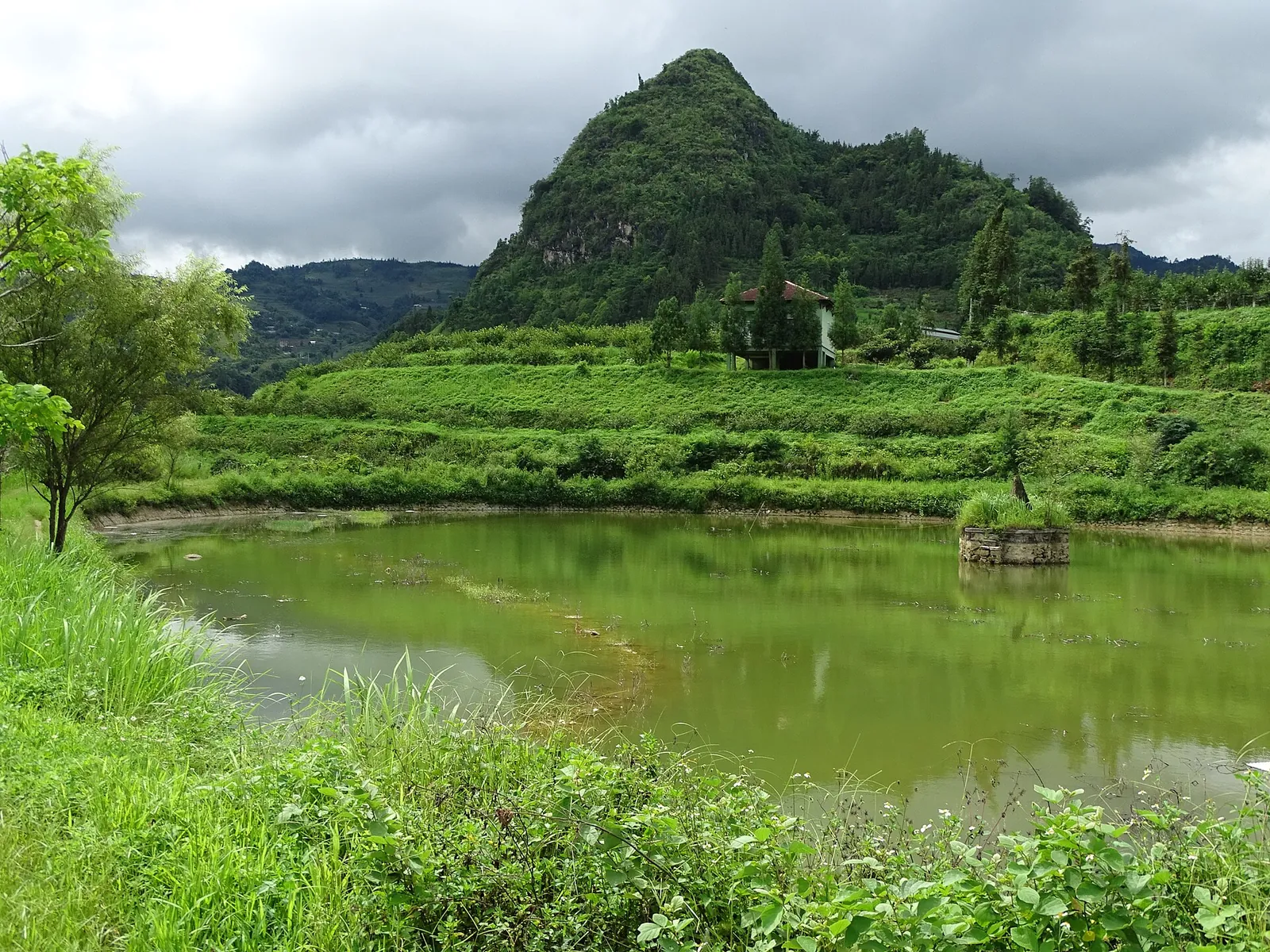
Farmland and hills around Bac Ha on the Lao Cai plateau
Photograph: Adam Jones from Kelowna, BC, Canada — opens in a new tab · CC BY-SA 2.0 — opens in a new tab
Changes: Resized and converted to WebP; displayed with responsive crops. · Original photograph and licence details ↗ — opens in a new tab
A mung bean cake from the Bac Ha Sunday market
Photograph: avlxyz — opens in a new tab · CC BY-SA 2.0 — opens in a new tab
Changes: Resized and converted to WebP; displayed with responsive crops. · Original photograph and licence details ↗ — opens in a new tab