Gangwon · Gangwon State
Samcheok travel guide: limestone caves, sea rail bike and where to stay
Samcheok is the last city on Gangwon's coast before the road and the railway cross into Gyeongsangbuk-do, and it is a smaller, quieter base than Gangneung or Sokcho to the north. It has two kinds of scenery. Inland, in the hills of Singi-myeon, some 27 kilometres from town by the cave centre's directions, the Daei-ri cave area holds Hwanseongul and Daegeumgul, limestone caves that VisitKorea dates to about 530 million years ago. Along the sea, south of town, a rail bike runs along the shore between Gungchon and Yonghwa, a cable car crosses the water to Jangho Port, and the beaches are smaller and quieter than the big resort strands further north. Samcheok town itself has Jukseoru, one of the Eight Sights of Gwandong, on a cliff above the Osipcheon stream.
- Suggested time
- 2 nights; 1 long day if you choose either the caves or the coast
- Where to stay
- Samcheok Beach or the town centre without a car; Yonghwa or Jangho on the southern coast with one
- Season and timing
- The caves are a year-round, all-weather option. Beaches have lifeguards only during the official swimming period in summer, which each beach sets for the year. April brings canola flowers and cherry blossoms at Maengbang. The rail bike stops on the second and fourth Wednesday of each month, and Haesindang Park, Lady Suro Heonhwa Park and Hwanseongul close on the 18th.
The short answer
Give Samcheok two nights: one day for the caves inland and one for the southern coast with the rail bike, the Jangho cable car and Haesindang Park. Stay near Samcheok Beach or in town if you are travelling by bus and train, since buses to the coast and the caves start from the town terminal; stay at Yonghwa or Jangho if you have a car and want to wake up on the quiet southern coast. Book Daegeumgul and the rail bike online in advance: both release the next month's tickets on the first day of each month. Arrive on the Donghae Line KTX-Eum from Gangneung or Pohang, or by express bus from Seoul, and continue south to Uljin and Pohang on the same line.
Town, Samcheok Beach or the southern coast: where to base yourself
Samcheok is a long city that works as three areas. The town centre sits around the Osipcheon stream, with Jukseoru Pavilion and the bus terminal. Samcheok Beach, just north of the centre, is linked to Samcheok Port by the Saecheonnyeon coastal road. The southern coast, around Geundeok-myeon and Wondeok-eup, has Gungchon, Yonghwa and Jangho, then Imwon and Sinnam further south.
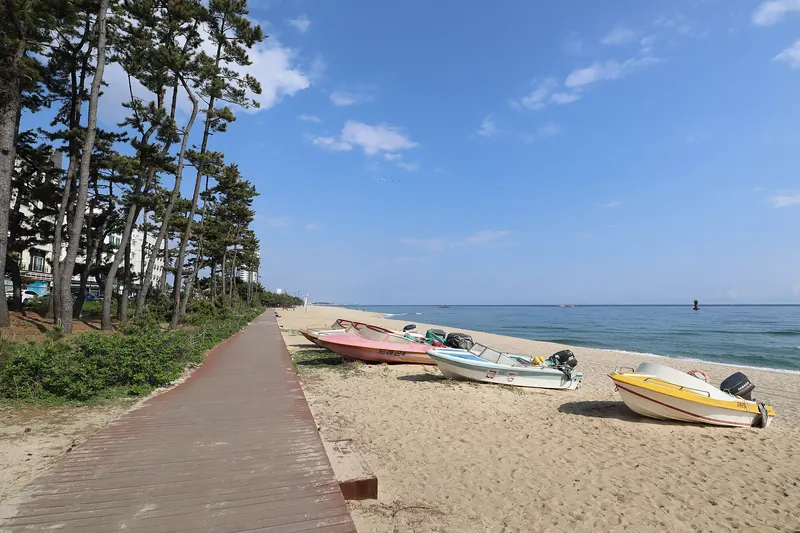
Without a car, stay in town or at Samcheok Beach. That is where the city buses start: the rail bike operator's site lists city buses bound for Hosan and Imwon from the terminal to Haesindang Park and Lady Suro Heonhwa Park, taking about 40 minutes, and the cave centre's own site posts a bus timetable from Samcheok and Dogye to Hwanseongul. VisitKorea describes Samcheok Beach as 1.2 kilometres of white sand, 100 metres wide, with a pine grove and shallow water. Sol Beach Samcheok, the resort whose water park VisitKorea lists at 453 Surobuin-gil, is at its northern end.
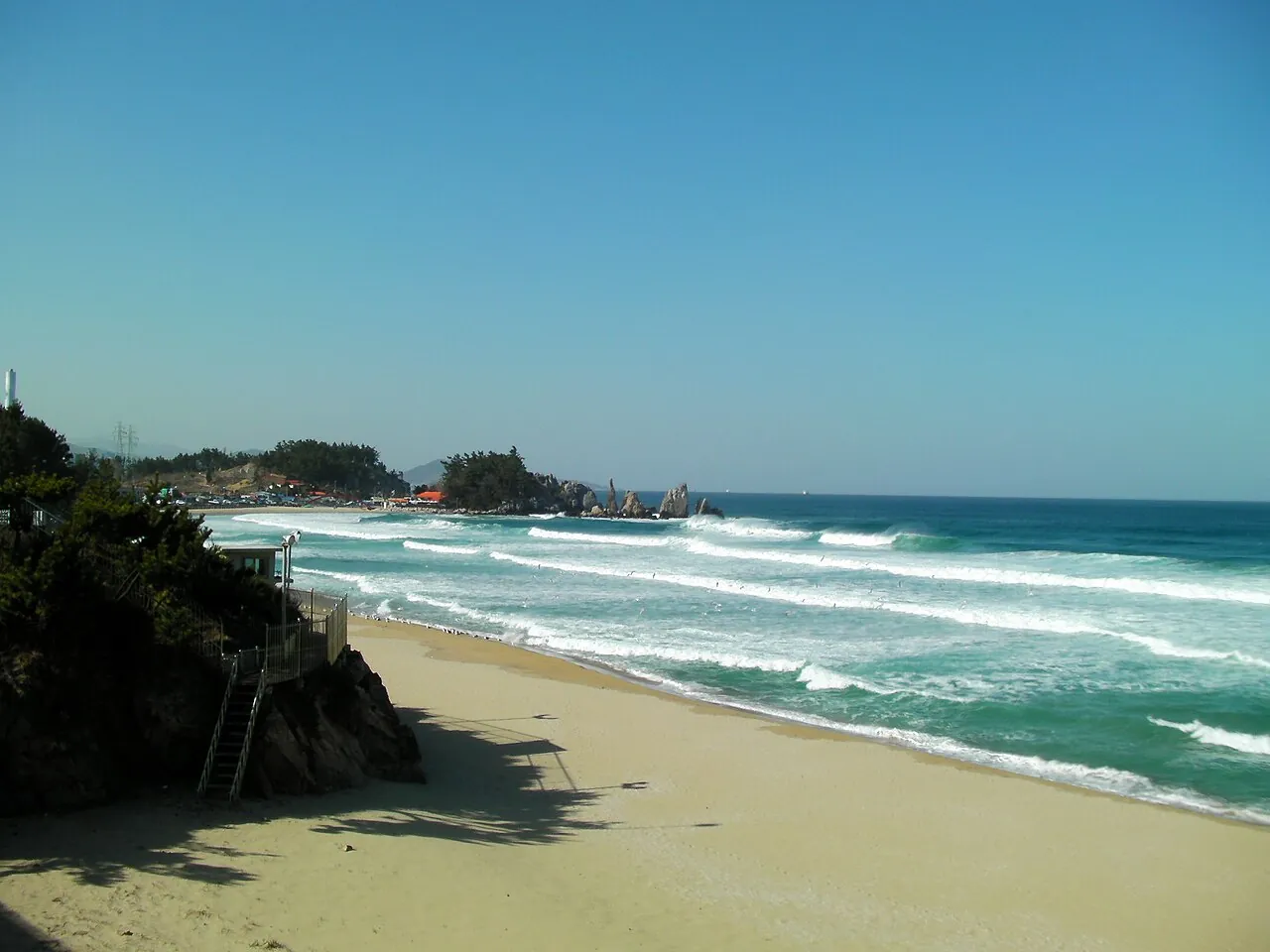
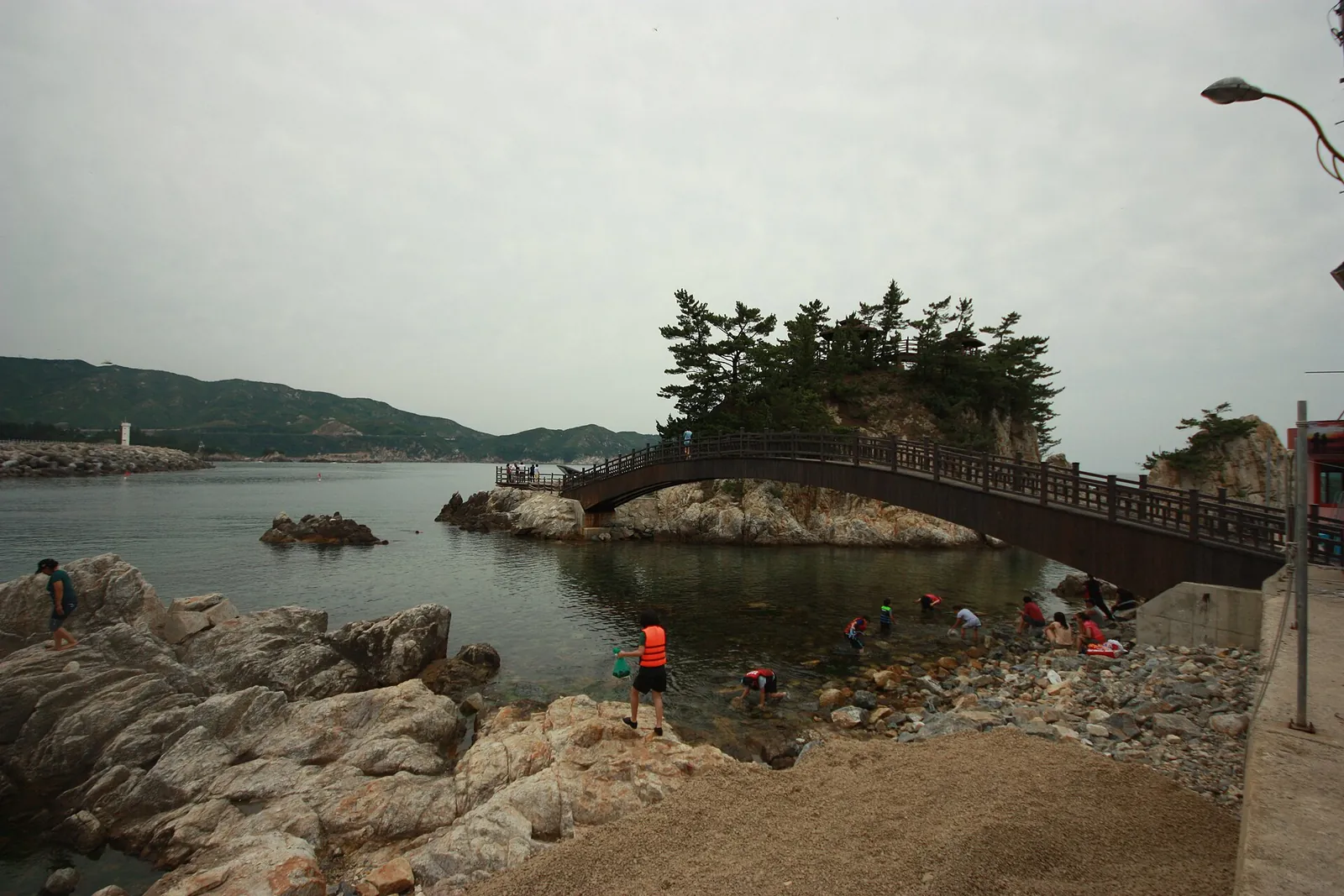
With a car, or for a slow coastal stay, sleep at Yonghwa or Jangho. VisitKorea describes Yonghwa Beach as only about a kilometre long, half-moon shaped, with shallow water, and quieter than the big beaches. It is also where the rail bike and the cable car meet. In a 2026 feature on registered stays, VisitKorea placed Stay Yonghwa a minute's walk from the rail bike and three minutes from the cable car. Jangho Port, just to the south, is what VisitKorea says is known as the 'Naples of Korea': a small round bay with white sand and rocks in the sea.
For families, VisitKorea's same feature lists High1 Choochoo Park in Dogye-eup, a railway-themed resort with cabins and glamping, inland in the mountains on the way to Taebaek. It is a stay in its own right, not a base for the coast.
Hwanseongul and Daegeumgul: the Daei-ri caves
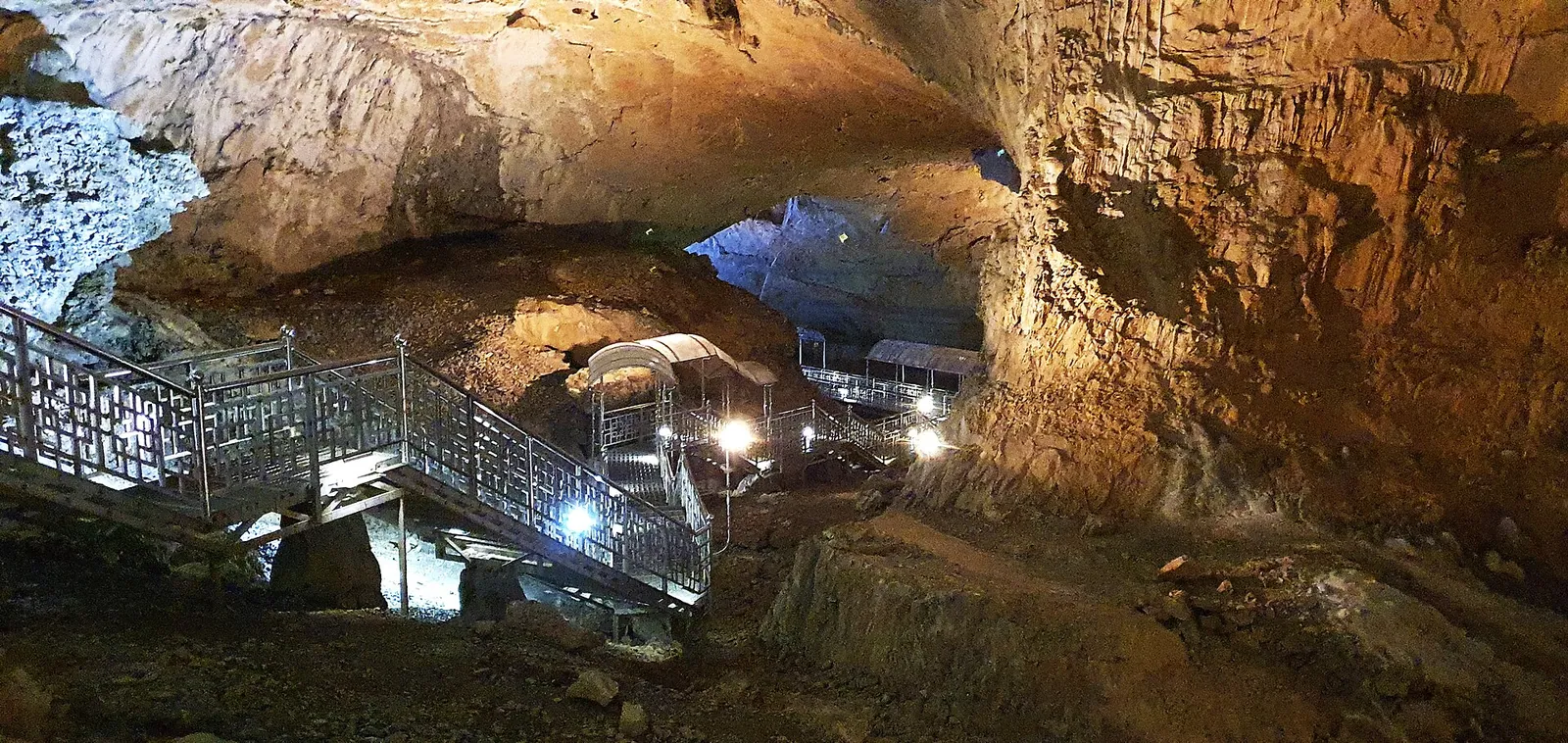
Two show caves sit side by side at the same visitor centre, 800 Hwanseon-ro in Singi-myeon, inside the Daei-ri cave area, which is Natural Monument No. 178. They are different visits, and most people only need one of them.
Hwanseongul is the big one. VisitKorea calls it the largest limestone cave in Asia, formed about 530 million years ago, with stalactites, stalagmites and 47 animal species recorded in it, four of them found only here. It is reached on foot or by a monorail that has run since 2010. The rail bike operator's page on nearby sights put the full visit at about two hours: an hour there and back to the cave and an hour inside. When we checked on 3 October 2026, VisitKorea listed Hwanseongul at 4,500 won for adults and the monorail at 7,000 won return or 4,000 won one way, with tickets sold on site only. Hours were 08:30 to 16:30 from March to October and 09:00 to 16:00 from November to February, with last entry 10 minutes before closing, and the cave closes on the 18th of each month.
Daegeumgul was found only in 2003, when a city excavation team broke into an underground hall full of waterfalls, and opened to the public on 5 June 2007, according to its official site. Much of its character comes from water: flowing streams, cave pools and waterfalls inside, and you reach it on a monorail that is included in the ticket. The official site listed adult tickets at 12,000 won when we checked. Online booking for each month opens at 10:30 on the first day of the month before, and the site asks you to be at the ticket office 30 minutes before your slot to collect tickets and get to the monorail platform. Without a booking you are relying on spare places.
Choose Hwanseongul if you want the scale and are happy with the walk up (or pay for the monorail); choose Daegeumgul if you want the waterfalls and the ride in by monorail, and can commit to a time.
- Address for both: 800 Hwanseon-ro, Singi-myeon, Samcheok
- Hwanseongul: tickets on site; closed on the 18th of each month
- Daegeumgul: book ahead on the official ticket site; monorail included
- By car, the cave centre's directions take Route 38 west from Samcheok towards Taebaek, then turn off at Singi
Make time for the local food
What to eat and where to look
Gomchiguk (gomchi fish soup)
Samcheok's best-known local dish: a soup of the soft, rather ugly fish locals call gomchi or kkomchi, which VisitKorea translates as moray eel. Once ignored because of its looks and soft flesh, it is now eaten as a mild, refreshing hangover soup along the eastern coast, and VisitKorea names it as Samcheok's local speciality.
- Where to look
- Seafood restaurants around Samcheok Port and in town; as a hangover soup it is often eaten in the morning.
- Fit it into your day
- Breakfast before a cave day, or lunch after a morning on the coast.
The texture is very soft and slippery; versions cooked with kimchi are spicier.
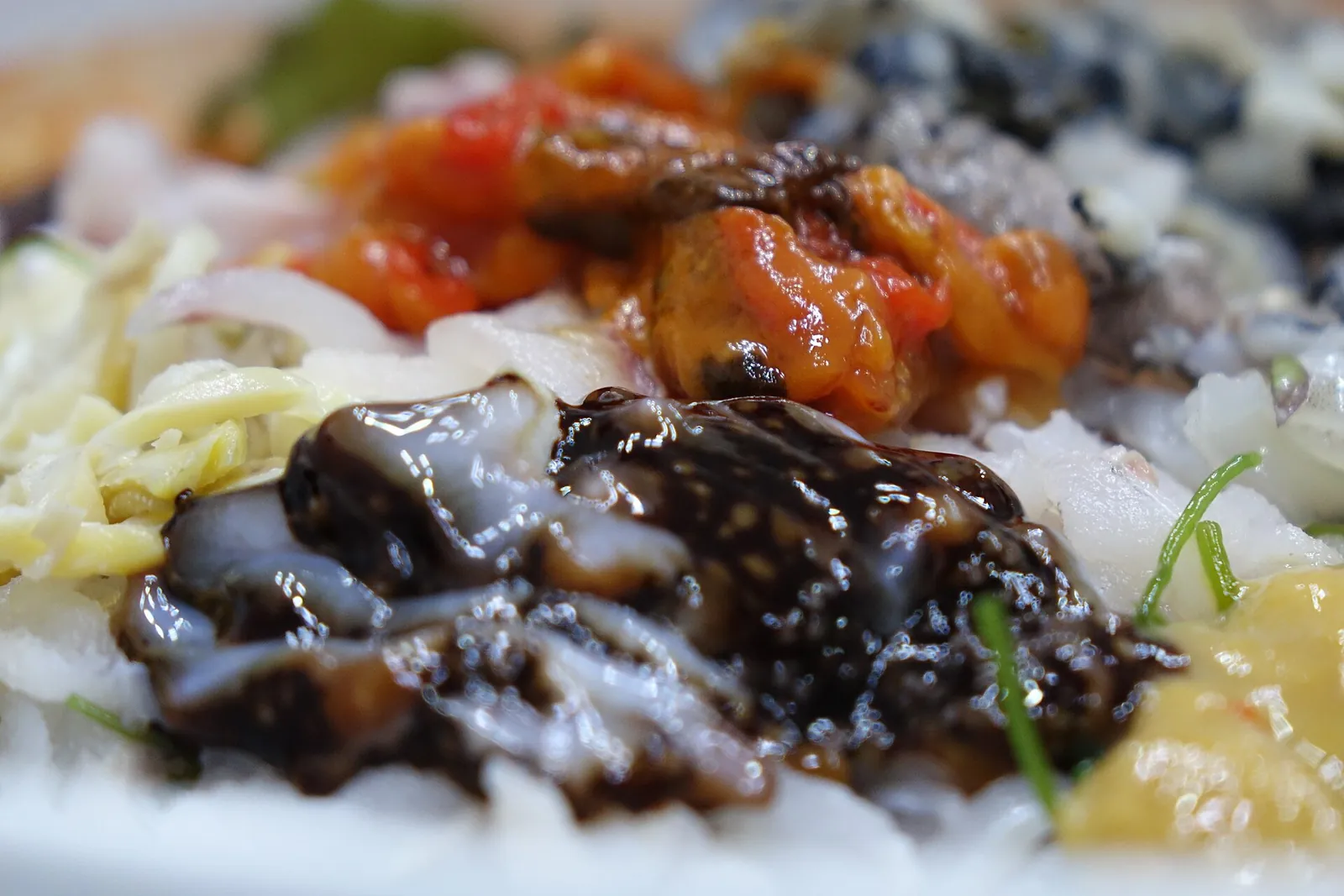
Mulhoe (cold raw fish soup)
Sliced raw fish in a cold, sweet-spicy broth with vegetables, eaten mainly in summer. VisitKorea lists Samcheok Hoetjip near Samcheok Port for mulhoe and assorted sliced raw fish, and its squid mulhoe page names Samcheok among the Gangwon coastal towns to eat it.
- Where to look
- Samcheok Hoetjip, 125 Saecheonnyeondo-ro; when we checked, VisitKorea listed it as open 11:30 to 20:00 with a break from 15:00 to 16:30, closed on Tuesdays. Also the raw-fish restaurants at Jangho and Imwon ports.
- Fit it into your day
- Lunch on the Saecheonnyeon coastal road or after the rail bike.
Raw seafood; ask the price before ordering.
Makguksu (buckwheat noodles)
Gangwon's buckwheat noodles, served in cold broth or with a spicy dressing and topped with cucumber and pickled radish. VisitKorea lists Buil Makguksu in Samcheok for mul makguksu, with boiled pork slices (suyuk) recommended alongside, and warns that queues form at peak times.
- Where to look
- Buil Makguksu, 596 Saecheonnyeondo-ro; VisitKorea listed 11:30 to 20:00 with a break from 15:00 to 16:30, closed on Tuesdays, when we checked.
- Fit it into your day
- A light, quick lunch between the town and the coast.
Buckwheat allergy; some broths use meat stock.
Bakery café on the sea
Samcheok's coast has its share of ocean-view cafés. VisitKorea lists Negaissneun Bada at Gallam Port, with terrace and rooftop seating and a bakery known for green onion scones and mugwort financiers.
- Where to look
- Negaissneun Bada, 49-75 Gallam-gil, Wondeok-eup; VisitKorea listed 11:00 to 18:30 (last order 18:00), closed on Thursdays, when we checked.
- Fit it into your day
- An afternoon stop on the drive south to Haesindang or Imwon.
Popular items run out later in the day.
Ocean Railbike, Yonghwa and the Jangho cable car
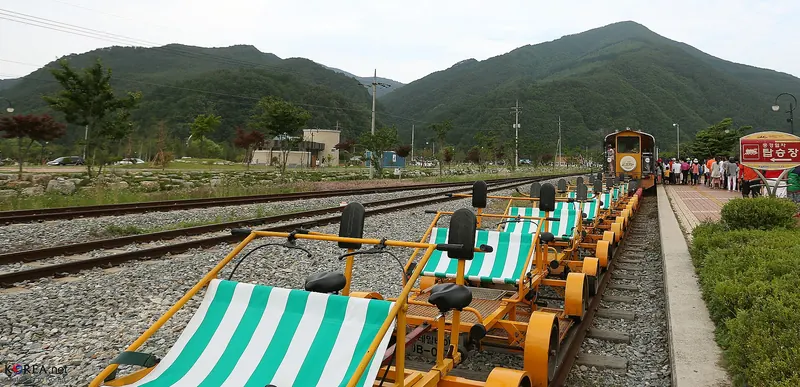
The Samcheok Ocean Railbike runs 5.4 kilometres along the coast between Gungchon Station and Yonghwa Station, with stops for a rest area at Chogok and tunnels lit with light shows. The operator puts the ride itself at about an hour, after which a free shuttle bus takes you back to your starting station, so allow up to an hour and a half in all. You can start at either end.
When we checked on 3 October 2026, the official site listed daytime departures at 09:00, 10:30, 13:00, 14:30 and 16:00, with an extra evening run on peak-season weekends. Its FAQ gave the price as 25,000 won for a two-seat bike and 35,000 won for a four-seater. Online booking for the next month opens at 10:00 on the first of each month, same-day online booking is not possible, and tickets are also sold at the stations; the ticket office does not sell during its lunch break. The rail bike is closed on the second and fourth Wednesday of each month, and the site posts extra closing days (in October 2026 it listed the 14th, 23rd and 28th, plus no afternoon runs on the 16th).
From Yonghwa, the Samcheok Marine Cable Car crosses the bay to Jangho. The rail bike operator describes an 874-metre span with no towers in between, from Yonghwa station at 2154-31 Samcheok-ro to Jangho station at 12-10 Janghohang-gil. We could not confirm current hours or fares from an official page, so check them on the day. VisitKorea notes that some attractions along the Donghae Line offer discounts to holders of a valid train ticket, so keep yours.
Between Gungchon and Yonghwa, the Chogok Yonggul Chotdaebawi trail is a 660-metre coastal path of decks and a 56-metre suspension bridge past the Chogok sea cave and candle-shaped rocks. When we checked, the operator's page listed it as free, open 09:00 to 18:00 from March to October (last entry 17:00) and closed on Mondays. Further north, near Deoksan Beach, VisitKorea lists the short Deokbongsan Coastal Eco-trail, with a 317-metre route to the summit of a small hill and a 626-metre loop round its base.
Jukseoru and the town by the Osipcheon
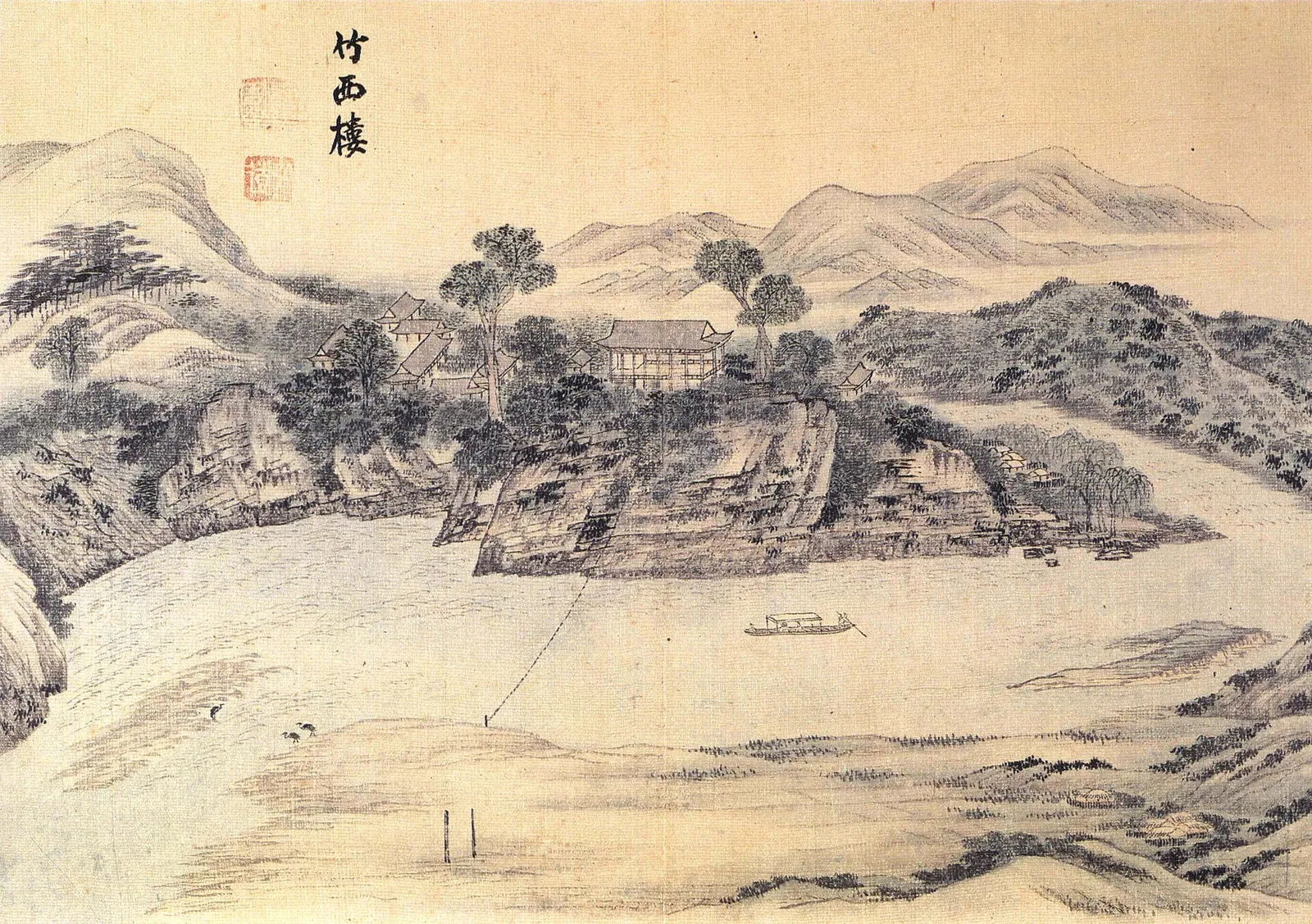
Jukseoru is the reason to spend an hour in town. VisitKorea dates the pavilion to around 1266 and counts it among the Eight Sights of Gwandong. It stands on a cliff above the Osipcheon, built so that the natural rock forms part of its foundations, and its rafters carry 26 inscribed boards, including calligraphy by the 17th-century scholar Heo Mok; VisitKorea notes that kings Sukjong and Jeongjo and the scholar Yi I (Yulgok) also left their mark here. When we checked on 3 October 2026, VisitKorea listed it as free, open 09:00 to 18:00 from March to October and 09:00 to 17:00 from November to February, with last entry 30 minutes before closing.
Heo Mok also left the Cheokjudonghaebi monument, which VisitKorea dates to 1661, when he was governor of Samcheok. Its inscription was believed to calm the sea that kept flooding the village. Together with a later stone honouring him, it stands at 13-7 Heomok-gil.
From Samcheok Port, the Saecheonnyeon coastal road runs 4.6 kilometres to Samcheok Beach along cliffs and rocks; the operator's page notes that it was chosen as one of Korea's 100 beautiful roads and that a sunrise festival is held at its Tower of Hope on 1 January. Samcheok Hoetjip, the raw-fish restaurant VisitKorea lists at 125 Saecheonnyeondo-ro, is on this road, next to Isabu Plaza and its sky deck.
The far south: Haesindang Park and Lady Suro Heonhwa Park
About 40 minutes south of the town terminal by city bus, the coast turns towards fishing villages. Haesindang Park, on a hill above the fishing village of Sinnam, is built around what the rail bike operator calls the east coast's only surviving phallic-worship folk tradition, and is known for its phallic sculptures, winners of a city sculpture contest. It sounds like a joke, and partly is, but it also has the Samcheok Fishing Village Folk Museum on the same ticket, Aerang's House, a traditional fishing household, and an observatory over the sea. When we checked on 3 October 2026, VisitKorea listed adult admission at 3,000 won and the park open 09:00 to 18:00 from March to October and 09:00 to 17:00 from November to February, closed on the 18th of each month. It is not a family outing for everyone; decide on that basis.
Further south at Imwon Port, Lady Suro Heonhwa Park is a sunrise viewpoint built on a hilltop around the 8th-century legend of Lady Suro, who was taken by a sea dragon and returned when the villagers sang the 'Song of the Sea'. VisitKorea says it takes about 20 minutes on foot from Imwon Port to the top and listed adult entry at 3,000 won, open 09:00 to 18:00 (17:00 from November to February), closed on the 18th. The rail bike operator's page adds that on clear days you can see Ulleungdo from the top.
Beyond Imwon, the coast continues to Hosan and the provincial border. This is where Samcheok becomes a route rather than a destination: the Donghae Line continues south to Uljin, Yeongdeok and Pohang.
Getting there and moving on down the coast
Since 30 December 2025, the Donghae Line KTX-Eum has run the whole east coast from Gangneung to Bujeon in Busan, stopping at Samcheok among its eleven stations. VisitKorea lists six services a day, three in each direction, and puts the full run at about 3 hours 50 minutes. Its route diagram shows about 15 minutes between Samcheok and Donghae and about 26 minutes between Samcheok and Uljin, and the train continues via Yeongdeok to Pohang and Gyeongju. With so few trains, book seats in advance through Korail, especially on summer weekends.
From Seoul, VisitKorea lists Samcheok among the routes from both Seoul Express Bus Terminal and Dong Seoul Terminal. By rail, KTX trains from Seoul run on the Gangneung Line towards Gangneung and Donghae; change there for the Donghae Line south.
Samcheok spreads out, and local transport is thin. With one or two days, the realistic pattern is one bus day to the caves using the cave centre's timetable and one bus day along the coast, or a taxi between the southern sights. If you are driving the coast road south towards Uljin, Samcheok is the natural overnight between Gangneung and the Gyeongsangbuk-do coast.
Practical questions
Should I visit Hwanseongul or Daegeumgul?
Hwanseongul is the larger cave, with tickets sold on site and an optional monorail; allow about two hours. Daegeumgul is known for its underground waterfalls and pools, and you reach it by a monorail included in the ticket, but it needs an online booking that opens at 10:30 on the first of the previous month. Both are at the same visitor centre at 800 Hwanseon-ro.
Do I need to book the Samcheok Ocean Railbike?
It is wise to. Online booking opens at 10:00 on the first of each month for the following month and is not possible on the day; tickets are also sold at Gungchon and Yonghwa stations if bikes are left. When we checked on 3 October 2026, the official site listed 25,000 won for a two-seater and 35,000 won for a four-seater.
How many days do I need in Samcheok?
Two nights lets you do the caves one day and the southern coast the next. With one day, choose either the caves or the rail bike and Jangho; doing both in a day without a car is rushed.
How do I get to Samcheok from Seoul?
VisitKorea lists Samcheok among the express and intercity bus routes from Seoul Express Bus Terminal and Dong Seoul Terminal. By rail, take the KTX towards Gangneung or Donghae, then the Donghae Line KTX-Eum, which stops at Samcheok.
Is Haesindang Park suitable for children?
It is a park of phallic sculptures based on a local legend, with a fishing-village museum on the same ticket. Decide for yourself; the free Isabu Lion Park on the coast north of town or the rail bike are easier choices with children.
Can I continue from Samcheok to Uljin and Pohang by train?
Yes. The Donghae Line KTX-Eum runs from Gangneung via Samcheok, Uljin, Yeongdeok, Pohang and Gyeongju to Bujeon in Busan, with three trains each way a day according to VisitKorea. Book ahead, as seats can sell out on weekends and in summer.
Sources and checks before you travel
Reference sources for the version dated 3 October 2026. Confirm opening times, access, transport and conditions for your travel dates.
- VisitKorea: Hwanseongul Cave ↗ — opens in a new tab
- VisitKorea: Daegeumgul Cave ↗ — opens in a new tab
- Daegeumgul official site (Samcheok Daei Cave Tourism Centre) ↗ — opens in a new tab
- Samcheok Ocean Railbike (official, Samcheok City) ↗ — opens in a new tab
- Samcheok Ocean Railbike: course ↗ — opens in a new tab
- Samcheok Ocean Railbike: hours, fares and FAQ ↗ — opens in a new tab
- Samcheok Ocean Railbike: nearby sights ↗ — opens in a new tab
- VisitKorea: Samcheok Ocean Railbike ↗ — opens in a new tab
- VisitKorea: Jukseoru Pavilion ↗ — opens in a new tab
- VisitKorea: Cheokjudonghaebi & Pyeongsutochanbi Monuments ↗ — opens in a new tab
- VisitKorea: Samcheok Haesindang Park ↗ — opens in a new tab
- VisitKorea: Samcheok Fishing Village Folk Museum ↗ — opens in a new tab
- VisitKorea: Lady Suro Heonhwa Park ↗ — opens in a new tab
- VisitKorea: Samcheok Beach ↗ — opens in a new tab
- VisitKorea: Yonghwa Beach ↗ — opens in a new tab
- VisitKorea: Janghohang Port ↗ — opens in a new tab
- VisitKorea: Deokbongsan Coastal Eco-trail ↗ — opens in a new tab
- VisitKorea: Samcheok Maengbang Yuchaekkot Village ↗ — opens in a new tab
- VisitKorea: Recommended Stays in Samcheok (2026) ↗ — opens in a new tab
- VisitKorea: Travel from Gangneung to Busan on the Donghae Line KTX-Eum ↗ — opens in a new tab
- VisitKorea: East Coast Train Trip by KTX-Eum ↗ — opens in a new tab
- VisitKorea: Express Bus and Intercity Bus ↗ — opens in a new tab
- VisitKorea: Train ↗ — opens in a new tab
- VisitKorea: Moray Eel Soup (Gomchiguk) ↗ — opens in a new tab
- VisitKorea: Cold Raw Squid Soup (Ojingeomulhoe) ↗ — opens in a new tab
- VisitKorea: Samcheok Hoetjip ↗ — opens in a new tab
- VisitKorea: Buil Makguksu ↗ — opens in a new tab
- VisitKorea: Negaissneun Bada ↗ — opens in a new tab
- VisitKorea: Isabu Lion Park & Picture Book Land ↗ — opens in a new tab
- VisitKorea: Sol Beach Samcheok Ocean Play ↗ — opens in a new tab
- VisitKorea: International Flights ↗ — opens in a new tab
Does this experience fit your route?
Samcheok is best done on your own: a train down the coast, a booked cave slot and a rail bike ride. Consider a guided trip only if it clearly includes Samcheok's caves or coast.
Browse relevant experiences on Viator ↗ — opens in a new tabAffiliate link · Book with ViatorPhoto credits
Samcheok Beach, the town's main beach, linked to Samcheok Port by the Saecheonnyeon coastal road.
Photograph: pcamp — opens in a new tab · CC BY 2.0 — opens in a new tab
Changes: Resized and converted to WebP; displayed with responsive crops. · Original photograph and licence details ↗ — opens in a new tab
Inside Hwanseongul in the Daei-ri cave area, which VisitKorea calls Asia's largest limestone cave.
Photograph: José Carioca — opens in a new tab · CC BY-SA 4.0 — opens in a new tab
Changes: Resized and converted to WebP; displayed with responsive crops. · Original photograph and licence details ↗ — opens in a new tab
Jangho Port on Samcheok's southern coast, the end of the cable car from Yonghwa.
Photograph: 우한길(HK Woo) — opens in a new tab · CC BY 3.0 — opens in a new tab
Changes: Resized and converted to WebP; displayed with responsive crops. · Original photograph and licence details ↗ — opens in a new tab
Mulhoe, the cold raw seafood soup eaten along the Gangwon coast in summer.
Photograph: 최광모 — opens in a new tab · CC0 — opens in a new tab
Changes: Resized and converted to WebP; displayed with responsive crops. · Original photograph and licence details ↗ — opens in a new tab
Jukseoru above the Osipcheon in a Joseon-era painting by Kim Hong-do; the pavilion still stands on the same cliff.
Photograph: Kim Hong-do — opens in a new tab · Public domain — opens in a new tab
Changes: Resized and converted to WebP; displayed with responsive crops. · Original photograph and licence details ↗ — opens in a new tab