Jeolla · South Jeolla
Damyang travel guide: Juknokwon bamboo, Metasequoia Road and Soswaewon
Damyang is a rural county on Gwangju's doorstep whose name in Korea means one thing: bamboo. VisitKorea notes that the county holds nearly 35% of the country's bamboo habitat, and the town turns that into a short, very walkable circuit — the Juknokwon bamboo garden, the 200-to-300-year-old trees of the Gwanbangjerim riverbank forest and the tall Metasequoia-lined road — all in and around Damyang-eup. Out in Gasamunhak-myeon, Soswaewon is one of the best-known private gardens of the Joseon period, surrounded by the pavilions where the region's gasa poets wrote. The decisions are how much of this to fit into one day out of Gwangju, and whether a night in a hanok inside the bamboo garden is worth it.
- Suggested time
- Half a day to 1 full day; 1 night if you stay in the bamboo garden
- Where to stay
- Gwangju for a day trip, or the hanok stay inside Juknokwon in Damyang-eup
- Season and timing
- Damyang's bamboo is green all year, and Juknokwon's own site says the grove is 4 to 7°C cooler than outside, which makes summer more pleasant than it sounds. VisitKorea calls summer the peak for the Metasequoia road's foliage. The Damyang Bamboo Festival is held in early May — VisitKorea listed 1 to 5 May 2026 at the sports complex, Juknokwon and Dambit Music Hall, with free entry. Juknokwon closes an hour earlier from November to February.
The short answer
Treat Damyang as a half day or a full day from Gwangju, and stay one night only if you want the bamboo garden early and quiet. For a half day, take bus 311 from Gwangju to Juknokwon, walk the bamboo paths, then follow the Gwanbangjerim riverside forest to the Metasequoia-lined road, and eat tteokgalbi in Damyang-eup before heading back. For a full day, add Soswaewon garden and the Gasa Literature Museum, which sit together on Gwangju city bus route 187. If you stay, book the hanok rooms inside Juknokwon (guests enter the garden free) or an old house in Changpyeong's slow-city village. From Seoul, a handful of direct express buses a day reach Damyang, but most travellers come via Gwangju.
Half a day from Gwangju, or a night in the bamboo
Damyang's main sights line up in and around the county town, Damyang-eup. Juknokwon, the bamboo garden, is in Damyang-eup itself; Gwanbangjerim is a 2-kilometre band of old trees along the banks of the Damyangcheon stream, and VisitKorea lists Juknokwon and the Metasequoia-lined road as its neighbours. That makes a compact loop on foot: bamboo first, the riverside forest next, the tree-lined road last, with a tteokgalbi lunch or dinner in town. Check walking distances in a map app on the day, but you do not need a car for this part.
Juknokwon's own directions page describes the bus most visitors use: route 311 from the stop in front of the main gate of Gwangju's U-Square bus terminal, or from the stop behind Gwangju Station, to Juknokwon. That puts Damyang within easy reach for a half day from Gwangju. A full day lets you add Soswaewon and the pavilions of Gasamunhak-myeon, which are on a different bus line (see the last section).
A night is worth it for one reason: the hanok rooms inside Juknokwon. Guests there enter the garden free, and the official booking page says check-in runs from 15:00 to 22:00 and check-out is at 11:00 — so you can walk the bamboo in the late afternoon and again first thing the next morning before the day visitors arrive. Otherwise, Gwangju has far more hotels and food, and Damyang works well as a day out.
Juknokwon bamboo garden
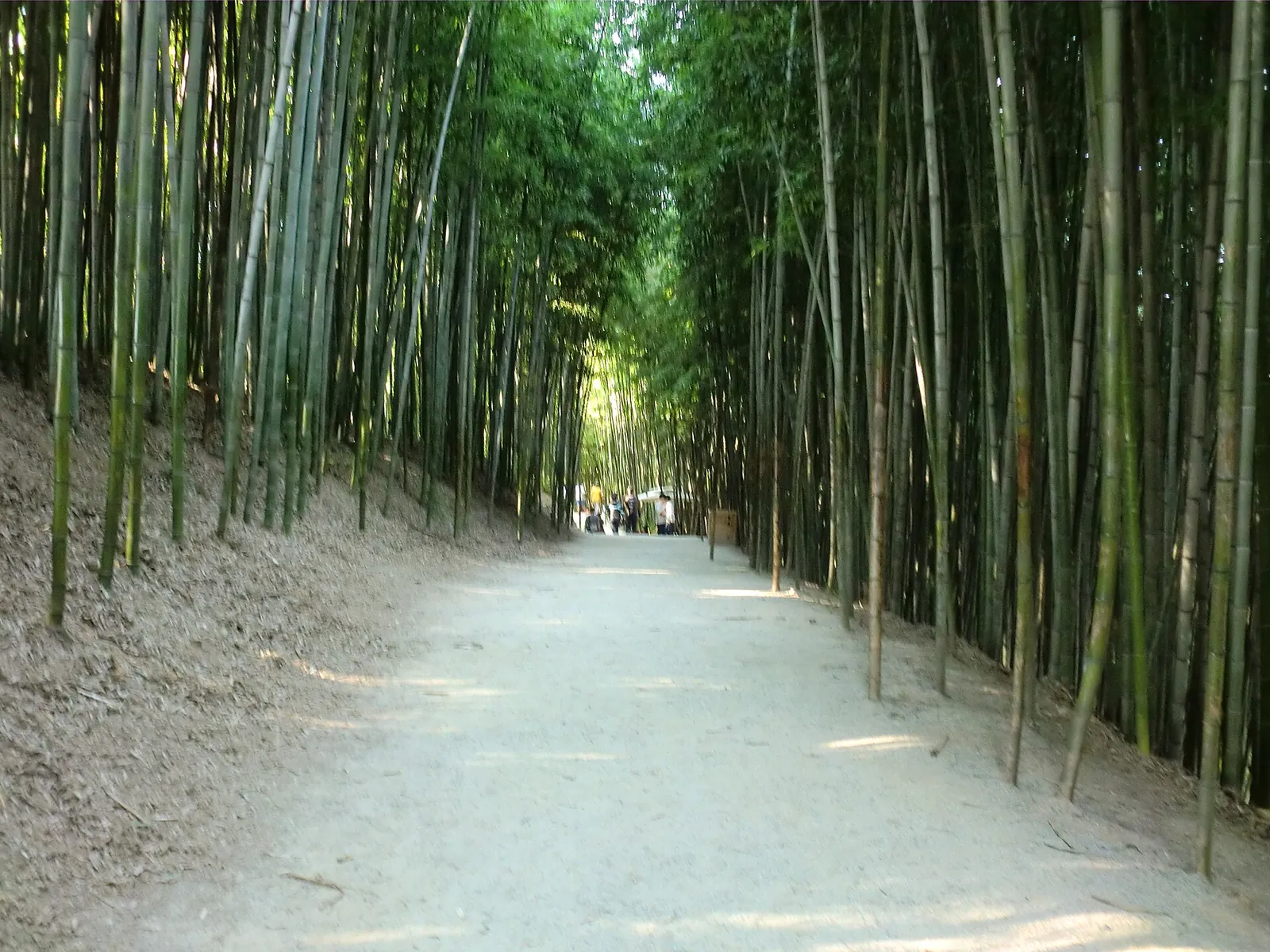
Juknokwon was created by Damyang County in May 2003, according to VisitKorea; the garden's official site gives a formal opening in March 2005 and an area of about 310,000 square metres, roughly double the 160,000 square metres VisitKorea quotes, because the official figure also counts the Siga Culture Village inside the grounds. Inside are dense groves of tall bamboo, 2.4 kilometres of walking paths divided into eight themed trails, pavilions, rest huts and two hanok cafés. VisitKorea's column suggests about an hour for a leisurely walk, and the first trail alone is 420 metres, about 15 minutes, on the official map.
When we checked on 3 October 2026, the official site and VisitKorea listed opening hours of 9:00 to 19:00 from March to October (last admission 18:00) and 9:00 to 18:00 from November to February (last admission 17:30), with no closing day. Admission was 3,000 won for adults, 1,500 won for teenagers and 1,000 won for primary-school children; preschoolers and visitors aged 65 and over enter free with ID. The main gate is at 119 Jungnogwon-ro and the rear gate at 363 Jukhyangmunhwa-ro.
The rules are stricter than in a park: the site lists no smoking anywhere, no outside food or cooking, no bicycles or e-scooters, no large dogs (small dogs only if carried), and no writing on the bamboo or picking bamboo shoots. Wheelchairs can be borrowed at the rear-gate ticket office, and the official site suggests wheelchair and pushchair users keep to the Siga Culture Village area because of the terrain.
That culture village, inside the garden, is worth the detour even if you will not reach the real thing: it recreates Damyang's famous pavilions — Myeonangjeong, Sigyeongjeong, Songgangjeong, Gwangpunggak of Soswaewon and others — alongside a hall for pansori teaching, a room for tasting jukro tea, and the hanok guest rooms. VisitKorea suggests ending a Juknokwon visit with a cup of bamboo-leaf tea.
- Hours (checked 3 October 2026): March–October 9:00–19:00, November–February 9:00–18:00; last admission 18:00 / 17:30.
- Tickets: adults 3,000 won, teenagers 1,500 won, children 1,000 won.
- Gates: main gate 119 Jungnogwon-ro; rear gate (hanok stay, parking) 363 Jukhyangmunhwa-ro.
Make time for the local food
What to eat and where to look
Damyang tteokgalbi
Minced and seasoned beef rib meat pressed into patties and grilled. VisitKorea picks tteokgalbi as Damyang's signature dish in its K-Local Food Trip list.
- Where to look
- Deokinkwan at 1121 Jukhyang-daero, Damyang-eup, which VisitKorea says opened in 1963 and is run by Park Gyu-wan, designated Korean Food Grand Master No. 82 for grilled galbi; VisitKorea listed it as open 11:00 to 20:30 every day.
- Fit it into your day
- The obvious lunch after Juknokwon or dinner before the bus back to Gwangju.
It is a marinated beef dish; hours were last updated by VisitKorea, so check a map app on the day.
Daetongbap (rice cooked in bamboo)
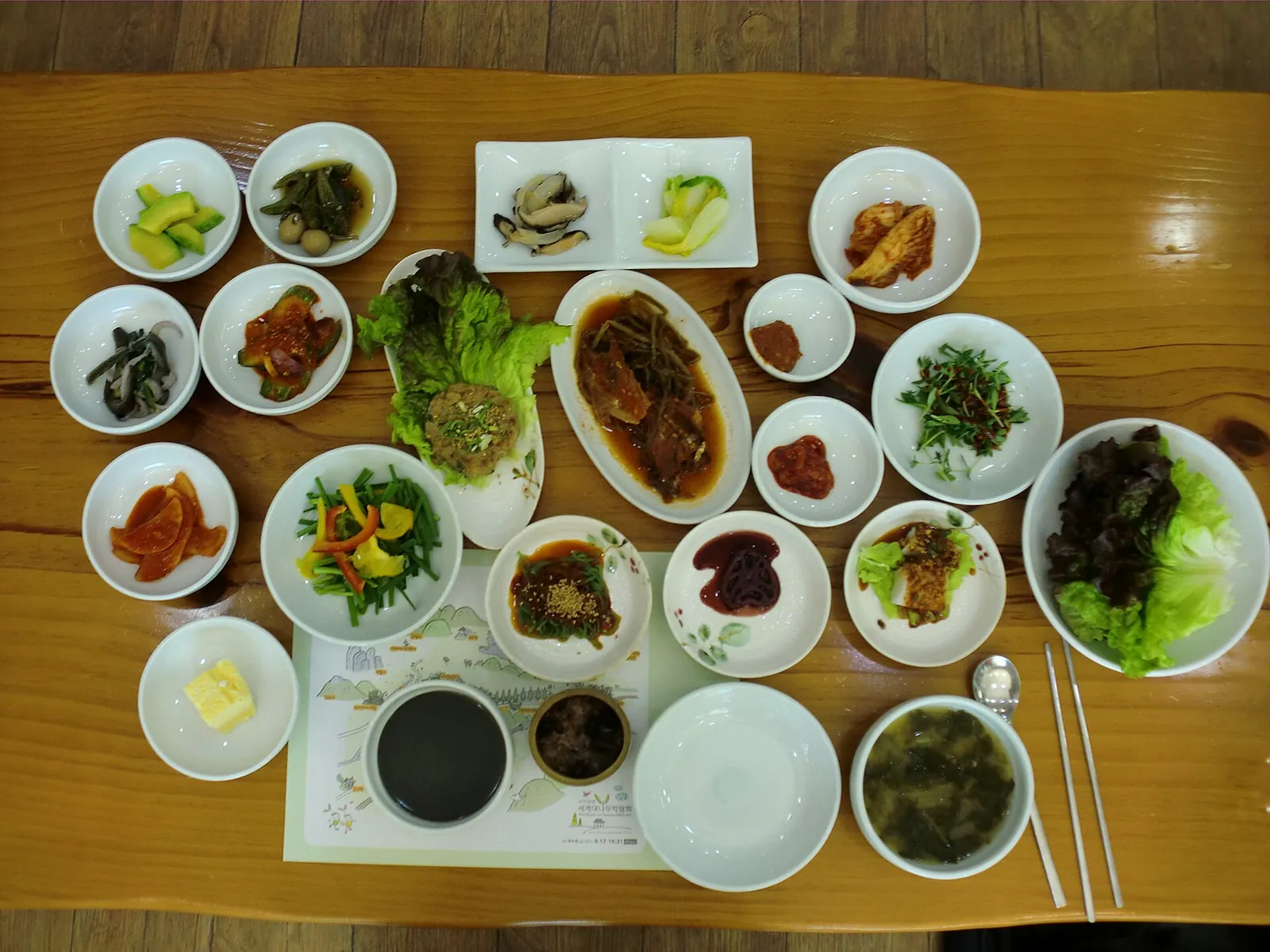
Rice steamed inside a section of bamboo; VisitKorea describes a version with millet, beans, sorghum, jujube and nuts, served with more than ten side dishes and bamboo-leaf tea afterwards.
- Where to look
- The restaurant opposite the Korea Bamboo Museum at 22 Jukhyangmunhwa-ro, which VisitKorea lists both as House by the Museum and under its newer name, Damyang Apzip, at the same address and phone number; Jungnimwon Garden in Wolsan-myeon serves daetongbap sets and a bamboo-steamed platter.
- Fit it into your day
- A long, sit-down lunch, often ordered as a set with tteokgalbi.
Side dishes can include salted shrimp and marinated crab; ask if you avoid shellfish.
Bamboo-leaf noodles and bamboo shoots
Damyang Apzip makes its own noodles from buckwheat and Damyang bamboo leaves and serves bamboo shoots with perilla oil noodles, as well as tteokgalbi on a large plate with salad.
- Where to look
- Damyang Apzip, 22 Jukhyangmunhwa-ro, Damyang-eup. VisitKorea listed 11:00 to 21:00, with a break from 14:30 to 17:00 on weekdays and 15:30 to 17:00 at weekends, last order 20:00, closed on Tuesdays.
- Fit it into your day
- A lighter lunch than the full tteokgalbi sets.
Closed on Tuesdays and during the afternoon break; buckwheat is an allergen.
Clam noodle soup
Kalguksu, hand-cut noodle soup, with clams — VisitKorea lists it as the best-known dish of Chonggak Kalguksu and describes the prices as reasonable.
- Where to look
- Chonggak Kalguksu, 24-17 Damju 4-gil, Damyang-eup; VisitKorea listed 11:00 to 20:00.
- Fit it into your day
- A quick, cheap meal if you want something simpler than grilled meat.
Contains shellfish; there is also a red bean version.
Gwanbangjerim and the Metasequoia-lined road
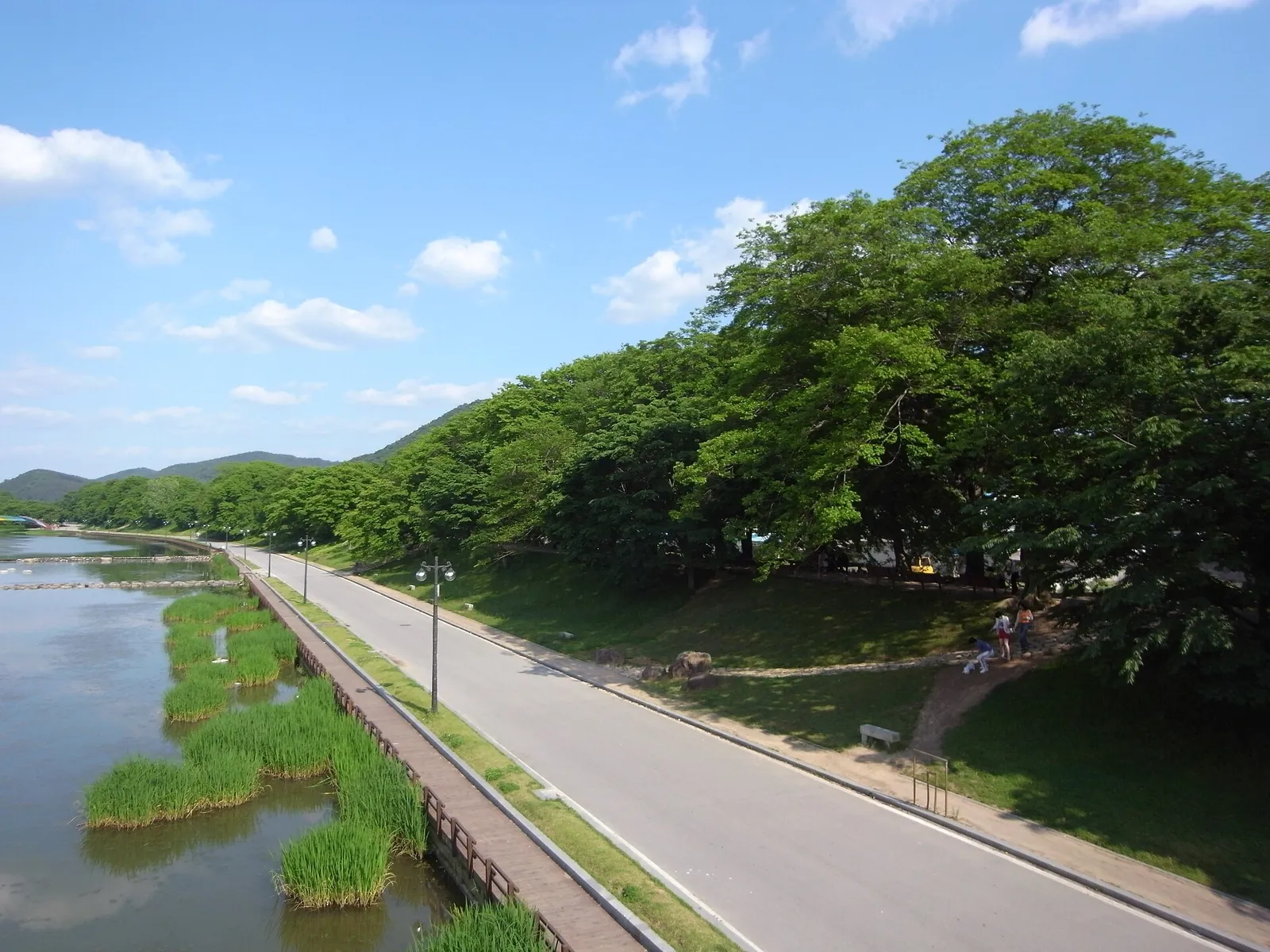
Gwanbangjerim is a man-made forest planted along the Damyangcheon stream to hold back floods. VisitKorea describes large muku, zelkova, nettle and cherry trees about 200 to 300 years old, stretching 2 kilometres from Dongjeong Village in Namsan-ri, and notes that the forest is a designated Natural Monument and was named Korea's most beautiful forest by the Korea Forest Service. It is a riverside walk rather than a sight with a gate — come for the shade and the old trunks, and use it as the link between town and the Metasequoia road.
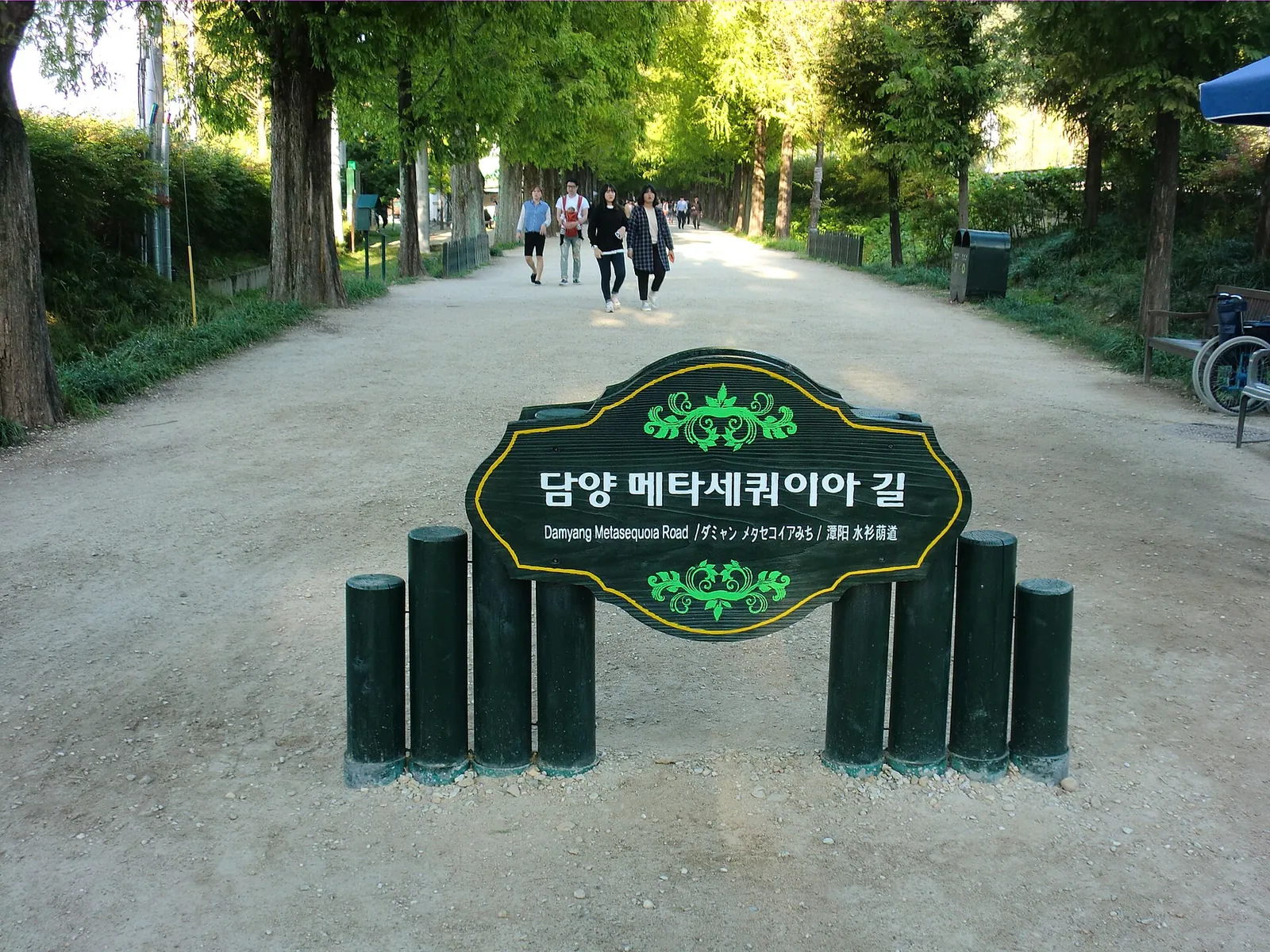
The Damyang Metasequoia-lined road was planted in the early 1970s along the rebuilt National Road 24; the saplings were three or four years old then, and VisitKorea says they now grow high enough to block out the sun. The Korea Forest Service picked the boulevard as one of Korea's most beautiful roads in 2002, and VisitKorea gives its full length as 8.5 kilometres.
The walking section near town is ticketed. When we checked on 3 October 2026, VisitKorea listed hours of 9:00 to 19:00 from May to August and 9:00 to 18:00 from September to April, closure on the days of Seollal and Chuseok, and an adult ticket of 2,000 won (teenagers 1,000 won, children 700 won; free for under-sevens and over-65s). The address is 12 Metasequoia-ro. Next to it, Meta Provence is a European-themed shopping and café complex; it is free and handy for a coffee, but it is not the reason to come.
Soswaewon and the gasa pavilions
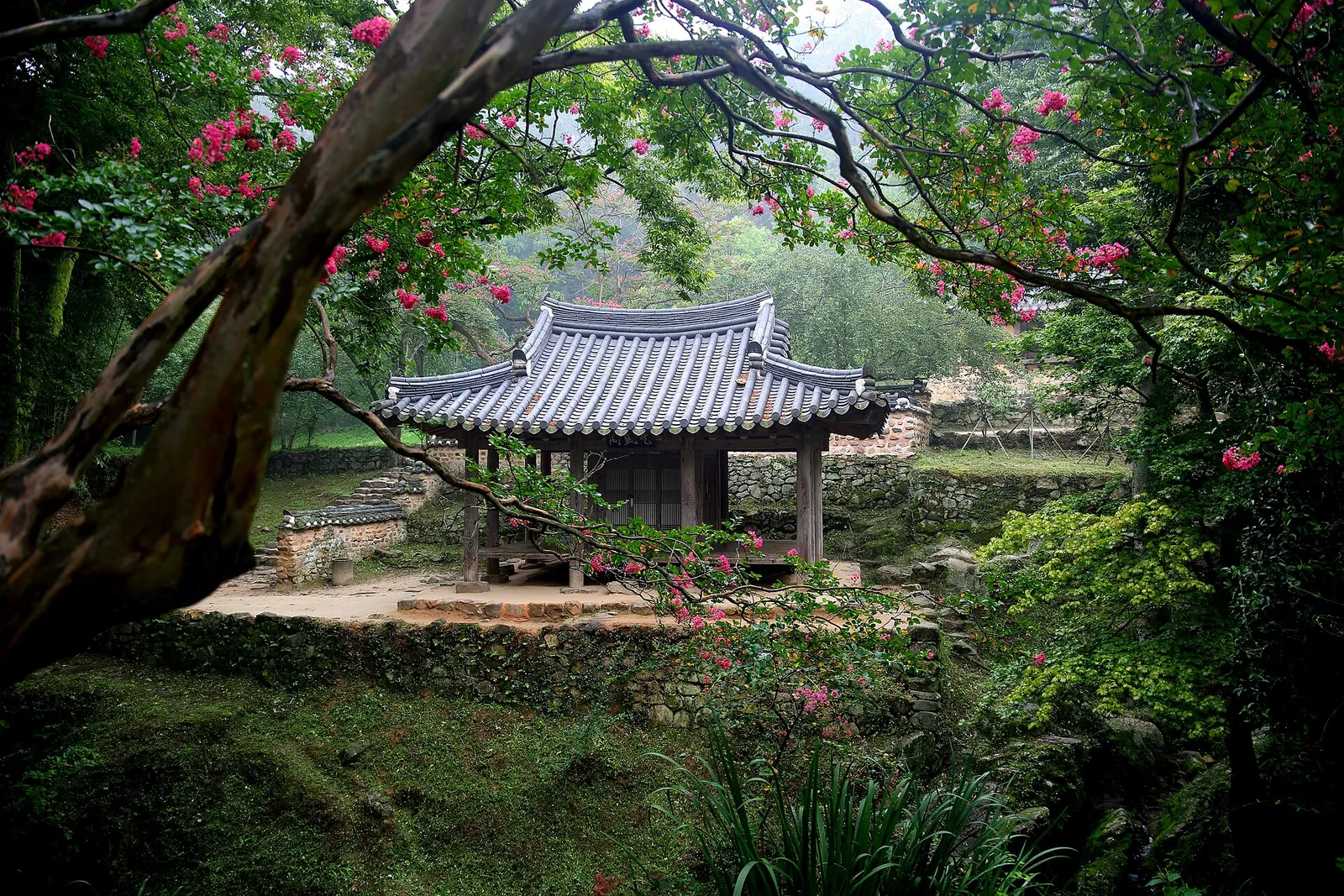
Soswaewon is a private garden of the Joseon period built by Yang San-bo (1503–1557), who gave up public life after his teacher Jo Gwang-jo was killed in the political purge of 1519. VisitKorea's feature describes the sequence as you walk in from the bamboo grove at the entrance: the thatched Daebongdae pavilion, a log bridge to the Ogongmun gate, whose openings let the stream pass under the wall, Gwangpunggak, where guests were received beside the water, and Jewoldang above it, where Yang read. It is small — the point is the way buildings, wall and stream fit into the valley — and it is best visited slowly and quietly.
VisitKorea gives two versions of its hours. Its destination page listed 9:00 to 17:00, open all year; its feature on the garden gave seasonal hours of 9:00 to 19:00 from May to August, 9:00 to 18:00 in March, April, September and October, and 9:00 to 17:00 from November to February. Plan around the earlier time. When we checked on 3 October 2026, adult admission was 2,000 won (teenagers 1,000 won, children 700 won), parking was free, and the address was 17 Soswaewon-gil, Gasamunhak-myeon.
Soswaewon is part of a cluster that explains why Damyang is called the cradle of gasa, a form of Korean verse. Nearby, Sigyeongjeong Pavilion is linked to the poet Jeong Cheol and his Seongsanbyeolgok, and the Korea Gasa Literature Museum at 877 Gasamunhak-ro displays the collected works of Song Sun and Jeong Cheol; when we checked, VisitKorea listed it as free, with the same seasonal hours as the Soswaewon feature. Myeonangjeong, built by Song Sun in 1533, is in Bongsan-myeon and needs a separate trip.
Changpyeong slow city
Samjinae Village in Changpyeong-myeon was the first place in Korea designated a slow city, in 2007, according to VisitKorea: a farming village of stone-walled lanes and old houses whose draw is food and craft rather than sights. VisitKorea lists hands-on sessions making hangwa (traditional sweets) and ssalyeot (rice taffy), tea ceremonies and homemade makgeolli; it notes that programmes depend on local conditions, so contact the village before you go.
Changpyeong suits a second day or a car trip combined with Soswaewon. It is also the place for a slower night: VisitKorea lists Gotaekhanok, an old house with men's and women's quarters and a large yard on Doldam-gil, with breakfast available.
Getting to Damyang and around
From Gwangju, the official Juknokwon and Damyang County pages describe the same route: bus 311 from the stop in front of the U-Square bus terminal's main gate, or from the rear of Gwangju Station, to Juknokwon. The county's travel FAQ says 311 runs every 10 to 15 minutes, and its timetable page listed direct buses between Gwangju and Damyang from 5:50 to 22:45, about every 15 minutes. From Gwangju Songjeong Station, the FAQ suggests a city bus to the bus terminal or Gwangju Station first and then the 311.
For Soswaewon, Damyang County lists Gwangju city bus Chunghyo 187, which runs from Yeoncheon via Soswaewon and the Gasa Literature Museum through Chunghyo-dong into Gwangju; rural bus 225 also links Gasamunhak-myeon with the Gwangju bus terminal. Damyang-eup and Gasamunhak-myeon are on different lines, so if you want both in one day, plan on Juknokwon in the morning, a return towards Gwangju, and Soswaewon on the way — or take a taxi between them. The county publishes local taxi numbers by district.
From Seoul, VisitKorea lists Damyang among the routes from the Central City terminal (Express Bus Terminal Station, Lines 3, 7 and 9). When we checked, the county's page showed four premium express buses a day each way, taking about 3 hours 30 minutes, and Juknokwon's page listed four departures too, at slightly different times — check a booking app before you rely on one. Most travellers are better off taking the train to Gwangju and continuing by bus 311.
- Morning: bus 311 from Gwangju to Juknokwon; walk the bamboo trails and the Siga Culture Village.
- Lunch: tteokgalbi or a daetongbap set in Damyang-eup.
- Afternoon: Gwanbangjerim along the stream, then the Metasequoia road.
- Full day or second day: Soswaewon, Sigyeongjeong and the Gasa Literature Museum on bus 187, or Changpyeong.
Practical questions
Is Damyang worth a day trip from Gwangju?
Yes. Bus 311 runs from Gwangju's U-Square bus terminal and from behind Gwangju Station to Juknokwon, and Juknokwon, Gwanbangjerim and the Metasequoia road sit close together in and around Damyang-eup, so half a day covers them. Add Soswaewon for a full day.
How much is Juknokwon and when is it open?
When we checked on 3 October 2026, adults paid 3,000 won. The garden was open 9:00 to 19:00 from March to October (last entry 18:00) and 9:00 to 18:00 from November to February (last entry 17:30), every day.
Can I stay inside the bamboo garden?
Yes. Juknokwon has hanok guest rooms in its Siga Culture Village, booked through the official site. Check-in is 15:00 to 22:00 and check-out 11:00; guests enter the garden free but must bring their own toiletries, and cooking and smoking are not allowed.
How do I get to Soswaewon by public transport?
Damyang County lists Gwangju city bus Chunghyo 187, which passes Soswaewon and the Gasa Literature Museum on its way into Gwangju. It does not go to Damyang-eup, so combine the two with a return towards Gwangju or a taxi.
When is the Damyang Bamboo Festival?
In early May. VisitKorea listed the 2026 festival for 1 to 5 May at the Damyang Sports Complex, Juknokwon and Dambit Music Hall, with free entry.
Is there a direct bus from Seoul to Damyang?
Yes, from the Central City terminal in Seoul. The county's page listed four premium express buses a day taking about 3 hours 30 minutes; check current times in a booking app.
Sources and checks before you travel
Reference sources for the version dated 3 October 2026. Confirm opening times, access, transport and conditions for your travel dates.
- Juknokwon (official site): directions ↗ — opens in a new tab
- Juknokwon (official site): visitor information ↗ — opens in a new tab
- Juknokwon (official site): introduction ↗ — opens in a new tab
- Juknokwon (official site): eight trails ↗ — opens in a new tab
- Juknokwon (official site): Siga Culture Village ↗ — opens in a new tab
- Juknokwon (official site): hanok stay booking ↗ — opens in a new tab
- VisitKorea: Juknokwon (Bamboo Garden) ↗ — opens in a new tab
- VisitKorea: Damyang Juknokwon (LuxuryKorea column) ↗ — opens in a new tab
- VisitKorea: 100 Must-Visit Tourist Spots ↗ — opens in a new tab
- VisitKorea: Gwanbangjerim Forest ↗ — opens in a new tab
- VisitKorea: Damyang Metasequoia-lined Road ↗ — opens in a new tab
- VisitKorea: Damyang Meta Provence ↗ — opens in a new tab
- VisitKorea: Soswaewon Garden ↗ — opens in a new tab
- VisitKorea: A Korean garden that kept its style for 500 years: Soswaewon Garden ↗ — opens in a new tab
- VisitKorea: Sigyeongjeong Pavilion ↗ — opens in a new tab
- VisitKorea: Korea Gasa Literature Collection ↗ — opens in a new tab
- VisitKorea: Myeonangjeong Pavilion ↗ — opens in a new tab
- VisitKorea: Damyang Changpyeong Samjinae Village [Slow City] ↗ — opens in a new tab
- VisitKorea: Gotaekhanok ↗ — opens in a new tab
- VisitKorea: Damyang Bamboo Festival ↗ — opens in a new tab
- VisitKorea: [Damyang] Bamboo handicraft ↗ — opens in a new tab
- VisitKorea: K-Local Food Trip 33 ↗ — opens in a new tab
- VisitKorea: Deokinkwan ↗ — opens in a new tab
- VisitKorea: House by the Museum ↗ — opens in a new tab
- VisitKorea: Damyang Apzip ↗ — opens in a new tab
- VisitKorea: Jungnimwon Garden ↗ — opens in a new tab
- VisitKorea: Chonggak Kalguksu ↗ — opens in a new tab
- Damyang County tourism: transport information ↗ — opens in a new tab
- Damyang County tourism: travel FAQ ↗ — opens in a new tab
- VisitKorea: Express bus and intercity bus ↗ — opens in a new tab
Does this experience fit your route?
Damyang is easy on your own: one city bus from Gwangju reaches the bamboo garden. A guided trip only makes sense if you are coming from Seoul without a night in Gwangju — check that Damyang is really on the route before you book.
Browse relevant experiences on Viator ↗ — opens in a new tabAffiliate link · Book with ViatorPhoto credits
The walking paths of Juknokwon run between dense stands of tall bamboo.
Photograph: hyolee2 — opens in a new tab · CC BY-SA 3.0 — opens in a new tab
Changes: Resized and converted to WebP; displayed with responsive crops. · Original photograph and licence details ↗ — opens in a new tab
The walking section of the Damyang Metasequoia-lined road, near Damyang-eup.
Photograph: hyolee2 — opens in a new tab · CC BY-SA 3.0 — opens in a new tab
Changes: Resized and converted to WebP; displayed with responsive crops. · Original photograph and licence details ↗ — opens in a new tab
Soswaewon, the Joseon-period garden of Yang San-bo in Gasamunhak-myeon.
Photograph: Kim Dae Jeung — opens in a new tab · CC0 — opens in a new tab
Changes: Resized and converted to WebP; displayed with responsive crops. · Original photograph and licence details ↗ — opens in a new tab
Gwanbangjerim, the old flood-defence forest along the Damyangcheon stream.
Photograph: Dalgial — opens in a new tab · CC BY-SA 3.0 — opens in a new tab
Changes: Resized and converted to WebP; displayed with responsive crops. · Original photograph and licence details ↗ — opens in a new tab
A daetongbap (bamboo rice) set meal in Damyang comes with a spread of side dishes.
Photograph: hyolee2 — opens in a new tab · CC BY-SA 4.0 — opens in a new tab
Changes: Resized and converted to WebP; displayed with responsive crops. · Original photograph and licence details ↗ — opens in a new tab