Seoul and the Capital Area · Seoul / Gyeonggi
Bukhansan hiking guide: Baegundae trails, transport and timing
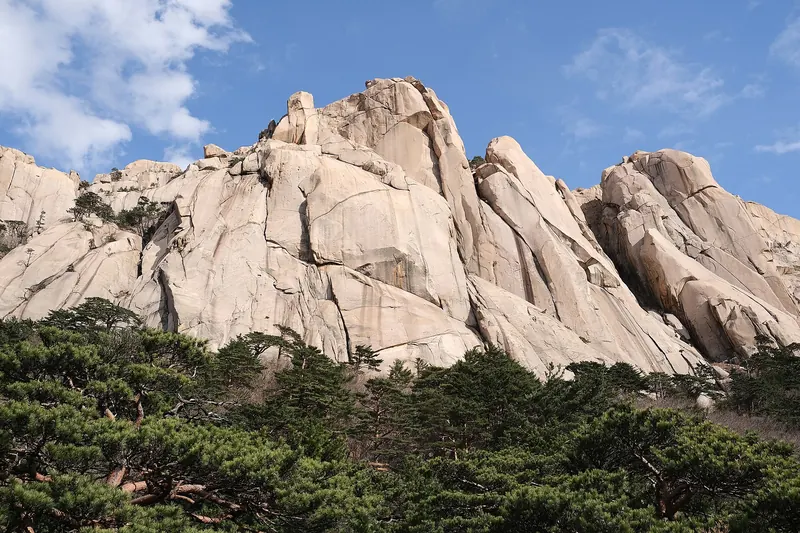
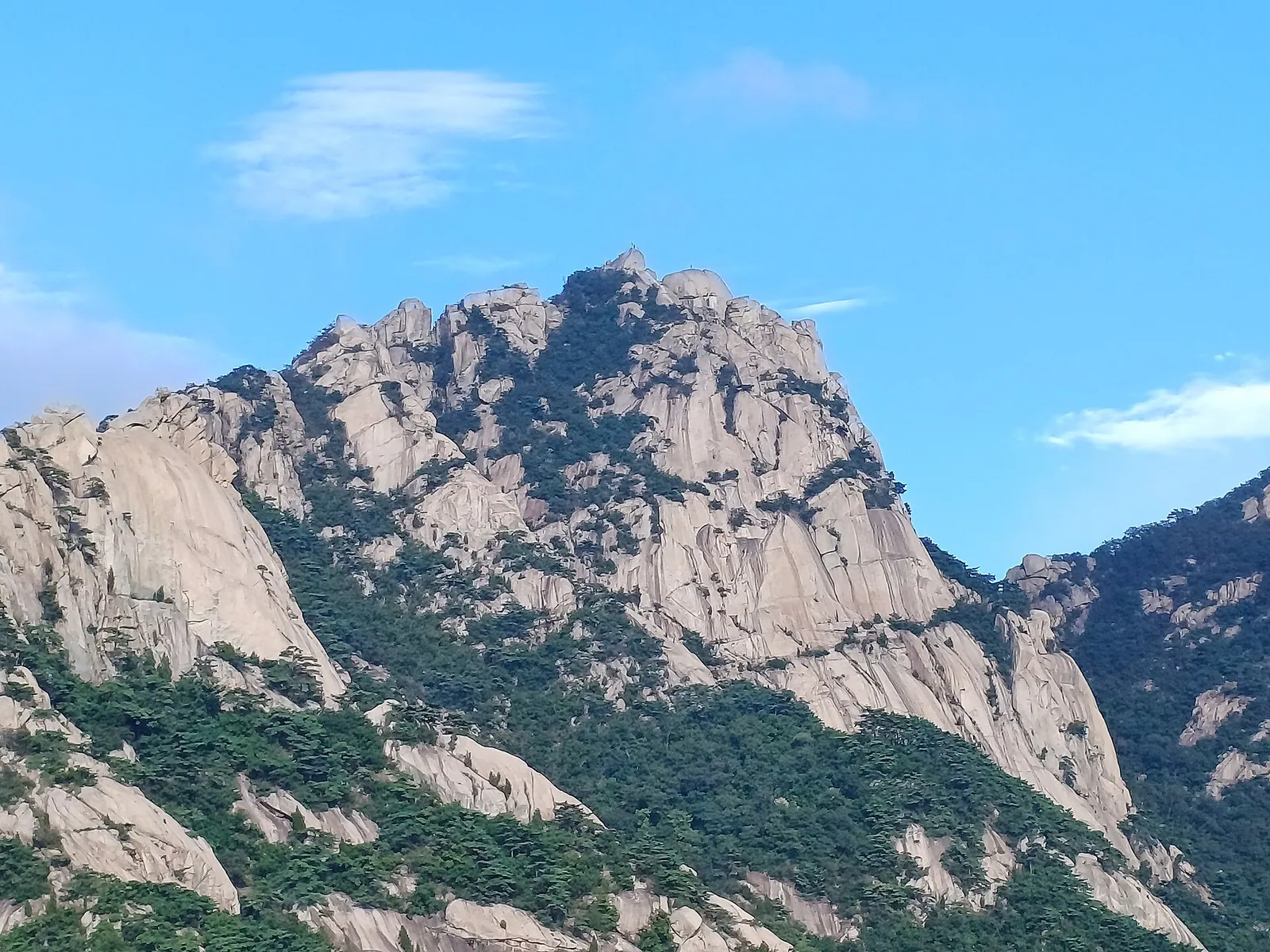
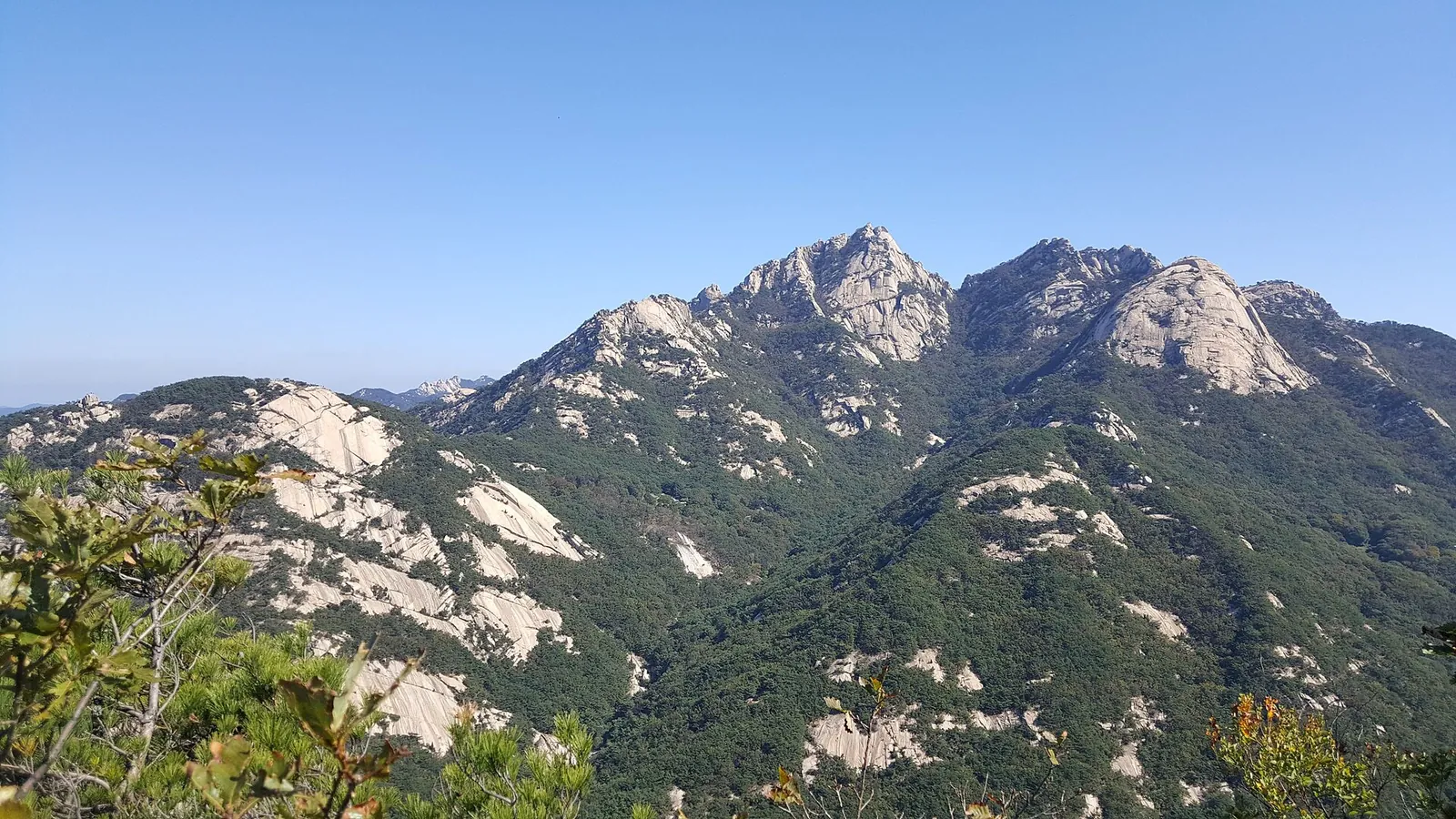
Bukhansan is the granite mountain on Seoul's northern edge, and the only national park inside the city. Its highest point, Baegundae, stands 836.5 metres above a city of millions, and the subway and city buses run to the trailheads. That makes it easy to underestimate. The paths to the summit are short but steep and rocky, with wire ropes on the final pitch. Choosing the right trailhead and starting early matter more here than on most city hikes.
- Suggested time
- 1 day from a Seoul base
- Where to stay
- Central Seoul (Jongno, for Line 3 to Gupabal); Ui-dong in Gangbuk-gu for an early start on the Baegundae side
- Season and timing
- No season is closed, but the rules change through the year. When we checked on 2026-10-03, the Korea National Park Service listed Bukhansan's trailhead entry hours as 04:00–17:00 from March to November and 04:00–16:00 from December to February. KNPS says crampons are essential in winter because many sections ice over. Visit Seoul and KNPS both point to autumn foliage, on Uiryeong-gil and on the Daenammun valley route.
The short answer
Give Bukhansan one full day and sleep in Seoul. Fit hikers who want the summit should take the Ui-dong approach: KNPS times the climb from the Baegun Visitor Center to Baegundae at about 1 hour 30 minutes one way (1.9 km), plus about 30 minutes on the paved road up from Ui-dong. If you want history and an easier gradient, start at the Bukhansanseong Visitor Center in the west. From there it is 3.4 km to the summit, or a gentler 5.8 km valley walk to Daenammun Gate. If you are new to rocky trails, walk the Daenammun valley route or a section of the Dulle-gil. Start in the morning on a weekday. Rent boots or crampons at the Seoul Hiking Tourism Center by Bukhansan Ui station, which closes on Mondays. Eat in Ui-dong on the way down.
Where to sleep, and which side of the mountain to start from
Bukhansan has two main summit approaches, on opposite sides of the mountain, and your hotel should suit the one you choose. The Ui-dong side in Gangbuk-gu, to the east, is where the shortest summit trail starts. It is the end of the line on the Ui-Sinseol light-rail line, at Bukhansan Ui station. The Bukhansanseong side in Eunpyeong-gu, to the west, is reached from Gupabal station on subway Line 3. The KNPS route description for this side runs from Jongno 3-ga, so a hotel in central Jongno works well for it.
Most visitors simply stay in central Seoul and treat the mountain as a day out. If you want to be on the trail early, sleep at the foot of the mountain. Visit Seoul lists Paraspara Seoul, a resort with pools and saunas in the pine forest at 689 Samyang-ro, Gangbuk-gu, and Eungjeongheon, a hanok guesthouse in Eunpyeong Hanok Village that takes one group of guests a day. Visit Seoul also describes the Ui-dong Family Camping Ground, which has tent decks and glamping. Bookings open on Interpark at 14:00 on the 10th of each month and go quickly.
Baegundae from Ui-dong: the shortest way to the summit
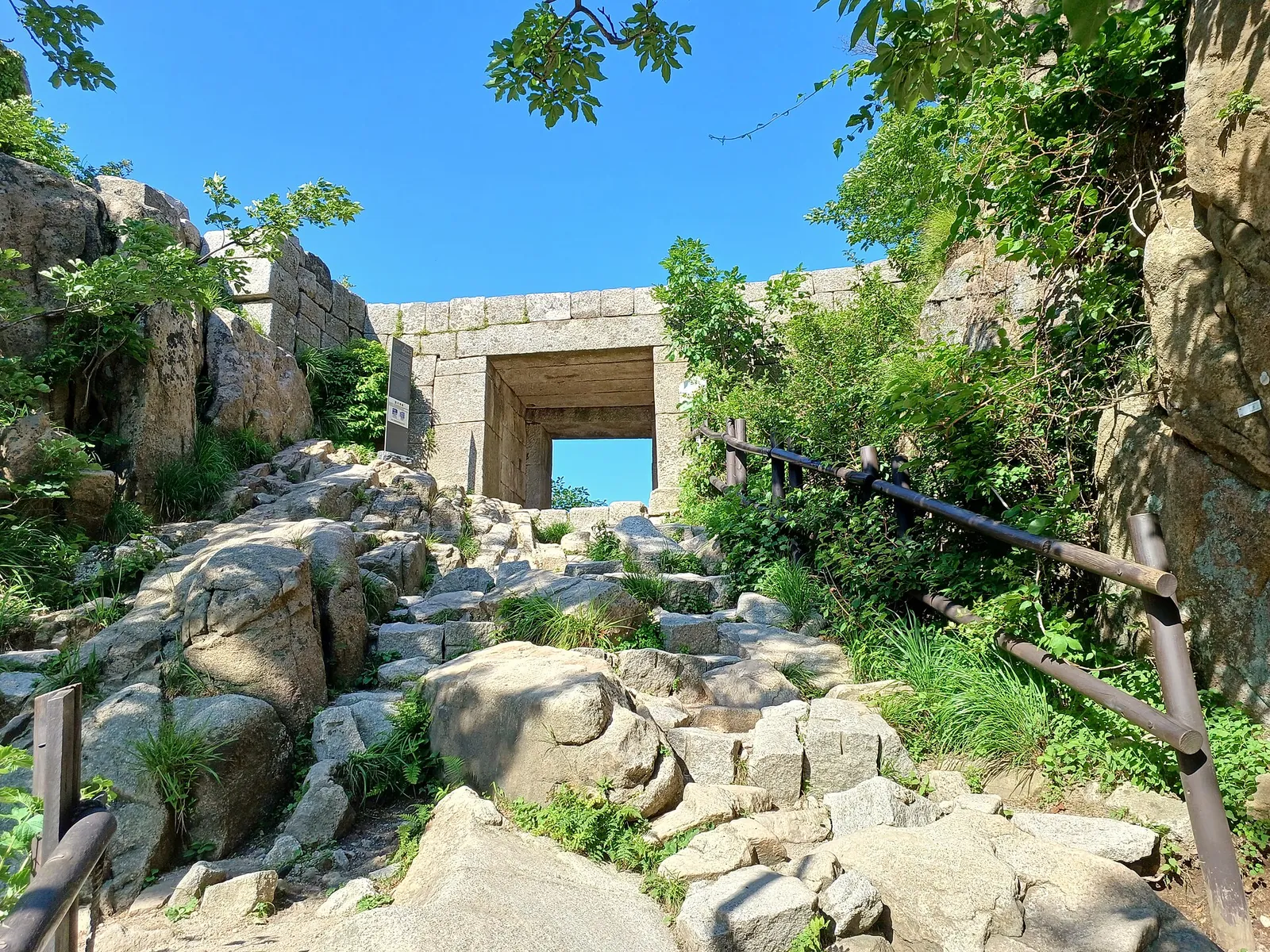
KNPS calls this the park's signature route. From the Ui-dong bus terminus, a paved road of a little over 2 km climbs along the Doseonsa temple road to Doseon Plaza (about 30 minutes, says KNPS). Taking a taxi from the station to the Baegun Visitor Center saves that road walk. From the visitor center the trail runs 1.9 km to the summit, which KNPS times at about 1 hour 30 minutes one way. It is about 0.8 km of earth and stone path to Harujae Pass, then 0.6 km of stone steps and rock with wire ropes to the Baegun Shelter. The last 0.5 km, through Baegunbongammun gate, is very steep: the path narrows and you climb with the help of fixed wire ropes.
This is a rocky, steep route, and KNPS warns that the climb to the summit can be badly delayed by crowds at weekends. Plan around your fitness and the sunset time, rest at the shelter before the last section, and wear proper boots. If the last pitch looks like too much, Visit Seoul suggests Yeongbong Peak (604 m) as an alternative, reached from Harujae Pass and facing Insubong, the rock face popular with climbers. The path from Harujae to Yeongbong is itself steep and slippery, Visit Seoul warns. Its full Baegundae–Ui Gugok loop, taking in both peaks, is 9.98 km and rated advanced, with an average time of 4 hours 20 minutes.
- Rest stop before the final pitch: Baegun Shelter, 0.5 km below the summit (KNPS).
- At the top: an unobstructed view across Seoul and into Gyeonggi-do, and a Korean flag that flies all year.
- Stay on marked paths. KNPS says the closed areas around Baegundae carry a high risk of falls.
Make time for the local food
What to eat and where to look
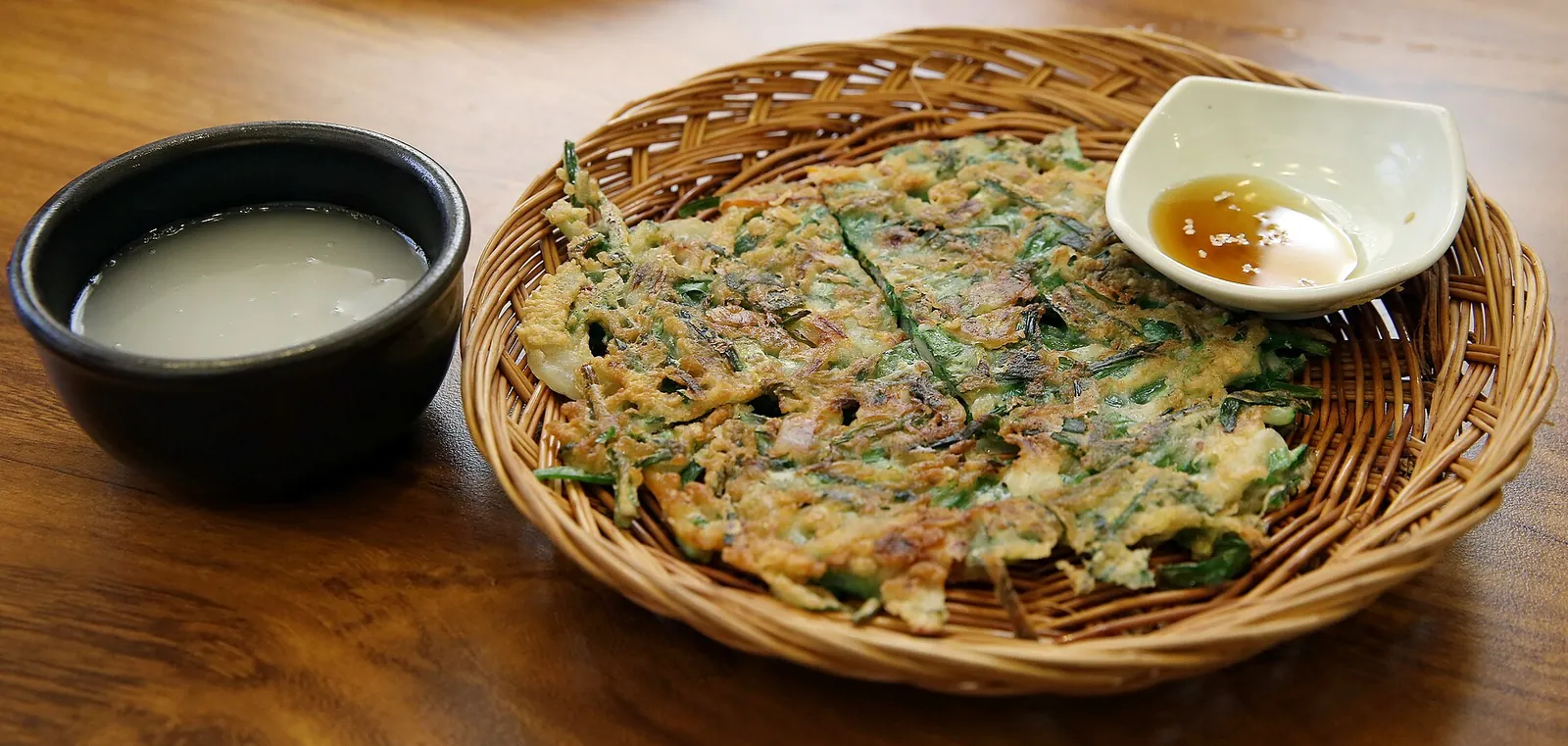
Sundubu and pan-fried tofu with makgeolli
Soft, freshly made tofu is a gentle first meal after a steep descent. Visit Seoul recommends Woorikong Sundubu, next to the Seoul Hiking Tourism Center, which makes its tofu from Jangdan soybeans grown in Paju. Its sundubu set, soy-pulp stew (biji-jjigae) and pan-fried tofu with makgeolli rice wine are the dishes to order.
- Where to look
- Woorikong Sundubu, 46 Samyang-ro 173-gil, beside the hiking center near Bukhansan Ui station.
- Fit it into your day
- Lunch straight off the Ui-dong trail; Visit Seoul listed it as open 09:30–19:00 when we checked.
Makgeolli is alcoholic. Drink it after the hike, not before the descent.
Perilla-seed kalguksu
Knife-cut noodles in a thick broth of toasted perilla seed. Visit Seoul describes Ellim Deulkkae Sujebi Kalguksu as a three-item menu (kalguksu, boiled pork and dumplings), packed with locals and hikers. Each kalguksu comes with barley rice and a few slices of pork.
- Where to look
- Ellim Deulkkae Sujebi Kalguksu, 177 Samgaksan-ro, Gangbuk-gu.
- Fit it into your day
- An early dinner after the hike. When we checked, Visit Seoul listed 11:30–20:30 Monday to Saturday with a break from 15:30 to 17:00.
Closed on Sundays, and Visit Seoul says queues form before opening even on weekdays.
Duck or chicken baeksuk with neungi mushrooms
Visit Seoul describes Sogwigol Baegunsanjang, beside the Ui-dong valley on the way up to Baegundae, as a place for long-simmered duck or chicken baeksuk with neungi mushrooms in a clear broth. You can eat on wooden platforms under the trees. A spicy chicken stew (dakdoritang) and braised beef short ribs are also on the menu.
- Where to look
- Sogwigol Baegunsanjang, 206 Samyang-ro 181-gil, Gangbuk-gu; Visit Seoul says the restaurant offers pickup from Bukhansan Ui station.
- Fit it into your day
- A shared late lunch for a group. When we checked, Visit Seoul listed main dishes at KRW 75,000–90,000, so it suits a group.
Not a quick solo meal; check the hours (Visit Seoul listed 09:30–21:00, last order 20:00).
Temple food at Jingwansa
On the western foothills, Jingwansa is a temple Visit Seoul dates to 1011. It is known for its temple food and baru gongyang, the formal monastic meal, which visitors can join, followed by tea with the resident monks.
- Where to look
- Jingwansa, 73 Jingwan-gil, Eunpyeong-gu, near Eunpyeong Hanok Village.
- Fit it into your day
- A slower day combined with a Dulle-gil walk on the Eunpyeong side.
Visit Seoul gives no programme times. Contact the temple before you go rather than turning up for a meal.
The Bukhansanseong side: fortress gates and the gentler Daenammun valley
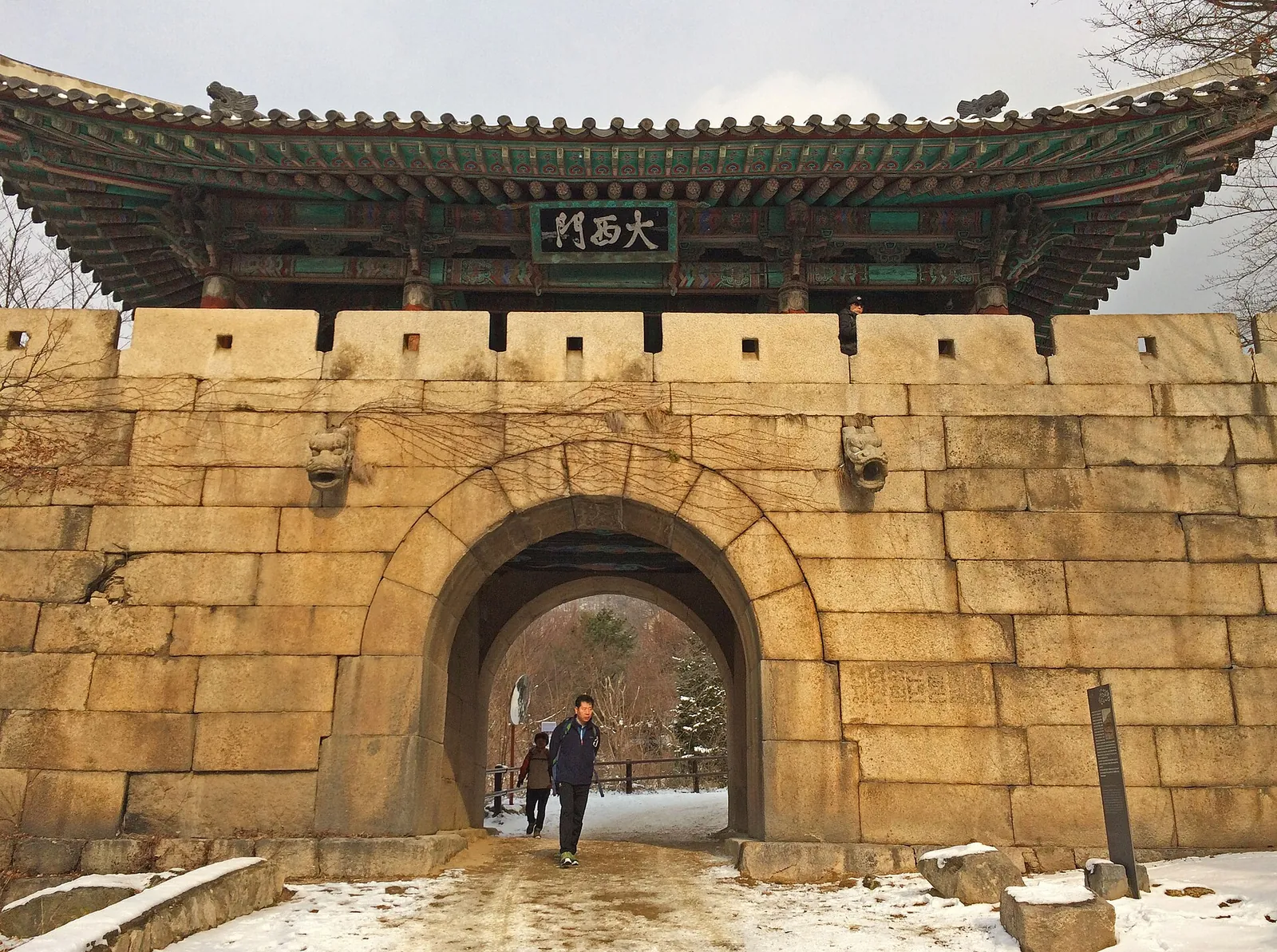
On the western side, the trails start at the Bukhansanseong Visitor Center, which has large car parks. KNPS has two routes from here. The Bukhansanseong course passes Daeseomun, the fortress's main gate, and Borisa Temple, then climbs to Baegundae: 3.4 km one way, about 2 hours 40 minutes. It starts on a gentle paved road. The roughly 500 m stretch from the Yaksuam hermitage site up to Baegunbongammun is, says KNPS, the hardest climb on any route to the summit.
The Daenammun course is the better choice if you want a long but steady walk. It follows the fortress valley past Jungseongmun Gate, a row of old memorial steles and the turn-off to the site of the temporary royal palace, and ends at Daenammun Gate: 5.8 km one way, about 3 hours. KNPS calls it easier than the park's other routes and possible with children, and recommends it for autumn colour. Visit Seoul explains the history behind it: after the invasions of 1592 and 1636, King Sukjong strengthened the capital's defences with Bukhansanseong Fortress. A temporary palace stood below Sangwonbong Peak until a landslide destroyed it in 1915.
Easier days: the Dulle-gil and Uiryeong-gil
If you do not want to climb a peak, walk part of the Bukhansan Dulle-gil. KNPS describes it as a low, mostly level 71.8 km trail around the foot of the mountain. It links existing paths into 21 themed sections of streamside track, forest path and village lanes, and you can walk just one section.
Section 21, Uiryeong-gil, is the unusual one. The pass between Bukhansan and Dobongsan was closed for about four decades after the failed 1968 raid by North Korean commandos, and it reopened in July 2009, Visit Seoul explains. Visit Seoul describes it as an easy 6.42 km walk of about 2 hours. When we checked, entry needed a reservation made at least a day ahead on the KNPS reservation system. Visit Seoul listed access hours of 09:00–18:00, with last entry at 16:00 (15:00 in winter), and said ID is checked at the trailhead.
Timing, gear and closures
Bukhansan uses the national parks' system of designated entry hours. When we checked on 2026-10-03, KNPS listed entry from 04:00 on the Bukhansan trails, and no entry after 17:00 from March to November or after 16:00 from December to February. Visit Seoul listed admission to the park as free. Sections also close for repairs. In late September 2026, for example, KNPS closed the 0.3 km from Baegunbongammun to the summit for path works and reopened it on 2 October. Check the park's notices on knps.or.kr the day before you go.
The Seoul Hiking Tourism Center – Bukhansan Branch is about five minutes' walk from Bukhansan Ui station. It is on the 5th floor at 52 Samyang-ro 173-gil, near the start of the Baegundae–Ui Valley course. When we checked, Visit Seoul listed it as open 09:00–18:00 and closed on Mondays, at Seollal and at Chuseok. It gives trail advice in English, Chinese and Japanese and rents hiking boots, clothing, trekking poles, backpacks and crampons, and you can reserve gear in advance. It also has luggage storage, so you can arrive with a bag and hike light.
Getting to the trailheads by subway and bus
For Baegundae from Ui-dong, take the Ui-Sinseol line to its last stop, Bukhansan Ui, and use Exit 2 for the hiking center. Or follow the KNPS route: subway Line 4 to Suyu station, then city bus 120 from the Gangbuk-gu Office stop to the Ui-dong terminus. Visit Seoul says you can also take a taxi from the station straight to the Baegun Visitor Center.
For the Bukhansanseong side, take subway Line 3 to Gupabal and use Exit 2. KNPS lists bus 704 or Yangju bus 37 from there to the Bukhansanseong entrance stop, and Visit Seoul notes that the visitor center is about 700 m up the road. Routes can also cross the mountain: Visit Seoul's Bukhansanseong–Daenammun trail ends at the Gugi Visitor Center on the south side (10.2 km, about 4 hours 10 minutes, rated advanced). Plan your return from wherever you finish.
Practical questions
How long does it take to climb Baegundae?
KNPS times the shortest route, from the Baegun Visitor Center in Ui-dong, at about 1 hour 30 minutes one way for 1.9 km. Add about 30 minutes for the paved road from the Ui-dong side. From the Bukhansanseong Visitor Center it is 3.4 km and about 2 hours 40 minutes one way. Allow extra time at weekends, when the final climb gets crowded.
Is Bukhansan suitable for beginners?
The summit routes are steep and rocky, with wire ropes near the top. Beginners do better on the Daenammun valley route, which KNPS calls easier and possible with children, or on a section of the Bukhansan Dulle-gil. Visit Seoul suggests Yeongbong Peak for hikers who find Baegundae too much, but the path up from Harujae Pass is steep.
Is there an entrance fee for Bukhansan National Park?
Visit Seoul listed admission as free when we checked. Trailhead entry is time-limited, though. KNPS listed 04:00–17:00 from March to November and 04:00–16:00 from December to February.
Can I rent hiking gear near Bukhansan?
Yes. The Seoul Hiking Tourism Center – Bukhansan Branch, near Bukhansan Ui station, rents boots, clothing, trekking poles, backpacks and crampons and stores luggage. When we checked, it opened 09:00–18:00 and was closed on Mondays, at Seollal and at Chuseok.
Do I need to book anything?
The Baegundae and Daenammun routes described here had no booking requirement on the pages we read. Uiryeong-gil does: when we checked, Visit Seoul said to reserve at least a day ahead through the KNPS reservation system and to bring ID.
Can I hike Bukhansan in winter?
Yes, but KNPS says crampons are essential because many sections ice over, and the last entry is an hour earlier from December to February. The hiking center rents crampons.
Sources and checks before you travel
Reference sources for the version dated 3 October 2026. Confirm opening times, access, transport and conditions for your travel dates.
- Korea National Park Service: Bukhansan National Park ↗ — opens in a new tab
- Korea National Park Service: Bukhansan trail courses and transport ↗ — opens in a new tab
- Korea National Park Service: designated entry hours ↗ — opens in a new tab
- Korea National Park Service: Baegunbongammun–Baegundae closure lifted ↗ — opens in a new tab
- Korea National Park Service: Bukhansan Dulle-gil ↗ — opens in a new tab
- Visit Seoul: Bukhansan National Park ↗ — opens in a new tab
- Visit Seoul: Seoul Hiking Tourism Center – Bukhansan Branch ↗ — opens in a new tab
- Visit Seoul: Baegundae–Ui Gugok Trail ↗ — opens in a new tab
- Visit Seoul: Bukhansanseong–Daenammun Trail ↗ — opens in a new tab
- Visit Seoul: Bukhansan Dulle-gil, Uiryeong-gil ↗ — opens in a new tab
- Visit Seoul: Crisscrossing between Nature and the City ↗ — opens in a new tab
- Visit Seoul: Sogwigol Baegunsanjang ↗ — opens in a new tab
- VisitKorea: airport transportation ↗ — opens in a new tab
Does this experience fit your route?
A guided hike takes care of the trail choice and the bus connections. Check the route, the meeting station and the finish time before you book.
Browse relevant experiences on Viator ↗ — opens in a new tabAffiliate link · Book with ViatorPhoto credits
Baegundae, at 836.5 metres the highest peak of Bukhansan, rising above forested slopes.
Photograph: Symtux — opens in a new tab · CC BY-SA 4.0 — opens in a new tab
Changes: Resized and converted to WebP; displayed with responsive crops. · Original photograph and licence details ↗ — opens in a new tab
Insubong, Baegundae and Mangyeongdae, the three peaks behind Bukhansan's old name, Samgaksan.
Photograph: Han_Dong_Cheol — opens in a new tab · CC BY-SA 3.0 — opens in a new tab
Changes: Resized and converted to WebP; displayed with responsive crops. · Original photograph and licence details ↗ — opens in a new tab
Baegunbongammun, the fortress gate below the summit on the final climb to Baegundae.
Photograph: Unknown author Unknown author — opens in a new tab · Public domain — opens in a new tab
Changes: Resized and converted to WebP; displayed with responsive crops. · Original photograph and licence details ↗ — opens in a new tab
One of the main gates of Bukhansanseong Fortress in winter.
Photograph: Lcarrion88 — opens in a new tab · CC BY-SA 4.0 — opens in a new tab
Changes: Resized and converted to WebP; displayed with responsive crops. · Original photograph and licence details ↗ — opens in a new tab
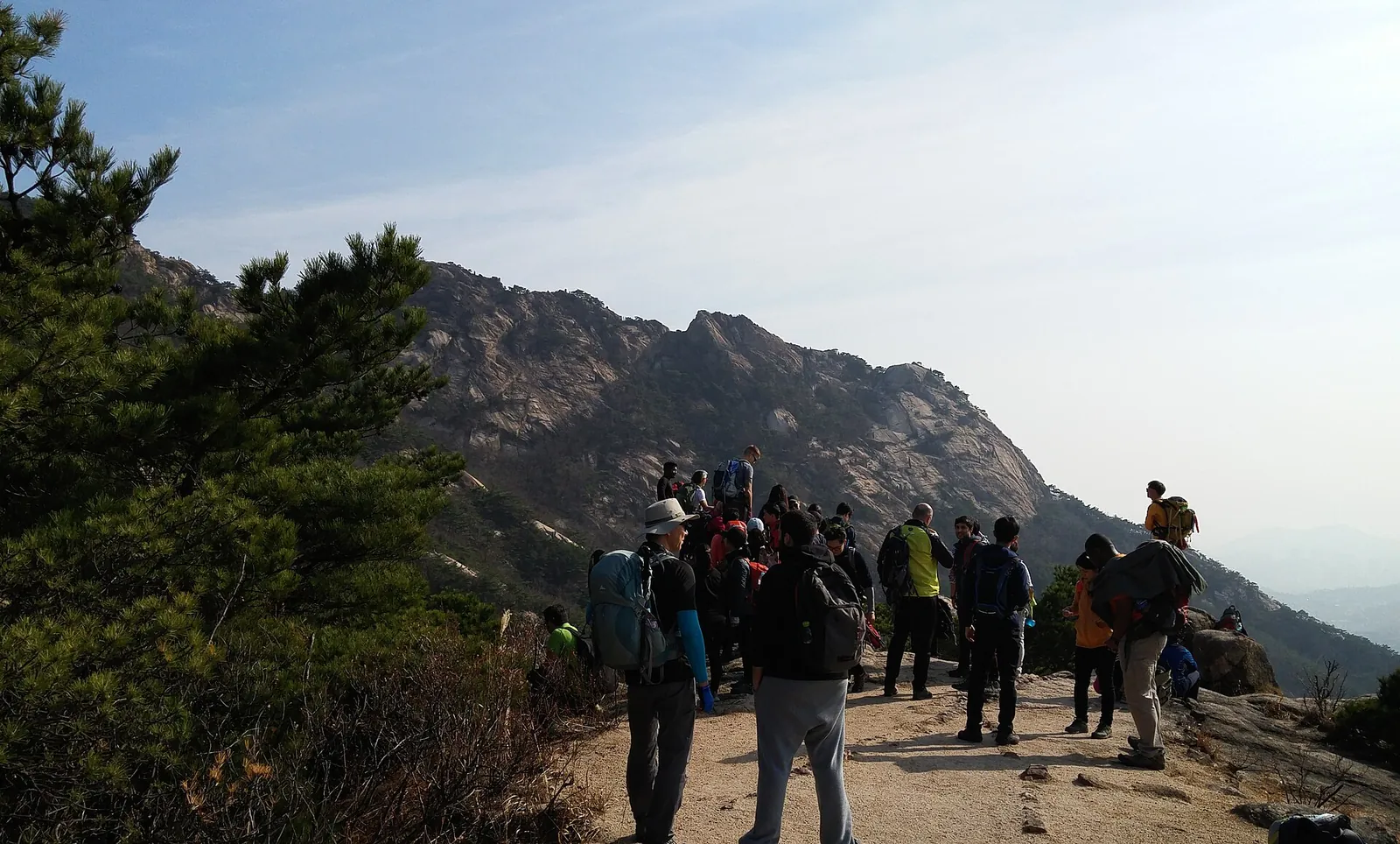
Hikers at a viewpoint in Bukhansan National Park.
Photograph: Christian Bolz — opens in a new tab · CC BY-SA 4.0 — opens in a new tab
Changes: Resized and converted to WebP; displayed with responsive crops. · Original photograph and licence details ↗ — opens in a new tab
Buchimgae, a pan-fried savoury pancake, served with makgeolli rice wine.
Photograph: Korea.net / Korean Culture and Information Service (Jeon Han) — opens in a new tab · CC BY-SA 2.0 — opens in a new tab
Changes: Resized and converted to WebP; displayed with responsive crops. · Original photograph and licence details ↗ — opens in a new tab