Java · West Java
Pangandaran travel guide: beaches, Green Canyon and the forest reserve
Pangandaran sits on a narrow neck of land on the south coast of West Java, where a forested headland juts into the Indian Ocean. That shape decides everything: a beach on each side of the isthmus, one for sunrise and one for sunset, and a nature reserve with langurs, deer and caves at the end of the road. It was a small fishing village before it became a popular domestic beach resort, and fresh fish still drives the evening meal. It works best as a slow stop on the long overland route between Bandung and Yogyakarta, not as a Bali substitute.
- Suggested time
- 2–3 days (3 nights)
- Where to stay
- West Beach (Pantai Barat) in Pangandaran town; Batu Karas for surfing and quiet
- Season and timing
- In most of Java, including the south coast, the dry season runs roughly April to October and the wet season November to March, though the tourism ministry notes the pattern has become less predictable. Weekends and national holidays are much busier than weekdays.
The short answer
Give Pangandaran two full days and three nights. Sleep on or near West Beach (Pantai Barat) for the swimming side and the sunsets, or in Batu Karas if surfing and quiet matter more than restaurants. Spend one morning in the Pananjung forest reserve and the evening at the East Beach fish market; spend the second day on a boat into Green Canyon (Cukang Taneuh), about 30 km west, followed by Batu Karas beach. Arrive by train to Banjar and a road transfer, or by road from Bandung, and avoid Indonesian public holidays, when the town fills up.
Two beaches, one isthmus: choose your side
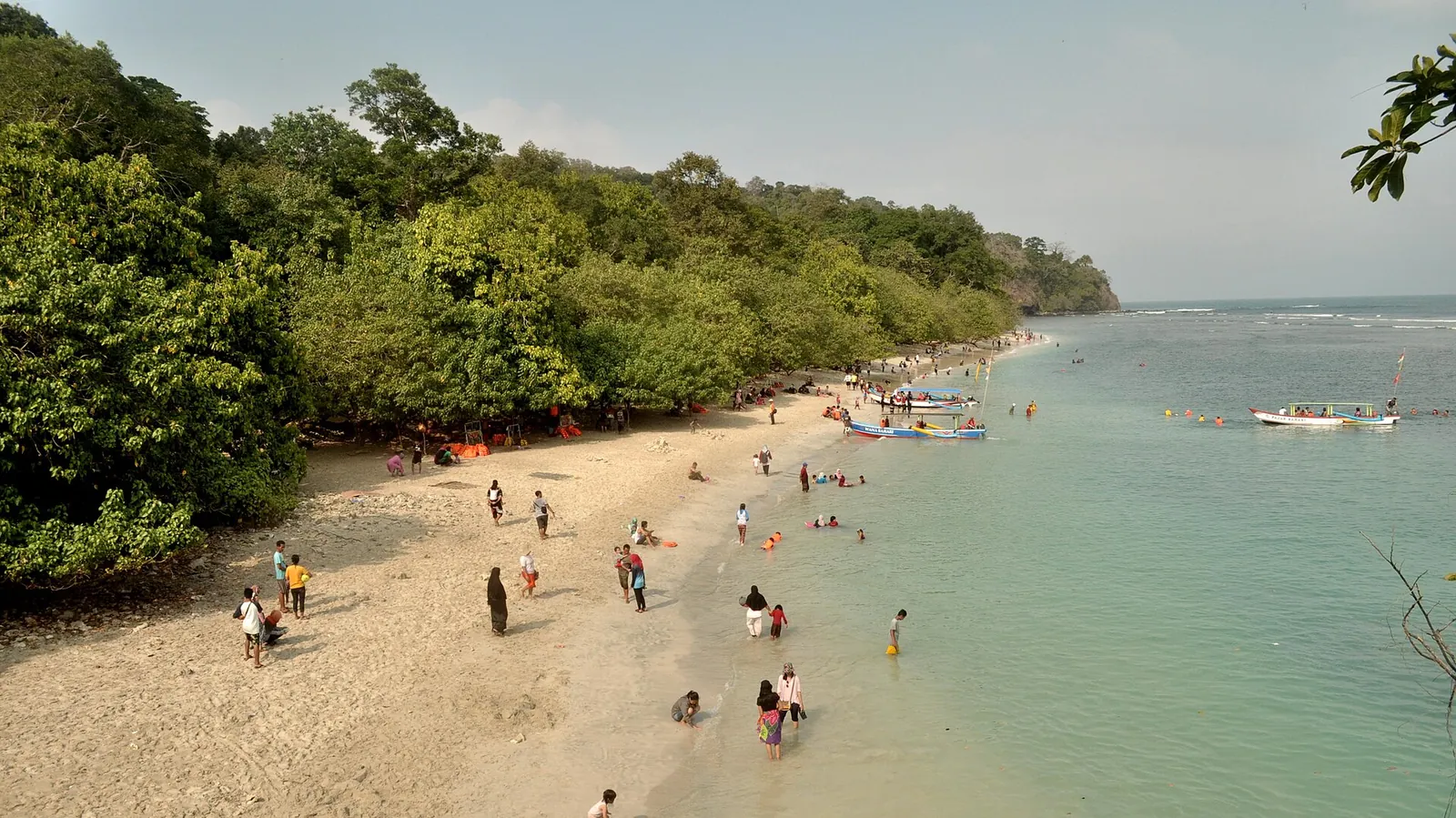
Pangandaran town fills the strip of land between the mainland and the Pananjung peninsula, so the two beaches are a short walk or bike ride apart. West Beach (Pantai Barat) is the main swimming beach: the tourism ministry describes its waves as relatively calm and its long shoreline as suited to swimming and beach games, with life vests for children for hire. East Beach (Pantai Timur) is the working side, with fishing boats, water-sports operators and a line of seafood restaurants, with the fish market at the southern end.
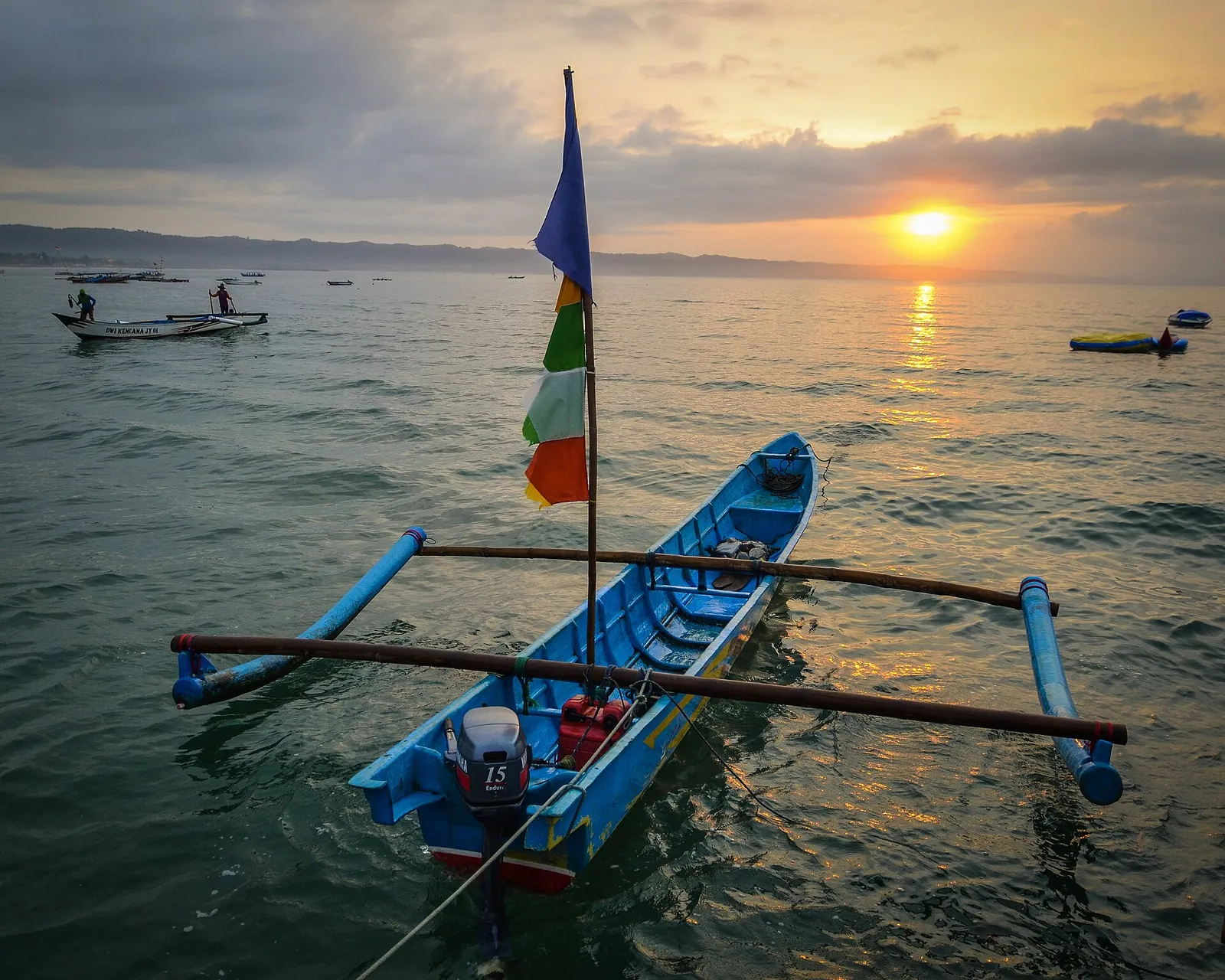
The ministry's guide points out the town's neat trick: watch the sunrise from East Beach and the sunset from West Beach, with fishing boats in silhouette. If you can only pick one side for your room, pick the West for swimming and sunsets; the East is for early risers and seafood dinners, and you can walk between them in minutes.
Pangandaran has its own entrance ticket for the tourist area. When we checked on 2026-10-03, the ministry's Pangandaran guide listed Rp10,000–15,000 per person on weekdays and Rp20,000–25,000 at weekends and on national holidays, with extra fees for vehicles and for the nature reserve. Treat these as indicative and check at the gate.
The Pananjung forest reserve: a morning with langurs and caves
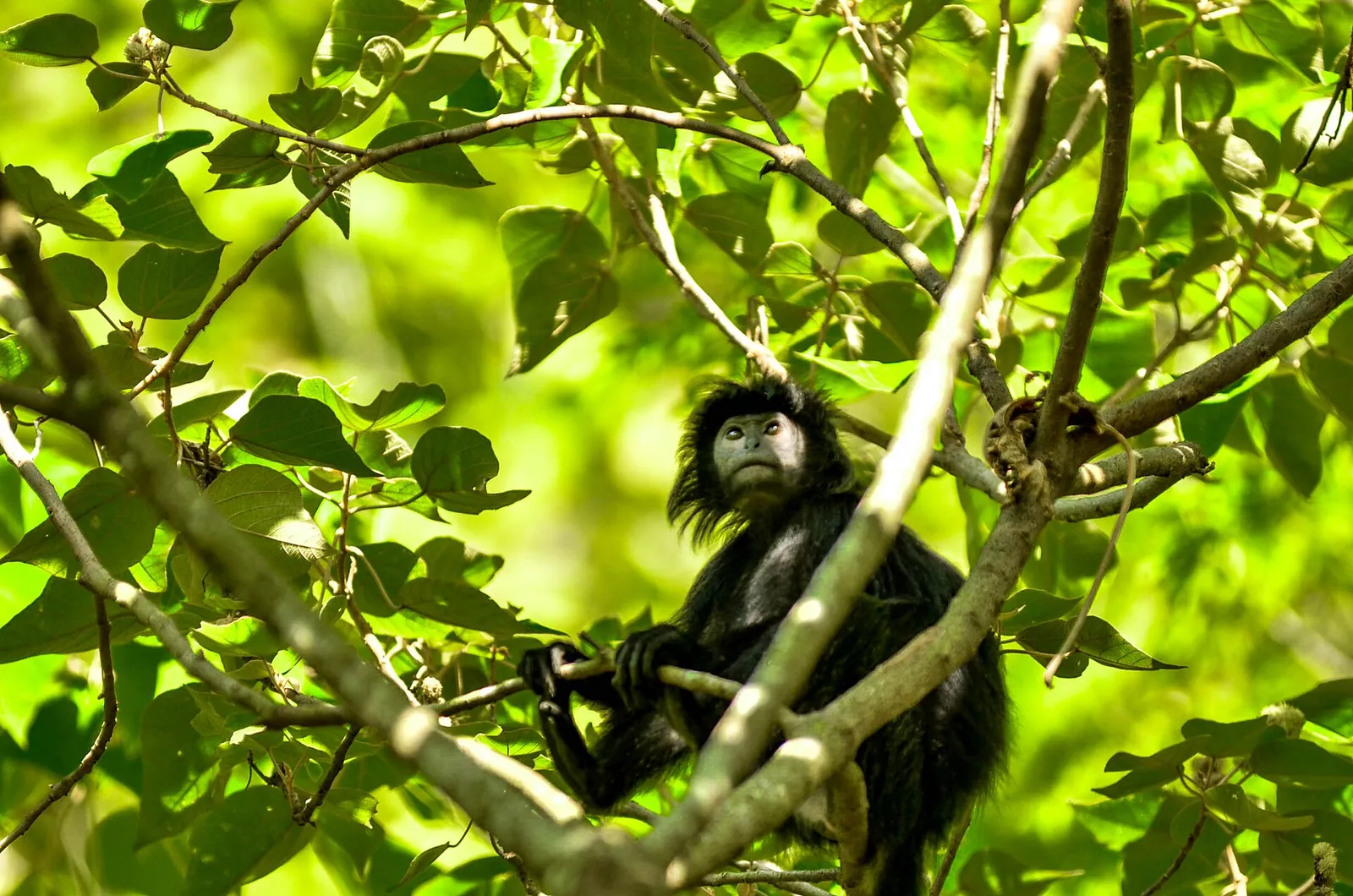
The headland at the end of town is a protected area in two parts: a strict nature reserve (Cagar Alam) and a smaller nature recreation park (Taman Wisata Alam, TWA) where visitors are allowed. The area was first set aside as a wildlife reserve in 1934 and became a nature reserve in 1961 after the Rafflesia flower was found there; most of the forest is old secondary growth. Long-tailed macaques, Javan langurs, deer and monitor lizards are the animals you are most likely to see.
The ministry's guide describes easy trekking on grassy paths among big trees, caves including one dating from the Japanese occupation, and torches for hire at the entrance. Its family guide adds a waterfall and freshwater pool deeper in the forest beyond a buffalo field. Go in the early morning, before the heat and the day-trippers; carry water and keep food out of sight around the macaques.
When we checked on 2026-10-03, the ministry's guide listed reserve admission at around Rp16,000 per person on weekdays and Rp21,000 at weekends, and torch rental at Rp10,000. That article is written for domestic visitors, and older travel listings show a much higher rate for foreigners, so confirm the price for your passport at the ticket office before you plan around it.
Make time for the local food
What to eat and where to look
Ikan bakar (grilled fish) from the fish market
Pangandaran's signature meal: choose a fish from the morning's catch at the East Beach fish market and have it grilled at one of the stalls or restaurants beside it, with rice and sambal.
- Where to look
- The fish market (pasar ikan) at the southern end of the East Beach restaurant strip, and the seafood restaurants that display their catch on the front veranda.
- Fit it into your day
- Dinner on your first full day, after an early start in the reserve. When we checked on 2026-10-03, the ministry's guide listed about Rp30,000–60,000 for a portion of grilled fish or squid, depending on size and type.
Agree the weight, the price per kilo and the cooking charge before the fish goes on the grill.
Cumi and udang (squid and prawns)
Squid, prawns and crab are the other staples of the Pangandaran seafood table, usually grilled, fried or cooked in a sweet-soy or chilli sauce and shared among the table.
- Where to look
- The same East Beach restaurants and market stalls as the grilled fish.
- Fit it into your day
- Order one or two shellfish dishes alongside a whole fish to share rather than one large plate each.
Shellfish; ask how a dish is cooked if you avoid very sweet or very spicy sauces.
Tumis kangkung with sambal terasi
Water spinach stir-fried with garlic and chilli, served with sambal terasi, the fiery chilli relish made with fermented shrimp paste — the ministry's guide lists both as local restaurant specialities.
- Where to look
- Any seafood restaurant in town; it is the standard vegetable side dish.
- Fit it into your day
- The green dish that balances a seafood dinner.
Sambal terasi contains shrimp paste and is very hot; taste a little first.
Nasi uduk
Rice cooked in coconut milk with lemongrass and bay leaf, offered in Pangandaran's restaurants as an alternative to plain white rice with seafood.
- Where to look
- Seafood restaurants and warung (small eateries) around town.
- Fit it into your day
- Ask for it instead of plain rice with your grilled fish.
Richer than white rice; often comes with fried toppings that may contain shrimp.
Green Canyon (Cukang Taneuh) and Batu Karas: the day west
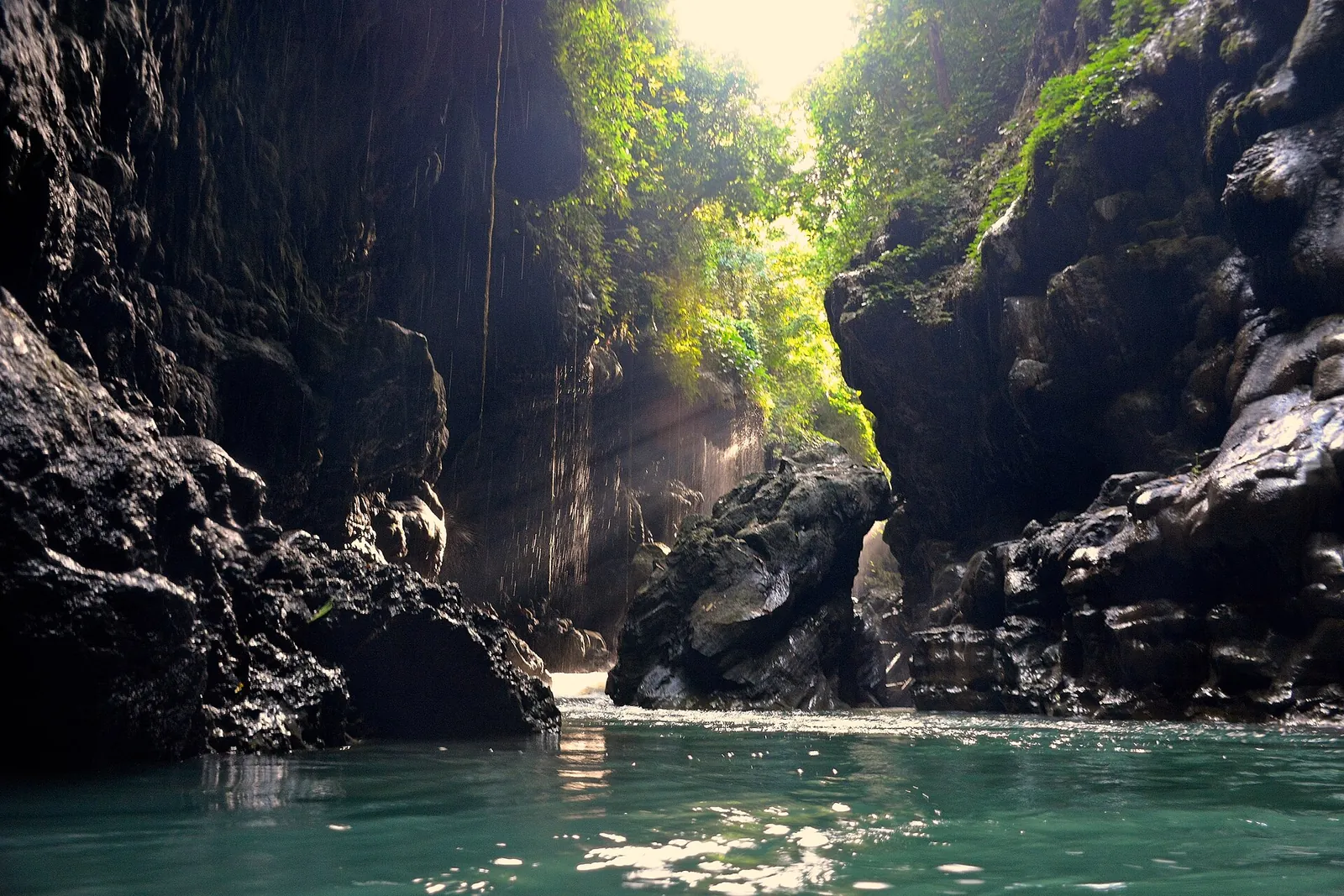
Green Canyon is the local name's English nickname: Sundanese speakers call it Cukang Taneuh, "soil bridge", after the natural bridge of earth spanning the cliffs over the Cijulang river. It is in Kertayasa village, Cijulang district; the ministry's page puts it about 31 km, or 45 minutes' drive, west of Pangandaran beach. Wooden motorboats (ketinting) leave from the river landing and run up between forested banks into the gorge, where moss-green walls close in and water drips from the rock.
The deeper, narrower section is reached by swimming or "body rafting" — floating downstream in a life jacket with a guide — which is offered locally with life jackets and guides. Wikivoyage says body rafting at Green Canyon cannot be done in the rainy season, unlike on the nearby Citumang river; ask locally the day before. Weekends and holidays bring queues of boats, so go on a weekday morning if you can.
Combine the canyon with Batu Karas, a beach village close to the canyon on the same stretch of coast, which Wikivoyage describes as one of Java's best places to learn to surf. It is quieter than Pangandaran and a good lunch-and-swim stop on the way back, or a base in its own right. The ministry's Green Canyon page says public transport means a minibus from Pangandaran terminal to Cijulang terminal and then a motorbike taxi (ojek); hiring a car with a driver or a scooter for the day is simpler.
Getting there: the train to Banjar, or the long road
Pangandaran has no railway station in use. The usual rail route is a train to Banjar, on Java's main southern line between Bandung and Yogyakarta, then onward by road; the ministry's guide gives this as the rail option from Jakarta. KAI's *Pangandaran* train, despite its name, runs between Jakarta Gambir and Banjar via Bandung and ends there. Coming from or going on to Yogyakarta, Banjar is also on the southern main line, which makes Pangandaran a natural break on a Bandung–Yogyakarta trip.
By road, the ministry's guide puts the journey at about six to seven hours from Bandung via Tasikmalaya and eight to ten hours from Jakarta by the southern route, by private car, door-to-door minivan ("travel") or public bus. Buses from Jakarta's Kampung Rambutan terminal and Bandung's Cicaheum terminal run towards Pangandaran, though some only go as far as Ciamis or Banjar, where you change.
Nusawiru Airport (CJN) near Cijulang, about 25 km west of town, is a small airfield; the ministry's older page mentions Susi Air services from Jakarta and Bandung, but we could not confirm a current schedule, so do not build a trip around it without checking with the airline.
A workable two-day plan
This is an editorial suggestion, not a timetable. Check conditions locally, especially for the river.
- Arrival day: reach town by mid-afternoon, walk West Beach and stay for sunset.
- Day 1 — Reserve and fish market: sunrise on East Beach, the Pananjung forest and caves in the morning, a lazy afternoon on West Beach or a short snorkelling trip from East Beach, then pick your fish at the East Beach market for dinner.
- Day 2 — West coast: Green Canyon by boat on a weekday morning, lunch and a swim or surf lesson at Batu Karas, back for a late sunset.
- Day 3: leave for Banjar station or start the road towards Yogyakarta or Bandung; add a night if you want a slower day of surfing or cycling.
Safety on Java's south coast
This is an open coast on the Indian Ocean. Swim where the locals swim on West Beach, stay out of the water when the surf is up, and keep children within arm's reach even on calm days. On boats, wear the life jacket provided.
On 17 July 2006 an undersea earthquake sent a tsunami into Pangandaran that killed more than 300 people in the town. Note the evacuation route signs near your hotel when you arrive; if you feel a strong or long earthquake on the coast, move inland or uphill at once without waiting for an official warning.
Practical questions
How many days should I spend in Pangandaran?
Two full days cover the beaches, the forest reserve and a day trip to Green Canyon and Batu Karas. Because getting there takes most of a day from Bandung or Jakarta, plan three nights rather than two.
Is West Beach or East Beach better for swimming?
West Beach. The tourism ministry describes its waves as relatively calm and suited to swimming; East Beach is the fishing and water-sports side. It is still the open ocean, so stay out when the surf is high.
How do I get from Pangandaran to Green Canyon?
It is about 31 km west by road, roughly 45 minutes' drive according to the ministry. Hire a car with a driver or a scooter, or take a minibus to Cijulang and an ojek from there; boats leave from the river landing at the canyon.
Can I reach Pangandaran by train?
Not directly. Trains stop at Banjar, on the southern main line between Bandung and Yogyakarta, and you continue by road. KAI's train named Pangandaran also ends at Banjar.
Is Pangandaran a good stop between Bandung and Yogyakarta?
Yes, if you want a beach break on an overland trip. It breaks a long journey and gives you a coast that feels very different from both cities; allow at least two nights to make the detour worthwhile.
When is the Pangandaran kite festival?
The Pangandaran International Kite Festival has been held since 1985. The ministry's events calendar listed the 2025 edition on 13 July 2025; check the calendar for the current year's date.
Sources and checks before you travel
Reference sources for the version dated 3 October 2026. Confirm opening times, access, transport and conditions for your travel dates.
- Indonesia Travel (Ministry of Tourism): Pangandaran ↗ — opens in a new tab
- Indonesia Travel (Ministry of Tourism): Pangandaran holiday guide ↗ — opens in a new tab
- Indonesia Travel (Ministry of Tourism): 5 fun family recreations in Pangandaran Beach ↗ — opens in a new tab
- Indonesia Travel (Ministry of Tourism): Pangandaran – Green Canyon ↗ — opens in a new tab
- Indonesia Travel (Ministry of Tourism): Pangandaran Kite Festival ↗ — opens in a new tab
- Indonesia Travel (Ministry of Tourism): weather, climate and seasons ↗ — opens in a new tab
- Wikipedia (Indonesian): Cagar Alam Pananjung Pangandaran ↗ — opens in a new tab
- Wikipedia (Indonesian): Cukang Taneuh ↗ — opens in a new tab
- Wikipedia: Pangandaran ↗ — opens in a new tab
- Wikipedia (Indonesian): Kereta api Pangandaran ↗ — opens in a new tab
- Wikipedia (Indonesian): Stasiun Banjar ↗ — opens in a new tab
- Wikivoyage: Pangandaran ↗ — opens in a new tab
Photo credits
The white-sand stretch of Pangandaran beach, with the forest of the Pananjung peninsula behind it
Photograph: Hahnsaja — opens in a new tab · CC BY-SA 4.0 — opens in a new tab
Changes: Resized and converted to WebP; displayed with responsive crops. · Original photograph and licence details ↗ — opens in a new tab
Sunrise over an outrigger boat on Pangandaran's East Beach
Photograph: Herdik.herlambang — opens in a new tab · CC BY-SA 4.0 — opens in a new tab
Changes: Resized and converted to WebP; displayed with responsive crops. · Original photograph and licence details ↗ — opens in a new tab
Inside Cukang Taneuh (Green Canyon) on the Cijulang river
Photograph: Ocyid X — opens in a new tab · CC BY-SA 4.0 — opens in a new tab
Changes: Resized and converted to WebP; displayed with responsive crops. · Original photograph and licence details ↗ — opens in a new tab
A Javan langur in the Pananjung nature recreation park
Photograph: Ibenk Kusyanto — opens in a new tab · CC BY-SA 4.0 — opens in a new tab
Changes: Resized and converted to WebP; displayed with responsive crops. · Original photograph and licence details ↗ — opens in a new tab
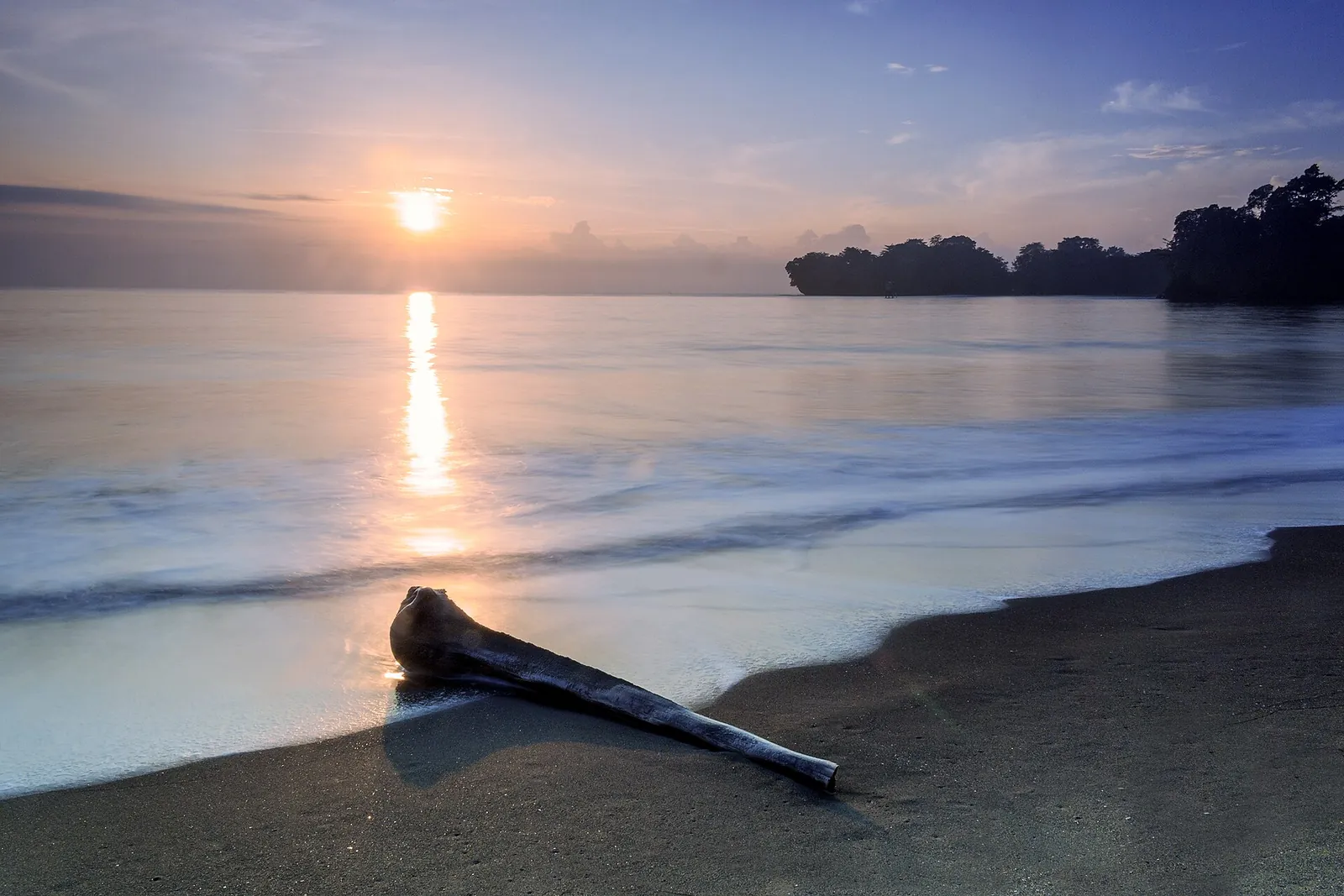
Early morning on the beach at Batu Karas, west of Pangandaran
Photograph: Ridwanad — opens in a new tab · CC BY-SA 4.0 — opens in a new tab
Changes: Resized and converted to WebP; displayed with responsive crops. · Original photograph and licence details ↗ — opens in a new tab
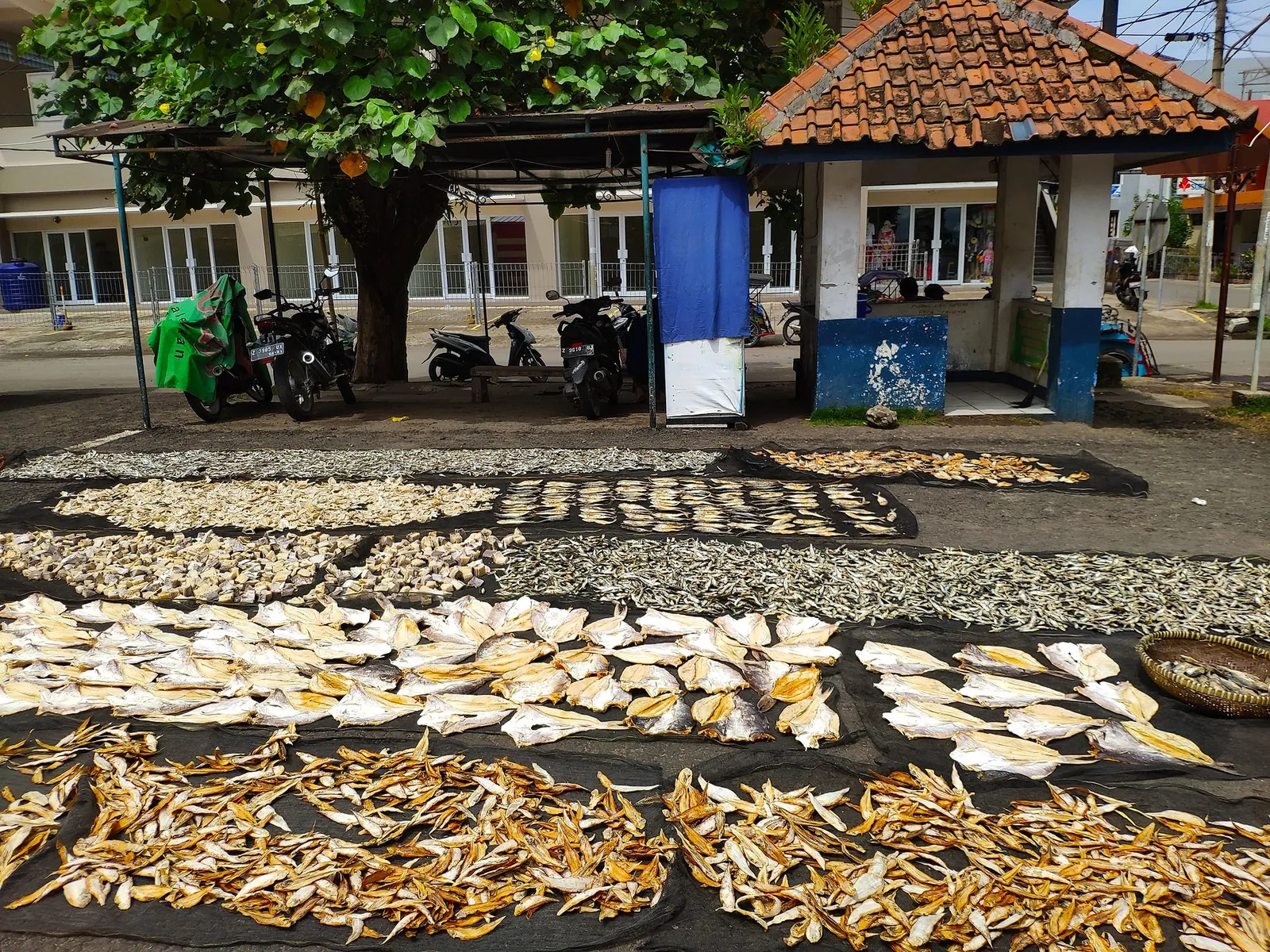
Fish drying in the sun in Pangandaran
Photograph: Ekaterina Kvelidze — opens in a new tab · CC BY-SA 4.0 — opens in a new tab
Changes: Resized and converted to WebP; displayed with responsive crops. · Original photograph and licence details ↗ — opens in a new tab