Vientiane and Vang Vieng · Vientiane Capital
Vientiane travel guide: two nights, temples and the Mekong
Vientiane rewards a short stay with time between its monuments. The gold-covered stupa of Pha That Luang stands apart from the old quarter, while Wat Si Saket and Ho Phra Keo bring Buddhist painting and sculpture into the centre. Patuxai gives the capital a monumental arch; COPE explains how unexploded ordnance still affects everyday lives. Stay centrally, walk the old streets and leave the evening for the Mekong rather than spending both nights in transit.
- Suggested time
- 2 nights
- Where to stay
- Central Vientiane around Ban Mixay and Nam Phou; both nights in the same hotel
- Season and timing
- The World Bank and Asian Development Bank climate profile describes Laos’s rainy season as May to mid-October and the dry season as mid-October to April. These are broad seasonal patterns, so leave room for rain outside those months.
The short answer
Book two nights in central Vientiane, around Ban Mixay or Nam Phou, and reserve the room and your flight or onward train first. Chanthapanya Hotel in Ban Mixay shows a Superior room from $50 a night (15 October 2026, the hotel’s own rate), and a shared dinner of beef or lam stew and mok pa at Khop Chai Deu comes to LAK95,700 with VAT; COPE is free. Give the old temple museums one morning, combine COPE with Patuxai and Pha That Luang on the full day, and spend the evenings by the Mekong. Two nights work as a capital break or the last stop before a flight from Wattay; keep Buddha Park outside this short plan.
A central base for both nights
Ban Mixay is the practical first choice for this stay. Chanthapanya Hotel is at 138 Norkeokoummarn Road in Ban Mixay; its rooms use timber furniture in a traditional Lao style. Its own booking page lists Superior King and Superior Twin rooms for two adults, so either suits two adults sharing. Nam Phou is another central search area if you prefer to choose around your evening restaurants.
On 15 October 2026 the hotel showed its Superior room from $50 a night, the hotel’s own rate. The room is 31 m², and the hotel has a swimming pool, gym and breakfast buffet. Taxes, service charge and breakfast are not included in that rate. Book through the hotel’s own reservation link for your dates.
ASEAN’s tourism portal describes the old quarter between the Mekong and Samsenthai Road as a place of colonial villas, temples and small restaurants. This is the part to explore on foot; use a car or tuk-tuk to join the farther sights rather than choosing a hotel beside a departure station.
Wat Si Saket and Ho Phra Keo: painting and sculpture
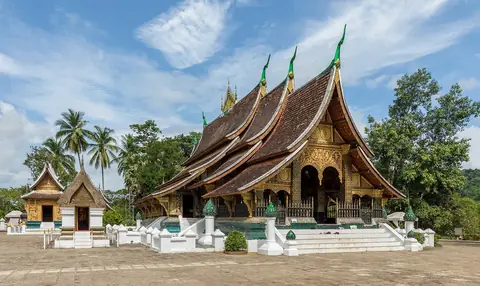
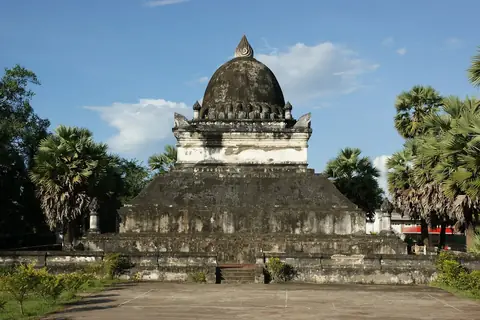
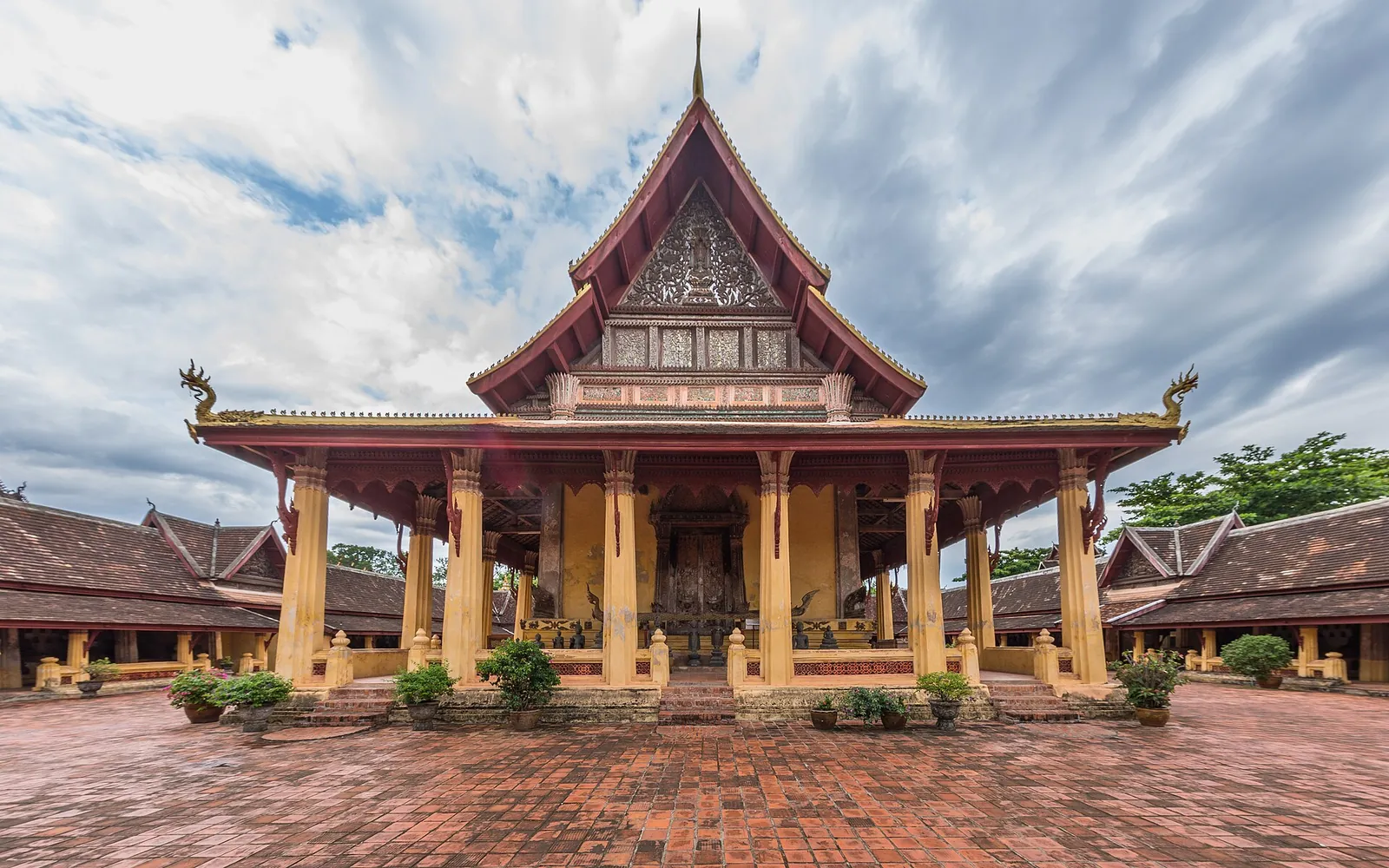
Begin with Wat Si Saket. Built in 1818–1824 for King Anouvong as his private monastery, it preserves a different kind of detail from the city’s big outdoor monuments. The inner walls depict Prince Pookkharabat, an earlier incarnation of the Buddha, in scenes from the Balasankhaya Jataka. KPL’s account of the painting restoration dates the works to several periods between 1820 and about 1960. Give the painted sanctuary your attention rather than treating the stop as a photograph at the gate.
Pair it with Ho Phra Keo, the former royal place of worship built by King Sayasetthathirath in 1565 to house the Emerald Buddha. It became a museum in the 1970s, with Buddhist sculptures and artefacts. The pairing works because one visit centres on painted narratives and the other on objects and sculpture, giving the old city more substance than a circuit of monuments.
Visit these temple museums in the morning and dress modestly. No official page publishes current opening hours, closure days or admission prices for Wat Si Saket and Ho Phra Keo, so their tickets are not included in the budget below.
Patuxai and Pha That Luang: the capital’s large monuments
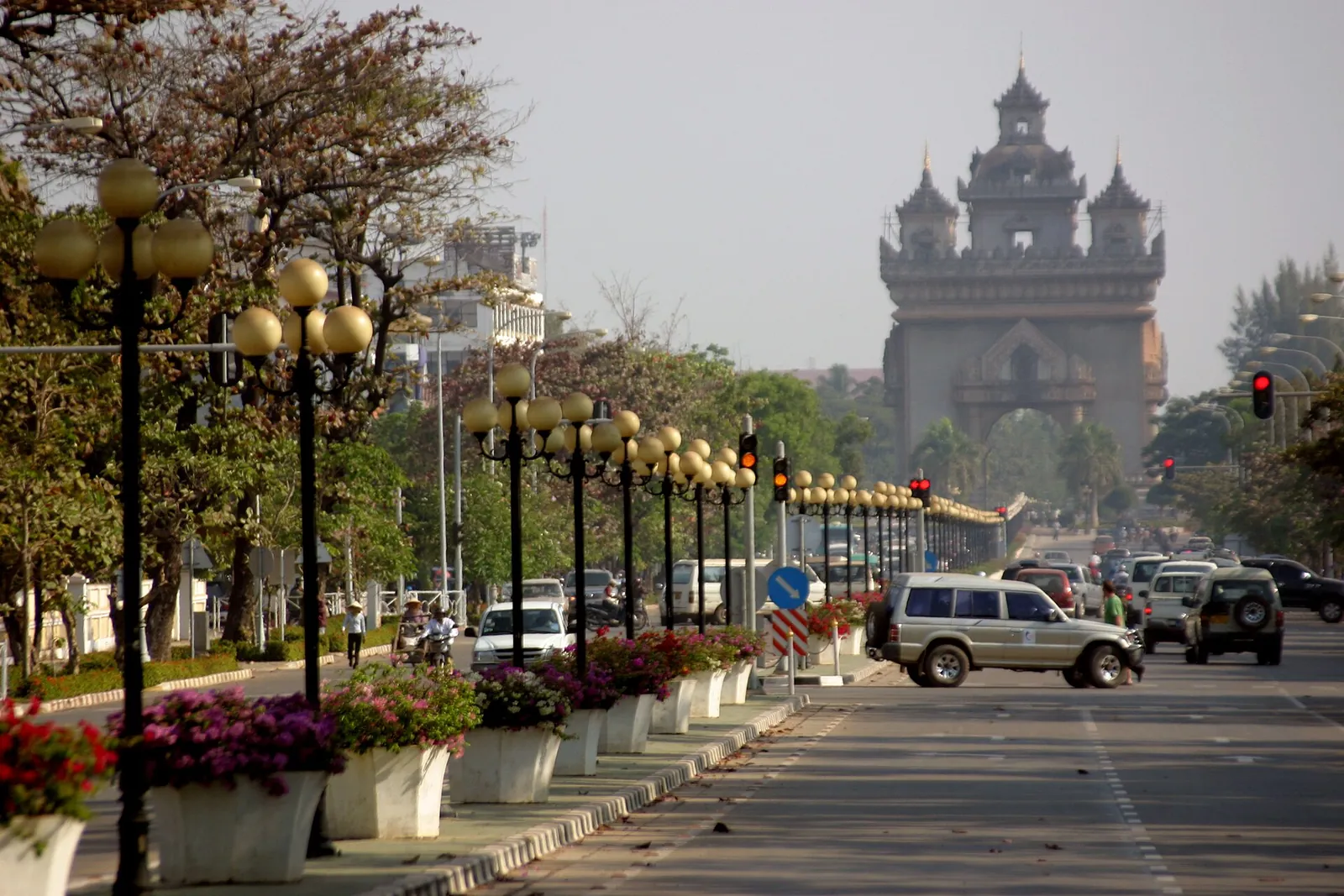
Patuxai is the huge triumphal arch that gives Vientiane its most recognisable urban landmark. See it as part of the journey out from the old quarter: it changes the scale from small temple museums and streets to the capital’s monumental avenue. This plan visits the arch from outside and does not depend on access to an upper terrace.
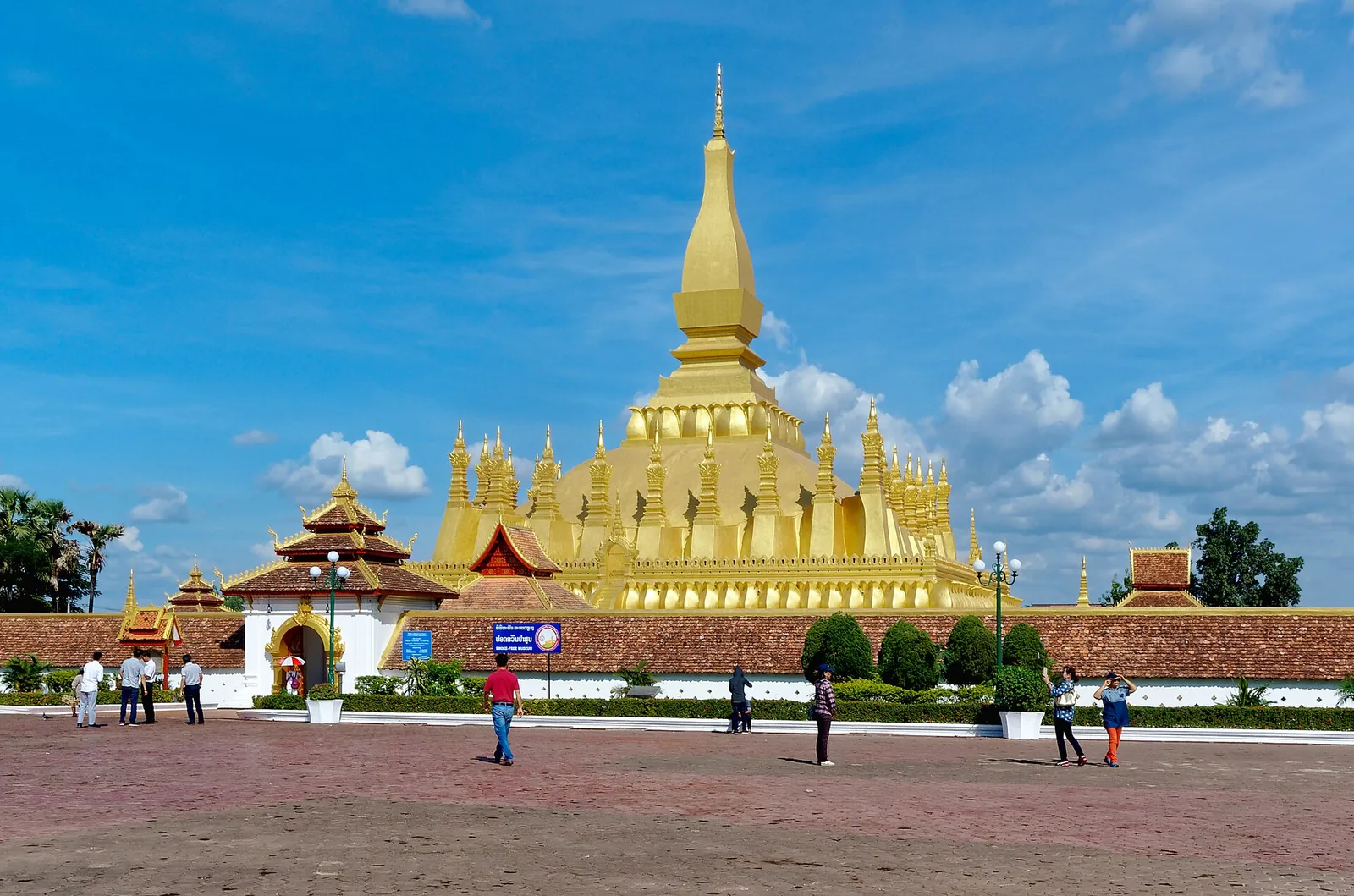
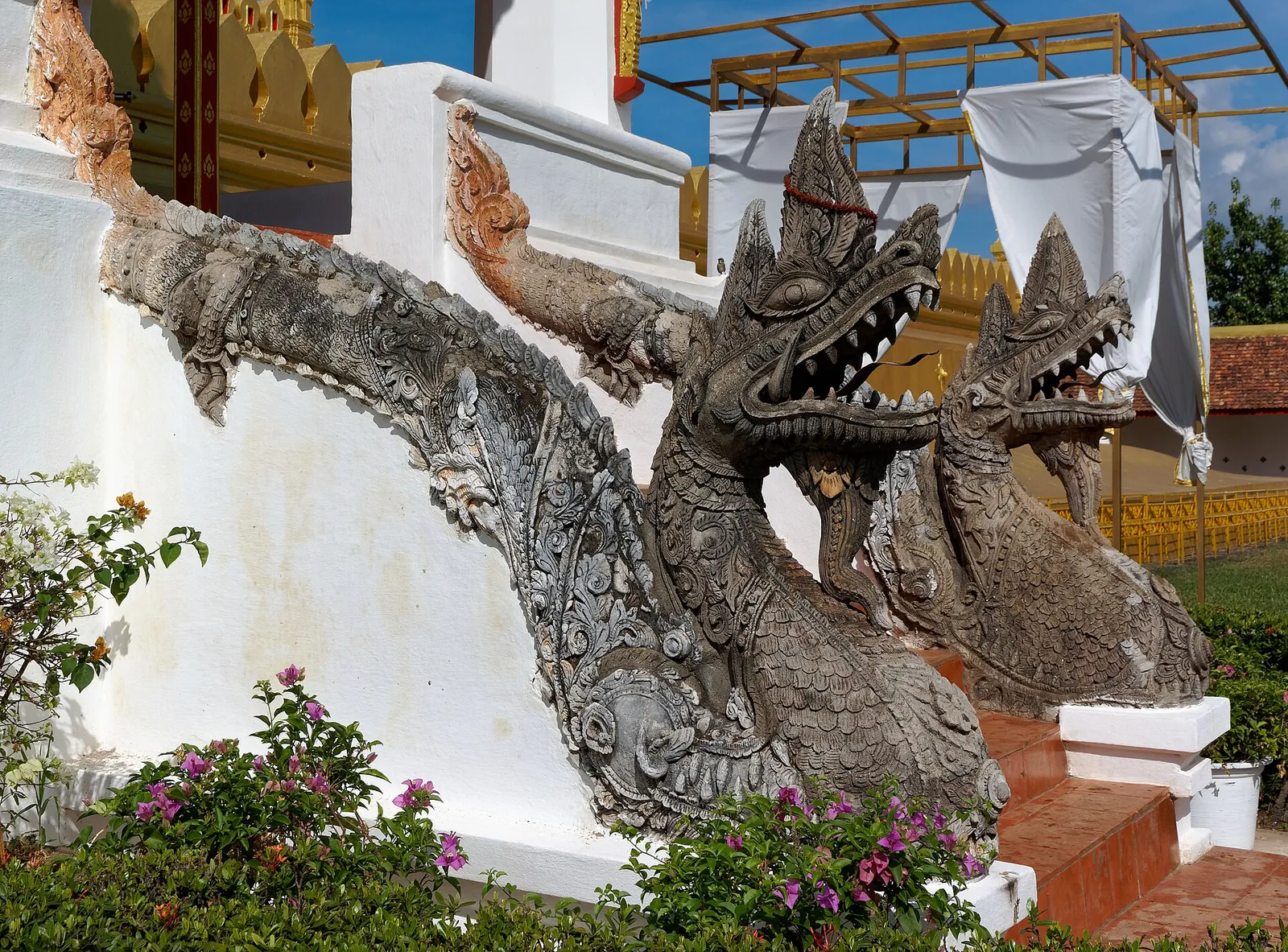
Continue to Pha That Luang, a gleaming angular stupa within a high-walled cloister. ASEAN’s tourism portal dates it to 1566 and describes it as a national symbol. The enclosure matters as much as the central spire: walk around the monument to see its changing outlines against the cloister rather than making only a front-on stop. Its religious importance makes this a different experience from Patuxai, even when you combine the two by car. No official page publishes current hours or an admission price for Pha That Luang, so it is not included in the budget.
The annual Bun That Luang festival falls around the full moon of the twelfth lunar month, usually around November, with almsgiving and candlelit processions. If the festival is your reason for coming, choose the stay around its announced dates; the ordinary two-night plan does not depend on it.
COPE and an evening beside the Mekong
COPE Visitor Centre is in the Centre for Medical Rehabilitation grounds on Khouvieng Road. Its exhibits explain the history of unexploded ordnance in Laos, its effects on people’s lives and the rehabilitation work that supports people with mobility-related disabilities. The personal stories make it a useful counterpoint to the royal and religious history of the temples. The Cave Cinema shows short documentaries in a space modelled on a wartime bunker; ask staff about the screening times.
Entry was free on 15 October 2026, with donations welcomed. The centre opens daily at 08:30 and its visit page gives the closing time as 16:00 or 17:00, so go in the morning. From the CMR entrance, follow the road in, turn right at the indoor stadium and continue to the white building marked COPE Visitor Centre. This is an active rehabilitation setting, so keep your visit within the visitor facilities.
Return to the Mekong riverfront for the evening, then walk back into the old quarter for dinner. The river is the natural edge of a central stay, while the streets towards Samsenthai Road provide the architectural interest. Keep the evening unstructured; the full sightseeing day already has the longer rides.
Two nights, three days, with meals in the centre
This plan assumes an arrival early enough for some sightseeing and a departure after the final morning. With a late flight in, move the temple pair to day 3 and make day 1 a check-in and dinner evening.
For a Lao lunch with clearly described dishes, Kualao is another Vientiane option. Its jeo mak len pairs grilled tomato dipping sauce with steamed vegetables; kang nor mai is a thick bamboo-shoot soup with assorted vegetables. Choose the dip for a vegetable plate to share or the soup for a more substantial hot bowl. Kualao’s prices are not included in the budget.
- Day 1: arrive at Wattay, check into the central hotel and visit Wat Si Saket and Ho Phra Keo if the day allows. Walk the old quarter, then have dinner at Khop Chai Deu on Setthathirath Road and finish beside the Mekong.
- Day 2: visit COPE in the morning, then take a car or tuk-tuk to Patuxai and Pha That Luang. Return centrally for a rest and an evening at Ban Anou Night Market, the food stop ASEAN’s tourism portal recommends in Vientiane.
- Day 3: use the morning for the temple museums if you arrived late, then collect your bags and leave for Wattay or your booked railway station. Keep departure transport separate from the sightseeing rides.
Make time for the local food
What to eat and where to look
Mok pa
Fish steamed in a banana leaf. Khop Chai Deu’s menu names its version as steamed Mekong fish in banana leaf.
- Where to look
- Khop Chai Deu, 54 Setthathirath Road, Nam Phou.
- Fit it into your day
- Share it with the stew at the first dinner.
Or lam
A Lao stew; Khop Chai Deu’s menu lists a beef version.
- Where to look
- Khop Chai Deu, alongside the mok pa.
- Fit it into your day
- The second shared dish in the priced dinner.
Laab
A spicy, aromatic minced-meat salad, described by ASEAN’s tourism portal as one of the country’s characteristic dishes.
- Where to look
- Look for it at Ban Anou Night Market, the Vientiane food stop recommended in the same ASEAN feature.
- Fit it into your day
- A dish to seek out on the second evening; choose a cooked version if you avoid raw meat.
Khao piak sen
A Lao noodle soup, named alongside laab in ASEAN’s food introduction.
- Where to look
- Look for a noodle-soup stall at Ban Anou Night Market.
- Fit it into your day
- An alternative to the meat salad, or a separate bowl for the other diner.
A dated two-person budget for the stay
This budget is for two adults sharing a Superior King or Superior Twin at Chanthapanya Hotel for two nights, using prices published on 15 October 2026. Dollars and kip are shown as published and are not converted.
Room: from $50 a night, the hotel’s own rate, as the hotel showed it on 15 October 2026 for this room type. This room line is not part of the dinner total below. Taxes, service charge and breakfast are not included.
One shared dinner: LAK95,700, from Khop Chai Deu’s menu: beef or lam stew at LAK46,000 plus mok pa at LAK41,000 is LAK87,000, plus the menu’s 10% VAT of LAK8,700. COPE has no admission charge.
Total of published prices for the meals: LAK95,700 for the dinner. The room is the separate “from $50 a night” line above and is not added into any total. No fare is published for the LOCA airport rides or the car or tuk-tuk to Patuxai and Pha That Luang (LOCA shows its fare in the app), and Ban Anou Night Market stalls publish no prices, so these are not included. Also not included: breakfasts, lunches (including Kualao), the other dinner, rice and drinks; tickets for Wat Si Saket, Ho Phra Keo and Pha That Luang; flights and trains; hotel taxes and service charge.
Arriving at Wattay and choosing the correct railway station
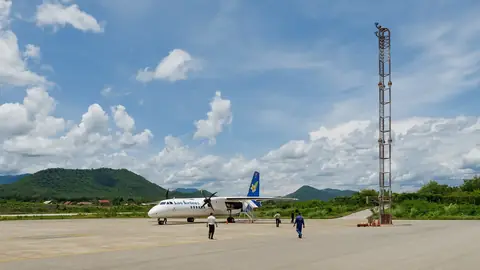
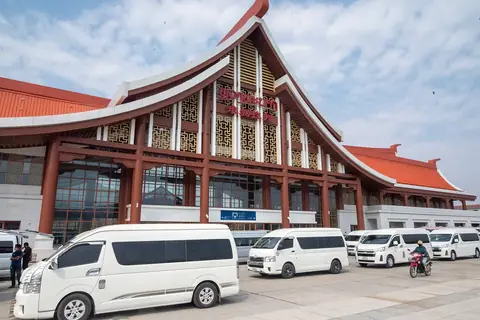
Wattay International Airport (VTE) is the air gateway for this stay. Chanthapanya Hotel puts itself 5.6 km from Wattay. Book a LOCA ride to the hotel after arrival; LOCA supports airport pickups and shows the price in its app. Use the same process for the return, choosing the airport as the destination. LOCA accepts international phone numbers and offers cash or supported card payments. No operator or official page publishes a road time between the airport and the city.
For 25 October 2026–27 March 2027, Lao Airlines lists Bangkok Suvarnabhumi–Vientiane twice daily, taking 1 hour 20 minutes, and Hanoi–Vientiane daily, taking 1 hour 10 minutes. From Ho Chi Minh City, its Tuesday, Thursday and Saturday service reaches Vientiane via Pakse in 3 hours 35 minutes.
For that winter timetable, the Bangkok Suvarnabhumi departures to Vientiane are 09:55 and 20:50, arriving at 11:15 and 22:10. Buy through Lao Airlines for the travel date; flight fares are additional to the stay model. The morning service fits day 1 sightseeing more easily than the late arrival.
Khamsavath railway station and the Laos–China Railway’s Vientiane station are different terminals. Khamsavath is named on the eVisa entry list; the Laos–China Railway’s station is in Xaythany district, according to Lao News Agency, and serves Vang Vieng and Luang Prabang. Neither station is Wattay airport. Book the road transfer to either one through LOCA or your hotel. No operator or official page publishes road distances or journey times from central Vientiane to these two stations.
LCR Ticket is the Laos–China Railway company’s official booking app. It provides train searches, reservations, online payment, changes and refunds. Download the app published by Laos-China Railway Company Limited.
Use the LCR Ticket app’s dated search to choose the train and buy the ticket. This short city stay does not require a train ride or a Thailand land crossing.
Complete the Lao Digital Immigration Form within three days before arrival and again within three days before departure when using Wattay, Luang Prabang or Pakse international airport, or Friendship Bridge I. This arrival and departure form is separate from your visa.
Buddha Park, border arrivals and the next stop
Buddha Park is an optional extension, outside the recommended two-night circuit. Add it only with a separately arranged return journey and the current admission details. With a short stay, the temple museums, COPE, Patuxai, Pha That Luang and the riverfront make a fuller capital visit than replacing them with an out-of-town transfer.
Friendship Bridge I is on the official eVisa entry list and the digital immigration form applies there. If you arrive from Thailand, use the entry guide to match the crossing to your nationality and visa, and the transport guide to choose a dated service and its onward ride into central Vientiane. This article’s budget starts with the city stay; it does not price a cross-border bus or train.
The Lao kip (LAK) is the local currency. Carry kip for everyday purchases; card acceptance is concentrated in larger hotels, restaurants and shops in the main cities. Exchange foreign currency at banks, airports or currency exchange offices. LOCA Pay offers card-funded payments through Lao QR codes.
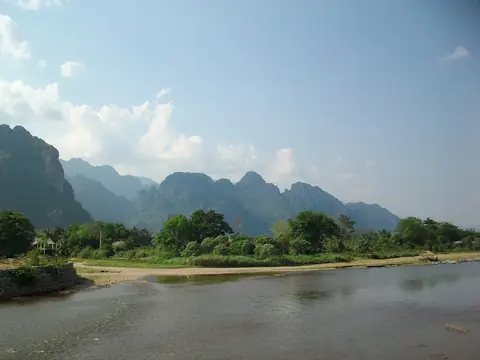
For a longer trip, choose Vang Vieng for the karst landscape or Luang Prabang for a longer temple stay, using the transport guide for the railway booking. On 15 October 2026, the UK FCDO advised against all but essential travel to Xaisomboun province. Germany advised avoiding journeys into Bokeo and Sainyabuli provinces and journeys near the Cambodian border. France advised against the Myanmar border area except for compelling reasons. Our routes avoid these areas; check your own government’s advice before booking.
Practical questions
How many nights should I book in Vientiane?
Two nights in a central hotel give you one full day plus the arrival and departure margins. Use them for the temple museums, COPE, Patuxai, Pha That Luang and the Mekong evenings.
Where is the best base for a first visit?
Ban Mixay or the Nam Phou area. Choose one central hotel for both nights, with the old quarter and evening food nearby, then use a car or tuk-tuk for the farther monuments.
Is Wattay the same place as Vientiane railway station?
No. Wattay (VTE) is the airport. Khamsavath and the Laos–China Railway’s Vientiane station are two separate railway terminals. Tell your driver the terminal named on your ticket.
Is COPE a war museum?
Its visitor centre explains unexploded ordnance and its continuing effects, alongside rehabilitation and stories of people with mobility-related disabilities. The visit is free, and donations support the work.
Can I fit Buddha Park into two nights?
Keep it as an optional extra with a separately arranged return ride. The recommended stay gives the city sights the full day and uses the remaining time for the old quarter and riverfront.
Does the two-night model cover everything?
No. The budget lists the hotel’s nightly room rate separately and prices one dinner. Breakfasts and other meals, temple tickets, hotel taxes and service charge, airport and city rides, and flights or trains are not included.
Sources and checks before you travel
Reference sources for the version dated 15 October 2026. Confirm opening times, access, transport and conditions for your travel dates.
- ASEAN tourism: Attractions in Laos ↗ — opens in a new tab
- ASEAN tourism: That Luang Stupa ↗ — opens in a new tab
- Lao News Agency: Wat Sisaket Painting Completed ↗ — opens in a new tab
- Lao News Agency: Ho Phra Keo museum history ↗ — opens in a new tab
- COPE: visit the Visitor Centre ↗ — opens in a new tab
- Chanthapanya Hotel: rooms and location ↗ — opens in a new tab
- Chanthapanya Hotel: Superior room ↗ — opens in a new tab
- Chanthapanya Hotel: direct room reservations ↗ — opens in a new tab
- Inthira: Khop Chai Deu ↗ — opens in a new tab
- Khop Chai Deu: food menu ↗ — opens in a new tab
- ASEAN tourism: Culture and heritage in Indonesia and Laos ↗ — opens in a new tab
- ASEAN tourism: getting around Lao PDR ↗ — opens in a new tab
- LOCA: rides and taxis ↗ — opens in a new tab
- LOCA: travel app in Laos ↗ — opens in a new tab
- Lao eVisa: accepted entry points ↗ — opens in a new tab
- UK FCDO: Laos entry requirements ↗ — opens in a new tab
- Laos–China Railway: LCR Ticket app ↗ — opens in a new tab
- Laos tourism: before you go ↗ — opens in a new tab
- Lao Airlines: winter 2026–2027 international timetable ↗ — opens in a new tab
- World Bank and ADB: Lao PDR climate profile ↗ — opens in a new tab
- UK FCDO: Laos travel advice ↗ — opens in a new tab
- Auswärtiges Amt: Laos travel advice ↗ — opens in a new tab
- France Diplomatie: Laos travel advice ↗ — opens in a new tab
- Lao News Agency: Vientiane railway station in Xaythany ↗ — opens in a new tab
- Kualao: Lao cuisine ↗ — opens in a new tab
Photo credits
Pha That Luang rises above its surrounding walls.
Photograph: Jakub Hałun — opens in a new tab · CC BY-SA 4.0 — opens in a new tab
Changes: Resized and converted to WebP; displayed with responsive crops. · Original photograph and licence details ↗ — opens in a new tab
Wat Si Saket stands in a paved courtyard.
Photograph: Basile Morin — opens in a new tab · CC BY-SA 4.0 — opens in a new tab
Changes: Resized and converted to WebP; displayed with responsive crops. · Original photograph and licence details ↗ — opens in a new tab
Patuxai stands at the end of a broad avenue.
Photograph: Gerd Eichmann — opens in a new tab · CC BY-SA 4.0 — opens in a new tab
Changes: Resized and converted to WebP; displayed with responsive crops. · Original photograph and licence details ↗ — opens in a new tab
A naga sculpture decorates the approach to Pha That Luang.
Photograph: Jakub Hałun — opens in a new tab · CC BY-SA 4.0 — opens in a new tab
Changes: Resized and converted to WebP; displayed with responsive crops. · Original photograph and licence details ↗ — opens in a new tab