Java · Special Region of Yogyakarta
Prambanan guide: the temples, Ratu Boko, Plaosan and the Ramayana ballet
Prambanan is the largest Hindu temple complex in Indonesia, a cluster of tall, narrow shrines dedicated to Shiva, Vishnu and Brahma on the border between the Special Region of Yogyakarta and Central Java, about 17 km east of central Yogyakarta. It is often squeezed into the same day as Borobudur, which is a mistake: the main compound, the Buddhist temples of Sewu, Lumbung and Bubrah inside the same park, the hilltop ruins of Ratu Boko and the quieter twin temples of Plaosan fill a day on their own, and the Ramayana ballet is performed a short drive away in the evening.
- Suggested time
- 1 full day, plus an evening for the ballet
- Where to stay
- Yogyakarta city (Malioboro or the east side along Jalan Laksda Adisucipto); the Kalasan and Prambanan hills for quieter stays near the temples
- Season and timing
- The tourism ministry gives April to October as the dry season on Java and November to March as the wet season, while noting that the seasons have become less predictable. The Ramayana ballet moves to its open-air stage in the dry months; in the wet months it is staged indoors.
The short answer
Give Prambanan one full day of its own, separate from Borobudur, and sleep in Yogyakarta. Arrive when the gates open in the morning for the three main shrines and the reliefs, walk north through the park to Sewu before the midday heat, rest over lunch, then drive to Plaosan in the early afternoon and up to Ratu Boko for the late-afternoon light. On a show night, end with the Ramayana ballet near the temple. Stay in central Yogyakarta for food and the Trans Jogja bus, or on the east side of the city or in the Kalasan and Prambanan hills if you want to be closer to the temples and the evening performance.
Make Prambanan its own day, and sleep in Yogyakarta
Prambanan lies east of Yogyakarta on the road to Solo, while Borobudur lies north-west of the city, so a tour that does both in one day spends much of it in a vehicle and gives each place only a couple of hours. Doing them on separate days lets you reach Prambanan at opening time, when the light is soft and the stone is still cool, and keep the afternoon for the other sites around it.
Central Yogyakarta, around Malioboro, is the practical base: restaurants and street food in the evening, and the Trans Jogja bus to the temples. The east side of the city, along Jalan Laksda Adisucipto towards the old Adisucipto airport and the northern ring road, cuts the drive and is where many of the larger hotels the tourism ministry lists for Prambanan stand. For quiet, the ministry also points to small resorts in the hills around Sambirejo above the temple and in the Kalasan villages to the west, a few kilometres away; from there you will need a car or a ride-hailing driver for dinner in town.
The main compound: Shiva, Vishnu and Brahma
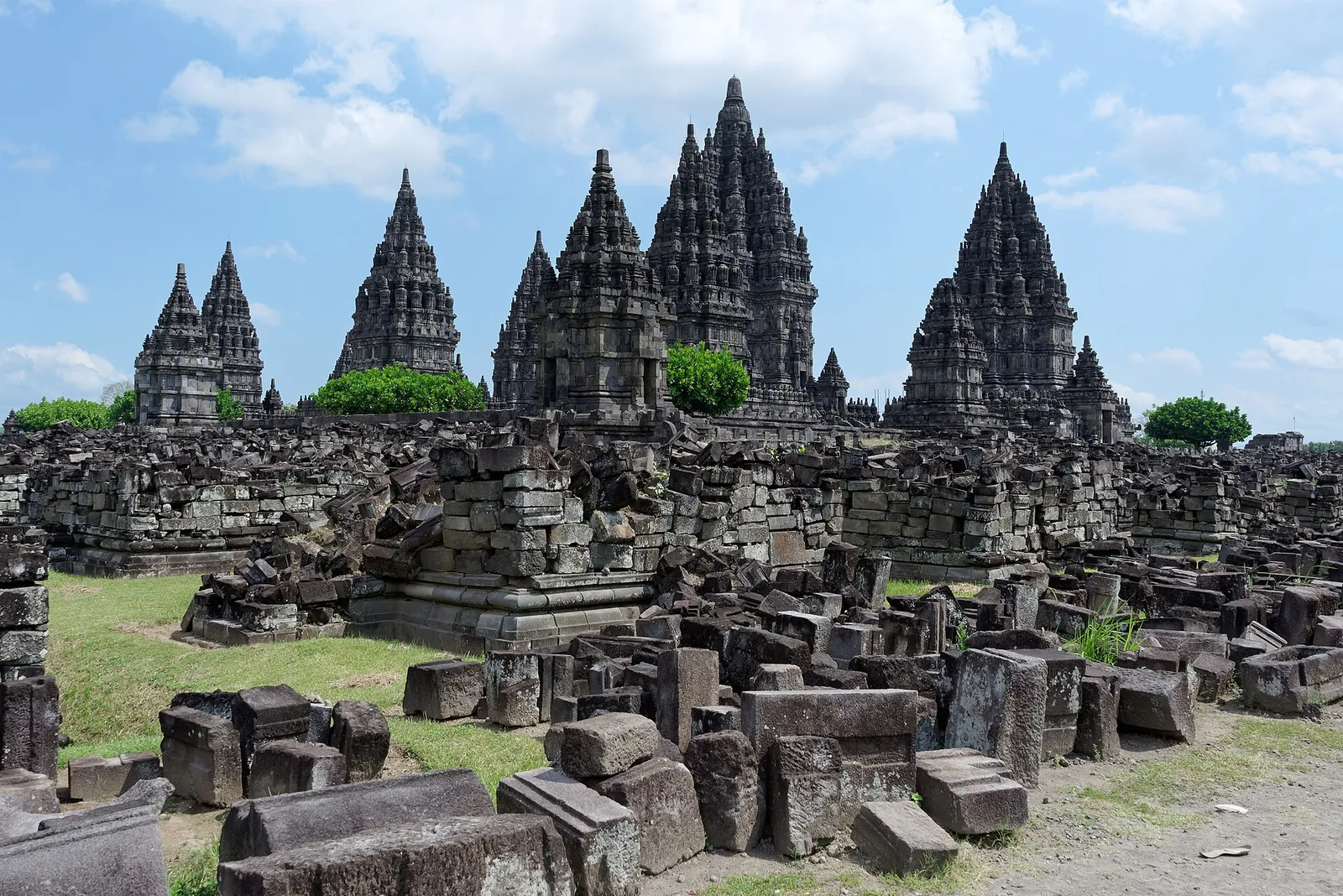
Prambanan was built in the 9th century, under the Ancient Mataram kingdom, as an offering to the Hindu Trimurti. The site operator describes three courtyards: a wide outer yard, a middle court once filled with rows of small ancillary shrines that now lie mostly in heaps of stone, and the inner court, the most sacred, with the three main temples. The Shiva temple in the centre is 47 metres tall; the Brahma and Vishnu temples on either side are about 33 metres. Facing them are smaller shrines for the gods' mounts.
Take your time with the carvings. The Ramayana is carved in panels around the inner wall of the balustrade, starting at the Shiva temple and continuing at the Brahma temple, so follow the galleries in order from Shiva to Brahma rather than just photographing the towers. Local legend says a statue of the goddess Durga inside the Shiva temple is Roro Jonggrang, the princess who was turned to stone after tricking a prince who had tried to build her a thousand temples in one night; the complex is still widely known by her name.
The complex fell out of use after power moved to East Java and was damaged by eruptions and earthquakes; restoration began in 1918, and UNESCO inscribed the Prambanan Temple Compounds as a World Heritage site in 1991. When we checked on 3 October 2026, the operator's official ticket site listed the Prambanan Temple ticket from 06:30 every day and said it covers the main compound, the Lumbung, Bubrah and Sewu temples and the Prambanan Museum. It did not give a closing time or a price on the page we could read, so check both on the ticket site before you go. These are temples, not just ruins: dress modestly and do not climb on fallen stones or the balustrades.
Make time for the local food
What to eat and where to look
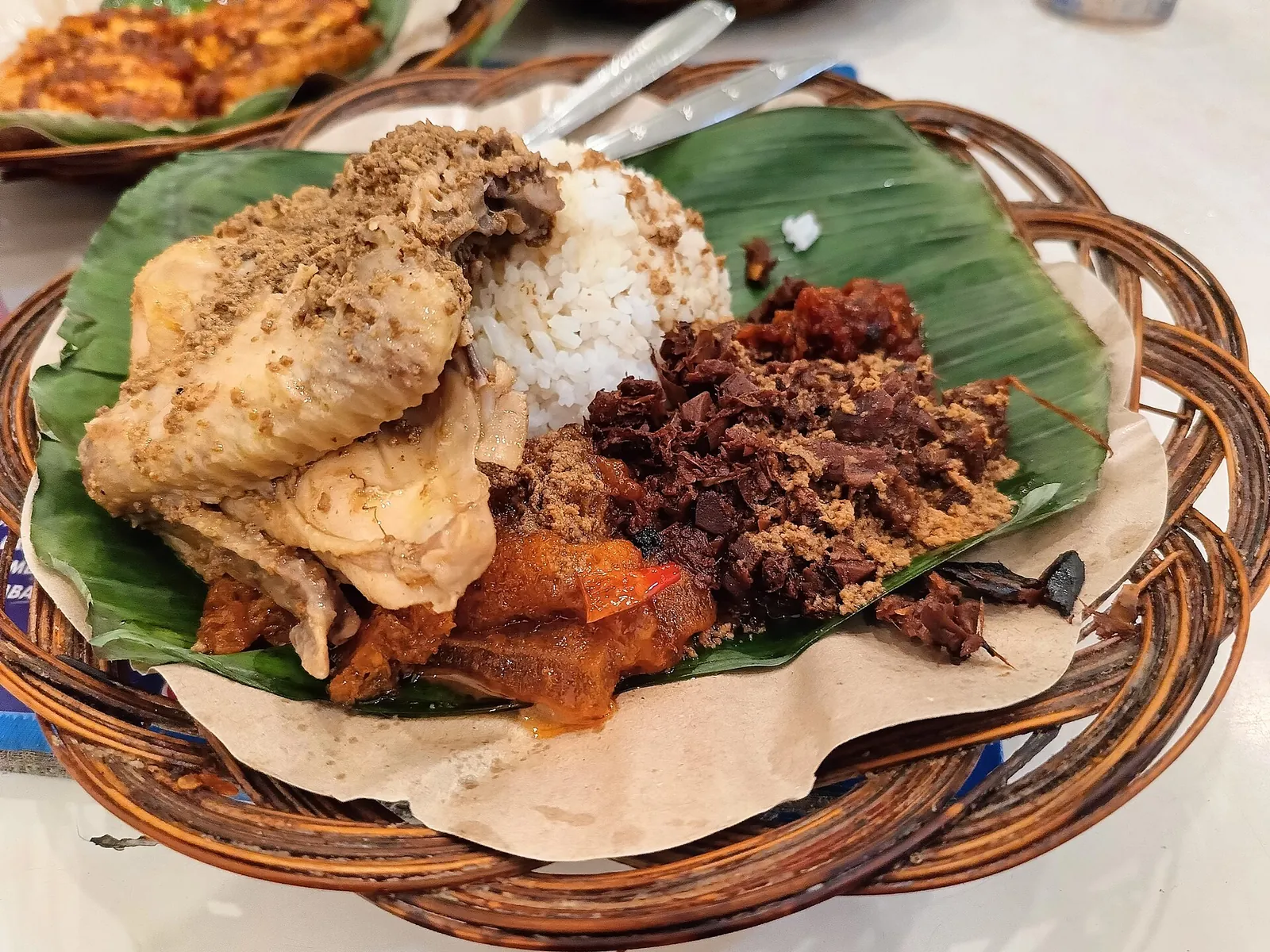
Gudeg
Young jackfruit slow-cooked for hours in coconut milk with shallots, garlic, coriander and galangal, coloured reddish-brown with teak leaves: Yogyakarta's signature dish. It is usually served as nasi gudeg with rice, spicy beef-skin krecek, chicken in coconut broth and a dark spiced egg.
- Where to look
- Traditional eateries across Yogyakarta; look for 'gudeg' on the sign, and for the drier, sweeter gudeg kering sold to take away.
- Fit it into your day
- A filling breakfast or lunch on your temple day; it travels well, so a boxed portion also works as a picnic before Ratu Boko.
Sweet by itself, but the krecek and chilli sauce served with it can be very hot.
Bakmi Jawa (Javanese noodles)
Yellow noodles, often mixed with rice vermicelli, cooked slowly over a charcoal brazier with duck egg and shredded chicken so that the savoury broth soaks into the noodles.
- Where to look
- Evening stalls in Yogyakarta, including around Alun-Alun Utara, the square north of the Kraton.
- Fit it into your day
- A hearty dinner back in the city after a long day at the temples.
Contains egg and chicken; ask before ordering if you avoid either.
Wedang ronde
A warm ginger drink with chewy glutinous-rice balls stuffed with peanuts, served in a bowl.
- Where to look
- Night stalls in central Yogyakarta, often near the squares.
- Fit it into your day
- A late-evening sweet after dinner, especially after a cool night at the open-air stage.
Contains peanuts.
Angkringan and kopi joss
Angkringan are simple roadside stalls where people sit on floor mats late into the evening over small snacks and drinks. The famous drink is kopi joss, black coffee served with a piece of glowing hot charcoal dropped into it.
- Where to look
- Angkringan carts all over Yogyakarta after dark; the ministry names Angkringan Lik Man on Jalan Wongsodirjan as the originator of kopi joss.
- Fit it into your day
- A cheap, late snack-supper in the city rather than a full meal.
Snacks at the stalls are often laid out at room temperature; ask for them to be warmed on the grill.
Sewu, Lumbung and Bubrah: the Buddhist temples inside the park
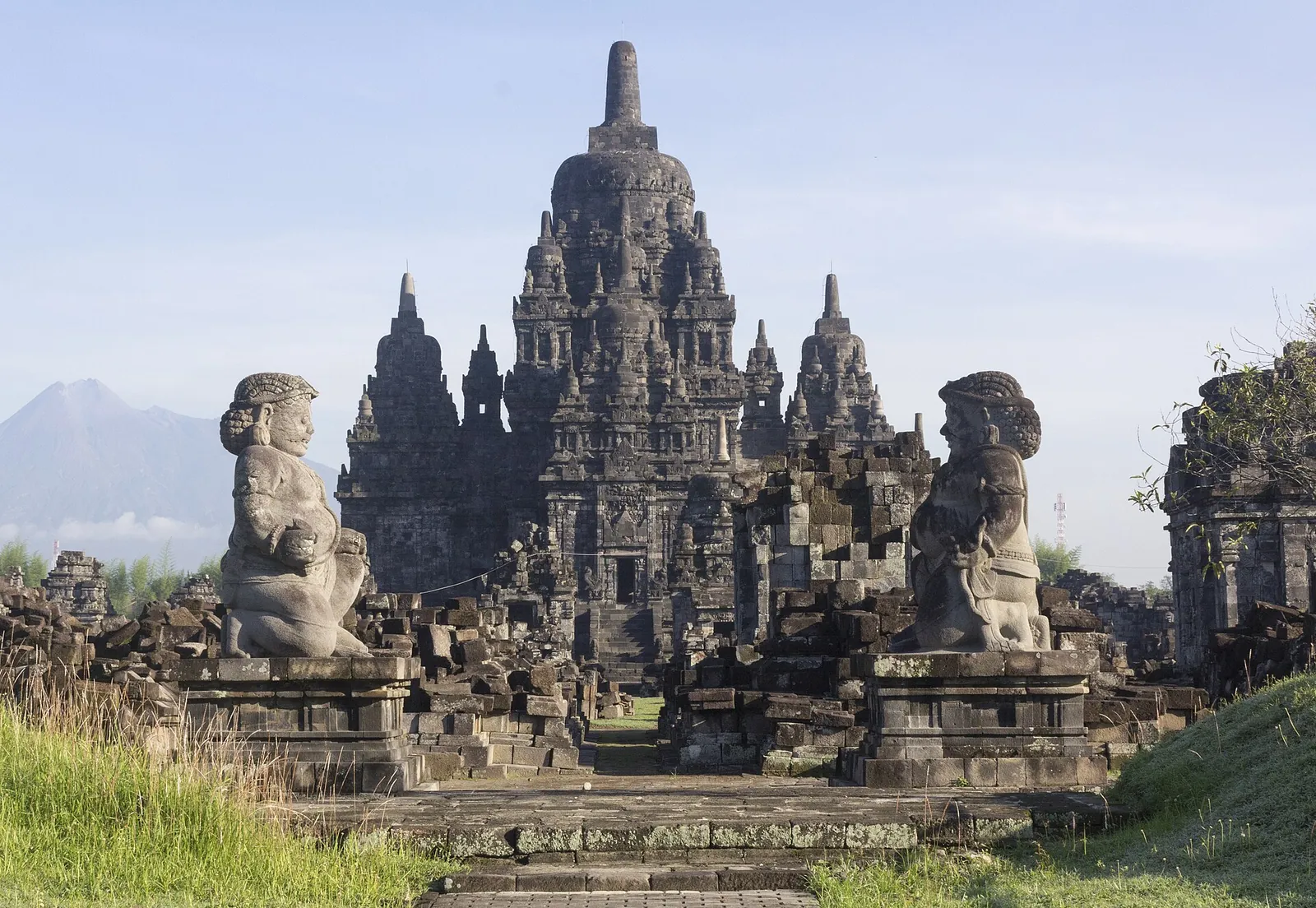
Walk north from the main compound and the park's character changes. Candi Sewu, whose name means "thousand" in Javanese after the many small shrines around the main temple, was built in the 8th century and is the largest Buddhist temple complex in Indonesia; it is guarded by giant dvarapala statues. On the way you pass Lumbung and Bubrah, two smaller Buddhist temples. That Hindu and Buddhist sanctuaries stand within one archaeological park is one of the most striking things about the area.
The distances inside the park are larger than they look on a map, and there is little shade between the sites, so carry water and a hat. If you would rather see these quieter temples with a guide and stay for the evening light, the operator also sells Kala Senja Prambanan for international visitors: when we checked, it was listed at IDR 450,000 on certain dates, from 15:30 to 18:00, with an English-speaking local guide around Lumbung, Bubrah and Sewu, a shuttle to Lumbung, a dance performance and entry to the complex. Groups are 15 to 20 people, latecomers of more than 15 minutes are turned away, and tickets cannot be refunded or rescheduled.
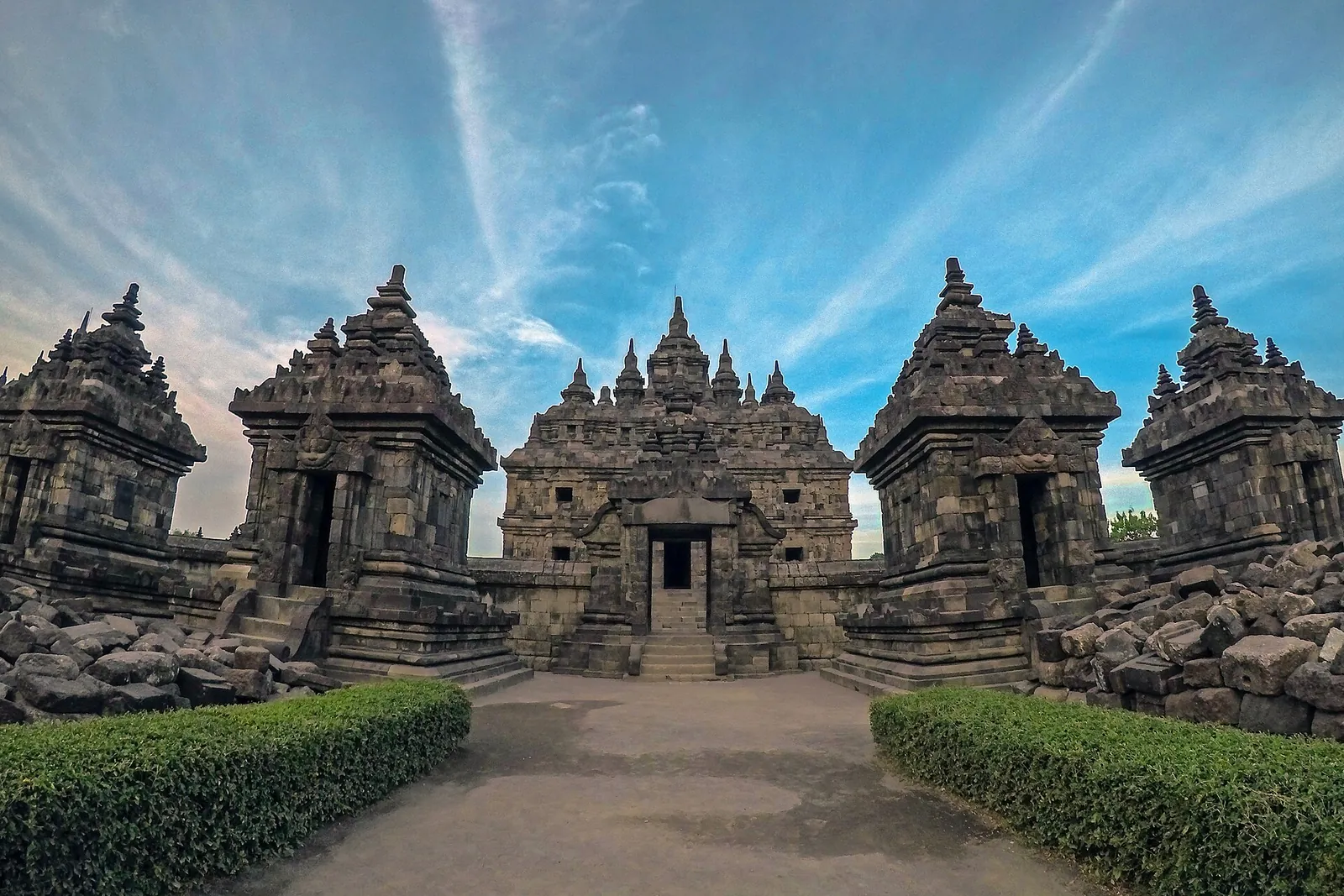
Plaosan and the temples along the Solo road
Candi Plaosan, in Bugisan village on the Central Java side of the border, is the best short add-on if you want a temple without the crowds. It is known as the twin temple for its two near-identical main buildings, and the tourism ministry links it to the 9th-century royal couple Rakai Pikatan and Pramodhawardhani, whose union is said to symbolise the meeting of Hinduism and Buddhism. Its northern half, Plaosan Lor, is the more complete and better restored. When we checked, the ministry's page listed opening from 7:30 to 17:00 every day and gave only the entrance fee for Indonesian visitors, so expect to confirm the price at the gate.
Closer to Yogyakarta, just off the Yogyakarta–Solo road, two more temples are easy to stop at on the drive out or back. Candi Kalasan, about 2 km from the Prambanan compound, is believed to be the oldest Buddhist temple in the region: an inscription found nearby dates its completion to 778 AD. Candi Sari stands a few hundred metres north-east of it. Candi Sambisari, also in Sleman, is a Hindu temple that lay buried underground for centuries and was only uncovered in 1966.
Ratu Boko: the hilltop ruins for the late afternoon
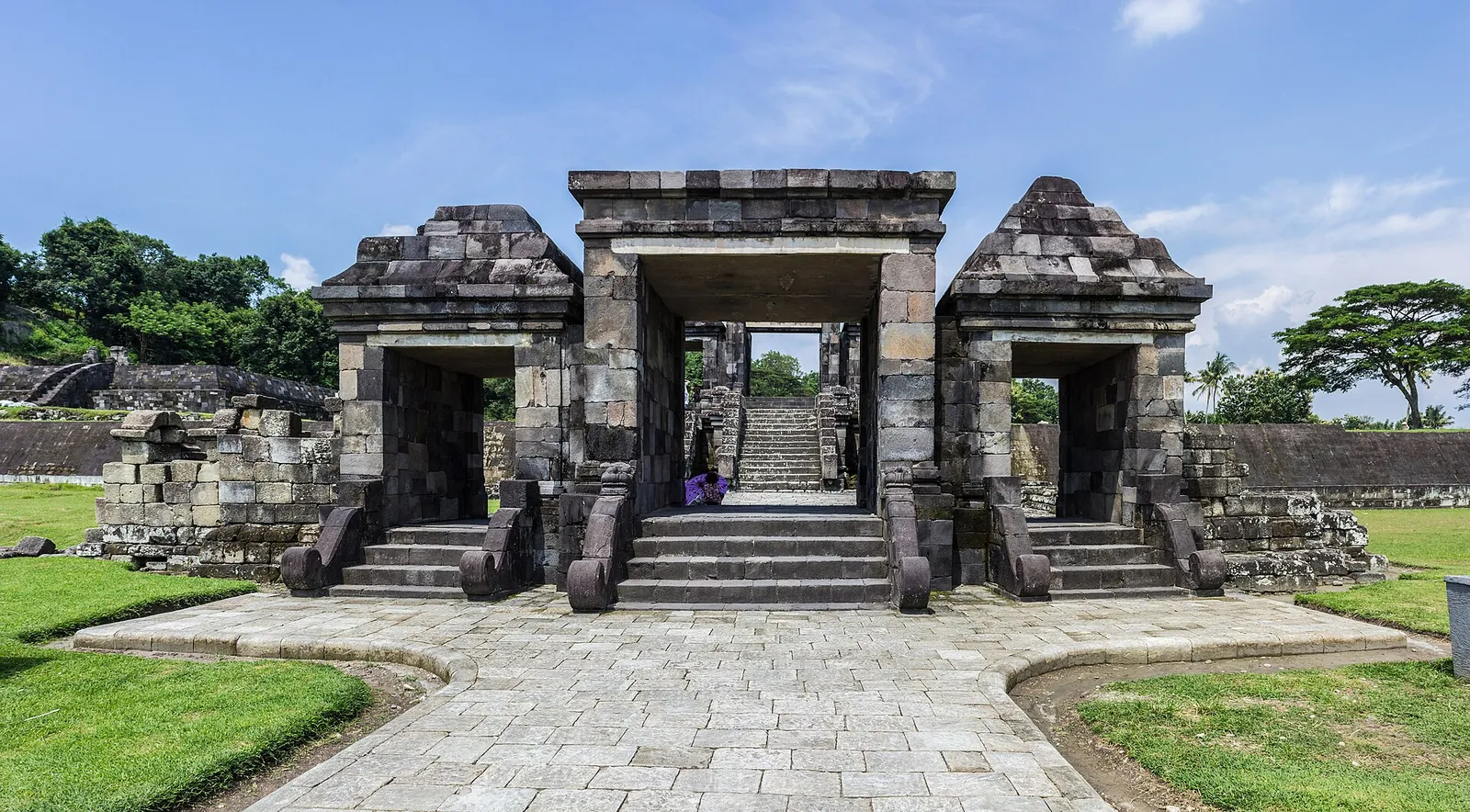
About 3 km south of Prambanan, on a hill around 196 metres above sea level, Ratu Boko is not a temple but the remains of an ancient palace or monastery complex from the 8th century, linked by inscriptions to the Abhayagiri hermitage. Its double stone gateway is the famous image, but it is worth walking on to the pavilion platforms, the bathing pools and the two small caves used for meditation. The site faces west, which is why it is the area's classic sunset viewpoint, with Prambanan's towers in the distance.
Check the hours before you plan around the sunset. When we checked, an official promotion page for foreign visitors listed opening from 07:00 to 17:00, with the ticket counter and entrance gates closing at 17:00 and visitors asked to leave by 17:30; the same page gave IDR 350,000 as the normal price for a foreign adult. The operator's own sunset programmes in the area run until about 18:00, so a regular ticket may not cover the last light; it sells a separate Ratu Boko Sunset package that lets you stay longer. Guides can be booked at the site. The operator has also sold combined Prambanan and Ratu Boko tickets with a shuttle between the two at the Prambanan ticket counter, so ask there before buying two separate tickets.
Ratu Boko means stairs and uneven paths. Wear shoes with grip and carry water, especially in the dry season.
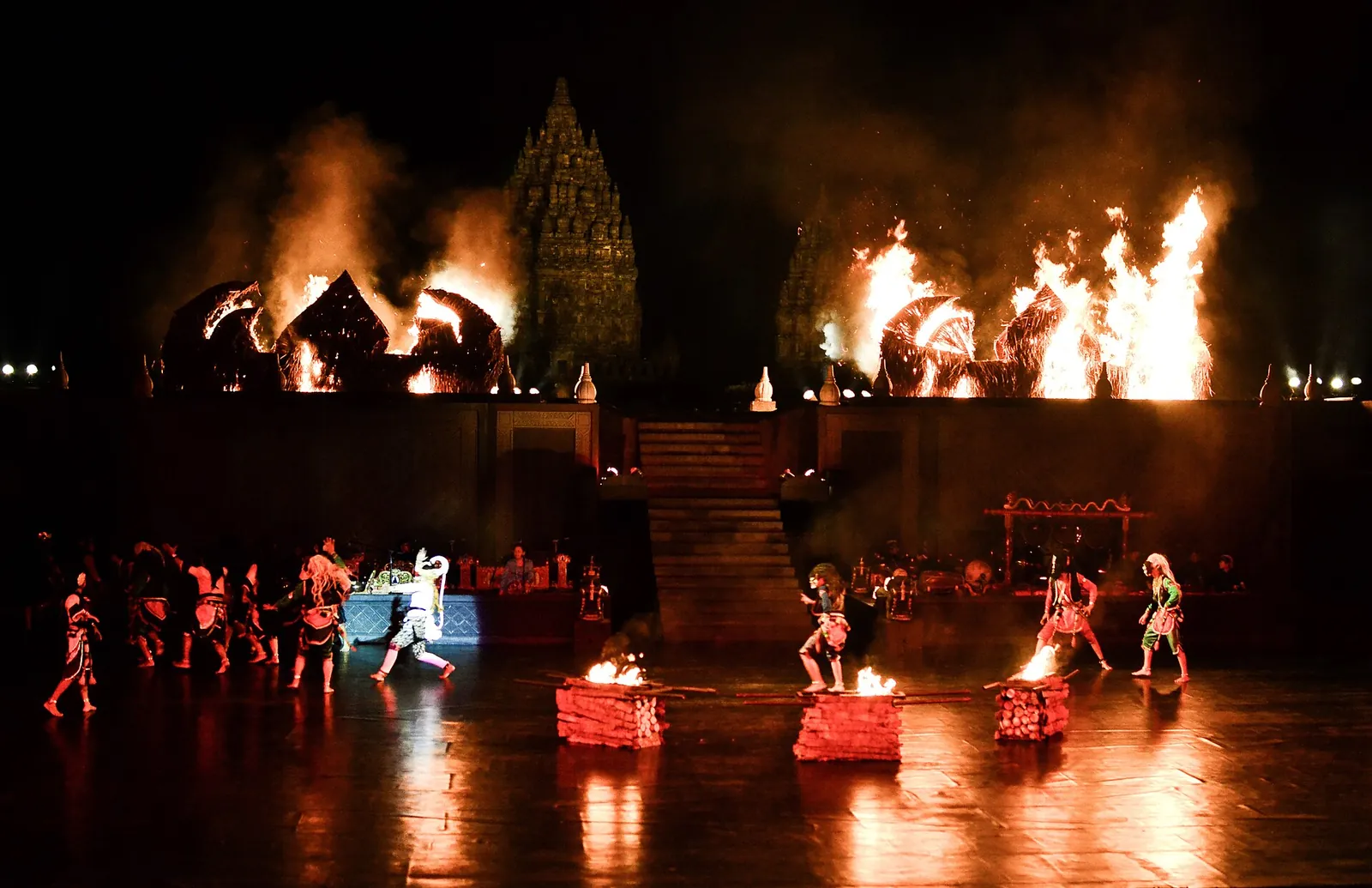
The Ramayana ballet: which stage, which night
The Ramayana ballet has been performed near Prambanan since 1961: a dance drama without spoken dialogue, with gamelan music and a large company of dancers and musicians, telling of Rama's rescue of Sita from Rahwana. The venue is on the Kalasan side of the temple in Sleman, a short drive from the main gate, so it fits easily after a day at Prambanan or Ratu Boko.
When we checked on 3 October 2026, the official ticket page listed the schedule below. It is marked as subject to change, and it did not yet show the Ramayana programme for November 2026 onwards, so check it again for later dates.
- May to October 2026: Ramayana on the open-air stage, with Prambanan as the backdrop, on Tuesdays, Thursdays and Saturdays from 19:30 to 21:00, with gamelan.
- November 2025 to April 2026: Ramayana in the indoor Trimurti theatre on Tuesdays, Thursdays and Saturdays, 19:30 to 21:00; from January to April 2026 there was also a shorter Saturday show at 17:30 in the outdoor amphitheatre, with recorded music.
- Every Friday in 2026: the Roro Jonggrang dance drama in the Trimurti theatre, 19:30 to 20:30.
- Rain: if it rains before an outdoor show begins, it moves indoors to the Trimurti theatre; if rain stops a show after it has run 45 minutes or more, it counts as completed and is not refunded.
- Seats: at the open-air stage, VIP and Special seats are numbered, while Class I and Class II are not. The operator recommends arriving 30 to 45 minutes early.
Getting there and a workable day
By public transport, the tourism ministry's Prambanan page names Trans Jogja routes 1A and 1B from stops around Malioboro, Tugu station and Giwangan terminal to the Prambanan stop in front of the temple complex, taking about 45 minutes to an hour; when we checked, it gave the fare as around IDR 3,500. A ride-hailing car from the centre takes about 30 to 40 minutes, depending on traffic. From Solo, take a local train towards Yogyakarta and get off at Brambanan station (spelled with a B), then take a motorbike taxi or walk 2 to 3 km.
Plaosan and Ratu Boko are a separate ride from the bus stop, and the ballet ends at 21:00, so for a full day it is simpler to hire a car and driver or use ride-hailing between sites. This is an editorial suggestion, not a timetable; check each site's hours on the day.
- Morning: Prambanan's main compound at opening time, then the walk north past Lumbung and Bubrah to Sewu.
- Midday: lunch and a rest out of the sun; the hottest hours are the worst for exposed temple courtyards.
- Early afternoon: Plaosan, or Kalasan and Sari on the main road.
- Late afternoon: Ratu Boko for the gates and the view, timing your arrival around the site's closing time.
- Evening (Tuesday, Thursday or Saturday; Friday for Roro Jonggrang): the ballet, then dinner back in Yogyakarta.
Practical questions
Can I visit Prambanan and Borobudur on the same day?
It is possible on a tour, but the two lie on opposite sides of Yogyakarta, so much of the day goes on driving. Give each its own day if you can, and use the Prambanan day for Sewu, Plaosan, Ratu Boko and the ballet as well.
How long do I need at Prambanan?
Allow two to three hours for the main compound and the walk to Sewu, and a full day if you add Plaosan, Ratu Boko and an evening at the Ramayana ballet.
Does the Prambanan ticket include Sewu temple?
When we checked on 3 October 2026, the official ticket site said the Prambanan Temple ticket includes the Lumbung, Bubrah and Sewu temples and the Prambanan Museum. Ratu Boko and Plaosan are separate sites with their own entry.
Which nights is the Ramayana ballet performed?
When we checked, the official schedule listed the Ramayana on Tuesdays, Thursdays and Saturdays from 19:30, on the open-air stage from May to October 2026 and indoors in the wet months, plus the Roro Jonggrang dance drama on Fridays. The schedule can change, so check the ticket page for your date.
Can I see the sunset at Ratu Boko on a normal ticket?
Not always. When we checked, an official page gave the regular closing as 17:00, with visitors leaving by 17:30, which can be before the last light. The operator sells a separate Ratu Boko Sunset package for a longer stay.
How do I get to Prambanan by bus?
The tourism ministry lists Trans Jogja routes 1A and 1B from stops around Malioboro, Tugu station and Giwangan terminal to the Prambanan stop in front of the complex, about 45 minutes to an hour.
Sources and checks before you travel
Reference sources for the version dated 3 October 2026. Confirm opening times, access, transport and conditions for your travel dates.
- Indonesia.travel: Prambanan Temple Compounds ↗ — opens in a new tab
- Indonesia.travel: Prambanan Temple, history and the legend of Roro Jonggrang ↗ — opens in a new tab
- InJourney Destination Management (site operator): Prambanan history ↗ — opens in a new tab
- Official ticket site: Prambanan Temple ↗ — opens in a new tab
- InJourney Destination Management: Kala Senja Prambanan for international tourists ↗ — opens in a new tab
- Indonesia.travel: Prambanan, graceful beauty of Indonesia's temple ↗ — opens in a new tab
- Indonesia.travel: Sewu Temple ↗ — opens in a new tab
- Indonesia.travel: Plaosan Temple ↗ — opens in a new tab
- Indonesia.travel: Kalasan Temple ↗ — opens in a new tab
- Indonesia.travel: Sambisari Temple ↗ — opens in a new tab
- InJourney Destination Management: Ratu Boko history ↗ — opens in a new tab
- Indonesia.travel: Ratu Boko Palace ↗ — opens in a new tab
- InJourney Destination Management: Ratu Boko entrance promotion for foreign adults ↗ — opens in a new tab
- InJourney Destination Management: Ratu Boko Sunset package ↗ — opens in a new tab
- Official ticket site: Ratu Boko Palace ↗ — opens in a new tab
- InJourney Destination Management: Prambanan and Ratu Boko combined package (September 2026) ↗ — opens in a new tab
- Official ticket site: Ramayana Ballet Prambanan ↗ — opens in a new tab
- InJourney Destination Management: Prambanan Ramayana Ballet ↗ — opens in a new tab
- InJourney Destination Management: Sewu Temple Park venue ↗ — opens in a new tab
- Indonesia.travel: Refreshing retreats near Prambanan ↗ — opens in a new tab
- Indonesia.travel: Weather, climate and seasons ↗ — opens in a new tab
- Indonesia.travel: Gudeg ↗ — opens in a new tab
- Indonesia.travel: legendary street-food stalls in Yogyakarta ↗ — opens in a new tab
Does this experience fit your route?
If you would rather not arrange drivers and tickets yourself, a guided Prambanan day from Yogyakarta can link the temples, Ratu Boko and the ballet. Check exactly which sites and tickets are included before you book.
Browse relevant experiences on Viator ↗ — opens in a new tabAffiliate link · Book with ViatorPhoto credits
Prambanan's central shrines seen across the ruined ancillary temples of the middle courtyard
Photograph: Jakub Hałun — opens in a new tab · CC BY-SA 4.0 — opens in a new tab
Changes: Resized and converted to WebP; displayed with responsive crops. · Original photograph and licence details ↗ — opens in a new tab
Candi Sewu from the south, with its dvarapala guardian statues in front of the main temple
Photograph: Crisco 1492 — opens in a new tab · CC BY-SA 3.0 — opens in a new tab
Changes: Resized and converted to WebP; displayed with responsive crops. · Original photograph and licence details ↗ — opens in a new tab
The main gate of Ratu Boko on its hilltop south of Prambanan
Photograph: Crisco 1492 — opens in a new tab · CC BY-SA 3.0 — opens in a new tab
Changes: Resized and converted to WebP; displayed with responsive crops. · Original photograph and licence details ↗ — opens in a new tab
Plaosan Lor, the restored northern compound of Plaosan temple
Photograph: Yasuspade — opens in a new tab · CC BY-SA 4.0 — opens in a new tab
Changes: Resized and converted to WebP; displayed with responsive crops. · Original photograph and licence details ↗ — opens in a new tab
The Ramayana ballet on the open-air stage, with Prambanan lit up behind
Photograph: Kandoi.sid — opens in a new tab · CC BY-SA 3.0 — opens in a new tab
Changes: Resized and converted to WebP; displayed with responsive crops. · Original photograph and licence details ↗ — opens in a new tab
Gudeg ayam: young jackfruit stewed in coconut milk, served with chicken and rice
Photograph: Indonesiagood — opens in a new tab · CC BY 4.0 — opens in a new tab
Changes: Resized and converted to WebP; displayed with responsive crops. · Original photograph and licence details ↗ — opens in a new tab