Java · Central Java
Karimunjawa guide: Java's marine park islands, snorkelling and ferries
Karimunjawa is the island escape Java keeps mostly to itself. The archipelago of 27 islands lies about 90 kilometres north of Jepara in the Java Sea and belongs to Jepara Regency in Central Java. Most of it is a marine national park of coral reefs, seagrass beds and mangroves, and only a handful of the islands are inhabited. There are no clubs, little alcohol and not much English, but there are white-sand islets, clear shallow reefs and a slow village pace. The catch is the sea crossing. Ferries do not run every day, and they stop when the waves are high, so the boat timetable, not the sights, decides how your trip works.
- Suggested time
- 3–4 nights, plus a buffer day for the boat
- Where to stay
- Karimunjawa town on the main island; a night in Jepara before an early ferry
- Season and timing
- The Ministry of Tourism recommends April to October for calmer seas. From roughly December to March the rainy season brings high waves that can cancel ferries for a day or more, so avoid tight onward plans then.
The short answer
Plan three to four nights, built around the boat days rather than a fixed number of sights. Sleep in or near Karimunjawa town at the southern end of the main island, where the ferries dock and the warungs, ATMs and tour boats are; choose Kemujan in the north only if you want an isolated resort near the airstrip. Spend one full day on a shared snorkelling boat to Menjangan Kecil and the Cemara islets, one day on a hired scooter for the beaches, the mangrove boardwalk and a sunset at Tanjung Gelam, and keep a spare day in case the return boat is cancelled. Reach the islands by ferry or fast boat from Kartini harbour in Jepara (Semarang is the nearest major airport), and travel between April and October, when the sea is calmer.
How Karimunjawa works: islands, town and the national park
Indonesia's Ministry of Tourism describes Karimunjawa as 27 islands with about 1,500 hectares of land and some 110,000 hectares of sea. The archipelago became a strict nature reserve in 1986, and in 1999 the Ministry of Forestry made it Karimunjawa Marine National Park, covering 111,625 hectares. Since 2020 the islands have formed the core of UNESCO's Karimunjawa-Jepara-Muria Biosphere Reserve, which notes nesting sites for hawksbill and green turtles and legal protection for giant clams (kima).
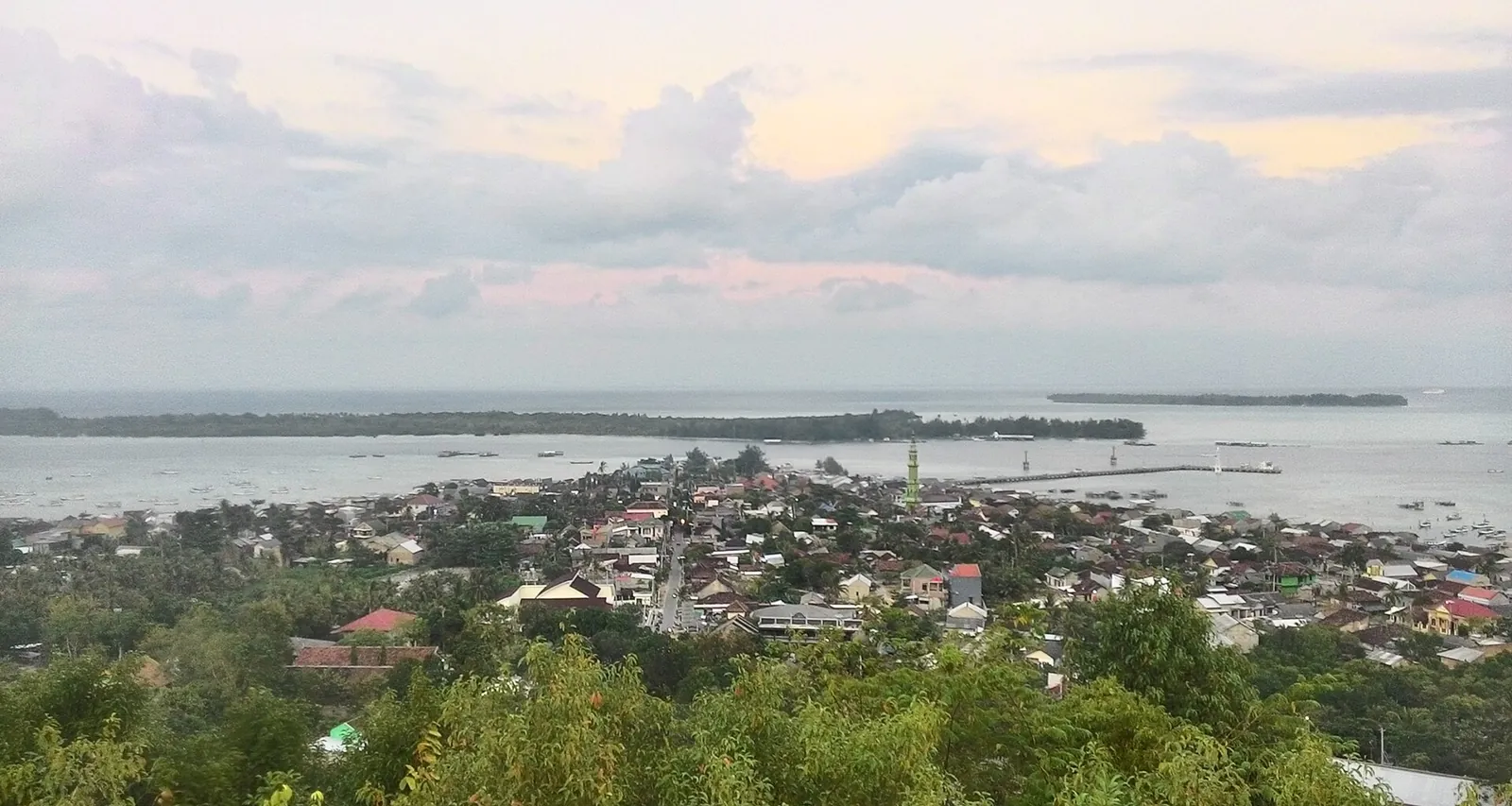
Only five islands are inhabited, according to the ministry: Karimunjawa, the largest and the centre of services, Kemujan, which has the airstrip, and Nyamuk, Parang and Genting. Wikivoyage explains that the main settlement, Karimunjawa town, sits at the southern end of the main island; the ferries dock there and most services are there, while hotels are scattered around the island. Kemujan is separated from the main island only by a narrow channel, and its airstrip lies about 22 kilometres from town, Wikipedia notes.
The islands are Javanese-speaking, and Wikivoyage warns that little English is spoken, so a few words of Indonesian help. It also notes that the main island has had 24-hour electricity in most places since 2016, while some outer islands may have power for only part of the day. Pay the national park ticket when you get off the boat and keep it: when we checked on 2026-10-03, the Ministry of Tourism's Karimunjawa page listed the entrance fee as around IDR 150,000 for international visitors and IDR 5,000 for domestic visitors.
- Karimunjawa town: ferry pier, alun-alun (town square) food stalls, homestays, ATMs and the snorkelling boats.
- Elsewhere on the main island: beach resorts and hill hotels, reached by scooter or car.
- Kemujan: the airstrip, mangroves and a few isolated resorts in the north.
Snorkelling day by boat: Menjangan Kecil and the Cemara islets
The reason to come is the water. The ministry lists Gosong Island, Menjangan Kecil, Tengah, Tanjung Gelam and Cemara Kecil among the favourite snorkelling spots, and counts 176 coral species and 444 fish species in the park. Hawksbill and green turtles occur here, and two protected corals, black coral and organ-pipe coral, grow on the reefs.
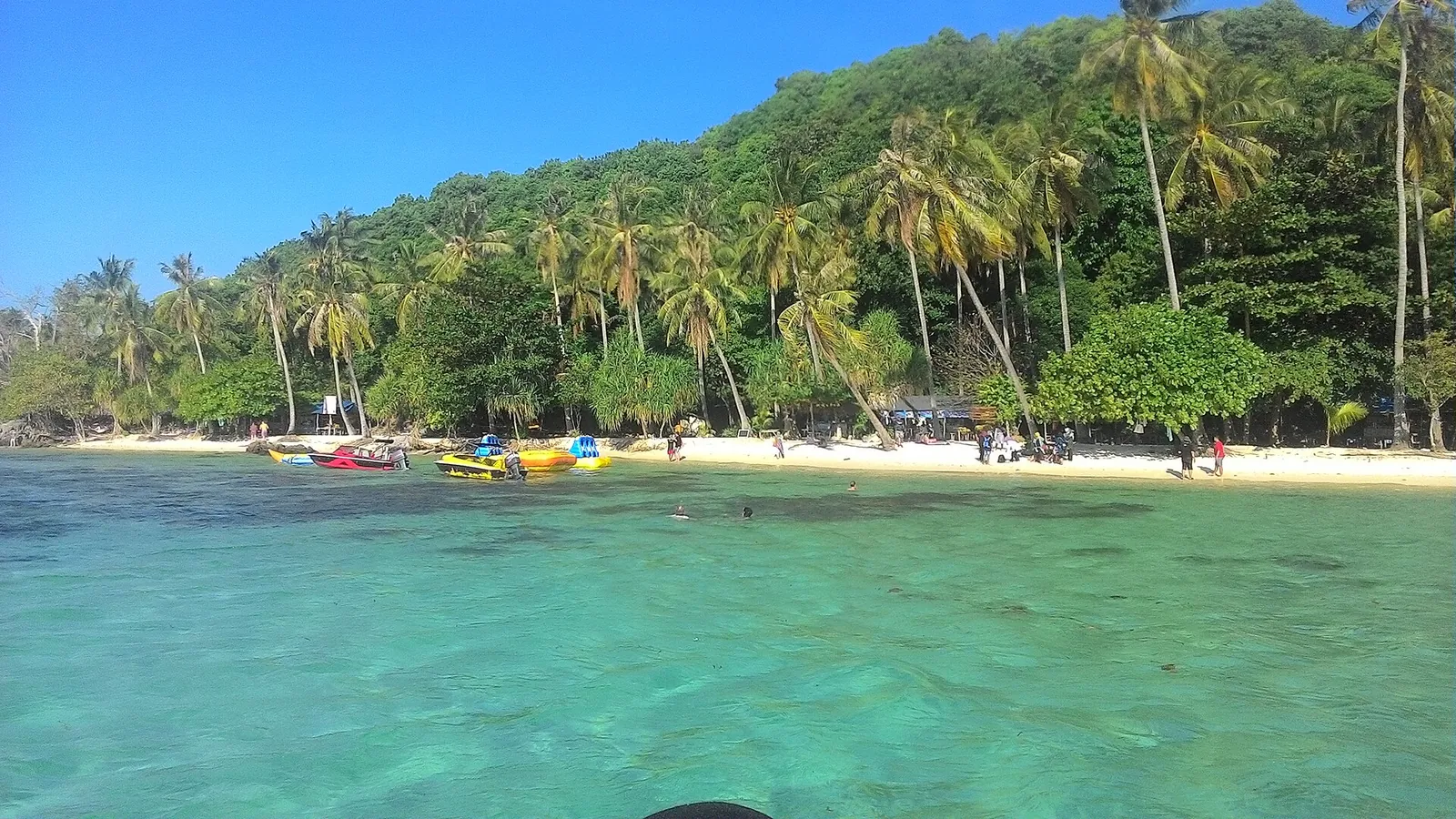
Most visitors join a shared day boat from the small tourist pier near the alun-alun. Wikivoyage describes a typical day as one snorkel stop near Menjangan Kecil, lunch and swimming on Cemara Besar, a second snorkel near Cemara Kecil and a final island stop, running roughly from morning to late afternoon in groups of up to about a dozen, with masks and lunch included. Your hotel or homestay can usually book a place for you; ask what is included and whether life jackets are on board. Wikivoyage recommends them for beginners.
On Menjangan Besar, close to town, there is a shark pen (penangkaran hiu) where visitors can get into the water with reef sharks; the ministry describes it as supervised by a guard. It is a captive enclosure, so decide for yourself whether it fits your trip; the open reefs are the alternative. For scuba diving, Wikivoyage mentions sites such as Taka Panyawangan and Gosong Cemara, and the wreck of a coal ship that sank off Kemujan in 1960. Whatever you do in the water, do not stand on or touch coral; the ministry asks visitors to respect the reef and not to litter.
Make time for the local food
What to eat and where to look
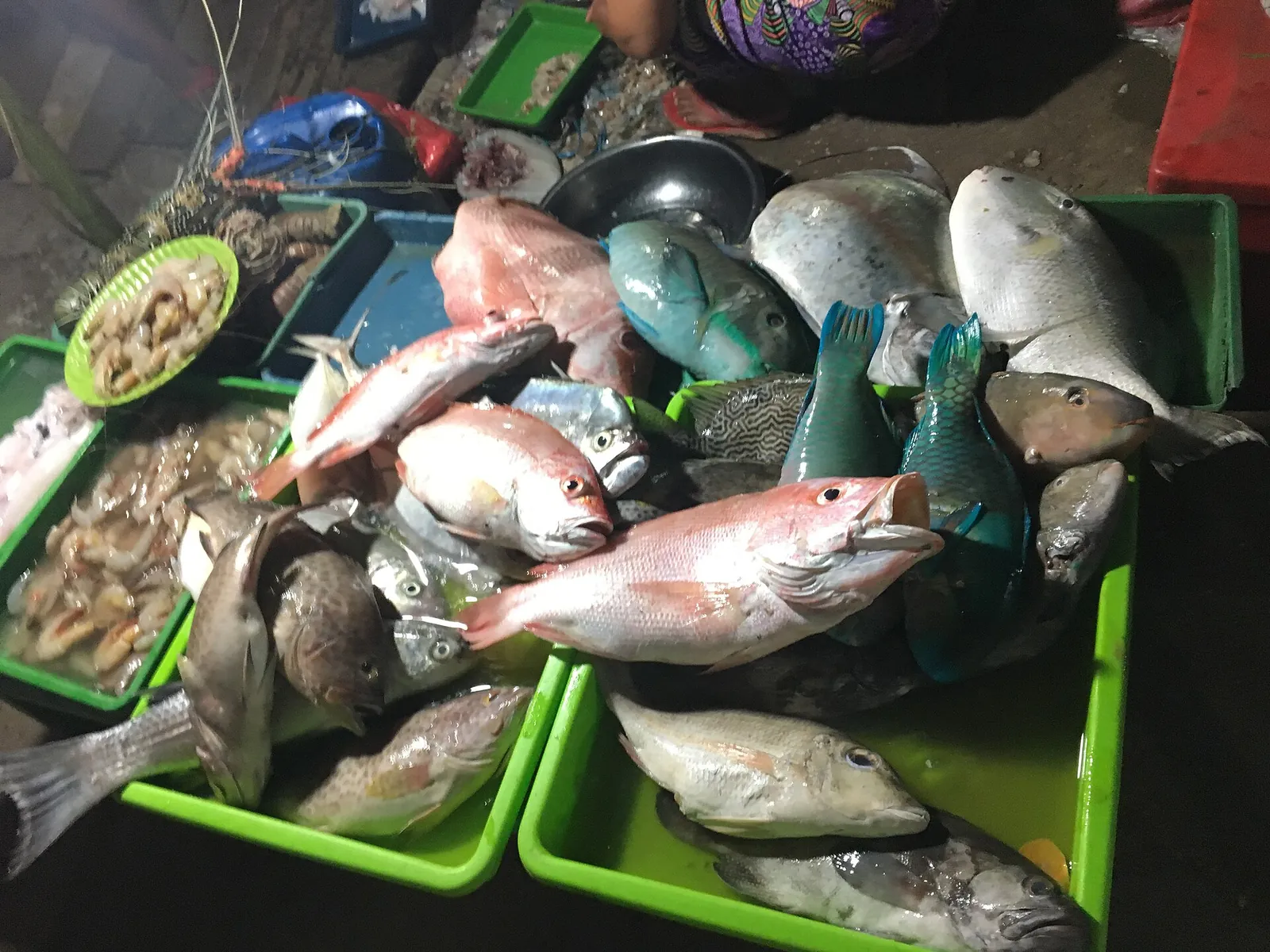
Grilled fish at the alun-alun
Wikivoyage describes the town square as lined with seafood stalls in the evening, displaying fresh fish, squid and prawns and grilling them to order.
- Where to look
- The alun-alun in Karimunjawa town, near the harbour, after dark.
- Fit it into your day
- Dinner after the snorkelling boat returns.
Agree the price by weight before the fish goes on the grill.
Tongseng cumi
Squid cooked as tongseng, the sweet and spiced Javanese stew, which Wikivoyage names as a local dish at the alun-alun stalls.
- Where to look
- Seafood stalls on the alun-alun.
- Fit it into your day
- Share it alongside grilled fish at dinner.
Contains shellfish; ask for less chilli if you prefer.
Lontong krubyuk
Rice cake with chicken, cabbage, tofu and bean sprouts in a brown broth, a breakfast dish Wikivoyage lists for Karimunjawa.
- Where to look
- Morning warungs on the streets around the town centre.
- Fit it into your day
- Early breakfast before the boat leaves.
Usually sold only in the morning and gone once the pot is empty.
Bakso ikan ekor kuning
Fish balls made from yellowtail fusilier, served in a clear soup, another local speciality Wikivoyage mentions.
- Where to look
- Small bakso shops and carts in Karimunjawa town.
- Fit it into your day
- A light lunch on a scooter day.
Fish-based; check the broth if you avoid meat stock.
Getting there: Jepara, Semarang and the weather
The main gateway is Kartini harbour in Jepara, on the north coast of Central Java. The ministry lists two services from there: the slow ferry KMP Siginjai and the faster Express Bahari boat. When we checked on 2026-10-03, the ministry's Karimunjawa page listed Siginjai adult fares at IDR 130,000 in economy and IDR 150,000 in VIP. Wikivoyage, updated in April 2024, puts the Siginjai crossing at about five hours and the fast boat at about two, and advises being at the port at least an hour before departure, as the ferry has sometimes left early.
Neither boat runs every day, and the days change, so check the current timetable with the operator or your hotel before you fix your dates; our advice is to plan the whole trip around the boat days. Siginjai tickets can be booked online, though Wikivoyage reports that the booking needs an Indonesian bank account, so many visitors ask their homestay to help. Wikivoyage notes that the fast boat may need booking ahead in high season, and the ministry recommends booking transport and rooms well ahead in holiday periods.
From Semarang, the ministry lists PELNI ships from Tanjung Emas port, which, Wikivoyage notes, use the pier in the north of the island rather than the town pier. Wikivoyage also lists a fast boat from Kendal, just west of Semarang. To reach Jepara by road, it estimates about two hours from Semarang by shuttle van (travel), and the Daytrans shuttle stops at Jepara's Kartini ferry terminal. If your boat leaves early in the morning, sleep in Jepara the night before.
All boats sail only when the waves are low to moderate. Wikivoyage records that at the end of 2014 about 500 visitors were stranded by 3.5-metre waves and the island's ATMs ran dry, and it advises carrying cash for at least five days. Pack seasickness tablets if you need them, as the ministry suggests, and do not book a non-refundable flight home for the day you return from the island.
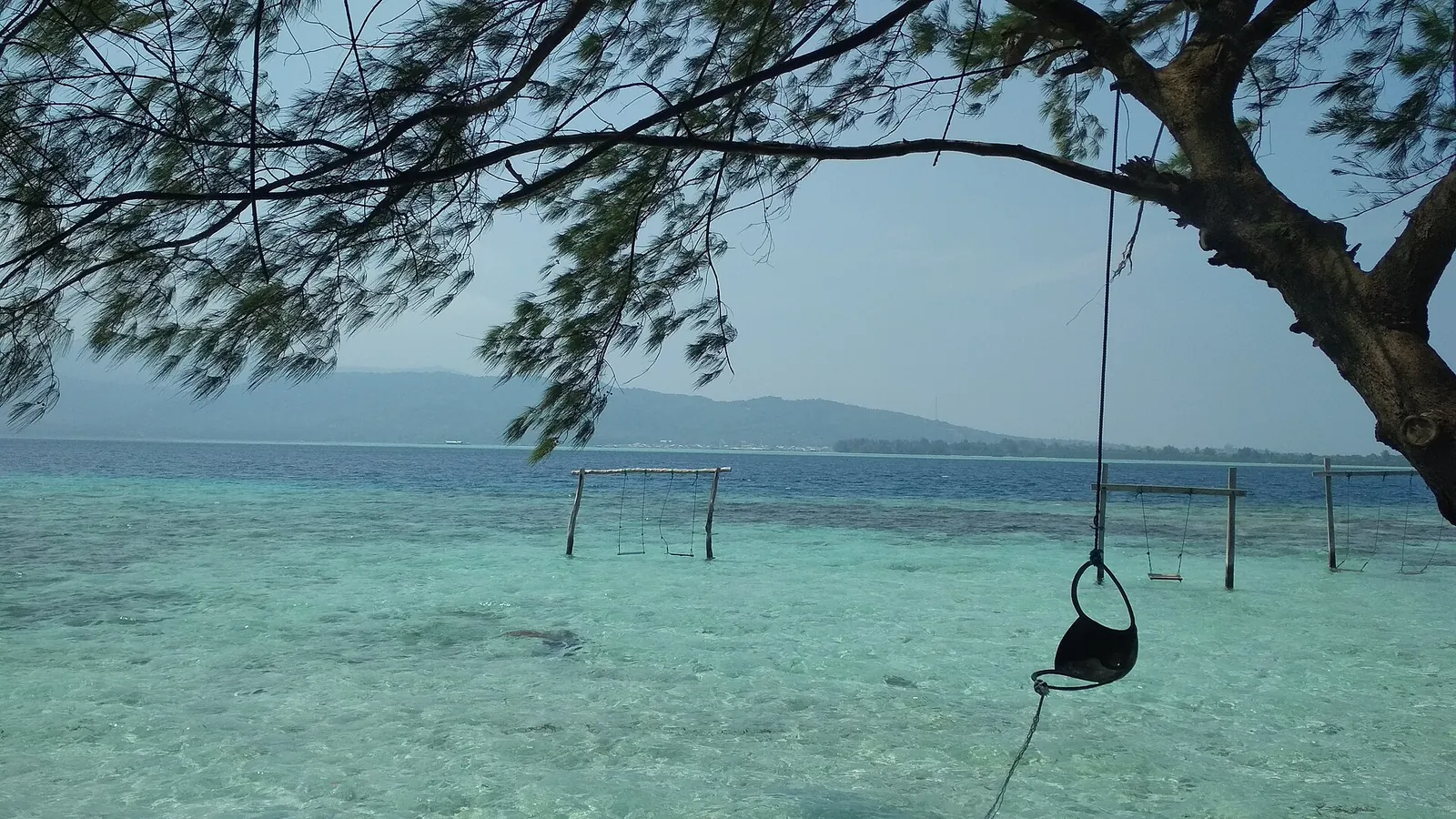
A scooter day: beaches, mangroves and the viewpoints
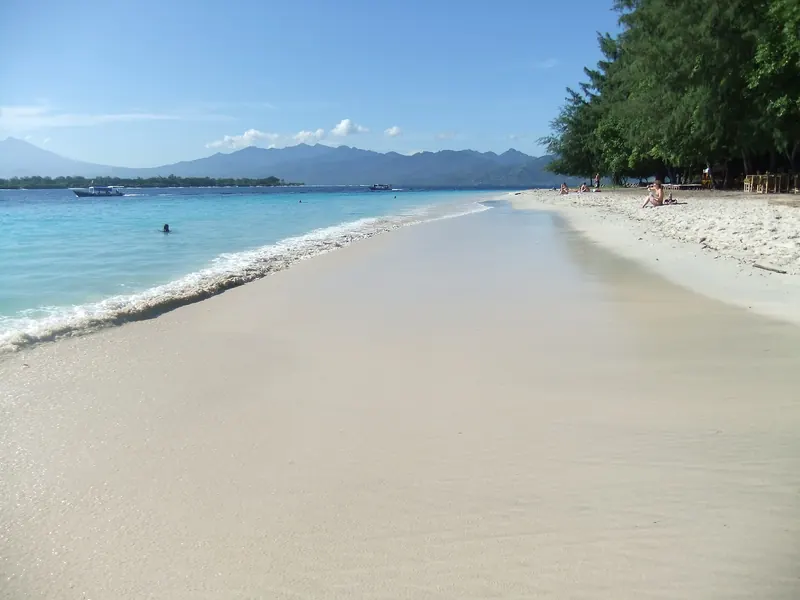
Rent a scooter or a car with a driver for a day on land; Wikivoyage notes that there are few cars on the islands, so book one in advance if you need it. The ministry singles out the beach at Tanjung Gelam (also called Ujung Gelam) for its sunset, so time your ride to end there. Wikivoyage maps other beaches such as Batu Topeng, Bobby Beach and Batu Putih near the airstrip.
The ministry describes a mangrove trail, a winding raised boardwalk through some of the 45 mangrove species found here, with a watchtower midway. The ministry mentions monkeys and a variety of birds along the way, and advises bringing water, as the sun is fierce. Inland forest outside such trails is protected: Wikivoyage notes that entry to the natural forest requires a national park guide.
For views, the ministry points to Bukit Love (Love Hill) above town, though Wikivoyage reports that access may have changed, so ask locally, and to Bukit Joko Tuo, where a whale skeleton is displayed as a monument. Wikipedia notes that the tomb of Sunan Nyamplungan, a son of one of the nine Islamic saints of Java who is said to have settled the island, is an important pilgrimage site; dress modestly if you visit.
When to go and practical tips
The Ministry of Tourism recommends April to October, when the sea is calmer. Wikivoyage describes this dry season as very hot and the rainy months, around December to March, as wet and humid, with high waves that can stop boats for a day or two between December and February. Wikipedia also notes that crossings are sometimes limited from January to March. Book boats and rooms early for Indonesian holiday periods, as the ministry advises.
Bring enough cash for the whole stay and a few extra days, since the ATMs have run out when boats were cancelled. Alcohol is hard to find, Wikivoyage reports, and is served at only a few tourist restaurants and resorts. Take sun protection for long days on open boats, and pack out your rubbish from the uninhabited islands.
Practical questions
How many days do I need in Karimunjawa?
Three to four nights, plus a spare day. Ferries do not run every day and can be cancelled in high waves, so build the trip around the boat days.
How do I get to Karimunjawa?
By KMP Siginjai ferry (about five hours) or the faster Express Bahari boat (about two hours) from Kartini harbour in Jepara, or by PELNI ship from Semarang. Semarang's Ahmad Yani airport is the nearest major airport.
When is the best time to visit Karimunjawa?
April to October, according to the Ministry of Tourism, when the sea is calmer. From about December to March, high waves can stop the boats.
Is there an entrance fee?
Yes. Pay the national park fee at the pier when you arrive. When we checked on 2026-10-03, the Ministry of Tourism listed around IDR 150,000 for international visitors.
Can I fly to Karimunjawa?
Dewadaru airstrip on Kemujan has had small-aircraft services on and off; Wikivoyage reported they stopped during COVID, and the Ministry of Tourism lists flights from Semarang. Check whether a flight is currently operating before relying on it.
Do I need cash?
Yes. Bring enough for your whole stay plus a few extra days; the island's ATMs have run out when boats were cancelled.
Sources and checks before you travel
Reference sources for the version dated 3 October 2026. Confirm opening times, access, transport and conditions for your travel dates.
- Indonesia Travel (Ministry of Tourism): Karimunjawa ↗ — opens in a new tab
- Indonesia Travel (Ministry of Tourism): Karimun Jawa Marine National Park ↗ — opens in a new tab
- UNESCO: Karimunjawa-Jepara-Muria Biosphere Reserve ↗ — opens in a new tab
- Wikivoyage: Karimunjawa ↗ — opens in a new tab
- Wikivoyage: Jepara ↗ — opens in a new tab
- Wikipedia: Karimunjawa ↗ — opens in a new tab
- Wikipedia: Dewadaru Airport ↗ — opens in a new tab
- Wikipedia: Jenderal Ahmad Yani International Airport ↗ — opens in a new tab
Photo credits
Ujung Gelam beach on the main island of Karimunjawa in the afternoon
Photograph: RXerself — opens in a new tab · CC BY-SA 4.0 — opens in a new tab
Changes: Resized and converted to WebP; displayed with responsive crops. · Original photograph and licence details ↗ — opens in a new tab
Tanjung Gelam beach, the main island's best-known sunset spot
Photograph: Chafidwahyu — opens in a new tab · CC BY-SA 4.0 — opens in a new tab
Changes: Resized and converted to WebP; displayed with responsive crops. · Original photograph and licence details ↗ — opens in a new tab
The shore of Menjangan Kecil, a regular stop on snorkelling day boats
Photograph: Sam Hidayat — opens in a new tab · CC BY-SA 4.0 — opens in a new tab
Changes: Resized and converted to WebP; displayed with responsive crops. · Original photograph and licence details ↗ — opens in a new tab
Karimunjawa town, where the ferries dock, seen from the hill above it
Photograph: RXerself — opens in a new tab · CC BY-SA 4.0 — opens in a new tab
Changes: Resized and converted to WebP; displayed with responsive crops. · Original photograph and licence details ↗ — opens in a new tab
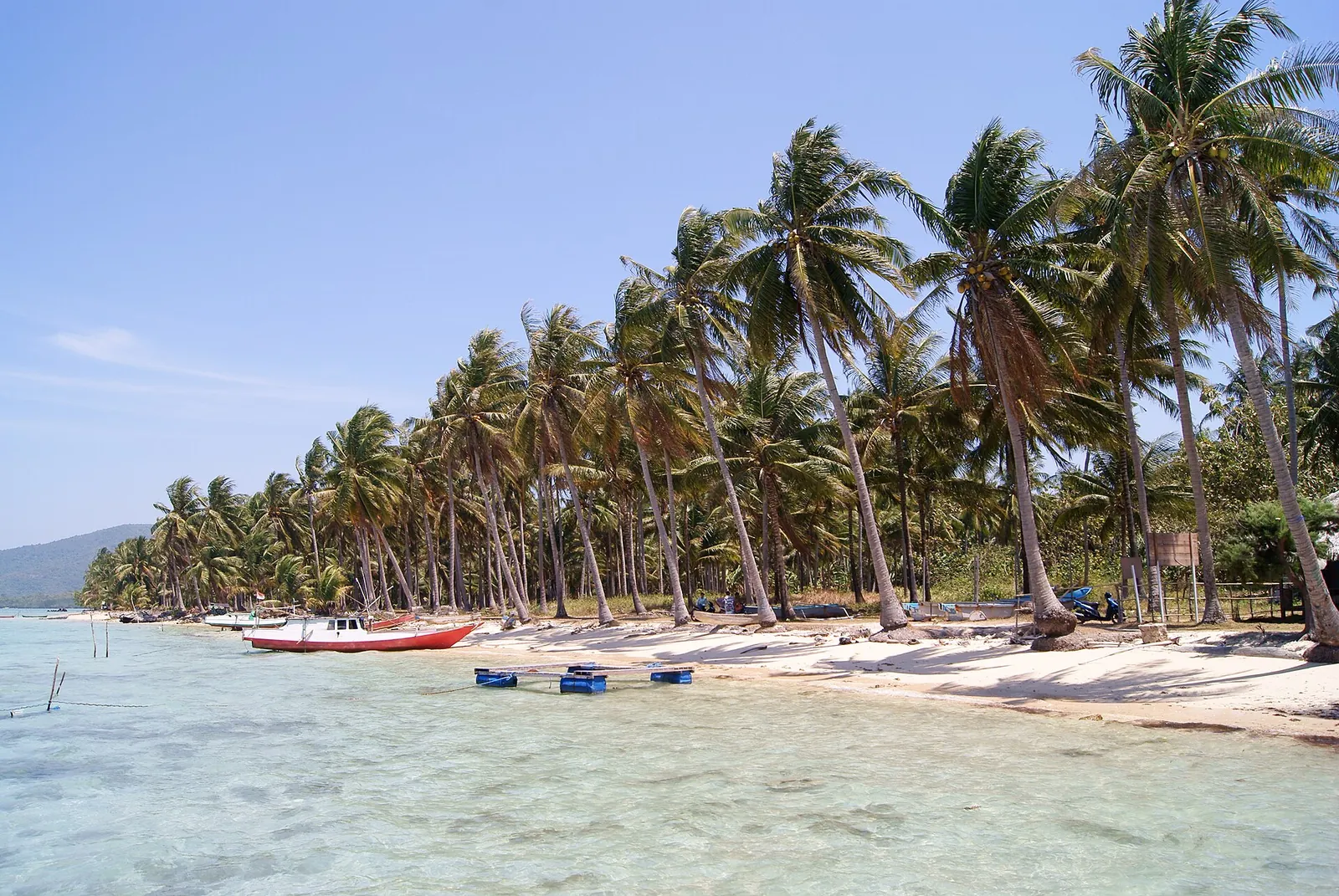
Barakuda beach on Karimunjawa
Photograph: Midori — opens in a new tab · CC BY 3.0 — opens in a new tab
Changes: Resized and converted to WebP; displayed with responsive crops. · Original photograph and licence details ↗ — opens in a new tab
Fresh fish on sale for grilling at the alun-alun food stalls in Karimunjawa town at night
Photograph: Elicefa — opens in a new tab · CC BY-SA 4.0 — opens in a new tab
Changes: Resized and converted to WebP; displayed with responsive crops. · Original photograph and licence details ↗ — opens in a new tab